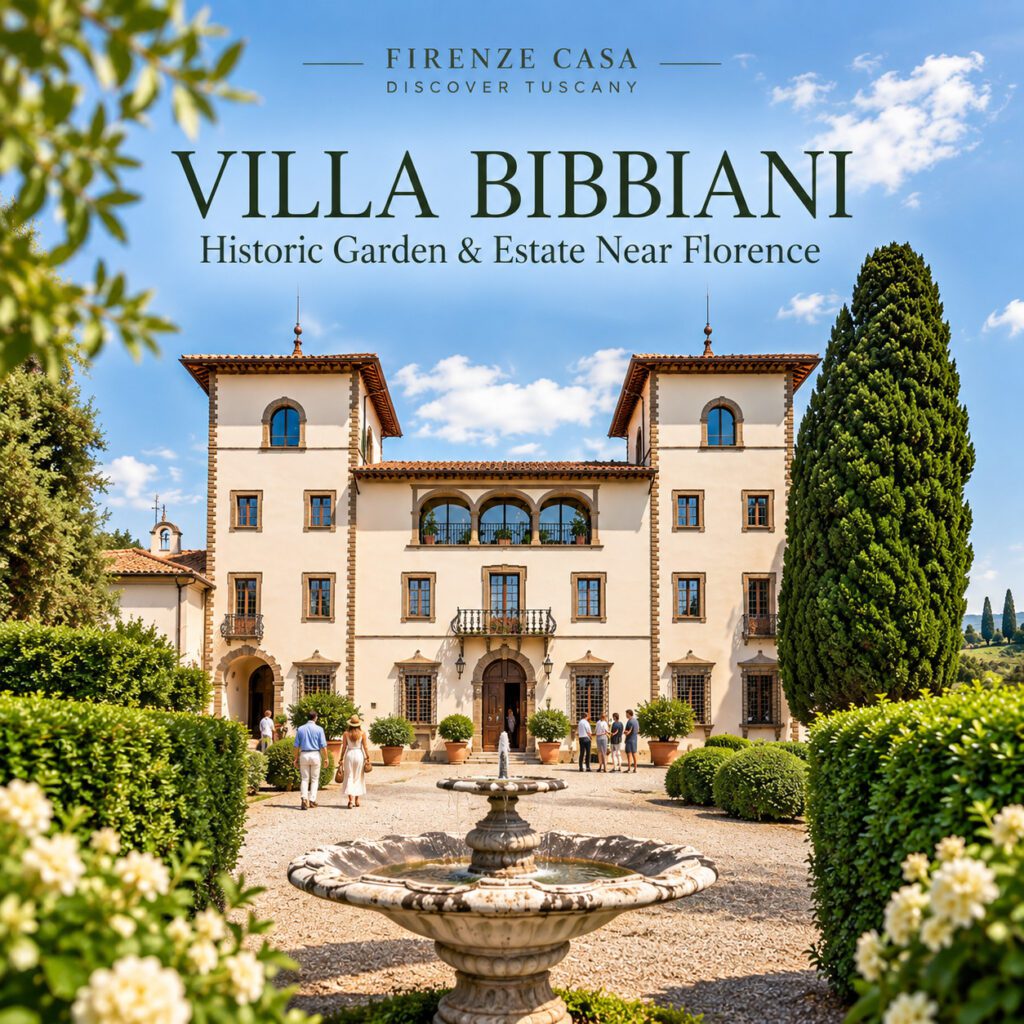
Villa Bibbiani is one of the most intriguing historic estates within easy reach of Florence. Set on the southern slopes of the Montalbano hills near Capraia e Limite, the villa combines a remarkable botanical park, Renaissance architecture, vineyards, olive groves and more than 1,300 years of history.
For travellers planning a longer stay in Florence, Villa Bibbiani offers something quite different from another museum or Renaissance city. It is a journey into the Tuscan countryside and into the history of landscape gardening, botany and wine. However, this is also an excursion that requires advance planning: Villa Bibbiani is a private estate rather than a conventional attraction with guaranteed daily public access.
Location: Capraia e Limite, on the southern slopes of Montalbano
From Florence: Approximately 30–40 minutes by car, depending on traffic
Best for: Historic gardens, botany, Tuscan landscape and wine
Main highlight: The historic botanical park created around the villa
Allow: Half a day if visiting only the estate; longer if combining it with the surrounding area
Important: Confirm access or arrange a visit before travelling
Where Is Villa Bibbiani?
Villa Bibbiani lies near Capraia e Limite, west of Florence and south of the Montalbano hills. The estate occupies a landscape of vineyards, olive groves and woodland between Florence and Pisa, with the River Arno running through the valley below.
This location makes Villa Bibbiani particularly interesting as a countryside excursion from Florence. It is far enough from the city to feel distinctly rural, yet close enough to avoid spending most of the day travelling.
If you are comparing possible excursions, our Tuscany Day Trips from Florence – Complete Guide explains which destinations work best by train, bus or car and how Villa Bibbiani fits into a longer stay in Florence.
Villa Bibbiani is much better suited to a car-based countryside day than to a spontaneous public-transport excursion. If you are travelling without a car, confirm both your transport and your access arrangements before setting out.
Is Villa Bibbiani Worth a Day Trip from Florence?
Yes – but for the right traveller. Villa Bibbiani is not an alternative to Siena, Pisa or Lucca if your priority is a full day of monuments, museums and historic streets. Its appeal is quieter and more specialised.
It is particularly rewarding if you enjoy historic gardens, unusual plants, landscape design, Tuscan estates or wine. The surrounding Montalbano countryside also gives the excursion a very different atmosphere from a day spent in Florence’s historic centre.
For visitors spending only two or three days in Florence, we would normally prioritise the city itself. With five to seven days, however, a carefully chosen countryside excursion can add considerably more variety. Our 7 Days in Florence – Florence & Tuscany in One Week guide explains why alternating city days with excursions often works better than trying to leave Florence every day.
The Remarkable History of Villa Bibbiani
The documented history of Villa Bibbiani reaches back extraordinarily far. The earliest known record dates to 767 AD, when Desiderius, King of the Lombards, gave the estate to a Benedictine monastery in Pistoia.
Over the following centuries the property passed through different hands and became associated with prominent Tuscan families, including the Medici and Frescobaldi. The villa therefore belongs to a much longer story of aristocratic estates, agriculture and land ownership around Florence.
Its most important transformation for today’s visitor, however, took place during the nineteenth century under Cosimo Ridolfi.
Villa Bibbiani is unusual because its history is not limited to architecture. Agriculture, experimental botany, landscape design and wine production all became part of the estate’s identity.
Cosimo Ridolfi and the Garden of Villa Bibbiani
Cosimo Ridolfi inherited Villa Bibbiani through his mother, Anastasia Frescobaldi, and transformed the estate during the nineteenth century. Ridolfi was not simply an aristocratic landowner: he was deeply interested in agriculture, science and education.
At Bibbiani, these interests found a physical expression in the landscape. The park became a place where ornamental and exotic species could be planted, observed and acclimatised to Tuscan conditions.
The result was far more ambitious than a decorative garden surrounding a country house. Villa Bibbiani developed into one of Tuscany’s notable historic botanical landscapes.
What Is Special About the Giardino di Villa Bibbiani?
The historic park extends across roughly 20 hectares and combines several different approaches to garden design. Formal Italian gardens lie closer to the villa, while woodland, lawns and more naturalistic areas extend across the surrounding slopes.
This combination makes the garden especially interesting for visitors who have already explored Florence’s better-known historic landscapes. The most beautiful gardens in Florence include formal Renaissance gardens, Romantic landscapes and botanical collections, but Bibbiani brings several of these traditions together within a rural estate.
Its historic plant collection included exotic species introduced during the nineteenth century. Mature cedars, pines, sequoias, camellias and other unusual trees became part of a landscape in which horticulture and scientific curiosity were closely connected.
Do not look only for flowers. Bibbiani’s real botanical treasures are its mature trees, the scale of the landscape and the contrast between formal gardens near the villa and the more naturalistic park beyond.
From the Italian Garden to the Romantic Landscape
One of the most interesting reasons to visit Villa Bibbiani is the opportunity to compare different ideas about what a garden should be.
The traditional Italian garden emphasised geometry, controlled perspectives and the architectural organisation of nature. By the nineteenth century, European taste increasingly favoured more naturalistic landscapes with irregular groups of trees, lawns, winding routes and carefully composed views.
Bibbiani contains traces of both traditions. For travellers interested in garden history, it therefore provides an excellent counterpart to the monumental geometry of the Boboli Gardens and the nineteenth-century landscape character of Villa il Ventaglio Park.
Rare and Monumental Trees
The botanical importance of Villa Bibbiani is closely connected with the trees introduced under Ridolfi. Historical descriptions record species from different parts of the world, including Lebanon cedars, sequoias, Caucasian firs, camphor trees and ornamental horse chestnuts.
Some specimens in the park are now approaching two centuries in age. Their size gives parts of the garden an atmosphere that cannot be created by recent landscaping: the history of the estate is literally growing within the park.
For visitors who enjoy botanical gardens, this is arguably more important than the villa itself.
The Arco dell’Uomo
Among the estate’s distinctive landscape features is the Arco dell’Uomo, a monumental garden structure associated with Cosimo Ridolfi’s nineteenth-century transformation of the property.
Framed by mature vegetation, the arch reflects the Romantic taste for architectural features placed within landscapes to create surprise, symbolism and carefully composed views.
It also demonstrates why Bibbiani should be understood as a designed landscape rather than simply a villa surrounded by attractive countryside.
A Medieval Ice House and Other Garden Features
The park contains further traces of the estate’s long practical history. Among them is a substantial historic ice house, once used to preserve food before mechanical refrigeration.
Features of this kind are easy to overlook, but they reveal how large Tuscan estates functioned as working environments. Gardens, orchards, agricultural land, water systems, storage buildings and decorative landscapes formed interconnected parts of the same property.
Historic Tuscan villas were rarely just country residences. They were centres of agriculture and estate management, where beauty, food production and experimentation could exist side by side.
Villa Bibbiani and the Montalbano Landscape
The garden makes more sense when seen within the wider landscape. Montalbano rises between the Florentine plain and western Tuscany, creating a green region of hills, vineyards, olive groves and woodland.
Villa Bibbiani occupies its southern slopes, while nearby Vinci lies on the same broader hill system. This makes the estate especially interesting for travellers who want to understand the countryside beyond Florence rather than simply visit another isolated monument.
The landscape is also closely connected with wine. Villa Bibbiani’s vineyards extend from the Arno plain towards higher ground, and the estate produces wines including Chianti Montalbano DOCG.
Villa Bibbiani and Wine
Wine production is not an incidental modern addition to the estate. The historic winery was already associated with Cosimo Ridolfi and reflected his interest in agricultural innovation.
The restored winery today combines modern production with traditional materials and methods. The estate cultivates approximately 30 hectares of vineyards within its much larger property, with Sangiovese playing a central role.
For travellers, wine can provide one of the most practical ways to experience Villa Bibbiani. The estate currently offers wine tastings by reservation, making advance contact particularly important.
If Villa Bibbiani is one of the main reasons for your excursion, arrange your visit before leaving Florence. Wine tastings are offered by reservation, while access to the villa and historic park should be confirmed directly with the estate.
Can You Visit Villa Bibbiani?
This is the most important practical question – and one that should be answered before planning the day.
Villa Bibbiani is a private estate and accommodation rather than a conventional public museum or municipal garden. It should therefore not be treated like Boboli or Bardini, where visitors can simply check opening hours and buy an ordinary admission ticket.
The estate currently advertises wine tastings by reservation. Other access may depend on stays, organised experiences, events or arrangements made directly with Villa Bibbiani.
If your main purpose is to see the historic garden, contact the estate beforehand and ask specifically whether the botanical park can be visited on your chosen date. Do not make the journey assuming that the garden will automatically be open.
Access arrangements can change. Confirm the date, time, type of visit and whether the historic garden is included before travelling from Florence. This is especially important if the garden rather than the winery is your main reason for going.
How to Get to Villa Bibbiani from Florence
By Car
For most independent visitors, driving is the most practical option. Villa Bibbiani is roughly 30–40 minutes from Florence under favourable traffic conditions, although journey times naturally vary.
A car also allows you to explore the Montalbano countryside and combine Bibbiani with another nearby destination rather than travelling directly back to Florence.
Without a Car
Reaching the estate without a car is possible in the wider sense, but it is less convenient than visiting major Tuscan cities served directly by rail. The final section of the journey requires more planning, and connections should be checked for the specific day.
If you prefer to explore Tuscany entirely by public transport, destinations such as Pisa, Lucca and Arezzo are considerably simpler. Our guide to Florence Without a Car compares some of the easiest alternatives.
How Long Should You Allow?
If you have a confirmed garden or wine experience, allow at least half a day including travel from Florence. There is little benefit in driving to Bibbiani simply to rush through an arranged visit and immediately return.
A full day becomes worthwhile if you combine the estate with another part of Montalbano, lunch in the countryside or nearby Vinci.
For many travellers, that is the best way to think about Villa Bibbiani: not as a single attraction consuming an entire day, but as the focal point of a slower excursion through western Tuscany.
Combine Villa Bibbiani with Vinci
Vinci is the most natural cultural combination. Leonardo da Vinci’s birthplace lies within the Montalbano landscape and offers museums, a compact historic centre and the countryside associated with his early life.
Our guide to Vinci from Florence – In the Footsteps of Leonardo includes the Museo Leonardiano, Leonardo’s birthplace at Anchiano and the Strada Verde walking route through vineyards and olive groves.
A day combining Villa Bibbiani and Vinci therefore brings together two very different experiences: nineteenth-century botanical experimentation at Bibbiani and the Renaissance world of Leonardo in Vinci.
If you have a car and confirmed access to Villa Bibbiani, combine the estate with Vinci rather than treating Bibbiani as an isolated return trip. The two places belong to the same Montalbano landscape but tell very different stories.
A Possible Villa Bibbiani Day Trip from Florence
A relaxed day might begin with a morning departure from Florence, followed by a pre-arranged visit or wine experience at Villa Bibbiani. Allow enough time to appreciate the estate rather than treating it as a quick photo stop.
Continue afterwards through the Montalbano countryside for lunch. In the afternoon, drive to Vinci and explore the historic centre and Museo Leonardiano. If daylight and energy allow, add part of the countryside around Anchiano before returning to Florence.
This itinerary works particularly well because the morning and afternoon are different. Bibbiani provides gardens, landscape and wine; Vinci adds Leonardo, history and a small Tuscan town.
When Is the Best Time to Visit?
Spring and early autumn are particularly attractive for a garden-focused excursion. Temperatures are generally more comfortable for walking outdoors, and the Tuscan landscape is at its most rewarding.
Summer can also be beautiful, but midday heat may reduce the pleasure of exploring gardens and vineyards. If visiting during the hottest months, an earlier appointment is preferable where available.
Autumn changes the character of the estate as vineyards approach or pass through harvest and the surrounding vegetation begins to shift colour.
As with Florence’s own historic gardens, season matters. Our Complete Guide to the most beautiful gardens in Florence also compares how different gardens change throughout the year.
Villa Bibbiani or a Garden in Florence?
If your main goal is simply to see a beautiful historic garden, you do not need to leave Florence. Boboli, Bardini and several lesser-known gardens provide exceptional experiences within or close to the historic centre.
Villa Bibbiani becomes worthwhile when you want something broader: a historic estate, botanical park, Tuscan countryside and wine landscape in a single excursion.
Visitors interested in nineteenth-century landscape design may also enjoy Giardino Torrigiani and Villa il Ventaglio Park in Florence. Those gardens make interesting comparisons with Ridolfi’s transformation of Bibbiani.
Is Villa Bibbiani a Good Choice Without a Rental Car?
Not particularly. It can be reached with more complicated transport arrangements, but convenience matters when planning a holiday. A destination that requires several connections and a pre-arranged private visit can consume far more of the day than its distance from Florence suggests.
If you are staying in Florence without a car, it may be better to choose one of the many direct rail excursions and save Villa Bibbiani for a day when you have hired a car or arranged transport.
This is one reason Florence works so well as a base: you do not need a car for the city itself, but you can use one selectively for countryside destinations where it genuinely improves the experience. The same principle is discussed in our Getting Around Florence guide.
Using Florence as a Base
Villa Bibbiani illustrates one of the advantages of staying several days in Florence rather than moving accommodation every night. You can spend one day among the museums, churches and streets of the historic centre and the next among vineyards and gardens on Montalbano, returning to Florence in the evening.
For guests staying at Firenze Casa, this type of excursion works particularly well as part of a longer itinerary: there is no need to pack again or turn a countryside visit into another overnight stop. The important decision is simply whether Villa Bibbiani matches your interests strongly enough to justify one of your days outside the city.
Who Will Enjoy Villa Bibbiani Most?
Villa Bibbiani is particularly suitable for travellers who enjoy gardens but want to understand more than flowers. Its appeal lies in the relationship between botany, landscape architecture, agriculture and Tuscan history.
It is also a strong choice for repeat visitors to Florence who have already seen the major Tuscan destinations and are looking for somewhere less obvious.
First-time visitors with limited time should be more selective. If you have never seen Siena, Pisa or the principal sights of Florence, Bibbiani probably should not displace them. But for a week-long stay, especially with a car for one or two days, it can provide exactly the kind of contrast that makes a Tuscany itinerary more memorable.
Why Villa Bibbiani Is Worth Discovering
Villa Bibbiani tells a different story from the famous Renaissance gardens of central Florence. Here, the landscape became a place for botanical experimentation, agricultural innovation and the nineteenth-century fascination with exotic plants.
Cosimo Ridolfi’s legacy, the monumental trees, formal and Romantic garden areas, vineyards and historic winery create an estate where nature and human intervention have been interacting for generations.
Most importantly for travellers, Bibbiani offers a reason to look beyond the famous Tuscan cities. With advance planning, it can become the centrepiece of a rewarding day on Montalbano – particularly when combined with Vinci and the surrounding countryside.
Just remember the essential practical point: arrange the experience first and plan the journey second. Villa Bibbiani is worth seeking out precisely because it is not a conventional mass-tourism attraction, but that also means it should never be approached as a guaranteed walk-in visit.
Frequently Asked Questions
Where is Villa Bibbiani?
Villa Bibbiani is in Capraia e Limite on the southern slopes of the Montalbano hills, west of Florence.
How far is Villa Bibbiani from Florence?
The estate is roughly 30–40 minutes from Florence by car in favourable traffic conditions. Actual journey times depend on your starting point and traffic.
Can you visit the Giardino di Villa Bibbiani?
Villa Bibbiani is a private estate, so do not assume that the historic garden is open for ordinary walk-in visits. Contact the estate in advance and confirm whether garden access is available on your chosen date.
Can you do a wine tasting at Villa Bibbiani?
Yes. The estate currently offers wine tastings by reservation. Arrangements should be made in advance.
Is Villa Bibbiani worth visiting from Florence?
Yes, especially for travellers interested in historic gardens, botany, wine and quieter Tuscan landscapes. It is most rewarding as part of a half- or full-day countryside excursion.
What can you combine with Villa Bibbiani?
Vinci is an excellent combination because it lies within the wider Montalbano landscape and adds Leonardo da Vinci, museums and a historic Tuscan town to the day.
Do you need a car for Villa Bibbiani?
A car is strongly recommended for most independent visitors. Public transport is less convenient than for major Tuscan cities such as Pisa, Lucca or Arezzo.
Further Reading on Firenze Casa
- Tuscany Day Trips from Florence – Complete Guide
- Vinci from Florence – In the Footsteps of Leonardo
- The Most Beautiful Gardens in Florence – Complete Guide
- Villa il Ventaglio Park – Romantic Garden in Florence
- Giardino Torrigiani – Florence’s Hidden Private Garden
- Florence Without a Car – How to Get Around Easily
- 7 Days in Florence – Florence & Tuscany in One Week
References
- Villa Bibbiani – Official estate history and visitor information
- Villa Bibbiani – Official winery and wine tasting information
- Visit Tuscany – Montalbano villas and historic landscapes
- Museo Galileo – Villa di Bibbiani Garden, historic and botanical documentation
- Regione Toscana – Historical gardens and villas of Tuscany