
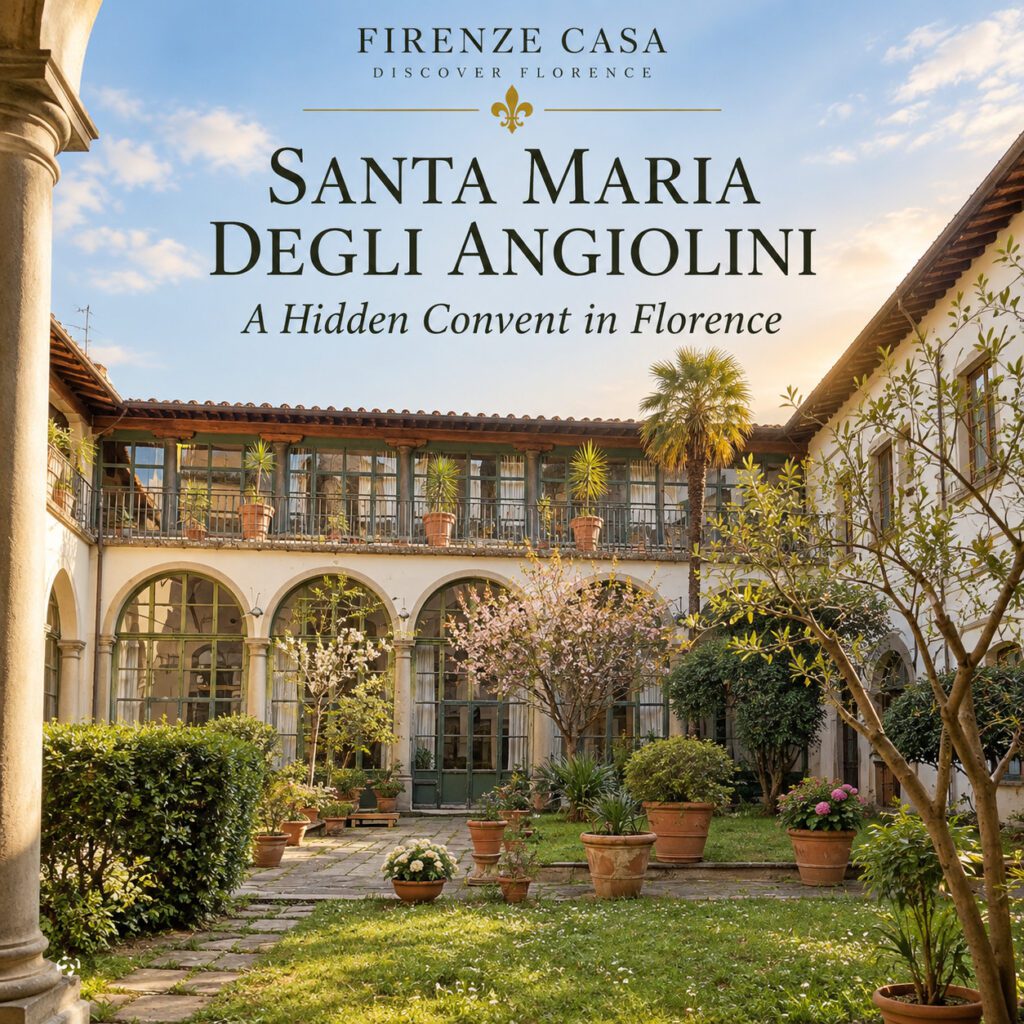
Santa Maria degli Angiolini is one of Florence’s most fascinating hidden former convents. Behind the discreet walls of Via della Colonna lies a historic complex of cloisters, religious spaces and artworks whose story stretches from a small community of women in the early sixteenth century to an educational institution that continues to function today.
Unlike Florence’s famous monasteries and churches, Santa Maria degli Angiolini remains largely outside the conventional tourist itinerary. Its combination of female religious life, Renaissance and Baroque art, education and architectural history makes it exactly the kind of lesser-known place explored in our Florence Secrets and Traditions – Complete Guide.
Historic name: Santa Maria degli Angiolini
Current institution: Fondazione Conservatorio Santa Maria degli Angeli
Location: Via della Colonna 34, Florence
Origins: Female religious community established in 1502
Dominican community: From 1509
Major transformation: Royal Conservatorio from 1785
Highlights: Church, cloister, refectory, historic rooms and art collection
Artists: Matteo Rosselli, Francesco Curradi and other Florentine masters
Current use: Educational and residential institution
Access: Historic spaces are not a conventional public museum; check current arrangements before visiting
Where Is Santa Maria degli Angiolini?
Santa Maria degli Angiolini stands at Via della Colonna 34, in the eastern part of Florence’s historic centre. The complex lies only a short walk from Piazza della Santissima Annunziata, yet it is easy to pass without realising the scale and history of what survives behind its walls.
This part of Florence once contained a dense network of convents, charitable institutions, gardens and religious communities. The nearby Piazza Santissima Annunziata and Basilica della Santissima Annunziata reveal the monumental side of this religious landscape, while the Angiolini preserve a more secluded world shaped primarily by women.
Combine Santa Maria degli Angiolini with Piazza Santissima Annunziata and the streets around Via della Colonna. Within a small area, you can discover very different aspects of religious life, education, charity and Renaissance architecture.
The Origins of Santa Maria degli Angiolini
The story began in 1502, when a small group of Florentine women withdrew to live together in a house purchased for them by a wool merchant. Their community developed during a period when female religious houses formed an important part of Florence’s social and spiritual landscape.
In 1509, the community was received into the Dominican Order, and construction began on the convent and church of Santa Maria degli Angiolini. The institution subsequently expanded considerably.
Its growth was remarkable. By 1561, records document 102 religious women living in the convent, demonstrating that this was no marginal community but a substantial Florentine religious institution.
What began as a small female community at the beginning of the sixteenth century had grown to more than one hundred religious women within around sixty years.
Why Is It Called Santa Maria degli Angiolini?
The historical terminology can be confusing because Florence had more than one religious institution dedicated to Santa Maria degli Angeli.
This complex became known as Santa Maria degli Angiolini, a diminutive form that helped distinguish it from the better-known monastery of Santa Maria degli Angeli elsewhere in Florence. Historical sources also use forms such as Santa Maria degli Angioli and Santa Maria degli Angioli detto Angiolini.
Today, the institution is known as the Fondazione Conservatorio Santa Maria degli Angeli, while the historical name Santa Maria degli Angiolini remains especially useful when discussing the former convent and its church.
Do not confuse this former female convent with Florence’s other historic monastery of Santa Maria degli Angeli. The name “Angiolini” became a useful way of distinguishing the two institutions.
A Female Religious Community in Renaissance Florence
Santa Maria degli Angiolini provides an important window into a part of Renaissance Florence that is easily overshadowed by stories of merchants, bankers, artists and political dynasties.
Female convents were religious institutions, but they were also communities with their own economic, educational and artistic lives. Women from different social backgrounds lived within them, while wealthy Florentine families could support individual convents through donations and artistic commissions.
The surviving artworks at Santa Maria degli Angiolini demonstrate these connections particularly clearly. Important commissions were made possible by benefactors and by nuns belonging to prominent Florentine families.
The result was a religious environment in which devotion, family patronage and Florentine artistic culture met behind convent walls.
The Church of Santa Maria degli Angiolini
The church forms one of the most important historic spaces within the complex. Although relatively intimate in scale, its decoration reflects the wealth and prestige that the convent acquired during its most prosperous centuries.
The building and its artworks developed over time rather than as part of a single decorative programme. This layered history is typical of Florence, where religious spaces were repeatedly altered as communities, artistic tastes and devotional practices changed.
Inside, works associated with important Florentine painters demonstrate that artistic patronage extended far beyond the city’s major basilicas and public churches.
Florence’s artistic heritage is not confined to famous museums. Convents such as Santa Maria degli Angiolini commissioned and preserved significant works that were originally created for specific religious communities rather than for public display.
Art at Santa Maria degli Angiolini
The Fondazione Conservatorio Santa Maria degli Angeli preserves an extensive and varied collection of paintings and historic objects. Its most important works largely date from the sixteenth to eighteenth centuries, corresponding to the period when the institution received significant donations and artistic commissions.
Among the artists associated with the complex are Francesco Curradi and Matteo Rosselli, two important figures in seventeenth-century Florentine painting.
The collection is particularly valuable because the artworks remain connected with the history of the institution for which many of them were created. Rather than encountering isolated paintings in a gallery, visitors able to access the historic spaces can understand them as part of a larger environment of worship, community and daily life.
Matteo Rosselli and the Last Supper
One of the most interesting artistic connections is the work of Matteo Rosselli. In the former refectory, a monumental Last Supper fresco dated 1631 survives as an important example of his religious painting.
The work was commissioned by Alessandro Berti, governor and an important benefactor of the monastery. Berti helped enrich Santa Maria degli Angiolini not only financially but also through significant artistic commissions.
The subject was particularly appropriate for a refectory. As the religious community gathered for meals, the representation of Christ and the apostles transformed the practical dining room into a space for continual spiritual reflection.
This tradition can also be explored elsewhere in Florence at the Cenacolo del Fuligno, where another historic refectory preserves a celebrated Last Supper associated with Pietro Perugino.
Last Supper scenes were especially appropriate for monastic dining halls. The biblical meal visually accompanied the religious community during its own daily meals, connecting ordinary routine with sacred history.
The Cloister and Convent Spaces
Santa Maria degli Angiolini is much more than its church. The complex developed around spaces required for communal religious life, including cloisters, residential areas, the refectory and rooms used for administration and education.
The cloister provided both circulation and separation from the surrounding city. Like many Florentine convent courtyards, it created an enclosed world of architecture, light and greenery around which daily activities could be organised.
These quieter spaces are essential to understanding the character of the Angiolini. The complex was never conceived simply as a church visited from the street; it was an environment in which a community lived, prayed, worked and later studied.
The Sala della Duchessa
One of the most unusual interiors is the Sala della Duchessa. Its decorative grotesques belong to the late eighteenth-century revival of ancient Roman and Pompeian-inspired ornament that spread across European interiors following archaeological discoveries in Italy.
The room therefore introduces a very different artistic language from the earlier religious paintings. Instead of the devotional atmosphere of the church and refectory, its decoration reflects the changing tastes of the late eighteenth century.
This contrast is one of the strengths of the complex: Santa Maria degli Angiolini preserves evidence of several centuries rather than presenting a single frozen moment in Florentine history.
The historic interiors reveal changing artistic tastes. Renaissance and Baroque religious art coexist with late eighteenth-century decoration inspired by the rediscovery of the ancient world.
1785: From Convent to Conservatorio
The most important institutional change came in 1785. Grand Duke Pietro Leopoldo introduced major reforms affecting religious institutions throughout Tuscany, and Santa Maria degli Angiolini was transformed from a convent into a Royal Conservatorio.
This change formed part of a wider programme concerning female education. The former monastery now had to accommodate a new educational mission while retaining aspects of its religious identity.
The transformation also required substantial changes to the buildings. Between 1785 and 1794, the complex underwent structural alterations, conservation work and adaptations necessary for its new function.
Santa Maria degli Angiolini therefore provides an unusually clear example of how Enlightenment reforms changed both institutions and architecture in late eighteenth-century Tuscany.
In 1785, Pietro Leopoldo’s reforms transformed Santa Maria degli Angiolini from a convent into a Royal Conservatorio. Female education became central to an institution originally created for religious life.
Women and Education in Florence
The transformation into a conservatorio makes the Angiolini especially interesting for the history of women in Florence. Education for girls and young women was changing during the late eighteenth century as Enlightenment ideas and government reforms challenged older institutional structures.
The conservatori created under Pietro Leopoldo were intended to provide organised education within a regulated framework. At Santa Maria degli Angiolini, religious tradition and educational reform therefore became closely intertwined.
This history complements that of the nearby Ospedale degli Innocenti. The two institutions had very different origins and purposes, but both demonstrate how Florence developed organised structures for care and education beyond the family household.
Suppression and Restoration
The political upheavals of the Napoleonic period interrupted this development. Santa Maria degli Angiolini was suppressed during French rule in 1808, along with numerous other religious and institutional bodies.
The suppression was not permanent. Following the restoration of Habsburg-Lorraine rule, the conservatorio was re-established and continued its educational mission.
This sequence of convent, conservatorio, suppression and restoration mirrors the wider political transformation of Tuscany between the eighteenth and nineteenth centuries. Institutions that had existed for generations suddenly had to adapt to changing governments, laws and ideas about religion and education.
The Florence Flood of 1966
Santa Maria degli Angiolini also suffered during the catastrophic Florence flood of 4 November 1966. Water entered the historic complex and caused serious damage to the church and its decoration.
The consequences lasted for decades. The church remained closed for many years before a major programme of restoration began in the 1990s.
Between 1996 and 2006, the Angiolini complex underwent extensive conservation work aimed at recovering and protecting its artistic heritage. The restored church reopened in 2006, forty years after the flood.
The story connects Santa Maria degli Angiolini with the enormous conservation effort that followed one of the greatest cultural disasters in modern Florentine history.
The 1966 flood severely damaged the complex. A major restoration campaign from 1996 to 2006 helped recover artworks and historic spaces that had remained inaccessible for decades.
A Historic Institution That Still Lives
One of the most remarkable aspects of Santa Maria degli Angiolini is continuity. The complex has not simply become another museum containing traces of a vanished institution.
The Fondazione Conservatorio Santa Maria degli Angeli continues the educational and hospitality tradition associated with the site. Parts of the complex provide accommodation for female university students, while the institution also offers hospitality within the historic building.
This continuing use gives the Angiolini a character very different from a conventional monument. Five centuries after the first female community settled here, women still live and study within the complex.
Santa Maria degli Angiolini is not simply a former convent preserved as a monument. Its long association with female community life and education continues within the historic complex today.
Can You Visit Santa Maria degli Angiolini?
Santa Maria degli Angiolini should not be approached like a conventional Florentine museum with continuous public opening hours. The complex remains an active institution, and access to the historic church, cloister and other spaces depends on current arrangements.
Guided visits and special openings have provided opportunities to explore areas including the church, cloister, nuns’ choir, refectory, Galleria Mariana and Sala della Duchessa. Because these arrangements can change, visitors should check directly with the Conservatorio or current cultural programmes before planning a special visit.
The location itself is easy to include in a walk through this part of Florence, even when the interiors are not accessible.
Address: Via della Colonna 34, 50121 Florence
Historic name: Santa Maria degli Angiolini
Current institution: Fondazione Conservatorio Santa Maria degli Angeli
Regular museum access: No
Possible access: Guided visits, special openings and institutional arrangements
Best advice: Check current access before making a special journey to see the interiors
What to See Near Santa Maria degli Angiolini
The location makes the former convent particularly easy to combine with several important sites in eastern central Florence.
Begin at Piazza Santissima Annunziata, where Brunelleschi’s architecture helped establish one of the city’s most harmonious Renaissance spaces. The Basilica della Santissima Annunziata adds another perspective on Marian devotion, religious orders and Florentine artistic patronage.
On the opposite side of the square, the Ospedale degli Innocenti connects Renaissance architecture with centuries of social welfare and childcare. Together, these institutions reveal that this part of Florence was shaped not only by art and architecture but also by communities devoted to religion, education and care.
The National Archaeological Museum of Florence is also nearby and provides a completely different journey into Etruscan, Roman and Egyptian history.
Combine Santa Maria degli Angiolini with Piazza Santissima Annunziata, the Basilica della Santissima Annunziata and the Ospedale degli Innocenti. The short route connects female religious life, Renaissance architecture, education and social history.
Why Santa Maria degli Angiolini Is Worth Discovering
Santa Maria degli Angiolini is worth discovering because it preserves a side of Florence that rarely appears in conventional sightseeing itineraries. Its story is not centred on a single famous artist, ruler or architectural masterpiece.
Instead, more than five centuries of history overlap within one institution. A small female religious community became a substantial Dominican convent. Important Florentine artists decorated its spaces. Enlightenment reforms transformed the convent into a centre of female education, while political suppression, restoration and the flood of 1966 repeatedly changed its fortunes.
Most importantly, the complex never became simply a relic of the past. Its continuing educational and residential role creates a direct connection between the women who entered the community centuries ago and those who live and study there today.
For visitors interested in hidden Florence, this combination of art, architecture, women’s history and living tradition makes Santa Maria degli Angiolini particularly rewarding.
Some of Florence’s most revealing places are not major monuments. Santa Maria degli Angiolini shows how one historic building can preserve stories of religion, art, women, education and everyday life across more than five centuries.
Frequently Asked Questions
What is Santa Maria degli Angiolini?
Santa Maria degli Angiolini is a former Dominican female convent in Florence that developed from a community founded in the early sixteenth century. In 1785, it was transformed into a conservatorio devoted to female education.
Where is Santa Maria degli Angiolini?
The complex stands at Via della Colonna 34 in Florence, a short walk from Piazza Santissima Annunziata.
When was Santa Maria degli Angiolini founded?
The community originated in 1502. In 1509, it was received into the Dominican Order and construction of the convent and church began.
Why is it called Angiolini?
The name helped distinguish the institution from another Florentine monastery dedicated to Santa Maria degli Angeli. Historical sources therefore commonly refer to this community as Santa Maria degli Angiolini.
What artworks can be found at Santa Maria degli Angiolini?
The complex preserves an important collection dating mainly from the sixteenth to eighteenth centuries, including works associated with Florentine artists such as Matteo Rosselli and Francesco Curradi.
What happened to the convent in 1785?
As part of reforms introduced by Grand Duke Pietro Leopoldo, the convent was transformed into a Royal Conservatorio with an important role in female education.
Was Santa Maria degli Angiolini damaged in the 1966 flood?
Yes. The complex suffered serious flood damage, and the church remained closed for decades. Extensive restoration took place between 1996 and 2006.
Can you visit Santa Maria degli Angiolini?
It is not a conventional museum with regular daily access. Guided visits and special openings may provide access to historic areas, so current arrangements should be checked before visiting.
Is Santa Maria degli Angiolini worth visiting?
Yes, especially for visitors interested in hidden Florence, religious history, Florentine art and the history of women and education. Its relative obscurity is part of what makes the complex so fascinating.
Further Reading on Firenze Casa
- Florence Secrets and Traditions – Complete Guide
- Piazza Santissima Annunziata – Florence’s Renaissance Square
- Basilica della Santissima Annunziata – Florence’s Marian Sanctuary
- Ospedale degli Innocenti – Brunelleschi and Florence’s Foundling Hospital
- Cappella di San Luca – Florence’s Chapel of the Painters
- Chiostro dello Scalzo – Florence’s Hidden Renaissance Cloister
- National Archaeological Museum Florence – Etruscans & Egypt
References
- Archivio di Stato di Firenze / SIAS – Convento di Santa Maria degli Angioli detto Angiolini di Firenze.
- Fondazione Conservatorio Santa Maria degli Angeli – history of the institution and artistic collections.
- Fondazione Conservatorio Santa Maria degli Angeli – Opere d’Arte.
- Università degli Studi di Firenze – studies on the transformation of Santa Maria degli Angiolini into a Conservatorio and Educatorio.
- Ministero della Cultura – Catalogo Generale dei Beni Culturali, artworks associated with Santa Maria degli Angiolini.
- Paolini, Claudio – Repertorio delle Architetture Civili di Firenze, Conservatorio di Santa Maria degli Angiolini.
- Teodori, Brunella (ed.) – Santa Maria degli Angiolini a Firenze: dieci anni di restauri.
- Richa, Giuseppe – Notizie istoriche delle chiese fiorentine divise ne’ suoi quartieri.

