
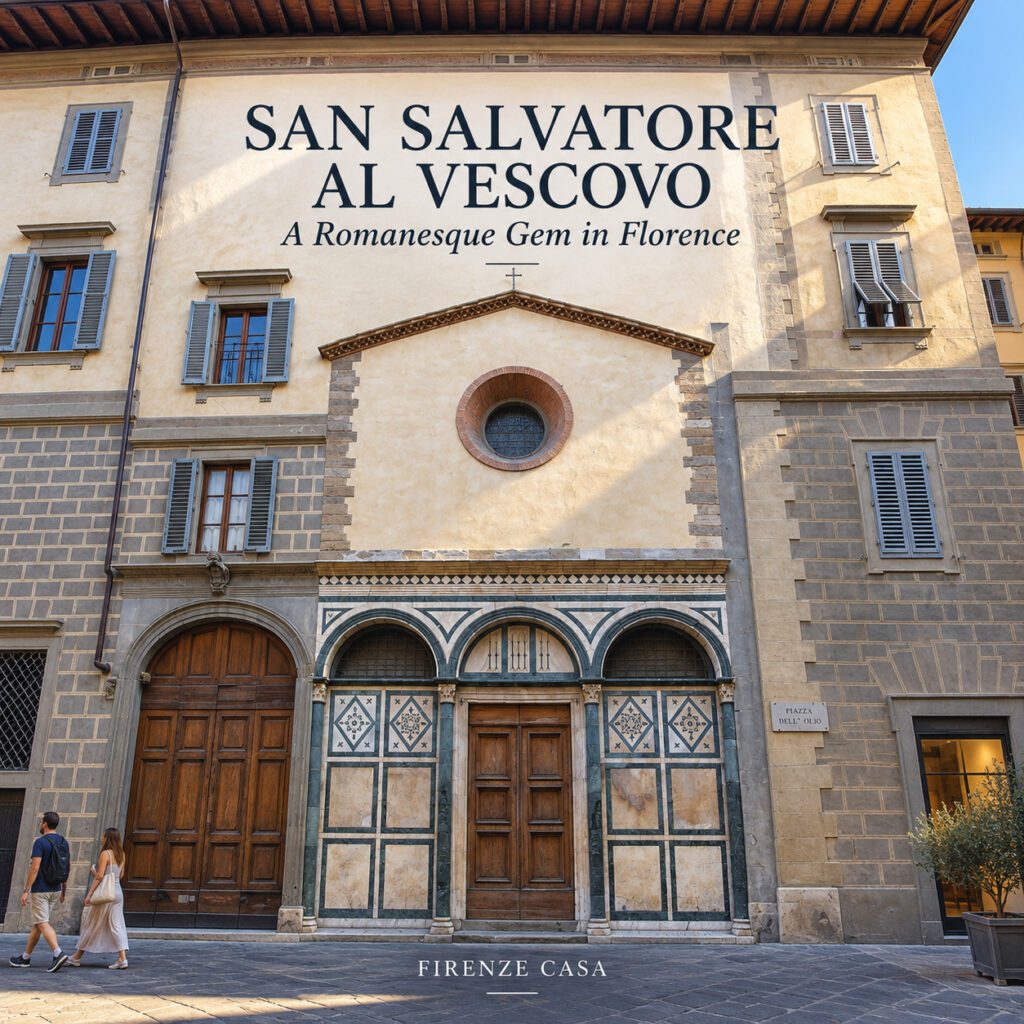
Only steps from Florence Cathedral, San Salvatore al Vescovo preserves a fragment of the medieval city that thousands of visitors pass without noticing. Almost absorbed into the surrounding Archbishop’s Palace, this tiny church faces Piazza dell’Olio with a remarkable Romanesque façade of white and green stone.
San Salvatore al Vescovo is not a major sightseeing destination, and that is part of its appeal. Travellers can see one of Florence’s rare surviving medieval marble façades within minutes of the Duomo, while the church’s later interior reveals a completely different chapter of Florentine religious art.
Church: San Salvatore al Vescovo
Location: Piazza dell’Olio, beside the Archbishop’s Palace
First documented: 1032
Medieval reconstruction: Traditionally dated to 1221
Architecture: Florentine Romanesque façade; Baroque interior
Main highlight: White and green marble façade
Interior transformation: 1737–1738
Best for: Medieval Florence, Romanesque architecture and hidden churches
Time needed: 5–10 minutes for the exterior
Access: Interior access is through the Archbishop’s Palace and may be limited
Why Notice San Salvatore al Vescovo?
Florence trains visitors to look for monumental buildings. The Cathedral of Santa Maria del Fiore, Giotto’s Campanile and the Baptistery dominate this part of the historic centre so completely that a tiny medieval church nearby can disappear from attention.
San Salvatore al Vescovo offers exactly the opposite experience. Its façade is small enough to examine in a few minutes, yet it preserves architectural ideas that belong to Florence before the great Renaissance transformation of the city.
The church is especially rewarding for travellers interested in how Florence developed architecturally. Its geometric marble decoration belongs to the same wider Florentine tradition visible much more dramatically at San Miniato al Monte and the Baptistery.
If you are visiting the Duomo area, San Salvatore al Vescovo requires almost no detour. Walk to Piazza dell’Olio and spend a few minutes studying the façade before returning to the cathedral complex. It is an easy way to add a glimpse of Romanesque Florence to a day dominated by much larger monuments.
Where Is San Salvatore al Vescovo?
The church stands on Piazza dell’Olio, immediately beside the Archbishop’s Palace and only a very short walk from Piazza del Duomo.
Its position explains the name al Vescovo – “at the Bishop’s” or “by the Bishop”. San Salvatore became closely integrated with the episcopal complex, and today the little façade appears almost embedded within the surrounding buildings.
This relationship can make the church slightly confusing for first-time visitors. The historic façade faces Piazza dell’Olio, but access to the interior is through the courtyard of the Archbishop’s Palace rather than directly through the façade.
Come primarily to see the façade. Interior access can be limited and opening arrangements may change, so do not build a tightly timed itinerary around entering the church. If the interior is accessible during your visit, treat it as an additional discovery.
A Church Older Than Renaissance Florence
San Salvatore al Vescovo appears in surviving documentation by 1032, although the religious site may have still earlier origins. This places the church firmly within the Florence that existed centuries before Brunelleschi, Michelangelo and the Medici transformed the city’s international image.
At that time, the cathedral quarter looked very different. The medieval city was smaller and more densely organised around churches, defensive structures, episcopal property and narrow streets.
San Salvatore belonged to this older ecclesiastical landscape. It later became one of the parishes within Florence’s ancient urban circuit and remained closely connected with the bishop’s residence beside it.
Our History of Florence – Complete Guide follows the city’s development from Roman Florentia through the medieval commune and into the Renaissance.
The Romanesque Reconstruction of 1221
The appearance that makes San Salvatore al Vescovo important today belongs largely to the 13th century. Historical tradition associates a reconstruction of the church in 1221 with an architect whom Giorgio Vasari called Lapo Tedesco.
The attribution requires some caution. Older accounts sometimes connected the church with Arnolfo di Cambio, but Arnolfo could not have designed a reconstruction in 1221 because he had not yet been born. What matters more for visitors is that part of the façade created during this medieval rebuilding still survives.
This makes San Salvatore particularly valuable. Florence has changed so profoundly that genuinely medieval decorative façades in the historic centre are less common than the city’s appearance might suggest.
Remember 1221 when looking at the façade. Florence Cathedral had not yet been begun, Brunelleschi’s dome lay two centuries in the future, and the city still belonged unmistakably to the Middle Ages.
Look Closely at the Marble Façade
The lower part of the façade is the great reason to seek out San Salvatore al Vescovo. Three blind arches rest on slender half-columns, while panels of pale marble and dark green stone create a restrained geometric pattern.
The materials and colour contrast belong to the tradition of polychrome marble in Florence. White Carrara marble contrasts with dark green serpentinite, producing the characteristic two-colour effect associated with Florentine medieval architecture.
Under the lateral arches, rectangular panels organise the surface. Some contain diamond-shaped marble inlays, while small windows occupy the lunettes above. Over the central portal, another decorated lunette introduces a sequence of vertical elements.
A narrow geometric frieze runs above the arches. The decoration is sophisticated but never overwhelming: proportion, repetition and the contrast between light and dark stone create the visual effect.
Stand directly opposite the façade and follow the geometry rather than looking for sculpture. Notice the three arches, the half-columns, the diamond-shaped inlays and the alternating white and dark green stone. The design depends on proportion and pattern more than elaborate ornament.
Why the Façade Looks So Florentine
Visitors who have already seen the Baptistery or San Miniato al Monte may immediately recognise something familiar.
Florentine Romanesque architecture developed a distinctive preference for geometric organisation and contrasting stone. Rather than covering façades with dense sculptural decoration, builders could use lines, arches, rectangles and coloured marble to organise the surface.
San Salvatore al Vescovo applies these ideas on an unusually intimate scale. San Miniato spreads its geometric marble decoration across a monumental basilica overlooking the city; San Salvatore compresses a related visual language into a tiny façade hidden in the centre.
That contrast makes the two churches particularly interesting to compare. Together they demonstrate that Florentine Romanesque architecture was not defined by size but by a recognisable approach to geometry, proportion and material.
A Rare Survival Beside the Duomo
The location makes the façade even more remarkable.
Florence’s cathedral district underwent repeated transformations. Buildings changed, streets disappeared, the episcopal complex expanded and later urban projects altered the relationship between the Baptistery, cathedral and surrounding structures.
San Salvatore survived within this changing environment. During the major restructuring of the Archbishop’s Palace at the end of the 19th century, builders incorporated the church façade and its medieval marble decoration into the reorganised complex rather than removing it.
The result explains its curious appearance today. San Salvatore does not stand independently like a conventional church. Instead, its Romanesque façade seems inserted into the larger architecture around it – a medieval fragment preserved inside a city that continued to develop for centuries.
The unusual setting is part of the experience. San Salvatore al Vescovo demonstrates how medieval Florence often survives not as isolated monuments, but as fragments incorporated into buildings and streets created much later.
The Interior Is a Completely Different Story
Anyone expecting the Romanesque character of the façade to continue inside will encounter a surprise.

In 1737–1738, Archbishop Giuseppe Maria Martelli commissioned a radical transformation of the church interior. Architect Bernardo Ciurini reorganised the small space, while leading Florentine artists of the period created an extensive decorative programme.
The result belongs to 18th-century Florence rather than the medieval city visible outside. Painted architecture, frescoes and a richer decorative language replaced much of the earlier appearance.
This contrast makes San Salvatore especially interesting: the exterior and interior effectively tell stories separated by more than five centuries.
The Frescoes Inside San Salvatore
The 18th-century decoration brought together several artists active in Florence.
Vincenzo Meucci painted the Ascension of Christ on the vault and also contributed a Resurrection. Giovanni Domenico Ferretti painted the Transfiguration in the small choir dome and an Adoration of the Shepherds behind the altar.
Pietro Anderlini contributed the illusionistic architectural decoration, helping transform the relatively compact interior through painted perspective.
The works are not the reason most travellers will seek out San Salvatore, but they provide a fascinating contrast if the church happens to be open. A medieval façade gives way to a space shaped by Florentine artists more than five hundred years later.
Pause before looking at individual paintings and notice the overall contrast. The exterior teaches you about 13th-century Florence; the interior largely reflects an 18th-century transformation. Few minutes apart, they reveal how radically a historic church could change while its façade survived.
Romanesque Outside, Baroque Inside
This architectural contrast is perhaps the easiest way to remember San Salvatore al Vescovo.
The façade represents a restrained medieval language based on stone, geometry and proportion. Inside, the 18th-century artists worked with fresco, illusion and a much richer decorative vocabulary.
Neither period needs to be considered more “authentic” than the other. Historic churches frequently evolved as generations adapted them to new liturgical needs and artistic tastes.
San Salvatore simply makes that process unusually easy to read because the difference between the two principal phases is so striking.
San Salvatore and Medieval Florence
Florence is so closely associated with the Renaissance that earlier layers of the city are easy to overlook. Yet the Florence of Dante and the medieval republic already possessed a sophisticated architectural culture.
Churches, tower houses, guild buildings and fortified residences filled a dense urban environment long before Renaissance palaces transformed its appearance.
San Salvatore al Vescovo belongs to that older city. Its façade survives from roughly the same broad medieval world explored in our Medieval Florence Walking Tour, where towers, ancient streets and civic buildings reveal Florence before the Renaissance.
Seeing this tiny church immediately after the monumental Duomo is therefore particularly effective. The two buildings belong to different stages in the growth and ambition of medieval Florence.
A Five-Minute Detour from Florence Cathedral
For most travellers, San Salvatore works best as a short addition to a visit to the cathedral quarter rather than as a destination requiring a separate journey.
After seeing the cathedral and Baptistery, walk towards Piazza dell’Olio and find the church façade incorporated into the Archbishop’s Palace. Spend a few minutes examining the marble patterns and comparing them with the much larger medieval monuments nearby.
You can then continue through the historic centre without significantly changing your itinerary.
This is precisely the kind of small discovery that becomes particularly rewarding during a longer stay in Florence. Once the essential monuments have been seen, places such as San Salvatore reveal architectural details that are easy to miss when moving quickly between major attractions.
Florence Cathedral → Baptistery → San Salvatore al Vescovo. The detour takes only a few minutes but adds an unusually intimate example of Romanesque architecture to the monumental Duomo experience.
Can You Visit Inside?
This is the practical limitation visitors should know before making plans.
The façade is easily visible from Piazza dell’Olio, but the church interior does not function like a major tourist attraction with predictable daily admission. Access is through the Archbishop’s Palace, and opening arrangements can vary.
If seeing the interior is important to you, verify access locally or with the Archdiocese shortly before your visit. Otherwise, plan on seeing the exterior and consider an open door a welcome bonus.
Fortunately, the most historically distinctive part of San Salvatore – its Romanesque marble façade – can be appreciated from the square.
Is San Salvatore al Vescovo Worth Seeing?
Yes – but think of it as a five-minute architectural discovery rather than a major church visit.
First-time visitors with only a day in Florence should naturally prioritise the cathedral complex, Santa Croce, Santa Maria Novella or other major monuments. San Salvatore becomes more rewarding when you have a little more time or a particular interest in medieval architecture.
Its greatest advantage is convenience. You do not need to cross the city, buy a ticket or reserve a time slot simply to see the façade. It sits almost beside one of Florence’s busiest attractions.
For architecture lovers, the combination of genuine medieval marble decoration, tiny scale and unusual integration into the Archbishop’s Palace makes it particularly worthwhile.
Why San Salvatore al Vescovo Matters
San Salvatore al Vescovo demonstrates that important architecture does not have to be monumental.
The church is documented more than nine centuries ago, while its surviving 13th-century façade preserves a refined example of Florentine Romanesque design. White and green stone, blind arches and geometric inlays connect the tiny building with a much broader medieval architectural tradition.
Later generations transformed the interior, incorporated the church into the episcopal complex and altered the streets around it. Yet the medieval façade survived.
Today, its location makes the church particularly compelling. Only moments from one of Europe’s most famous cathedrals, a small piece of an earlier Florence remains hidden in plain sight.
Look beyond the Duomo, and medieval Florence is still there.
Frequently Asked Questions
Where is San Salvatore al Vescovo?
The church faces Piazza dell’Olio beside the Archbishop’s Palace, only a short walk from Florence Cathedral and the Baptistery.
How old is San Salvatore al Vescovo?
The church is documented by 1032 and may have earlier origins. Its surviving Romanesque façade is associated with a reconstruction traditionally dated to 1221.
Why is the façade important?
It preserves rare medieval polychrome marble decoration using white and dark green stone. The geometric design is characteristic of the Florentine Romanesque tradition.
Who designed San Salvatore al Vescovo?
Giorgio Vasari associated the 1221 reconstruction with an architect he called Lapo Tedesco. Claims that Arnolfo di Cambio designed it are chronologically impossible and should be treated as a later misunderstanding.
Is the interior Romanesque?
Not primarily. Archbishop Giuseppe Maria Martelli commissioned a major transformation in 1737–1738, giving the interior much of its present 18th-century character.
Can I visit inside San Salvatore al Vescovo?
Interior access may be limited and is through the Archbishop’s Palace. The Romanesque façade, however, can be seen from Piazza dell’Olio without entering the church.
How much time should I allow?
Five to ten minutes is sufficient to appreciate the exterior. Allow a little longer if the church is open and you can see the 18th-century interior.
Further Reading on Firenze Casa
- The Most Beautiful Churches in Florence – Complete Guide
- Polychrome Marble in Florence – The Churches in White, Green and Red
- San Miniato al Monte – Florence’s Romanesque Basilica
- Florence Cathedral – Complete Visitor’s Guide
- Medieval Florence – Towers, Palaces & Ancient Streets
- History of Florence – Complete Guide
References
- Treccani – Enciclopedia dell’Arte Medievale: Firenze
- BeWeB – Chiesa di San Salvatore al Vescovo, Archdiocese of Florence
- Repertorio delle Architetture Civili di Firenze – Palazzo Arcivescovile
- Giorgio Vasari – Le vite de’ più eccellenti pittori, scultori e architettori
- Historical studies on Florentine Romanesque architecture and polychrome marble decoration
- Studies on Vincenzo Meucci, Giovanni Domenico Ferretti and 18th-century Florentine painting

