Palazzo Ramirez de Montalvo tells an unusual story of Spanish influence in Renaissance Florence. Standing in Borgo degli Albizi, the palace was created for Antonio Ramírez de Montalvo, a Spanish nobleman who became a trusted member of the court of Cosimo I de’ Medici and Eleonora di Toledo.
The Palazzo Ramirez de Montalvo is easy to overlook when exploring Florence, yet its extraordinary decorated façade rewards a closer look. Designed by Bartolomeo Ammannati and later covered with elaborate sgraffito decoration, the building reveals how architecture could express loyalty, status and political relationships at the Medici court.
Location: Borgo degli Albizi 26, Florence
Construction: Early 1560s–1568
Architect: Bartolomeo Ammannati
Construction supervision: Alfonso Parigi
Commissioned by: Antonio Ramírez de Montalvo
Façade decoration: 1573–1574
Designs for the decoration: Giorgio Vasari
Iconographic programme: Vincenzo Borghini
Best for: Renaissance architecture, Medici history and decorative façades
Visit: Best appreciated from the street
Why Notice Palazzo Ramirez de Montalvo?
Florence contains so many monumental palaces that smaller buildings can disappear from a visitor’s attention. Palazzo Ramirez de Montalvo deserves a closer look for a different reason: its façade tells a story.
Instead of relying primarily on massive rusticated stone to communicate wealth and authority, the palace presents an elaborate decorative surface. Figures, architectural motifs and allegorical imagery transform the exterior into a carefully planned celebration of its owner’s relationship with the Medici court.
The building also adds an international dimension to Renaissance Florence. Its patron was not a member of one of the familiar Florentine dynasties but a Spanish nobleman who established himself within Cosimo I’s court.
When walking along Borgo degli Albizi, stop opposite number 26 and look at the façade rather than only at street level. The decoration becomes much easier to understand when you examine the entire elevation from bottom to top.
Where Is Palazzo Ramirez de Montalvo?
The palace stands at Borgo degli Albizi 26, in the eastern part of Florence’s historic centre. This street preserves an exceptional concentration of historic residences and provides an interesting route between the area around the Duomo and the eastern quarters of the old city.
Nearby buildings include Palazzo Pazzi and other residences connected with families that shaped Florentine political and commercial life. The neighbourhood therefore rewards travellers who enjoy exploring streets rather than moving only between major museums.
The palace does not need to become a separate sightseeing destination. Instead, allow a few minutes to examine it while exploring Borgo degli Albizi and the surrounding historic streets.
Palazzo Ramirez de Montalvo is primarily an exterior architectural discovery for travellers. You do not need a ticket or reservation to appreciate its most distinctive feature: the richly decorated façade facing Borgo degli Albizi.
Who Was Antonio Ramírez de Montalvo?
Antonio Ramírez de Montalvo was a Spanish nobleman who became closely connected with the Medici court during the reign of Cosimo I de’ Medici. His position was unusually close to the ruling household. He served as Cosimo’s personal chamberlain and as cupbearer to Eleonora di Toledo, Cosimo’s Spanish-born wife.
These roles were not simply ceremonial titles. Service within a Renaissance court depended heavily on proximity, loyalty and trust. A person admitted into the ruler’s private household occupied a privileged position within the political and social structure surrounding the dynasty.
Between 1558 and 1564, Ramírez de Montalvo acquired several existing properties on the site of the future palace. Some had previously belonged to the Buonafede, Pazzi and Adimari families. Financial support from Cosimo I helped him consolidate the properties and create a residence appropriate to his position.
A Spanish Presence at the Medici Court
Antonio Ramírez de Montalvo’s career makes more sense when placed within the wider world of Cosimo I and Eleonora di Toledo.
Eleonora was born into one of the most important Spanish noble families in the Kingdom of Naples. Her marriage to Cosimo in 1539 brought political prestige as well as stronger connections with the Spanish and imperial world.
Spanish courtiers and officials therefore formed part of the international environment surrounding the Medici household. Ramírez de Montalvo belonged to this circle and built his Florentine position through service to the ruling couple.
The palace provides a physical reminder that sixteenth-century Florence was not an isolated Tuscan court. It participated in diplomatic, dynastic and cultural networks extending across Italy and Europe.
The Spanish connection was particularly visible through Eleonora di Toledo. Palazzo Ramirez de Montalvo shows how that international court culture could leave a permanent mark on the streets of Florence.
Bartolomeo Ammannati Designs the Palace
Ramírez de Montalvo entrusted the design of his new residence to Bartolomeo Ammannati, one of the leading architects and sculptors working for the Medici during the second half of the sixteenth century.
Construction began in the early 1560s. Alfonso Parigi supervised the work, and the Florentine diarist Agostino Lapini recorded the palace as completed in 1568.
Ammannati faced an interesting architectural problem. Rather than designing on an empty site, he had to unite several pre-existing houses into a coherent palace. This history helps explain one of the building’s unusual characteristics: the principal entrance does not occupy a perfectly symmetrical central position.
The result demonstrates how Renaissance architects often worked within the existing medieval fabric of Florence instead of simply replacing it.
Ammannati’s work can also be explored elsewhere in the city. His celebrated Ponte Santa Trinita demonstrates a very different side of the same architect, combining structural engineering with remarkable visual elegance.
Look Closely at the Windows
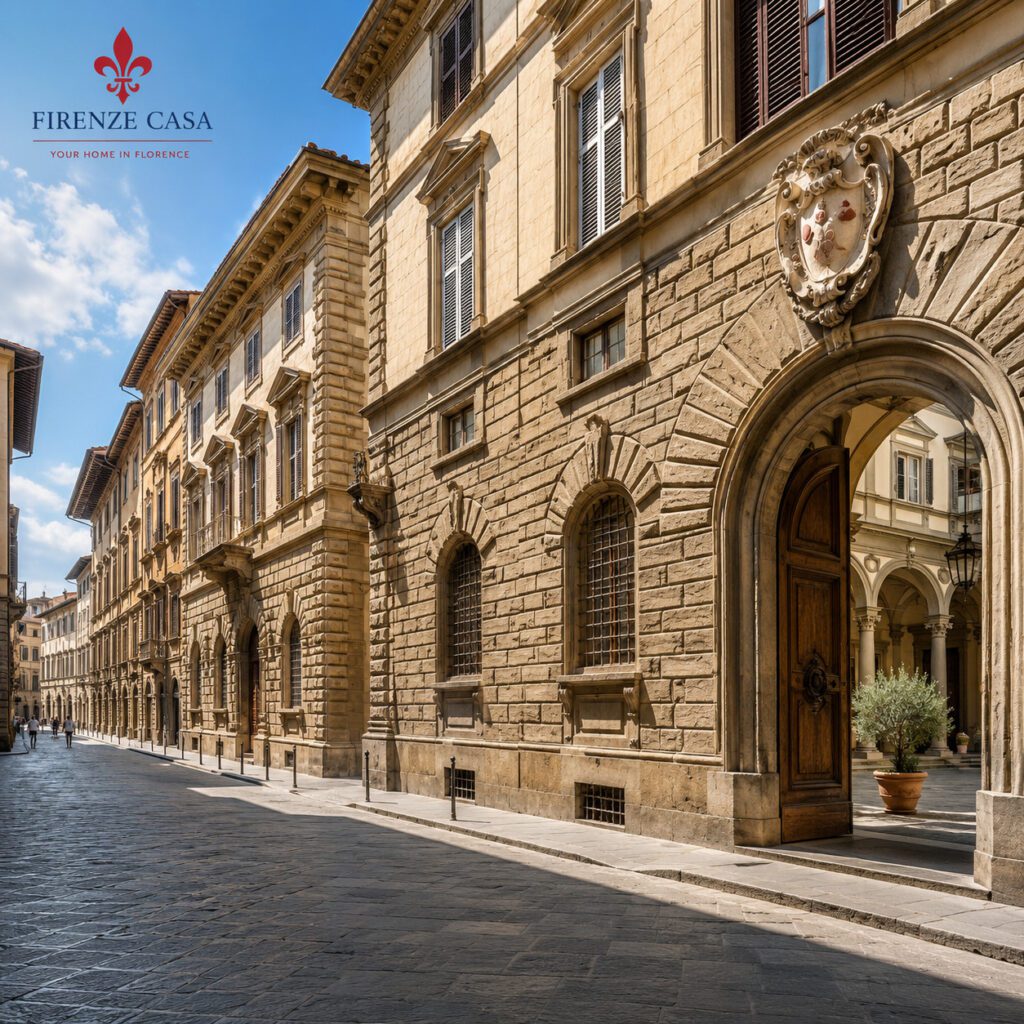
The architectural details become particularly interesting at street level. Ammannati used substantial window surrounds and sculptural elements to give the façade a strong rhythm.
These details belong to the increasingly expressive architectural language of the later Renaissance. Windows no longer function simply as openings in a wall. Frames, supports and decorative forms become architectural compositions in their own right.
Similar ideas appear in other buildings connected with Ammannati, allowing attentive visitors to recognise elements of his architectural vocabulary while walking through Florence.

Do not look only at the painted decoration. Examine the stone window frames and the relationship between openings and wall surfaces. The palace combines Ammannati’s architecture with a second decorative layer added only a few years after construction.
The Extraordinary Sgraffito Façade
The feature that makes Palazzo Ramirez de Montalvo immediately distinctive arrived after the building itself was complete.
Between 1573 and 1574, artists covered the façade with an elaborate programme of sgraffito decoration. Giorgio Vasari provided designs for the scheme, while the young Bernardino Poccetti may have participated in its execution.
The technique is easier to understand than its name suggests. To create a sgraffito, craftsmen first covered the wall with a darker layer of plaster and then applied a lighter layer on top. While the upper layer was still fresh, they scratched away selected areas according to the artist’s design. Wherever the lighter plaster was removed, the darker layer underneath became visible. In this way, figures, ornaments and decorative patterns appeared directly in the surface of the façade.

Think of sgraffito as drawing by removing rather than adding material. Instead of painting an image onto a finished wall, the artist scratches through a light layer of plaster to expose a darker layer beneath. The contrast between the two layers creates the design.
Florence preserves several important examples of this Renaissance technique, but the scale and complexity of the decoration at Palazzo Ramirez de Montalvo make this façade particularly remarkable. Although centuries of weathering have faded much of its original appearance, visitors can still recognise the figures and ornamental patterns that once covered the palace far more vividly.
A Façade Designed to Send a Message
The decoration was not simply ornamental.
Humanist scholar Vincenzo Borghini developed the iconographic programme. Its purpose was to celebrate the relationship between Antonio Ramírez de Montalvo and Cosimo I, presenting the duke as the family’s benefactor.
The lower part of the façade represents virtues considered appropriate for someone serving a prince. These include Modesty, Prudence and Fidelity. Above them appear qualities or consequences associated with faithful court service, including Obedience, Secrecy and Solicitude.
For a modern visitor, this makes the building much more interesting. What initially appears to be decorative Renaissance imagery actually communicates a carefully structured statement about political loyalty and courtly behaviour.
Think of the decoration as a public résumé written in images. The virtues on the façade presented Antonio Ramírez de Montalvo as the ideal loyal servant of Cosimo I and reminded viewers that his position depended on Medici favour.
Architecture as Political Communication
Palazzo Ramirez de Montalvo demonstrates how architecture functioned within Medici Florence.
A palace provided comfortable accommodation and announced wealth, but it could also communicate relationships. Its scale, decoration, heraldry and location helped explain who its owner was and where he stood within Florentine society.
In this case, the message is unusually explicit. Ramírez de Montalvo was a foreign-born courtier whose success depended on service to the ruling dynasty. The façade turns loyalty itself into decoration.
This also places the palace within the broader transformation of Florence under Cosimo I. Public spaces, palaces, sculpture and infrastructure increasingly expressed the authority of the new ducal state.
Giorgio Vasari and the Medici Cultural Network
The involvement of Giorgio Vasari adds another layer to the story. Vasari was far more than a painter. He worked as an architect, organiser and artistic adviser within Cosimo I’s cultural programme. His projects helped give architectural form to the increasingly centralised Medici state.
At Palazzo Ramirez de Montalvo, Vasari’s designs joined Ammannati’s architecture and Borghini’s intellectual programme. The palace therefore emerged from a network of artists and scholars who repeatedly collaborated on Medici commissions.
This combination of architecture, art and learned symbolism is characteristic of sixteenth-century court culture. The façade was meant not only to look impressive but also to be interpreted.
From Cosimo I to Eleonora di Toledo
The palace also provides an indirect connection with one of the most influential women in Medici Florence.
As cupbearer to Eleonora di Toledo, Ramírez de Montalvo belonged to her household environment. Eleonora herself played an important role in the development of the Medici court, managing substantial property and helping reshape the dynasty’s residential world.
Her purchase of Palazzo Pitti in 1549 laid the foundation for its transformation into the grand-ducal residence. Ammannati subsequently became one of the architects involved in expanding that enormous complex.
Palazzo Ramirez de Montalvo therefore belongs to the same period in which the Medici court was transforming Florence through architecture on several different scales.
The Palace After Antonio Ramírez de Montalvo
The building remained closely connected with the Ramírez de Montalvo family for almost three centuries.
The family retained ownership until 1860, when the last male descendant died. Apart from temporary periods of occupation by others, generations of the family continued to use the palace as their Florentine residence.
One temporary resident gives the building an unexpected connection with eighteenth-century European collecting. Between 1739 and 1758, the palace became the home of Philipp von Stosch, a Prussian-born antiquarian, collector and political agent who had settled in Florence.
His remarkable collection of engraved gems attracted considerable scholarly attention.
Winckelmann and a Collection of Ancient Gems
After Philipp von Stosch died in 1757, another famous figure became connected with the palace: Johann Joachim Winckelmann.
Winckelmann, one of the foundational figures in the development of modern art history and archaeology, came to Florence to catalogue and classify Stosch’s collection of ancient engraved gems.
This episode gives Palazzo Ramirez de Montalvo a second cultural history beyond its Renaissance origins. Nearly two centuries after Ammannati designed the building, its rooms became associated with the scholarly study of antiquity that would profoundly influence European Neoclassicism.
The palace links two very different intellectual worlds: the court culture of Cosimo I in the 16th century and the European fascination with classical antiquity in the 18th century.
Later Owners and Changes
After the end of the male Ramírez de Montalvo line, inheritance brought the palace to the Matteucci family of Volterra in 1866.
Later interventions altered parts of the building, and nineteenth-century observers criticised some restoration work for damaging the character of the historic façade.
The Desii family acquired the property in 1940. Over time, offices and businesses occupied parts of the building, changing its function from aristocratic residence to a more modern urban property.
Despite these transformations and centuries of exposure, much of the remarkable façade decoration survives.
How to See Palazzo Ramirez de Montalvo
For most travellers, the palace works best as a short architectural stop during a walk through the historic centre.
Approach along Borgo degli Albizi and step back far enough to see the façade as a complete composition. Then move closer and examine the individual figures and decorative bands.
One particularly useful viewpoint is from the area around Via de’ Giraldi. The angle allows a broader view of the decorated façade and makes its relationship with the surrounding street easier to appreciate.
Morning or late-afternoon light can make the sgraffito easier to read because oblique light increases the contrast across the surface.
The façade is easier to photograph from an angle than from directly beneath it. Move towards Via de’ Giraldi and compare several positions before taking the photograph; the narrow street makes small changes in viewpoint surprisingly important.
A Short Walk Through Renaissance Florence
Palazzo Ramirez de Montalvo fits naturally into a wider exploration of the eastern historic centre.
From the Duomo area, walk towards Borgo degli Albizi and follow the street past its sequence of historic palaces. After seeing Palazzo Ramirez de Montalvo, continue towards the nearby streets around Santa Croce or return towards the political centre around Piazza della Signoria.
This is an excellent area for travellers who have already visited Florence’s major museums and want to understand how Renaissance history survives in ordinary streets.
The palace requires only a few minutes, but knowing its story changes the experience. A decorated façade becomes evidence of Spanish courtiers, Medici patronage, Ammannati, Vasari and the political culture of Cosimo I.
Palazzo Ramirez de Montalvo and Ammannati’s Florence
Visitors interested in Bartolomeo Ammannati can use the palace as one stop in a much broader architectural exploration.
At Palazzo Ramirez de Montalvo, Ammannati adapted several older houses to create an urban residence. At Palazzo Pitti, he worked on a vast grand-ducal complex. Along the Arno, his Ponte Santa Trinita demonstrates his ability to combine engineering and architectural elegance.
Comparing these projects reveals why Ammannati matters. His work ranges from domestic architecture to courtly spaces, sculpture and major infrastructure.
The Palazzo Ramirez de Montalvo may be less famous than these larger monuments, but it adds an intimate chapter to the same story.
Is Palazzo Ramirez de Montalvo Worth Seeing?
Yes – particularly if you enjoy discovering Florence through its streets rather than only through museums.
Do not expect a major visitor attraction with galleries and ticket desks. The principal reason to stop is the exterior itself.
The palace rewards travellers who spend five or ten minutes looking carefully. Its architecture introduces Ammannati, while the sgraffito decoration reveals the political culture of the Medici court. The story of Antonio Ramírez de Montalvo then adds a Spanish dimension that is easy to overlook in conventional accounts of Renaissance Florence.
For visitors spending several days in Florence, small discoveries like this are particularly worthwhile. They turn a walk between major monuments into an opportunity to understand the city in greater depth.
Why Palazzo Ramirez de Montalvo Matters
Palazzo Ramirez de Montalvo is more than an attractive Renaissance façade.
It preserves the story of a Spanish nobleman who entered the inner circle of Cosimo I and Eleonora di Toledo. Ammannati transformed several older properties into his Florentine residence, while Vasari and Borghini helped turn its façade into an elaborate statement about loyalty and service.
Later, Philipp von Stosch and Johann Joachim Winckelmann connected the same building with the European study of classical antiquity.
Few façades in Florence reveal so clearly how architecture, politics and personal ambition could become intertwined.
Look closely at Palazzo Ramirez de Montalvo and a seemingly decorative palace becomes a document of Medici Florence.
Frequently Asked Questions
Where is Palazzo Ramirez de Montalvo?
The palace stands at Borgo degli Albizi 26 in Florence’s historic centre. Its richly decorated façade faces directly onto the street.
Who designed Palazzo Ramirez de Montalvo?
Bartolomeo Ammannati designed the palace in the early 1560s, while Alfonso Parigi supervised its construction. Contemporary evidence records the building as completed in 1568.
Who was Antonio Ramírez de Montalvo?
He was a Spanish nobleman and trusted courtier of the Medici. He served as personal chamberlain to Cosimo I and as cupbearer to Eleonora di Toledo.
Why is the façade unusual?
An elaborate sgraffito programme covers much of the façade. Created in 1573–1574 from designs associated with Giorgio Vasari, it celebrates virtues connected with loyal service to Cosimo I.
Can you visit Palazzo Ramirez de Montalvo?
The palace is best treated as an architectural sight to appreciate from the street rather than as a conventional museum. Its façade is the principal feature for visitors.
How long should I allow?
About five to ten minutes is enough for most travellers. Allow longer if you want to study or photograph the sgraffito decoration in detail.
What should I combine with the palace?
Explore the other historic buildings of Borgo degli Albizi and continue towards Santa Croce, the Duomo or Piazza della Signoria. The palace works particularly well as part of a walk through Florence’s historic centre.
Further Reading on Firenze Casa
- Palazzo Pitti Florence – Grand Ducal Palace
- Ponte Santa Trinita – Florence’s Renaissance Bridge
- Historic Palaces of Florence – Complete Guide
- The Medici Family – The Dynasty That Shaped Florence
References
- Repertorio delle Architetture Civili di Firenze – Palazzo Ramirez de Montalvo
- Claudio Paolini – Architetture e decorazione in Borgo degli Albizi
- Giorgio Vasari – Le vite de’ più eccellenti pittori, scultori e architettori
- Studies on Bartolomeo Ammannati and Florentine Mannerist architecture
- Historical studies on Cosimo I de’ Medici and the court of Eleonora di Toledo
- Studies on Vincenzo Borghini and Medici iconographic programmes