
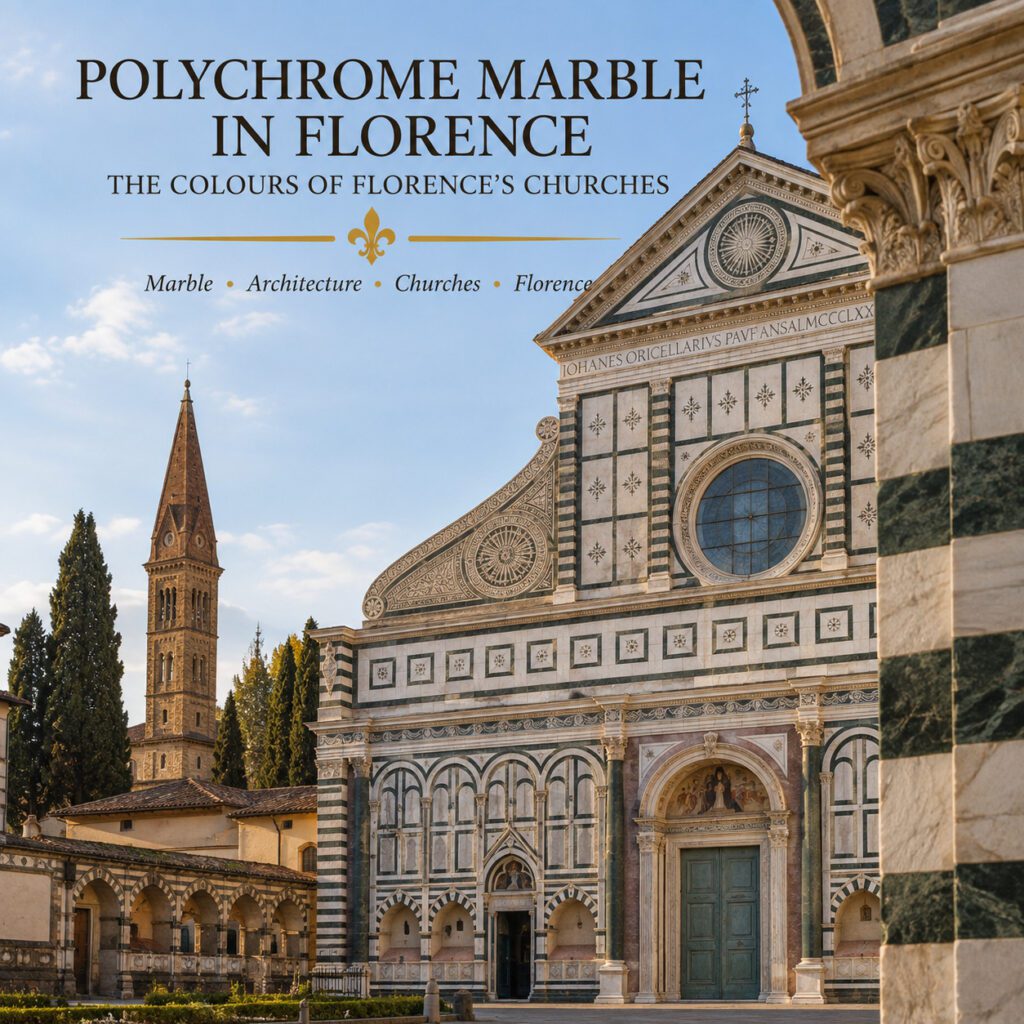
Polychrome marble in Florence is one of the city’s most recognisable architectural features. White, dark green and reddish stone forms geometric patterns across churches, baptisteries and bell towers, creating façades that seem unmistakably Florentine.
Yet these buildings are not all products of the same period. Some of the marble decoration dates back to the Middle Ages, others belong to the Renaissance, while several façades that appear ancient were actually completed during the nineteenth century. Looking closely at the marble churches of Florence therefore reveals a fascinating architectural story spanning many centuries.
Characteristic colours: White, green and red or pink
Typical materials: White marble, green serpentinite and reddish stone
Early examples: Baptistery of San Giovanni and San Miniato al Monte
Renaissance masterpiece: Santa Maria Novella
Later interpretations: Santa Croce and Santa Maria del Fiore
What to notice: Geometric patterns, symmetry, arches, panels and architectural frames
A Florentine Language of Stone
Walking through Florence, it is easy to recognise a recurring combination of colours. Pale marble is contrasted with dark green stone and, in some buildings, reddish or pink elements. Rather than covering façades with a single material, Florentine architects used differences in colour to emphasise architectural structure.
Horizontal bands, rectangles, arches, circles and other geometric forms turn the surface of a building into an ordered composition. The stone is therefore not simply decorative. It helps define proportions and gives visual rhythm to walls that might otherwise appear comparatively flat.
This tradition became so closely associated with Florence that later architects deliberately returned to it when completing unfinished medieval churches.
The green elements on Florentine façades are not simply green marble in the strict geological sense. Dark serpentinite was used to create the strong contrast with pale marble that became characteristic of Florentine architecture.
Where Did the Colours Come From?
The architectural identity of Florence is closely connected with the geology of Tuscany. Different stones provided architects and craftsmen with a natural palette that could be combined to create coloured surfaces.
White marble supplied the light background. Dark green serpentinite created dramatic lines and geometric forms, while reddish and pink stones introduced a third colour into more elaborate compositions.
Other local stones shaped Florence in very different ways. The warm ochre tones of pietraforte dominate many medieval palaces, while grey pietra serena became closely associated with Renaissance architecture. Together, these materials help explain why Florence possesses such a distinctive architectural colour palette.
San Miniato al Monte – An Early Masterpiece
One of the finest places to understand polychrome marble in Florence is the Basilica of San Miniato al Monte.
Standing high above the city, the basilica is one of the great examples of Tuscan Romanesque architecture. Its façade, dating largely from the early thirteenth century, uses white and green stone to create elegant geometric patterns.
The decoration does not hide the structure of the building. Instead, lines and panels reinforce it. Arches, rectangles and triangular forms create a carefully balanced surface whose visual effect depends as much on proportion as on colour.
Inside, the relationship between stone and decoration continues. The medieval inlaid floor includes an extraordinary zodiac panel, while marble elements around the raised presbytery demonstrate how decorative stonework was used throughout the building rather than only on its exterior.
Do not look at San Miniato only from a distance. Stand close to the façade and examine how the dark lines divide the pale surface into individual geometric fields. Then step back towards the terrace and see how those details merge into a remarkably harmonious composition.
The Baptistery – Geometry at the Heart of Florence
The Baptistery of San Giovanni provides another fundamental example. Standing opposite Florence Cathedral, the octagonal building is among the oldest and most important religious monuments in the city.
Its exterior is organised through contrasting pale and dark stone into a disciplined system of rectangles, arches and other geometric forms. The decoration gives the walls an almost graphic quality and helped establish a visual language that later Florentine architecture repeatedly echoed.
The Baptistery also demonstrates how closely religious architecture and civic identity were connected. Generations of Florentines were baptised here, and San Giovanni became inseparable from the identity of Florence itself.
You can explore the entire architectural ensemble in our guide to Piazza del Duomo.
Santa Maria Novella – Medieval Tradition Meets the Renaissance
The façade of Santa Maria Novella is perhaps the most intellectually refined expression of the Florentine marble tradition.
The lower part of the façade already contained medieval Gothic elements when Leon Battista Alberti was commissioned by Giovanni Rucellai to complete the building during the fifteenth century. Alberti faced an unusual challenge: he had to create a new Renaissance composition without destroying what was already there.
His solution was remarkably sophisticated. White and dark green marble, geometric panels, classical proportions and the famous great volutes connecting the upper and lower sections created a unified façade from elements belonging to different periods.
The result demonstrates an important characteristic of Renaissance Florence. Innovation did not always mean rejecting the Middle Ages. Alberti transformed an established Florentine decorative language by organising it according to new ideas of proportion and classical harmony.
Santa Maria Novella is particularly fascinating because its façade is not the work of a single period. Alberti incorporated an existing medieval lower section into a Renaissance composition, turning architectural continuity into part of the design.
Santa Maria del Fiore – A Medieval Cathedral with a Nineteenth-Century Face
Visitors standing before Florence Cathedral could easily assume that its elaborate marble façade belongs to the same medieval world as Giotto’s Campanile.
It does not.
The original façade begun in the period of Arnolfo di Cambio remained incomplete and was eventually dismantled in the late sixteenth century. For centuries, the western front of Santa Maria del Fiore remained unfinished.
The façade visible today was designed by Emilio De Fabris and completed during the nineteenth century. Its elaborate combination of white, green and red marble was deliberately created to harmonise with the neighbouring Baptistery and Giotto’s Campanile.
This makes the cathedral especially interesting for understanding the longevity of the Florentine marble tradition. Medieval forms and colours were not simply preserved; they were consciously revived centuries later to create the appearance of a unified monumental ensemble.
The colourful façade seen on Florence Cathedral today is not medieval. It was completed in the nineteenth century, centuries after Brunelleschi built the famous dome.
Giotto’s Campanile – Colour Becomes Architecture
Beside the cathedral, Giotto’s Campanile demonstrates how coloured stone could be applied to an entire architectural structure rather than simply to a church façade.
The bell tower is covered in an elaborate marble revetment whose changing patterns emphasise windows, architectural divisions and sculptural panels. White, green and reddish tones create a surface of exceptional richness.
Seen together with the Baptistery and cathedral, the Campanile helps explain why Piazza del Duomo appears so visually coherent despite the fact that its principal monuments developed over very different periods.
For a broader introduction to the complex, see our Florence Cathedral guide and Museo dell’Opera del Duomo.
Santa Croce – Medieval Church, Modern Marble Façade
The Basilica of Santa Croce provides another excellent example of how easily the appearance of Florence can mislead us about architectural chronology.
The great Franciscan church is fundamentally medieval, but its familiar façade is much younger. For centuries the front remained unfinished. The architect Niccolò Matas designed the present façade, which was completed in 1863.
Its white, green and reddish marble and strong geometric organisation deliberately connect Santa Croce with Florence’s older religious architecture. Seen from Piazza Santa Croce, the façade feels entirely at home in the historic city even though it belongs to the nineteenth century.
Santa Croce and Santa Maria del Fiore therefore reveal something important: by the nineteenth century, polychrome marble had become more than a construction technique. It had become a visual symbol of Florence.
Not Every Florentine Church Has a Marble Façade
The tradition becomes even clearer when compared with churches where it is absent.
San Lorenzo, for example, presents a famously unfinished and undecorated exterior despite its extraordinary Renaissance interior and its close association with the Medici.
Santo Spirito offers another striking contrast. Brunelleschi’s celebrated church has a restrained plastered façade rather than the elaborate marble surface many visitors associate with Florence.
These differences remind us that there was never a rule requiring Florentine churches to be clad in coloured marble. Cost, changing architectural tastes, patronage and unfinished projects all influenced what was actually built.
Some of Florence’s most celebrated Renaissance churches have surprisingly plain exteriors, while façades that look medieval may actually date from the nineteenth century. Florence rewards visitors who look beyond first impressions.
From Romanesque Geometry to Renaissance Harmony
The long history of polychrome marble in Florence also reveals changing architectural ideas.
At San Miniato and the Baptistery, contrasting stone creates the disciplined geometric language associated with Florentine Romanesque architecture. At Santa Maria Novella, Alberti transformed that inherited tradition through Renaissance ideas of proportion and classical order.
Centuries later, architects such as Niccolò Matas and Emilio De Fabris returned to coloured marble when designing façades for Santa Croce and the cathedral. Their work was new, but it deliberately entered into a visual dialogue with medieval Florence.
The result is something unusual: a recognisable architectural identity created not in a single period, but through repeated reinterpretation over hundreds of years.
How to Look at Florence’s Marble Churches
When visiting these buildings, it is worth spending a few minutes looking at the façades before entering. Instead of concentrating only on sculpture and portals, follow the lines created by the coloured stone.
Notice how rectangles frame architectural elements, how dark bands emphasise arches and how patterns change between the lower and upper parts of a façade. Compare the disciplined geometry of San Miniato with Alberti’s carefully calculated composition at Santa Maria Novella and the much richer nineteenth-century surface of Santa Maria del Fiore.
A particularly rewarding comparison can be made by walking from the Baptistery and cathedral to Santa Maria Novella. The distance is short, but the route connects several centuries of Florentine architecture.
Why Polychrome Marble Matters in Florence
The marble decoration of Florence is easy to appreciate simply because it is beautiful. Yet its significance goes much deeper.
These coloured surfaces connect medieval religious architecture with Renaissance ideas of harmony and later attempts to preserve a recognisably Florentine architectural identity. They also demonstrate how local and regional materials became part of the visual language of an entire city.
Perhaps most importantly, the façades challenge the idea that historic Florence belongs to a single golden age. The city visitors admire today is layered. Medieval builders, Renaissance architects and nineteenth-century designers all contributed to what now appears to be a remarkably coherent whole.
Once you begin recognising polychrome marble in Florence, walking through the city changes. White, green and red are no longer simply decorative colours. They become clues to the history of Florentine architecture.
Further Reading on Firenze Casa
- The Most Beautiful Churches in Florence – Complete Guide
- San Miniato al Monte – Romanesque Basilica in Florence
- Basilica of Santa Maria Novella – Art and Architecture in Florence
- Florence Cathedral – Complete Visitor’s Guide
- Piazza del Duomo – Florence’s Cathedral Square
- Basilica of Santa Croce – Florence’s Monumental Church
- Basilica of San Lorenzo – The Medici Church of Florence
- Museo dell’Opera del Duomo – Florence Cathedral Museum
References
- Comune di Firenze – Feel Florence, historical and architectural information on the churches and stone materials of Florence.
- Opera di Santa Maria del Fiore – historical documentation on Florence Cathedral, Giotto’s Campanile and the Baptistery of San Giovanni.
- Basilica di San Miniato al Monte – historical and architectural information.
- Meridiani, Firenze, No. 67, April 1998.
- Murray, Peter – The Architecture of the Italian Renaissance.

