

Cafè 1926 in Florence feels less like an ordinary neighbourhood bar than a small journey into an imagined Florence of another era. Hidden on Via Giovan Battista Niccolini near Piazza d’Azeglio and Sant’Ambrogio, the café combines mirrors, marble, dark wood, painted walls, books and curious historic objects to recreate the atmosphere of an old European café.
For travellers, Cafè 1926 Florence offers something increasingly difficult to find in the busiest parts of the city: a place where the setting itself is part of the experience. You can come for breakfast or coffee, stop for lunch, return for an evening drink or simply enjoy the unusual rooms – but it is worth understanding that this is a deliberately created vintage environment, not a Florentine café preserved unchanged since 1926.
Name: Cafè 1926 Bistrot
Address: Via Giovan Battista Niccolini 30/R, Florence
Area: Piazza d’Azeglio / Sant’Ambrogio
Style: Vintage café and bistrot inspired by historic European café culture
Come for: Breakfast, coffee, lunch, aperitivo, dinner or an evening drink
Special feature: Themed interiors and an extensive rum collection
Atmosphere: Intimate, theatrical and deliberately nostalgic
Best for: Travellers looking for somewhere different from Florence’s central tourist cafés
From Firenze Casa: About 30 metres
Important: Check current opening hours and events before making a special journey
Cafè 1926 offers an interesting contemporary counterpart to the establishments explored in our Historic Cafés of Florence – Complete Guide. Unlike Gilli, Paszkowski or Rivoire, however, its appeal lies not in centuries of continuous café history but in the way it recreates the atmosphere of an earlier age.
Why Visit Cafè 1926?
Florence has no shortage of places to drink an espresso. Cafè 1926 is worth knowing because it offers something different from both the everyday Italian bar and the grand historic cafés around Piazza della Repubblica.
The interior is deliberately atmospheric. Mirrors, marble, wood, decorative painting, subdued lighting and collections of objects create a series of spaces that invite visitors to slow down rather than simply drink a coffee at the counter and leave.
That makes the café particularly appealing during a longer stay in Florence. After visiting the city’s major monuments, spending an hour somewhere with a strong individual character can reveal another side of contemporary Florentine life.
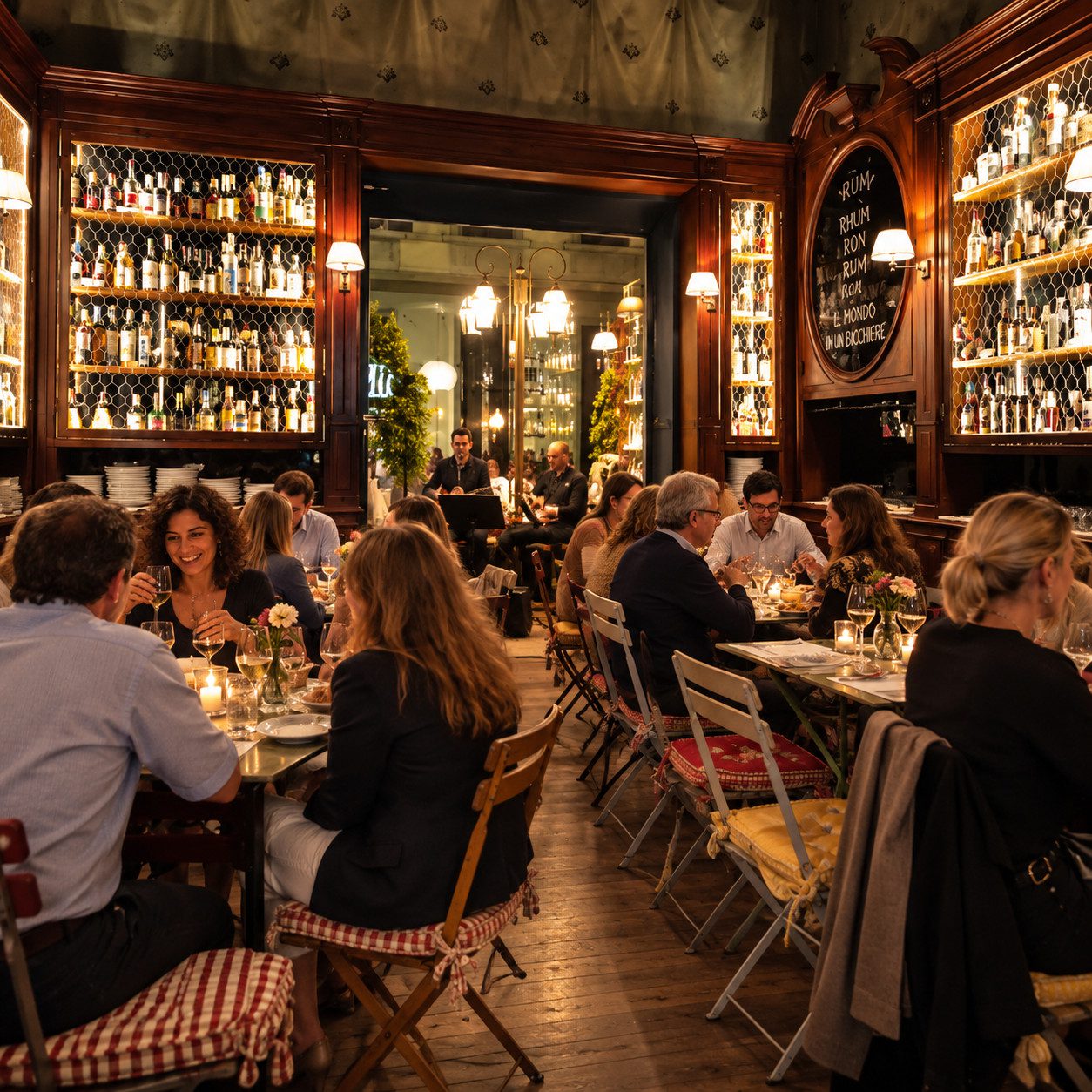
Come primarily for the atmosphere rather than because Cafè 1926 is a historic monument. The pleasure lies in entering a carefully created world inspired by old Florence and European café culture.
Where Is Cafè 1926?
Cafè 1926 stands at Via Giovan Battista Niccolini 30/R, east of Florence’s main tourist centre. It lies close to Piazza d’Azeglio and within easy walking distance of the Sant’Ambrogio neighbourhood.
This location is part of its appeal. You are away from the intensely visited axis between the Duomo, Piazza della Signoria and Ponte Vecchio, but still comfortably within the historic city.
For guests staying at Firenze Casa, the café is particularly convenient: it is only about 30 metres from the apartment. That makes Cafè 1926 an easy option for breakfast or a first morning coffee before setting out to explore Florence.
The nearby Mercato di Sant’Ambrogio and surrounding streets make this a good area for travellers interested in everyday Florence as well as monuments. The neighbourhood has retained a more residential character than the streets immediately surrounding the city’s principal attractions.
If you are staying at Firenze Casa, Cafè 1926 is practically around the corner – only about 30 metres from the apartment. It is particularly convenient for breakfast or a first coffee before setting out for the day. For other visitors, it combines naturally with Sant’Ambrogio, Piazza d’Azeglio and the surrounding neighbourhood.
Why Is It Called Cafè 1926?
The name Cafè 1926 can easily suggest that the café itself dates from that year. It does not. The venue is a modern creation whose vintage interior evokes the atmosphere of older European cafés and the world of late nineteenth- and early twentieth-century Florence.
There is, however, an intriguing Florentine connection to the year itself. 1926 was the year in which ACF Fiorentina was founded. The club was established on 26 August 1926 and went on to become one of the strongest symbols of modern Florentine identity. If you want to understand why the purple shirts mean so much to the city, read our guide to football in Florence and ACF Fiorentina.
Whether the founders of Cafè 1926 deliberately chose the name because of Fiorentina has not been reliably documented in the sources we have found. The connection should therefore not be presented as established fact. Nevertheless, the coincidence gives the number an unmistakably Florentine association.
The year 1926 has a special place in modern Florentine history: ACF Fiorentina was founded on 26 August that year. Today, the club and its famous violet colours are inseparable from the identity of Florence.
A Journey into the World of Firenze Capitale
The concept becomes even more interesting when placed within the history of the surrounding neighbourhood.
Between 1865 and 1871, Florence served as the capital of the newly unified Kingdom of Italy. The period known as Firenze Capitale transformed the city dramatically. New boulevards, residential districts and public spaces were created as Florence attempted to present itself as a modern European capital.
The area around Piazza d’Azeglio belongs closely to this nineteenth-century expansion of Florence. Elegant residential buildings and tree-lined spaces created an urban environment quite different from the dense medieval streets around the Duomo.
Cafè 1926 consciously draws on this later image of Florence: less Renaissance workshop and more bourgeois salon, café, reading room and evening meeting place.
The café is not itself a surviving institution from the Firenze Capitale period. Its interior uses that world as inspiration. Knowing the difference actually makes the concept more interesting: you are seeing how modern Florence imagines and recreates its nineteenth- and early twentieth-century café culture.
The Interior Is the Main Attraction
The first reason to choose Cafè 1926 over an ordinary bar is visual.
The rooms are filled with a mixture of mirrors, marble, dark wood, decorative painting, lamps, books and collected objects. Instead of one uniform dining room, the interior is divided into spaces with different identities.
The effect is deliberately theatrical. Depending on where you sit, the café can feel like an old tearoom, private salon, library or cabinet of curiosities.
This is not minimalist contemporary design. The attraction lies precisely in the accumulation of details and the sense that there is always something else to notice.
If the café is quiet enough, take a moment to see the different rooms before choosing a table. Cafè 1926 makes considerably more sense when experienced as a collection of small environments rather than simply as a place to order coffee.
The Carriage Room
One of the most memorable features is the room associated with an old restored carriage. It is exactly the sort of unexpected object that gives Cafè 1926 its slightly eccentric character.
The carriage is not merely decoration in the conventional sense. Together with the surrounding furniture and lighting, it helps create the impression of stepping temporarily outside contemporary Florence.
For travellers who enjoy unusual interiors, this is likely to be one of the details they remember most clearly after leaving.
Tea, Coffee and a Place to Read
Other spaces were conceived more like traditional sitting rooms. The café has been associated with a tearoom and a small library where guests can linger with coffee, tea, newspapers, magazines or books.
This slower approach is very different from the everyday Italian coffee ritual. In a neighbourhood bar, ordering un caffè and drinking it standing at the counter may take only a few minutes.
Both experiences are authentically part of contemporary Florence, but they serve different purposes. Our Coffee in Florence – Historic Cafés & Italian Bar explains how these different café traditions coexist in the city.
From Breakfast to Evening Bistrot
Cafè 1926 changes character during the day.
Morning is the natural time for coffee, pastries and a relaxed breakfast. Later, the café operates more like a bistrot, with savoury dishes and drinks becoming increasingly important.
That flexibility is useful for travellers. You do not need to visit at one specific time to understand the place: breakfast provides a quieter experience, an afternoon stop suits tea or coffee, while evening brings a more social atmosphere.
For guests at Firenze Casa, the morning option is particularly useful. With the café only around 30 metres away, you can have breakfast almost outside the apartment door and then begin your day in Florence directly from the Sant’Ambrogio and Piazza d’Azeglio area.
Menus, prices and individual dishes naturally change over time, so it is better to choose Cafè 1926 for its overall character rather than travel across Florence for one particular menu item.
Choose morning for the quietest café experience, late afternoon for a relaxed break, or evening if you want drinks and the livelier side of the bistrot. Check current opening hours before visiting, particularly on Sundays.
The Extraordinary Rum Collection
Coffee is only part of the story. One of Cafè 1926’s most unusual specialities is rum.
The establishment has become known for a collection numbering several hundred bottles, with a particular emphasis on rums from the Caribbean. Rather than treating rum simply as another spirit behind the bar, the café presents it as something to explore through tasting.
Chocolate and candied fruit have traditionally been offered as accompaniments, encouraging guests to compare aromas and flavours rather than simply order a mixed drink.
For anyone with a serious interest in rum, this may actually be a stronger reason to visit than the coffee.
The exact number of bottles can naturally change, so claims about a fixed total quickly become outdated. What matters is the scale: Cafè 1926 has built an unusually extensive rum selection that forms a genuine part of its identity.
The Old Pharmacy Room
The vintage concept continues in the room inspired by an antica farmacia – an old pharmacy.
Historic pharmacies occupy a special place in Florentine culture. Their wooden cabinets, glass bottles, labels and carefully arranged preparations created interiors that combined commerce, medicine and craftsmanship.
At Cafè 1926 the reference is atmospheric rather than historical: another visual layer within the café’s imagined journey into the past.
Combined with the rum collection, the old-pharmacy aesthetic gives this part of the café something of a collector’s cabinet – appropriate for a place that deliberately avoids the anonymous appearance of a conventional modern bar.
Music, Theatre and Books
Cafè 1926 has also developed a cultural identity that goes beyond its interior decoration.
Over the years the venue has hosted live music, jazz, small theatrical performances and literary events. In 2016, for example, the Cantiere Futurarte staged a series of short theatrical performances here. Later programmes included jazz evenings, while authors and readers have also used the café for book presentations and literary gatherings.
This aspect creates an interesting connection with Florence’s genuine historic café tradition. The great Florentine cafés were important not simply because people drank coffee there, but because they functioned as meeting places for writers, artists, musicians and intellectuals.
Cafè 1926 does not share their long history, but its use as a small cultural venue consciously echoes that social role.
Live events are not something to assume will happen every evening. If music or a cultural event is important to your visit, check the café’s current programme shortly beforehand rather than relying on older event listings.
How Cafè 1926 Differs from Florence’s Historic Cafés
The distinction is worth making because the two experiences complement one another.
Caffè Gilli, Paszkowski and Rivoire derive much of their significance from their own histories. Their locations, traditions and surviving interiors connect visitors directly with the evolution of Florence’s café culture.
Cafè 1926 approaches the past differently. It assembles historic references and vintage objects to create an atmosphere that feels deliberately removed from the contemporary street outside.
One is inherited history; the other is historical imagination.
If café culture interests you, experiencing both can be surprisingly rewarding. Our Italian Coffee Culture in Florence also explains why the elegant café and the quick neighbourhood espresso bar represent very different but equally interesting ways of experiencing coffee in Italy.
Combine Cafè 1926 with Sant’Ambrogio
The café works particularly well as part of a morning or afternoon in the eastern side of central Florence.
Begin around Sant’Ambrogio, explore the market and surrounding streets, then continue towards Piazza d’Azeglio and Via Niccolini. The change from the crowded monumental centre is noticeable: this is a part of Florence where residential streets and everyday businesses play a larger role.
Travellers interested in less obvious places can also use our Hidden Gems in Florence – Complete Guide to build a day that mixes major sights with smaller discoveries.
Sant’Ambrogio Market → neighbourhood streets → Piazza d’Azeglio → Cafè 1926.
Allow enough time to wander rather than treating the route as a sequence of attractions. The appeal of this part of Florence lies partly in the streets between the named places.
Is Cafè 1926 Worth Visiting?
Yes – if atmosphere matters to you.
Do not choose Cafè 1926 because you expect one of Florence’s great historic institutions. Choose it because you want an unusual café away from the most heavily touristed streets, with an interior unlike the standard Italian bar.
It is particularly suitable for travellers interested in vintage interiors, café culture, rum, small cultural venues or simply places with a strong personality.
If you have only a few hours in Florence, there is no reason to cross the city specifically to visit it instead of seeing an essential monument. But during a stay of several days, combining it with Sant’Ambrogio or Piazza d’Azeglio makes excellent sense.
For guests staying at Firenze Casa, the calculation is even simpler: Cafè 1926 is close enough to become a useful neighbourhood address rather than a sightseeing destination – somewhere you can return to for breakfast, coffee or an evening drink during your stay.
Why Cafè 1926 Is Worth Discovering
Florence’s café culture has always been about more than espresso. Cafés can be places to read, talk, listen to music, meet friends or simply watch the city around you.
Cafè 1926 takes that idea and wraps it in an intentionally nostalgic setting. A restored carriage, books, mirrors, dark wood, old-pharmacy references and an extensive rum collection create an environment that feels deliberately detached from the modern city outside.
Its cultural events add another layer. Theatre, jazz and literature have all found a place here, connecting a contemporary bistrot – however loosely – with the much older Florentine tradition of the café as a social and cultural meeting point.
It is not old Florence preserved unchanged. It is contemporary Florence dreaming about the past – and that is precisely what makes it interesting.
Frequently Asked Questions
Where is Cafè 1926 in Florence?
Cafè 1926 is at Via Giovan Battista Niccolini 30/R, close to Piazza d’Azeglio and within walking distance of Sant’Ambrogio. For guests at Firenze Casa, it is particularly convenient because the café is only about 30 metres from the apartment.
Is Cafè 1926 really a historic café from 1926?
No. Cafè 1926 should not be understood as a café that has operated continuously since 1926. Its appeal lies in a deliberately created vintage atmosphere inspired by historic café culture.
Why is it called Cafè 1926?
The precise reason for the name has not been reliably documented in the sources we found. Interestingly, 1926 is also the year ACF Fiorentina was founded, giving the number an important association in modern Florentine history, although we cannot confirm that this inspired the café’s name.
What is Cafè 1926 known for?
It is known for its unusual vintage interiors, themed rooms, café and bistrot service, extensive rum selection and history of hosting music, theatre and literary events.
Can you have breakfast at Cafè 1926?
Yes. The café traditionally opens in the morning and serves coffee and breakfast items before becoming more of a bistrot later in the day. This makes it an especially convenient breakfast option for guests staying at nearby Firenze Casa.
Does Cafè 1926 have live music?
The venue has a documented history of jazz, live music and other cultural events. Programmes vary, so check current listings rather than assuming there will be music on a particular evening.
Why is the rum collection special?
Cafè 1926 is known for a selection numbering several hundred bottles, particularly from the Caribbean, making rum tasting one of the more unusual aspects of the venue.
Is Cafè 1926 worth visiting on a first trip to Florence?
Yes if you have several days and enjoy atmospheric cafés. With very limited time, prioritise Florence’s essential monuments and visit Cafè 1926 if you are already exploring Sant’Ambrogio or the surrounding neighbourhood.
Further Reading on Firenze Casa
- Historic Cafés of Florence – Coffee, Culture & History
- Coffee in Florence – Historic Cafés & Italian Bar
- Italian Coffee Culture – How Florence Enjoys Coffee
- Florence as Capital of Italy – Firenze Capitale 1865–1871
- Football in Florence – Why Fiorentina Means So Much to the City
- Hidden Gems in Florence – Complete Guide
References
- Cafè 1926 Firenze – venue information and historical descriptions
- Treccani – history of Italian football clubs and the foundation of ACF Fiorentina
- Comune di Firenze, Portalegiovani – Cantiere Futurarte events at Cafè 1926
- Edizioni Spartaco – literary events at Cafè 1926
- Circolo Letterario Firenze – meetings and literary events at Cafè 1926
- Firenze Weekend – jazz and cultural events at Cafè 1926
- Comune di Firenze – historical resources on Firenze Capitale and nineteenth-century Florence

