
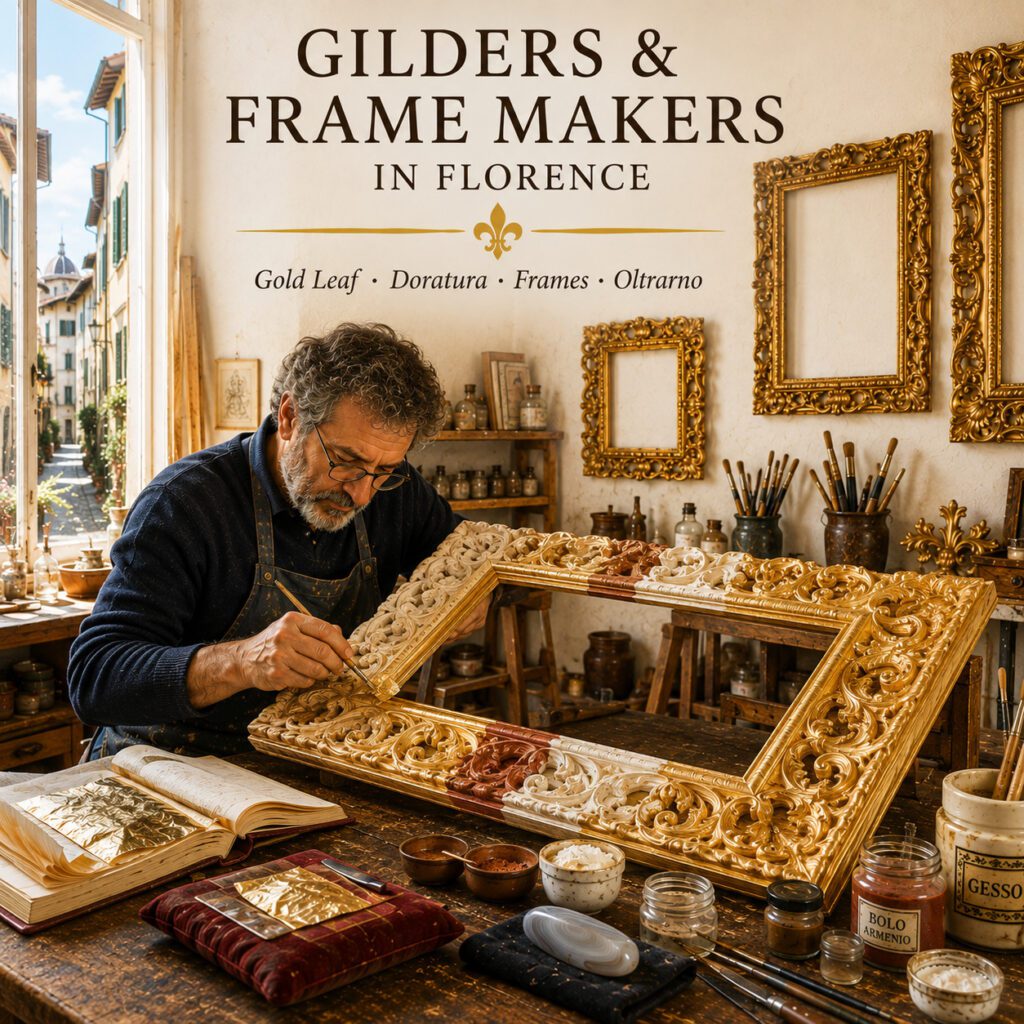
In a Florentine gilding workshop, an ordinary piece of carved wood can slowly become something luminous. Gilders and Frame Makers in Florence preserve the traditional skills behind the elaborate gold frames that visitors see in churches, palaces and museums throughout the city. Their work combines woodworking, surface preparation, decoration and the extraordinary delicacy of genuine gold leaf.
These crafts developed alongside Florence’s painters and sculptors and still play an important role in restoration today. In traditional botteghe, particularly in the Oltrarno, artisans continue to practise techniques whose basic principles would have been familiar to Renaissance craftspeople. They form part of the living heritage explored in our Traditional Florentine Workshops – Where Craftsmanship Survives.
✨ At a Glance
Italian term for gilding: Doratura
Gilder: Doratore / Doratrice
Key material: Extremely thin gold leaf
Traditional support: Carved or moulded wood
Important preparation: Gesso and bole
Typical work: Frames, furniture, church decoration and restoration
Where to look: Oltrarno, Santo Spirito and San Frediano
Florence and the Art of Gold
Gold has played an extraordinary role in Florentine art. Medieval altarpieces shimmered against gold backgrounds, Renaissance interiors incorporated gilded decoration, and elaborate frames created luminous boundaries between paintings and the architecture around them.
Yet the gold itself tells only part of the story. Before artisans can apply a single sheet of gold leaf, they must carefully prepare the surface through several stages. Experienced gilders understand exactly how wood, gesso, bole and gold interact.
The Italian term doratura describes gilding, while a specialist who carries out the work is called a doratore or doratrice. Although the final result may appear purely decorative, traditional gilding demands exceptional precision and years of experience.
🇮🇹 Florence Language Tip
Oro means gold, while doratura means gilding. A traditional doratore does much more than simply apply gold. Careful preparation of the surface forms one of the most important parts of the craft.
Why Florence Needed Specialist Gilders
Florence’s enormous production of religious art created constant demand for skilled gilders. Churches, confraternities and wealthy patrons commissioned altarpieces, tabernacles, frames and furnishings in which gold emphasised both spiritual importance and material splendour.
Gold also interacted beautifully with candlelight. Before electric illumination, gilded surfaces captured and reflected even relatively weak light, giving religious interiors greater warmth, brilliance and visual richness.
As artistic fashions changed, gilders adapted their techniques to furniture, architectural decoration and increasingly elaborate frames. Their work became an important part of the visual language that developed from medieval Florence through the Florentine Renaissance and later periods.
A Frame Is More Than a Border
Modern visitors often concentrate entirely on the painting inside a frame. Historically, however, artists and patrons treated frames as carefully designed objects that connected an artwork with the room or architectural setting around it.
A frame could reinforce the composition of a painting, indicate its importance and visually connect it with an altar, palace interior or private collection. Its proportions, ornament and finish therefore mattered enormously.
Several specialists often contributed to a single frame. A carpenter created the basic structure, a woodcarver developed the ornament and a gilder transformed the prepared surface with gold. The relationship between these trades is explored further in our article about Woodcarvers and Furniture Restorers in Florence.
Seen in this way, the frame becomes part of the artwork’s history rather than an interchangeable accessory.
🖼 Look Differently
Next time you visit the Uffizi or a Florentine church, spend a moment looking at the frames. Their carving, proportions and gilded surfaces can reveal almost as much about changing taste as the paintings they surround.
From Woodcarver to Gilder
A traditional gilded frame begins with wood. A frame maker first constructs the basic structure before a carver develops its decorative elements.
Florentine frames range from relatively restrained profiles to elaborate architectural compositions filled with scrolls, leaves, flowers and other ornament. Complex designs require especially close cooperation between the frame maker and woodcarver.
Once the wooden form is complete, artisans can begin the lengthy preparation for gilding. Traditional frame making therefore depends on a network of related crafts rather than a single isolated profession.
🪵 From Wood to Gold
A magnificent gilded frame may begin as relatively plain timber. Construction establishes the structure, carving creates the ornament and gilding finally transforms the surface.
Preparing a Surface for Gold Leaf
Gold leaf is so thin that it cannot hide imperfections beneath it. On the contrary, the gold can make irregularities in the underlying surface even more visible.
Traditional gilders therefore devote considerable time to preparation. They cover the wooden support with layers that create a smooth and stable surface. A traditional gesso preparation based on chalk and animal glue may require several applications followed by careful smoothing.
The artisan must preserve every decorative detail throughout this process. Too much material can obscure the carving, while insufficient preparation leaves an uneven surface.
The glamorous moment when gold finally touches the frame therefore comes only after many hours of patient work that the finished object largely conceals.
What Is Bole?
For traditional water gilding, artisans add another important layer called bolo, or bole in English. This fine clay preparation sits over the gesso and beneath the gold leaf.
Gilders can use red, yellow and other shades of bole to influence the final appearance of the gold. As a historic gilded surface wears, the warmer layer underneath may gradually become visible.
Bole also creates the foundation for one of the most beautiful stages of traditional gilding: burnishing.
💡 Did You Know?
The warm reddish tone sometimes visible beneath worn historic gilding may come from the bole rather than paint. This clay layer forms part of the carefully prepared foundation beneath the gold.
Gold Leaf and the Gilder’s Tools
One of the most surprising experiences in a gilding workshop is seeing genuine gold leaf before the artisan applies it. The sheets are extraordinarily thin and delicate. Even a slight movement of air can disturb them, while direct contact with ordinary fingers can make the leaf adhere, wrinkle or tear.
A gilding cushion provides a protected surface where the artisan can handle and cut the leaf. A specialised knife divides it without tearing, while a gilder’s tip made from fine hair helps lift and transfer the gold onto the prepared surface.
For burnishing, artisans use another distinctive tool: polished agate. When moved across suitable traditional gilding, it compresses and polishes the surface until the gold develops extraordinary reflective brilliance.
The tools themselves remain relatively simple. Their effectiveness depends almost entirely on the skill of the person using them.
🔍 Inside the Workshop
Even a draught from an open window can move gold leaf across the workbench. Handling this extraordinarily light material requires a calm environment and considerable practice.
Water Gilding and Oil Gilding
Traditional water gilding ranks among the most refined methods used on frames and decorative objects. Immediately before laying the gold leaf, the gilder activates the prepared bole with moisture.
After the gold settles and dries, the artisan can burnish suitable areas with agate. This creates the brilliant, mirror-like finish associated with finely gilded historic objects. The technique requires careful control of moisture, timing and surface preparation.
Not every gilded surface uses this method. Oil or mordant gilding employs an adhesive size to attach the gold and works particularly well on surfaces where traditional water gilding would be unsuitable.
Historic objects can contain several types of gilding. During restoration, specialists therefore examine the existing surface carefully before deciding how to proceed.
🛠 Traditional Technique
Water gilding and oil gilding use different preparation and application methods. An experienced restorer first identifies the existing technique before intervening.
Burnishing and Decorative Gold
Burnishing is one of the most visually satisfying stages of traditional gilding. The artisan carefully moves a polished agate tool across selected areas of the gold surface, creating an exceptionally smooth and reflective finish.
The gilder may deliberately leave other areas matte, producing contrasts between brilliant and softer gold. Light behaves differently across polished highlights, recessed ornament and matte surfaces, giving a gilded frame depth and movement.
Gilders can also decorate the gold itself. Historic craftspeople used punches, incised lines and other techniques to create patterns that catch the light in different ways. Such methods played an especially important role in medieval and early Renaissance painting, particularly in halos, borders and gold backgrounds.
These techniques demonstrate why gilding deserves recognition as a creative craft rather than simply the application of an expensive material.
Why Old Gold Does Not Look New
Historic gilding changes with time. Frequent contact and natural ageing can wear raised areas and gradually reveal the bole or preparation beneath the gold. Dirt and environmental conditions also alter the surface, while previous restorations may add further materials.
These changes can become part of the visual history of an object. If a restorer replaces old gilding simply because it looks worn, valuable original material may disappear.
Professional restoration therefore requires restraint. Conservators aim to preserve surviving material and stabilise vulnerable areas rather than automatically returning every surface to brilliant new gold.
🏛 Restoration Principle
Old gilding does not need to look newly gilded. Wear can form part of an object’s history, and surviving original gold may hold far greater value than a flawless modern replacement.
Restoring a Historic Gilded Frame
A restorer begins by studying the frame’s construction, surface layers and condition. Loose preparation may require consolidation, while cracks or structural damage in the wood can demand separate treatment.
Cleaning requires particular care. A method that works safely on one surface can damage another, especially when the frame contains water-sensitive materials or layers from previous restorations.
Sometimes specialists visually integrate missing areas of gilding, but the appropriate approach depends on the significance and condition of the object. Modern conservation ethics favour original material and discourage unnecessary intervention.
A historic frame can therefore require expertise in woodworking, gilding, chemistry and art history, connecting the traditional gilder directly with Florence’s wider network of art restoration workshops.
Frames Can Have Their Own History
A painting and its frame have not necessarily remained together since their creation. Owners frequently reframed paintings as fashions changed, collections moved or new interiors required a different appearance.
A frame can therefore come from a different period than the painting it surrounds. Art historians may investigate whether a frame originally belonged to the artwork, dates from roughly the same period or represents a later addition.
Historic frames can also survive independently from paintings. Their carving, gilding and construction may give them considerable importance as decorative objects in their own right.
🔎 Look Closely
Do not automatically assume that an old painting and its frame were made together. Many important artworks acquired different frames as they passed through churches, palaces and collections over the centuries.
From Medieval Altarpieces to Renaissance Frames
Changes in painting also transformed frame making. Medieval polyptychs often combined painted panels and elaborate architectural frames into a unified visual structure.
As Renaissance painters developed new formats and approaches to perspective, frame makers changed their designs as well. Classical architecture increasingly inspired decorative forms, including columns, pilasters, cornices and other elements drawn from antiquity.
Later centuries introduced further changes in taste, from restrained profiles to exuberant carved ornament. Florence therefore offers an extraordinary opportunity to study the history of frames simply by moving through its churches and museums.
The Uffizi Gallery is an especially rewarding place to start looking beyond the paintings themselves. Its collections allow visitors to compare frames and paintings from different periods while exploring the artistic legacy of the Medici.
Gilders and Frame Makers in the Oltrarno
The Oltrarno has long attracted specialist artisan workshops, including woodcarvers, restorers, frame makers and gilders. The concentration of related trades encouraged close collaboration on complex commissions.
A frame could move easily between nearby specialists. A carpenter or frame maker constructed it, a carver created the ornament and a gilder completed the decorative surface.
The neighbourhood has changed considerably, and fewer traditional workshops remain than in earlier generations. Nevertheless, the areas around Santo Spirito and San Frediano still retain a strong connection with Florence’s artisan identity. Our guide to the Artisan Districts – Oltrarno, San Frediano and Santo Spirito explores this living workshop culture in greater detail.
🚶 Firenze Casa Tip
When exploring the Oltrarno, look for words such as doratura, cornici, intaglio and restauro. They can lead to small specialist workshops that are easy to overlook.
How to Recognise a Traditional Gilding Workshop
A genuine gilding workshop often contains objects at very different stages of completion. One frame may still show bare carved wood, another may display the pale preparation layers, while a third already shines with gold.
You may also notice small books of gold leaf, fine brushes, gilding cushions and agate burnishers around the workbench. Frames awaiting restoration often occupy walls and shelves.
The workshop may look very different from a polished retail shop because the artisan organises the room around production and conservation rather than display. Visitors can therefore see stages of the process that normally disappear beneath the finished surface.
✨ Inside the Bottega
Look for frames in different colours: bare wood, pale gesso, reddish bole and finally gold. Together they reveal the sequence of layers hidden beneath a finished gilded surface.
Gilding and Florence’s Art Restoration Tradition
Traditional gilding remains particularly relevant in Florence because the city contains an extraordinary concentration of historic objects requiring specialist conservation. Frames, altarpieces, furniture and architectural decoration all contain gilded surfaces.
Modern conservators combine manual expertise with scientific analysis. Specialists can examine microscopic samples and study the sequence of layers before deciding how to treat a surface.
The Opificio delle Pietre Dure has helped establish Florence as an internationally important centre for conservation. Originally founded under Ferdinando I de’ Medici as a court workshop for hard-stone decoration, the institution gradually developed an increasingly important role in restoration and conservation.
Florence therefore maintains an unusually close relationship between traditional craft and modern conservation.
The 1966 Flood and Florence’s Gilded Heritage
When the Arno flooded Florence on 4 November 1966, water and mud entered churches, museums, archives and historic buildings. The disaster damaged countless gilded frames and wooden objects alongside paintings, books and manuscripts.
Water can make wooden supports swell and distort. It can also loosen gesso and gilding, causing layers to crack or detach. Mud and other contaminants create additional conservation problems.
After the flood, restorers, scientists and craftspeople from Florence and around the world joined an immense conservation effort. Their collaboration accelerated developments in conservation and reinforced the city’s international role in restoration. The disaster remains one of the defining events in the modern history of Florence.
🌊 Florence 1966
The flood demonstrated that a gilded frame is a complex layered object. Water can affect the wood, preparation and gold in different ways, making conservation a highly specialised process.
Why Genuine Gold Leaf Still Matters
Modern materials can imitate the appearance of gold at far lower cost, but they do not necessarily behave or age like genuine gold leaf.
Traditional artisans select their materials according to the object, technique and intended result. During restoration, they must pay particular attention to compatibility with historic materials.
Genuine gold also possesses distinctive optical qualities. Because the leaf is so thin and follows the prepared surface closely, every detail beneath it influences the final appearance.
Traditional gilding therefore involves much more than the value of the gold itself. Most of the expertise lies in preparing, applying and finishing an extraordinarily demanding surface.
Learning to Become a Gilder
Learning traditional gilding requires repetition and patience. A student must master gesso preparation, smoothing, bole application, the handling of fragile gold and the precise timing required for burnishing.
Small changes in humidity, preparation or timing can influence the result. Written instructions alone cannot teach all these subtleties.
The traditional workshop therefore remains an important place for transmitting knowledge. Watching an experienced artisan solve practical problems teaches lessons that theory cannot easily reproduce.
As with woodcarving and furniture restoration, the survival of gilding ultimately depends on giving another generation the opportunity to learn it.
👐 Living Heritage
The most fragile part of a traditional craft may not be an old object but the knowledge required to make or restore it. Skills survive only when experienced artisans can pass them to another generation.
Visiting a Gilder or Frame Maker
A working gilding studio can offer a fascinating glimpse into Florentine craftsmanship, but it remains a professional workplace. Gold leaf is extremely delicate, while frames undergoing restoration may belong to museums, churches or private clients.
Always ask before photographing works in progress. Avoid touching frames, tools or materials, and remember that an artisan handling gold leaf may need to finish a delicate step before speaking with visitors.
If the workshop welcomes visitors and the artisan has time, ask about the different stages of preparation. Understanding the layers beneath the gold often reveals far more than simply looking at the finished frame.
🤝 Workshop Etiquette
Never touch gold leaf or a prepared gilding surface. Even slight contact can damage work that may have required many hours of preparation.
Buying a Handmade Florentine Frame
A handmade frame differs fundamentally from mass-produced decorative moulding. The frame maker can adapt its proportions to a particular artwork, while carving, preparation and finishing give every surface individual character.
If you consider commissioning or buying a frame, ask about the materials and techniques. Genuine artisans can usually explain whether they carved or moulded the ornament, which type of gilding they use and how they finish the surface.
Handmade work inevitably requires time, and the price reflects that labour. In return, the buyer receives an object created through the same broad family of skills that has surrounded Florentine artworks for centuries.
Can Florence’s Gilding Tradition Survive?
Gilders and Frame Makers in Florence face many of the same challenges as other traditional artisans. Historic workshop spaces have become expensive, handmade work must compete with industrial production, and specialist skills require years of training.
Florence nevertheless provides an unusual environment in which these crafts remain relevant. Museums, churches, collectors, restorers and owners of historic properties continue to require specialist frames and conservation expertise.
Visitors can also contribute by recognising the difference between authentic local craftsmanship and products that merely imitate a Florentine appearance.
The craft will survive not by turning workshops into picturesque relics, but by ensuring that artisans can continue to use and transmit their skills.
Seeing Florence Through Its Frames
Once you understand how artisans create a gilded frame, paintings throughout Florence begin to look different. The carved ornament no longer seems effortless, and the gold surface becomes evidence of numerous preparation stages hidden beneath it.
You also begin to notice variation. Some frames appear architectural, while others resemble sculpture. Some glow with polished gold; others display deliberately restrained or aged surfaces.
This awareness is one of the pleasures of discovering traditional craftsmanship. The workshops teach visitors how to look more carefully at the masterpieces elsewhere in the city.
🖼 Firenze Casa Tip
After discovering how gilders work, visit the Uffizi Gallery or a Florentine church and look specifically at the frames. Knowing how artisans constructed and gilded them can completely change the way you see them.
Why Florence’s Gilders and Frame Makers Are Worth Discovering
Gilders and Frame Makers in Florence are worth discovering because their work reveals the hidden craftsmanship surrounding some of the city’s most celebrated art. A magnificent frame is not simply a border. It represents the combined skills of design, woodworking, carving, preparation and extraordinarily delicate gilding.
Traditional workshops also create a direct connection between Renaissance Florence and the modern city. Artisans still lay gold leaf onto carefully prepared surfaces, finish carved ornament by hand and use generations of accumulated knowledge to conserve historic frames.
In the Oltrarno and other parts of Florence, these skills remain part of a living artisan culture. Their survival allows visitors to see not only what earlier Florentines created, but something of how they created it.
That makes the humble bottega an important companion to Florence’s great museums. The museums preserve the masterpieces, while the workshops help preserve the knowledge needed to understand, frame and restore them.
Frequently Asked Questions About Gilders and Frame Makers in Florence
What is traditional Florentine gilding?
Traditional gilding involves applying extremely thin gold leaf to a carefully prepared surface, usually over layers of gesso and bole. Water gilding can then be burnished to create a brilliant reflective finish.
What is a doratore?
A doratore, or doratrice, is a specialist gilder. The craft involves surface preparation, handling gold leaf, finishing and often restoration.
Why is bole used beneath gold leaf?
Bole is a fine clay layer applied over gesso. It helps create the surface required for traditional water gilding and influences the appearance of the finished gold.
Where can I find traditional gilders in Florence?
The Oltrarno, particularly around Santo Spirito and San Frediano, remains closely associated with specialist artisan workshops, including gilders and frame makers.
Are the frames in Florence’s museums original?
Not necessarily. Paintings were often reframed as tastes, owners and locations changed, so some historic frames date from a different period than the paintings they surround.
Can old gilding simply be replaced?
Professional conservation normally aims to preserve surviving original material. Wear, bole and older repairs may form an important part of an object’s history.
Can visitors enter a Florentine gilding workshop?
Some workshops welcome interested visitors, but they remain professional workplaces. Always ask before photographing works in progress or entering working areas.
Further Reading on Firenze Casa
- Traditional Florentine Workshops – Where Craftsmanship Survives
- Woodcarvers and Furniture Restorers in Florence
- Art Restoration Workshops in Florence
- Artisan Districts – Oltrarno, San Frediano and Santo Spirito
- Museo dell’Opificio delle Pietre Dure
- Uffizi Gallery: History and Medici Legacy
- The Medici Family: The Dynasty That Shaped Florence
- History of Florence
References
- Artex – Centro per l’Artigianato Artistico e Tradizionale della Toscana
- Regione Toscana – Artigianato artistico e tradizionale
- Comune di Firenze – Florentine artisan traditions and the Oltrarno
- Opificio delle Pietre Dure – Conservation and restoration of gilded works
- Gallerie degli Uffizi – Historic paintings, frames and conservation
- Museo di Palazzo Davanzati – Florentine furniture and decorative arts
- Museo Horne – Renaissance furniture, frames and decorative arts
- Istituto Centrale per il Restauro – Conservation principles and techniques

