
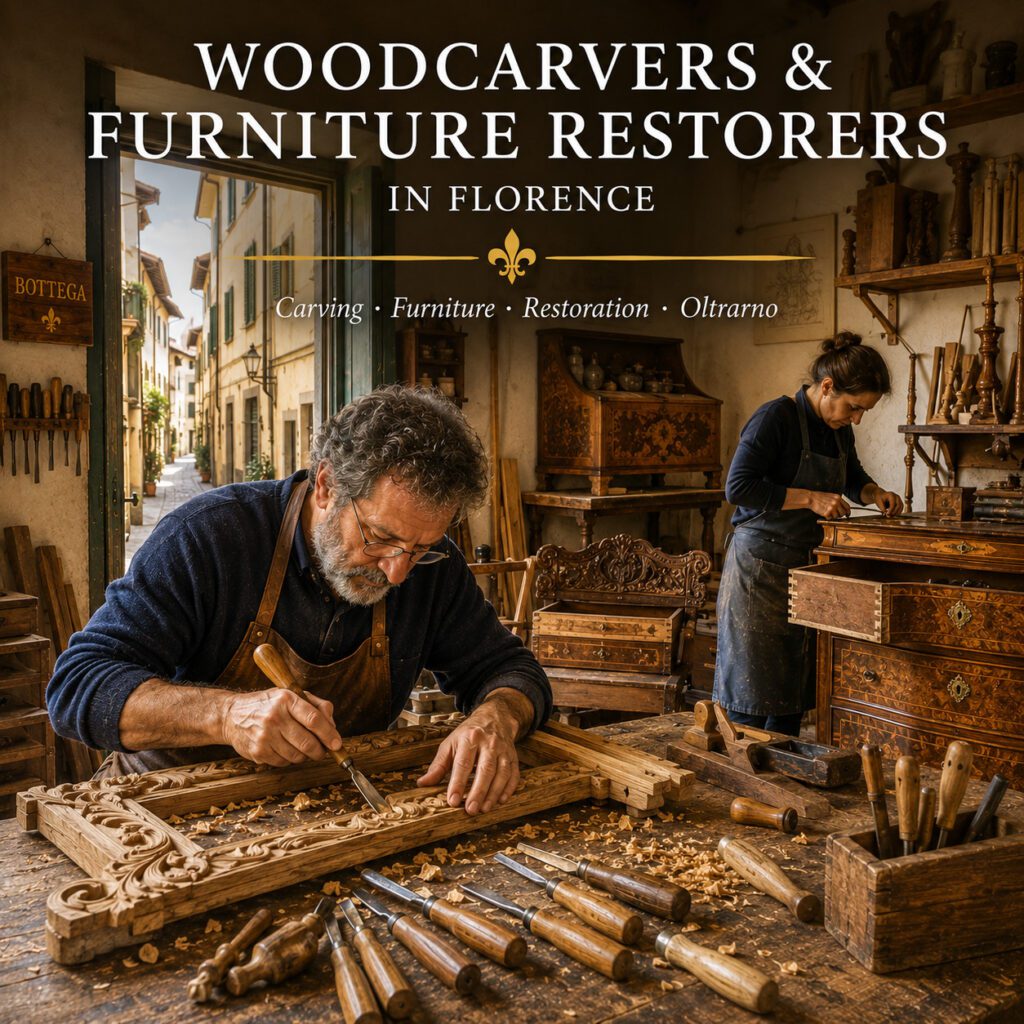
Behind the doors of Florence’s traditional workshops, wood is still carved, repaired and restored by hand. Woodcarvers and Furniture Restorers in Florence preserve skills that once furnished Renaissance palaces, decorated churches and produced the elaborate frames surrounding some of the city’s greatest paintings.
These crafts have never belonged exclusively to the past. Particularly in the Oltrarno, specialist workshops continue to work with antique furniture, carved ornament and historic wooden objects. They form an important part of the living craftsmanship explored in our Traditional Florentine Workshops – Where Craftsmanship Survives.
🪵 At a Glance
Traditional crafts: Woodcarving and furniture restoration
Italian terms: Intagliatore, ebanista and restauratore
Typical materials: Walnut, poplar, chestnut and other woods
Traditional techniques: Carving, veneering, inlay, polishing and structural repair
Where to look: Oltrarno, Santo Spirito and San Frediano
Why it matters: These workshops preserve skills that have shaped Florentine interiors for centuries
Florence and the Art of Working with Wood
Florence is usually associated with marble sculpture, fresco painting and architecture, yet wood has always played an essential role in the city’s artistic life. Churches required doors, choir stalls, cabinets, crucifixes and elaborate frames. Palaces needed tables, chairs, chests, beds and decorative furnishings.
Producing these objects required many different skills. Carpenters constructed the basic forms, while specialised craftspeople carved ornament, created veneers, applied decorative finishes or prepared surfaces for gilding.
Wood was therefore everywhere in Renaissance Florence, even though much of it attracts less attention today than paintings and sculpture. Look carefully inside the city’s churches and palaces and the importance of Florentine woodworking quickly becomes apparent.
👀 Look Differently
When visiting a Florentine church, look beyond the paintings. Choir stalls, sacristy cabinets, doors, carved ceilings and frames often preserve extraordinary examples of woodworking that visitors easily overlook.
Intagliatori, Ebanisti and Restauratori
Several Italian terms help explain the different specialisations found within traditional woodworking. An intagliatore is a woodcarver who creates decorative forms by removing material with chisels and other carving tools.
An ebanista is a highly skilled cabinetmaker associated particularly with fine furniture, veneers, inlay and precise joinery. The term is related to ebony, historically one of the precious woods used in luxury cabinetmaking.
A restauratore specialises in conserving and restoring historic objects. In practice, these areas can overlap. A furniture restorer may need extensive knowledge of carving, cabinetmaking, traditional finishes and the construction methods used by earlier generations.
🇮🇹 Florence Language Tip
Intaglio means carving or cutting into a material. An intagliatore creates ornament by carefully removing wood, while an ebanista traditionally specialises in fine cabinetmaking and furniture.
Woodcarving in Renaissance Florence
The Renaissance created enormous demand for skilled woodcarvers. Churches commissioned elaborate choir stalls and liturgical furnishings, while wealthy Florentine families filled their homes with carved furniture and decorative objects.
Architectural interiors also required wooden elements. Doors, cornices, ceilings and wall furnishings could incorporate carving ranging from restrained geometric ornament to elaborate foliage, figures and heraldic motifs.
Carvers frequently worked alongside painters and gilders. A wooden frame intended for an altarpiece, for example, might pass through several different workshops before completion. This close relationship continues in the tradition explored in our article about Gilders and Frame Makers in Florence.
This collaborative system is essential to understanding Florentine craftsmanship. Objects that today appear to be individual works of art were often the result of several highly specialised trades.
The Renaissance Cassone
One of the most characteristic pieces of furniture associated with Renaissance Florence is the cassone, a large decorated chest. Such chests were important household objects and were often connected with marriage and the establishment of a new household.
Depending on the wealth of the family, a cassone could be relatively simple or richly decorated with carving, gilding and painted scenes. Some became prestigious objects designed to demonstrate the status and cultural sophistication of their owners.
Surviving examples provide valuable evidence of the close relationship between furniture making and the visual arts. A carpenter might construct the chest while carvers, painters and gilders transformed it into an elaborate decorative object.
💡 Did You Know?
Renaissance furniture was often created collaboratively. A single cassone or frame could involve carpenters, woodcarvers, painters and gilders, each contributing a different specialist skill.
From Walnut to Poplar – Understanding the Material
A skilled woodworker must understand the material before beginning to cut or repair it. Different woods vary greatly in hardness, grain, colour, stability and response to humidity.
Walnut has long been valued for fine furniture and carving because of its attractive colour and working qualities. Poplar was widely available in central Italy and frequently used for furniture, panels and structures that would later be painted or decorated.
Chestnut and other locally available woods also played important roles. More luxurious cabinetmaking could incorporate imported or precious woods, particularly when decorative veneers and inlays became fashionable.
For a restorer, identifying the wood provides important clues about how an object was constructed and how it should be treated.
The Tools and Skills of the Woodcarver
Walk into a traditional carving workshop and many of the tools appear remarkably simple. Chisels and gouges of different widths and profiles remain fundamental to the craft.
The apparent simplicity is deceptive. Each tool produces a particular cut, and experienced carvers learn how to select and control it according to the grain and the form they want to create. Sharpening is itself an essential skill because a blunt tool can tear fibres rather than cutting them cleanly.
Carving begins by studying the wood, the direction of its grain and the overall design. Larger tools establish the basic form before progressively smaller ones create detailed ornament. Complex curves may require the artisan to approach the same form from several directions.
Modern machinery can assist with some stages of production, but intricate hand carving still depends on coordination between eye, hand and material developed through prolonged practice.
🛠 Inside the Workshop
Rows of chisels with different curved profiles are one of the easiest signs of a traditional carving workshop. Each shape allows the artisan to create different contours, recesses and decorative details.
Furniture Restoration Is Not Renovation
One of the most important distinctions in historic furniture care is the difference between restoration and simply making an old object look new.
A historic piece of furniture contains evidence of its age. Original surfaces, tool marks, joints, wear and even some old repairs form part of its history. Removing all of these traces can destroy information as well as aesthetic character.
A responsible restorer therefore begins by examining the object and understanding its construction. Intervention should respond to genuine structural or conservation needs rather than automatically replacing everything that appears old.
This philosophy is central to modern conservation and connects traditional furniture restoration with the wider world of art restoration workshops in Florence.
🪑 Restoration Principle
An antique does not need to look new. Wear, patina and historical repairs may belong to the story of the object. Good restoration aims to preserve rather than erase that history.
What Does a Furniture Restorer Actually Do?
The first stage is examination. A restorer studies the type of wood, construction, joints, surface finish and evidence of previous interventions. Damage may result from age, humidity, insects, accidents or inappropriate earlier repairs.
Loose joints can require careful stabilisation. Missing elements may sometimes need replacement, while veneers can lift from their substrate, drawers can distort and carved elements can become detached. Surface finishes may also require cleaning or consolidation.
Every object presents a different problem. Furniture restoration therefore combines practical skill with historical knowledge and careful judgement.
Traditional Joinery
Historic furniture was often assembled using sophisticated joints rather than the screws and industrial fittings familiar from modern mass-produced furniture.
Mortise-and-tenon joints, dovetails and wooden pegs allowed craftspeople to create strong structures while accommodating the natural movement of wood. Examining these details can help specialists understand how and sometimes when an object was made.
A restorer needs to understand these traditional methods because an inappropriate modern repair can create new stresses or permanently alter the original structure. Knowing how an object was made is therefore the first step towards knowing how to preserve it.
🔎 Look Closely
Open an old drawer and examine its corners. Hand-cut dovetail joints are often irregular in ways that reveal the work of an individual craftsperson rather than industrial production.
Veneer, Marquetry and Intarsia
Florentine woodworking was not limited to carving. Decorative surfaces could be created by combining different woods and materials to produce patterns, images and sophisticated visual effects.
Veneering uses thin sheets of valuable wood over a structural core. Marquetry creates decorative designs from carefully cut pieces of veneer, while forms of intarsia developed into extraordinarily complex pictorial compositions.
Renaissance masters used perspective to create architectural illusions in wood. Cupboards, books, instruments and imaginary views could appear to occupy convincing three-dimensional spaces despite being constructed from thin pieces of contrasting material.
This combination of material knowledge, precision and pictorial illusion has an interesting parallel in Florentine pietra dura, where carefully selected pieces of coloured stone are fitted together to create remarkably detailed images.
Traditional Finishes and Patina
The surface of a piece of furniture is crucial to its appearance. Traditional finishes enhance the colour and grain of wood while helping to protect it from everyday use.
Wax, oils, resins and other preparations have been used in different periods and for different purposes. Later furniture traditions also employed sophisticated polished finishes requiring repeated applications and considerable manual labour.
For restorers, an old surface presents a difficult question. Cleaning too aggressively can remove not only dirt but also original finish and the patina created by age. The best treatment therefore depends on understanding what survives and distinguishing deterioration from historically meaningful ageing.
🪵 What Is Patina?
Patina is the subtle change in a surface produced through age, light, handling and use. On historic furniture it can contribute significantly to the character and authenticity of the object.
Woodcarvers and Furniture Restorers in the Oltrarno
The Oltrarno remains the part of Florence most closely associated with traditional artisan workshops. Around Santo Spirito and San Frediano, small streets historically provided working spaces for craftspeople who served churches, palaces, collectors and local households.
Woodworking fitted naturally into this environment. Furniture restoration requires benches, tools and storage, while carving produces the unmistakable evidence of a working bottega: pieces of timber, curls of wood and fine dust.
The number and character of workshops have changed as the neighbourhood has evolved, but the Oltrarno remains one of the best areas for visitors hoping to encounter Florence’s living artisan culture. Our guide to the artisan districts of Oltrarno, San Frediano and Santo Spirito explores this side of the city in greater detail.
🚶 Firenze Casa Tip
Explore the side streets between Santo Spirito and San Frediano rather than following only the busiest routes. Traditional workshops are often found behind modest entrances and may have very little resemblance to conventional shops.
How to Recognise a Working Woodshop
A genuine workshop usually reveals itself through its tools and materials. Workbenches may carry partially completed objects, while walls hold chisels, clamps, saws and templates accumulated through years of use.
Unfinished furniture or pieces awaiting restoration are another clue. Unlike a retail shop, a bottega may appear slightly chaotic because the room is organised around work rather than display.
The artisan may also specialise very narrowly. One workshop might concentrate on antique furniture, another on carving or frames, and another on particular conservation problems. Such specialisation is part of what makes traditional craftsmanship valuable.
The Relationship Between Woodcarvers and Gilders
Carving and gilding have historically been closely connected in Florence. An elaborate Renaissance frame begins as a wooden structure, but carving gives it architectural and decorative form before the surface passes through the complex stages required for gilding.
The same relationship can be seen in church decoration. Carved wooden ornament may be partially or completely covered with gold, transforming a relatively humble material into something visually sumptuous.
Traditional workshops therefore rarely existed in complete isolation. Carvers, gilders, painters and restorers depended on one another, creating networks of specialist knowledge across the city. These connections continue today when complex restoration projects require several different specialists.
✨ From Wood to Gold
Many magnificent gilded Florentine frames begin with the work of a woodcarver. The carved structure creates the form; the gilder then transforms its surface with preparation layers and gold leaf.
Furniture Restoration and Art Conservation
Furniture restoration overlaps with the wider field of art conservation because historic furniture can combine wood with paint, gilding, metal, textiles, leather, stone and other materials.
A single object may therefore require several specialists. A furniture restorer can stabilise the wooden structure while a conservator treats painted decoration or a gilder works on damaged gold surfaces.
Florence is particularly well suited to this collaborative approach because of its concentration of specialist conservation knowledge. The city’s museums, historic buildings, private collections and churches create continuing demand for highly trained professionals.
The Museo dell’Opificio delle Pietre Dure provides an especially fascinating introduction to this tradition. The institution behind it developed from the Medici hard-stone workshops into one of the world’s leading centres for conservation and restoration.
The 1966 Florence Flood and Wooden Heritage
The catastrophic Arno flood of 4 November 1966 affected far more than paintings, manuscripts and books. Wooden furnishings, doors, frames and church interiors were also exposed to water, mud and contaminants.
Wood presents particular conservation problems after flooding. It absorbs moisture, swells and can distort as it dries. Veneers may detach, joints can fail and decorated surfaces can separate from their wooden supports.
The enormous restoration campaign following the flood brought Florentine craftspeople, conservators and international specialists together. The disaster became a decisive chapter in the development of modern conservation and remains an important event in the wider history of Florence.
🌊 Florence 1966
The Arno flood demonstrated how vulnerable wooden heritage can be. Furniture and carved objects require carefully controlled drying and conservation because rapid changes in moisture can cause severe deformation and structural damage.
Learning a Craft That Takes Years
Traditional woodcarving cannot be mastered through a short course. The artisan must learn to sharpen tools, understand different woods, read the grain and develop the manual control required for precise carving.
Furniture restoration demands an equally broad education. Practical skills must be combined with knowledge of furniture history, materials and conservation principles.
Historically, much of this knowledge passed from master to apprentice within the workshop. Formal professional education has become increasingly important, particularly in conservation, but practical experience remains irreplaceable.
This transmission of knowledge is one of the central challenges facing traditional craftsmanship today.
Can Traditional Woodworking Survive in Modern Florence?
Woodcarvers and Furniture Restorers in Florence face pressures that earlier generations could scarcely have imagined. Historic neighbourhoods are expensive, while workshops require space for benches, machinery, materials and objects awaiting treatment.
Handmade work also competes with industrial production. A carved object produced over many hours cannot be sold at the same price as a machine-made imitation.
At the same time, Florence gives these crafts an unusual advantage. Museums, churches, collectors, antique dealers and historic properties continue to require restoration expertise, while visitors increasingly value objects with a genuine connection to local production.
The future of the craft therefore depends on balancing tradition with contemporary demand and, above all, on ensuring that younger artisans have opportunities to acquire the necessary skills.
👐 Living Heritage
A traditional workshop survives only when its skills continue to be used. Preserving craftsmanship therefore means supporting working artisans, apprenticeships and genuine local production rather than treating the bottega merely as part of Florence’s past.
Visiting a Woodcarver or Furniture Restorer
Entering a working bottega can be one of the most memorable ways to experience Florence, but visitors should remember that it is a professional workplace.
Some artisans welcome people who are curious about their work, while others may be concentrating on delicate restoration projects or working to deadlines. Always greet the artisan and ask before photographing the workshop or individual objects.
Private furniture and works undergoing restoration should never be photographed without permission. Nor should tools or objects be touched unless the artisan invites you to do so.
A respectful conversation can often reveal fascinating details about materials and techniques that would otherwise remain invisible.
🤝 Workshop Etiquette
A bottega is not a museum. Ask before entering beyond the public area, never photograph restoration projects without permission and remember that the artisan’s first responsibility is to the work in progress.
What to Look for When Buying Handmade Woodwork
If you are considering buying a handmade wooden object in Florence, ask about its materials and where it was produced. A genuine artisan should be able to explain the wood, construction and techniques used.
Small variations can be signs of handwork rather than defects. Tool marks, slight differences in carved details and natural variation in the wood distinguish handmade objects from perfectly repetitive industrial production.
Quality should also be visible in construction. Good joinery, carefully finished surfaces and attention to less visible details often reveal the amount of work involved.
Buying directly from a maker also creates a connection between the object and the person who produced it – something no mass-produced souvenir can reproduce.
A Different Way to Understand Renaissance Florence
Watching a woodcarver work can change the way you look at Florence’s museums. Suddenly an elaborate Renaissance frame is no longer simply a decorative border. You begin to see the gouges, grain and hours of work required to create it.
The same is true of furniture. A cassone or cabinet becomes evidence of joinery, carving, surface preparation and collaboration between different craftspeople. Historic interiors such as those preserved in Palazzo Pitti become more interesting when viewed with this understanding of the materials and specialist work behind them.
This is one of the great values of Florence’s surviving workshops. They make historical objects easier to understand because the processes behind them are still visible.
Florence’s past stops being entirely remote when someone is still using a chisel to practise a skill that would have been immediately recognisable to a Renaissance artisan.
Why Florence’s Woodcarvers and Furniture Restorers Are Worth Discovering
Woodcarvers and Furniture Restorers in Florence are worth discovering because they preserve one of the less visible foundations of the city’s artistic heritage. Florence could not have created its churches, palaces and Renaissance interiors without generations of skilled woodworkers.
The craft also provides an unusually direct connection between past and present. Historic techniques survive not behind glass but at workbenches where artisans continue to carve wood, repair furniture and understand objects through the way they were made.
In the Oltrarno, this tradition remains part of the character of neighbourhoods such as Santo Spirito and San Frediano. Discovering a working bottega here offers something different from visiting another monument: an opportunity to encounter the knowledge that helped create those monuments in the first place.
In a city famous for preserving masterpieces, these workshops remind us that preserving the skills required to make and restore them is equally important.
Frequently Asked Questions About Woodcarvers and Furniture Restorers in Florence
Where can I find traditional woodworkers in Florence?
The Oltrarno, particularly around Santo Spirito and San Frediano, remains one of the best areas to look for traditional artisan workshops.
What is an intagliatore?
An intagliatore is a woodcarver who creates decorative forms by cutting and removing wood with chisels, gouges and other hand tools.
What is the difference between an ebanista and a restauratore?
An ebanista specialises in fine cabinetmaking and furniture, while a restauratore conserves and repairs historic objects. Their skills can overlap considerably.
What is a Renaissance cassone?
A cassone is a large decorated chest associated particularly with Renaissance households and marriage. Wealthy families often commissioned examples with carving, gilding or painted decoration.
Can visitors enter traditional workshops in Florence?
Some artisans welcome interested visitors, but a bottega is a working professional space. Always ask before entering, photographing objects or touching tools and materials.
Why is the 1966 Florence flood important to restoration?
The flood damaged enormous quantities of art and historic furnishings. The international conservation effort that followed contributed significantly to the development of modern restoration practice.
Is traditional woodcarving still practised in Florence?
Yes. Although fewer workshops survive than in the past, specialist woodcarvers, cabinetmakers and furniture restorers continue to work in Florence today.
Further Reading on Firenze Casa
- Traditional Florentine Workshops – Where Craftsmanship Survives
- Gilders and Frame Makers
- Art Restoration Workshops in Florence
- Artisan Districts – Oltrarno, San Frediano and Santo Spirito
- Museo dell’Opificio delle Pietre Dure
- History of Florence
- Palazzo Pitti: History, Architecture & Museums
References
- Artex – Centro per l’Artigianato Artistico e Tradizionale della Toscana
- Regione Toscana – Artigianato artistico e tradizionale
- Comune di Firenze – Florentine artisan traditions and the Oltrarno
- Opificio delle Pietre Dure – Conservation and restoration in Florence
- Museo di Palazzo Davanzati – Florentine furniture and domestic interiors
- Museo Horne – Furniture and decorative arts in Renaissance Florence
- Museo Nazionale del Bargello – Renaissance decorative arts and craftsmanship
- Archivio di Stato di Firenze – Florentine guilds and artisan history

