
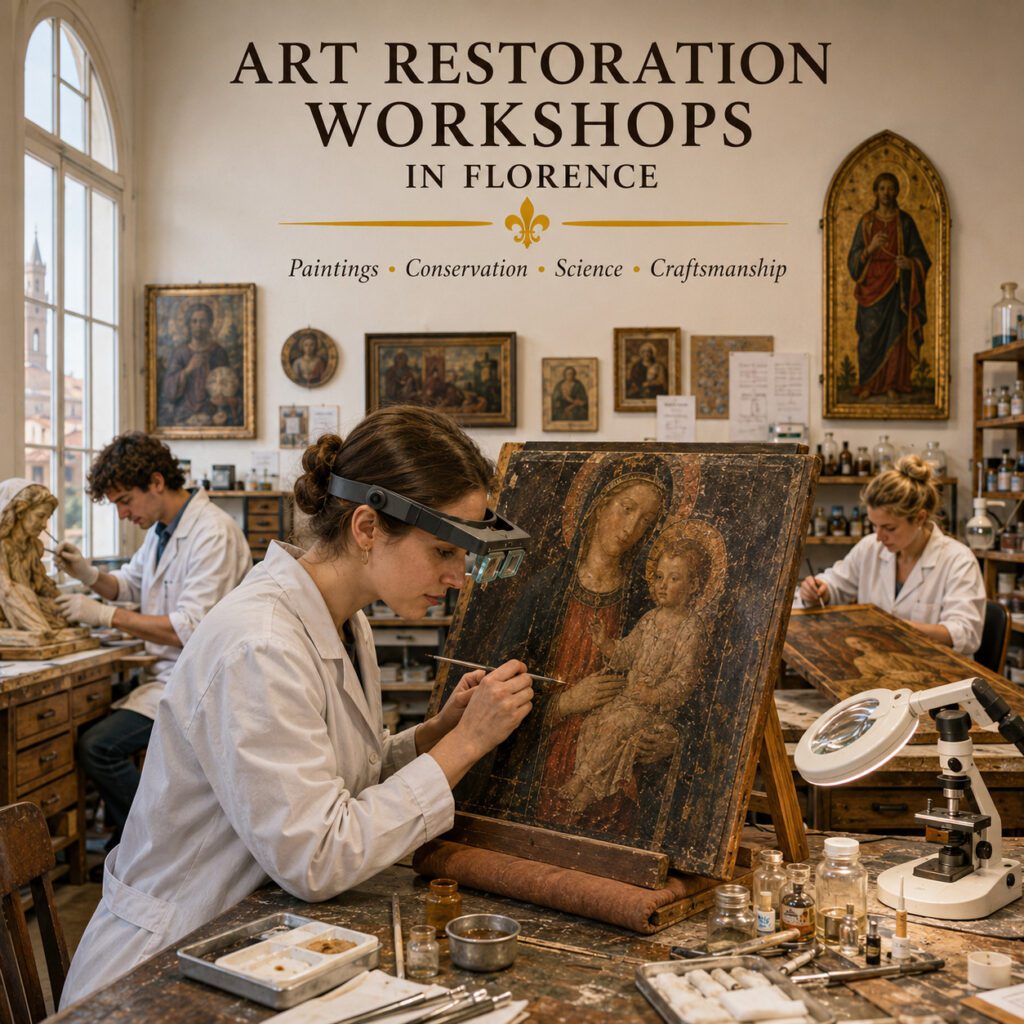
In Florence, preserving art is almost as important as creating it. Art Restoration Workshops in Florence continue a long tradition of conserving paintings, sculptures, frames, furniture and other historic objects that form part of the city’s extraordinary cultural heritage. Restoration in Florence combines traditional manual skill with scientific analysis, documentation and an intimate understanding of materials.
From small private botteghe to internationally renowned institutions, conservators stabilise fragile works and preserve them for future generations. This living tradition forms an essential part of our guide to Traditional Florentine Workshops – Where Craftsmanship Survives.
🎨 At a Glance
Italian term: Restauro
Specialist: Restauratore / Restauratrice
Main fields: Paintings, sculpture, wood, gilding, stone and decorative arts
Key institution: Opificio delle Pietre Dure
Historic turning point: The Florence Flood of 1966
Where to look: Oltrarno and specialist conservation centres
Why it matters: Florence preserves not only artworks but also the knowledge needed to care for them
Why Florence Became a Centre for Art Restoration
Florence contains an extraordinary concentration of paintings, sculptures, churches, palaces, archives and decorative objects. This wealth of cultural heritage created a constant need for specialists who could repair, stabilise and conserve historic works. Over centuries, artisans developed practical knowledge of wood, pigments, stone, gold, plaster and other materials.
Painters, gilders, carpenters and sculptors often understood how objects were constructed because they worked with the same materials themselves. Modern conservation grew from this practical foundation but gradually became more scientific. Today, Florence combines traditional craftsmanship with research, documentation and advanced analysis.
🏛 Historical Context
Florence did not become an important restoration centre by accident. Centuries of artistic production created an enormous practical need for people who understood how works were made and how they could be preserved.
What Does an Art Restorer Actually Do?
A restorer does not simply repair damage or make an old object look new. The first task is to understand the object itself: its materials, construction, condition and previous interventions. Conservators may examine cracks, paint layers, structural weaknesses, surface deposits or evidence of earlier restoration before deciding which problems genuinely threaten the object.
Other traces of age may remain untouched because they form part of the work’s history. The goal is preservation rather than transformation, and good restoration avoids unnecessary intervention.
🧭 Restoration Principle
A historic work does not need to look new. Age, patina and some earlier repairs may form part of its history. Conservation aims to preserve evidence rather than erase it.
From Artisan Skill to Conservation Science
Traditional restoration relied heavily on practical experience. A woodworker understood joints and timber, a gilder recognised preparation layers, and a painter knew how pigments and binders behaved. Modern conservation retains this manual expertise but adds scientific methods such as microscopy, imaging, chemical analysis and detailed photography.
This combination allows conservators to make better decisions before treatment begins. A surface that appears dirty may contain fragile original material, while a later repainting can conceal an older layer beneath it. Florence therefore offers one of the clearest examples of traditional workshop knowledge working alongside modern conservation science.
The Opificio delle Pietre Dure
No discussion of restoration in Florence is complete without the Opificio delle Pietre Dure. Its origins lie in the Medici grand-ducal workshops devoted to hard-stone decoration, but the institution later developed into one of the world’s most important centres for conservation.
Today, specialists work across a wide range of materials, including paintings, sculpture, wood, textiles and decorative arts. The Opificio combines practical treatment with scientific research, documentation and professional training. This evolution makes the institution particularly characteristic of Florence: a workshop founded to create luxury objects eventually became a centre dedicated to understanding and preserving them.
🔬 Florence Institution
The Opificio delle Pietre Dure represents the meeting point between Florence’s historic artisan tradition and modern conservation science.
The 1966 Florence Flood – A Turning Point
On 4 November 1966, the Arno flooded Florence and caused enormous damage throughout the city. Water, mud and fuel entered churches, museums, libraries, archives, workshops and private buildings. Paintings absorbed moisture, wooden panels warped, frescoes suffered contamination and books became saturated, while frames, furniture and decorative objects faced equally serious damage.
The scale of the disaster demanded an international response. Conservators, scientists, craftspeople and volunteers worked together to rescue and stabilise thousands of objects. The flood became one of the defining events in the modern history of Florence and accelerated the development of more systematic approaches to conservation.
🌊 Florence 1966
The flood transformed restoration practice in Florence. Emergency rescue work encouraged scientific methods, international cooperation and more systematic approaches to conservation.
The Mud Angels
Among the most famous figures associated with the flood were the volunteers who became known as the Angeli del Fango, the Mud Angels. Young people from Italy and abroad came to Florence to recover books, paintings and other cultural treasures from mud-filled buildings.
Many had no professional conservation training, yet their assistance proved essential during the first emergency phase. The Mud Angels became a powerful symbol of international solidarity with Florence and demonstrated how cultural heritage could inspire people from around the world to participate in its rescue.
Santa Croce and the Restoration of Cimabue’s Crucifix
Few works became more closely associated with the disaster than Cimabue’s great painted crucifix in Santa Croce. Floodwater, mud and oil caused severe losses to its painted surface, and the crucifix became a symbol of the damage suffered by Florence’s artistic heritage.
Its conservation also reflected a changing philosophy of restoration. Not every loss should be disguised completely, and the history of the damaged object itself could remain visible. Santa Croce therefore offers one of the most powerful examples of how conservation can preserve both an artwork and the memory of a historical catastrophe.
👀 Look Closely
Cimabue’s Crucifix still bears visible traces of the 1966 flood. Those losses have become part of the modern history of the artwork rather than something to be completely hidden.
Restoring Paintings
Painting conservation involves much more than retouching damaged colour. Conservators first examine the support, ground layers, pigments, varnish and previous interventions. A painting on wood presents different problems from one on canvas: wooden panels can split, warp or react strongly to changes in humidity, while canvas can deform, weaken or separate from its preparation layers.
Cleaning is equally complex. Removing discoloured varnish or surface deposits can reveal extraordinary colours, but overly aggressive treatment may damage original paint. Modern conservators therefore work gradually and document each stage carefully.
Retouching Without Falsifying the Original
When paint has disappeared, conservators sometimes reduce the visual distraction created by missing areas. However, restoration should not invent details for which no reliable evidence survives. Retouching techniques therefore aim to reintegrate losses while preserving a distinction between original material and later intervention.
The exact method depends on the object, its condition and its significance. This principle reflects a broader idea in contemporary conservation: the restorer should support the artwork rather than compete with the original artist.
🎨 Conservation Ethics
Good retouching should help viewers understand the artwork without pretending that missing original paint has magically returned.
Wood, Frames and Furniture
Wooden objects require another set of specialist skills. Panels, furniture and carved frames respond to humidity, insects, structural stress and centuries of use. Traditional knowledge remains particularly valuable here because historic joinery, veneers, carved ornament and surface finishes behave very differently from modern materials.
The methods used by Woodcarvers and Furniture Restorers in Florence help conservators understand how these objects were made. Restoration may involve stabilising joints, securing loose veneers or consolidating weakened wood, but the aim remains preservation rather than simply returning the object to a new appearance.
Gilding and the Restoration of Frames
Historic gilded surfaces present another complex conservation problem. A gilded frame can consist of carved wood, gesso, bole, gold leaf and several later layers added during previous restorations. Each material reacts differently to moisture, cleaning and ageing, so conservators must understand the complete structure before treating the surface.
This specialised field overlaps directly with the traditional skills preserved by Gilders and Frame Makers in Florence. Modern conservation science has expanded the available tools, but practical knowledge of historic gilding remains essential.
Stone, Sculpture and Decorative Arts
Florence’s restoration tradition extends far beyond paintings and furniture. Stone sculpture, terracotta, mosaics, textiles, metalwork and decorative objects all require specialists who understand their particular materials. Stone may appear durable, but environmental exposure, salts, pollution and earlier treatments can cause significant deterioration.
Decorative objects can be even more complex because several materials may exist within a single work. The varied expertise needed to treat them explains why collaboration is so important. One conservation project may bring together scientists, restorers, photographers, art historians and specialist craftspeople.
Why Documentation Matters
Modern restoration involves detailed documentation before, during and after treatment. Photographs, written reports and analytical results create a record of what the conservator found and what was changed.
This information allows future specialists to understand earlier interventions rather than beginning from zero and also makes conservation more transparent. A restoration treatment therefore produces two results: the preserved object itself and a body of information about its condition, materials and history.
Art Restoration Workshops in the Oltrarno
Not all conservation takes place inside large institutions. Small specialist workshops remain part of Florence’s artisan landscape, particularly in and around the Oltrarno. Some focus on paintings, while others specialise in furniture, gilded frames, sculpture or decorative objects.
Their narrow expertise often reflects years of concentrated practical experience. The neighbourhoods around Santo Spirito and San Frediano remain especially interesting for visitors who want to understand this working tradition. Our guide to the Artisan Districts – Oltrarno, San Frediano and Santo Spirito explores these areas in greater detail.
🚶 Firenze Casa Tip
Look for small signs with words such as restauro, dipinti, doratura or mobili. Specialist workshops often occupy modest spaces that are easy to overlook.
How to Recognise a Restoration Workshop
A working conservation studio often contains objects at different stages of treatment. Paintings may rest on easels or padded tables, while frames, panels or sculptures wait nearby for examination.
Magnifying lamps, microscopes, fine brushes, conservation materials and photographic equipment may sit beside much older hand tools. This mixture reflects the dual character of restoration in Florence: scientific analysis and manual skill. The studio may also appear quieter and more controlled than other artisan workshops because even small amounts of dust, vibration or careless handling can affect fragile objects.
Visiting a Restoration Workshop
A restoration workshop is a professional environment rather than a museum. Objects in treatment may belong to churches, museums or private clients, and confidentiality can be important. Always ask before photographing anything and never touch artworks, tools or work surfaces.
The conservator may also need to concentrate on a delicate procedure. If visits are possible, asking about the materials and decisions behind a treatment can reveal far more than simply looking at the finished object.
🤝 Workshop Etiquette
Never assume that an artwork under restoration can be photographed. Always ask permission, especially when the object belongs to a private client or institution.
Training the Next Generation of Conservators
Art restoration demands a rare combination of manual ability, scientific understanding and historical knowledge. Becoming a professional conservator therefore requires extensive training in materials, chemistry, art history, documentation and conservation ethics alongside the steady hand required for practical treatment.
Florence remains an important training environment because students can encounter an extraordinary range of historic materials and conservation problems within a relatively small city. Passing this knowledge to younger specialists is essential, because cultural heritage survives only when the expertise needed to care for it survives as well.
Why Restoration Changes the Way You See Florence
Understanding conservation changes the way visitors look at museums and churches. A painting is no longer simply an image; it becomes layers of wood or canvas, preparation, pigments and varnish that have survived centuries of environmental change and human intervention.
The same applies to carved furniture, gilded frames and sculpture. Once you understand how restorers study and stabilise these materials, signs of age and earlier repair become more meaningful. Florence’s celebrated artistic heritage is therefore inseparable from the less visible work of conservation.
Why Art Restoration Workshops in Florence Are Worth Discovering
Art Restoration Workshops in Florence reveal a side of the city that visitors rarely see. Museums display finished masterpieces, while restoration studios expose the materials, vulnerabilities and technical decisions that allow those masterpieces to survive.
They also demonstrate how Florence continues to connect its past with the present. Traditional skills in wood, gilding and painting now work alongside microscopy, imaging and conservation science. The result is not simply the repair of damaged objects, but the preservation of knowledge, evidence and cultural memory.
In a city famous for creating masterpieces, discovering how Florence protects them provides an equally fascinating perspective on its artistic heritage.
Frequently Asked Questions About Art Restoration Workshops in Florence
Why is Florence famous for art restoration?
Florence has an exceptional concentration of historic artworks and developed specialist conservation knowledge over centuries. The 1966 flood further strengthened its international role in restoration.
What does an art restorer do?
A restorer studies an artwork’s materials, condition and previous interventions before deciding how to stabilise or conserve it. The aim is preservation rather than making the object look new.
What is the Opificio delle Pietre Dure?
It is one of Florence’s leading institutions for conservation and restoration. Its origins lie in Medici hard-stone workshops, while its modern work covers many different materials.
Why was the 1966 Florence flood important for conservation?
The flood damaged an enormous quantity of cultural heritage and required an international rescue effort. The emergency accelerated new scientific methods and cooperation in conservation.
Who were the Mud Angels?
The Angeli del Fango were volunteers from Italy and abroad who helped rescue books, artworks and other cultural treasures after the 1966 flood.
Can visitors enter restoration workshops in Florence?
Some workshops may welcome visitors by arrangement, but they remain professional workplaces. Always ask before entering work areas or photographing objects under treatment.
Is restoration the same as making an old object look new?
No. Modern conservation aims to preserve original material and historical evidence. Wear, patina and some earlier repairs can remain important parts of an object’s history.
Further Reading on Firenze Casa
- Traditional Florentine Workshops – Where Craftsmanship Survives
- Woodcarvers and Furniture Restorers in Florence
- Gilders and Frame Makers in Florence
- Artisan Districts – Oltrarno, San Frediano and Santo Spirito
- Museo dell’Opificio delle Pietre Dure
- Pietra Dura in Florence – The Art of Stone Inlay
- History of Florence
References
- Opificio delle Pietre Dure – conservation, restoration and professional training
- Ministero della Cultura – conservation of Italian cultural heritage
- Gallerie degli Uffizi – conservation and restoration of museum collections
- Opera di Santa Croce – Cimabue’s Crucifix and the Florence Flood of 1966
- Biblioteca Nazionale Centrale di Firenze – conservation after the 1966 flood
- Istituto Centrale per il Restauro – conservation principles and professional methodology
- Artex – traditional craftsmanship and specialist workshops in Florence

