The History of Ponte Vecchio: Florence’s Most Famous Bridge
Ponte Vecchio is more than Florence’s most famous bridge. For centuries, it has been a marketplace, a private passageway for the Medici family, a witness to floods and wars, and one of the most recognisable symbols of the city.
Spanning the River Arno at one of its narrowest points, Ponte Vecchio connects the historic centre of Florence with the Oltrarno district. Its jewellery shops, stone arches and unusual upper corridor make it unlike almost any other bridge in Europe.
But the story of Ponte Vecchio is far richer than its postcard image suggests. From Roman origins and medieval merchants to Renaissance rulers and the dramatic events of the Second World War, the history of Ponte Vecchio reflects the history of Florence itself.
A Bridge with Ancient Origins
The site of Ponte Vecchio has been used as a crossing point since ancient times. A bridge may already have existed here during the Roman period, close to the point where the Roman road system passed through the early settlement of Florentia.
The location was practical. The Arno is relatively narrow at this point, and the bridge created a direct connection between the Roman city on the northern bank and the roads leading south.
Over the centuries, earlier wooden and stone bridges were repeatedly damaged or destroyed by the river. The Arno has always been central to the prosperity of Florence, but it has also posed a constant threat through sudden and destructive floods.
When Was Ponte Vecchio Built?
The present bridge dates largely from the 14th century. It was constructed after a devastating flood in 1333 destroyed an earlier bridge at the same location.
The replacement bridge was completed around 1345. Its design is traditionally associated with the Florentine architect and painter Taddeo Gaddi, although the exact authorship remains a matter of historical discussion.
Unlike many medieval bridges with narrow semicircular arches, Ponte Vecchio uses three broad segmental arches. This design allowed the river to pass beneath the bridge more freely and reduced the number of supporting piers exposed to the force of the current.
| Period | Development |
|---|---|
| Roman period | An early crossing probably connected the Roman settlement with routes leading south. |
| Middle Ages | Successive bridges were rebuilt after damage caused by floods. |
| 1333 | A severe flood destroyed the previous bridge. |
| Around 1345 | The main structure of the present Ponte Vecchio was completed. |
| 1565 | The Vasari Corridor was constructed above the bridge. |
| 1593 | Butchers and other food traders were replaced by goldsmiths and jewellers. |
| 1944 | The bridge survived the German retreat from Florence, while the surrounding streets were destroyed. |
| 1966 | Ponte Vecchio survived the catastrophic flood of Florence. |
Why Is It Called Ponte Vecchio?
Ponte Vecchio translates directly as “Old Bridge”. The name may sound simple, but it reflects the bridge’s exceptional longevity.
For centuries, it was the principal crossing over the Arno in the centre of Florence. As additional bridges were constructed, including Ponte Santa Trinita and Ponte alle Grazie, the older crossing became known as Ponte Vecchio.
Today it is the oldest surviving bridge in Florence and one of the few remaining European bridges still lined with shops.
From Butchers to Goldsmiths
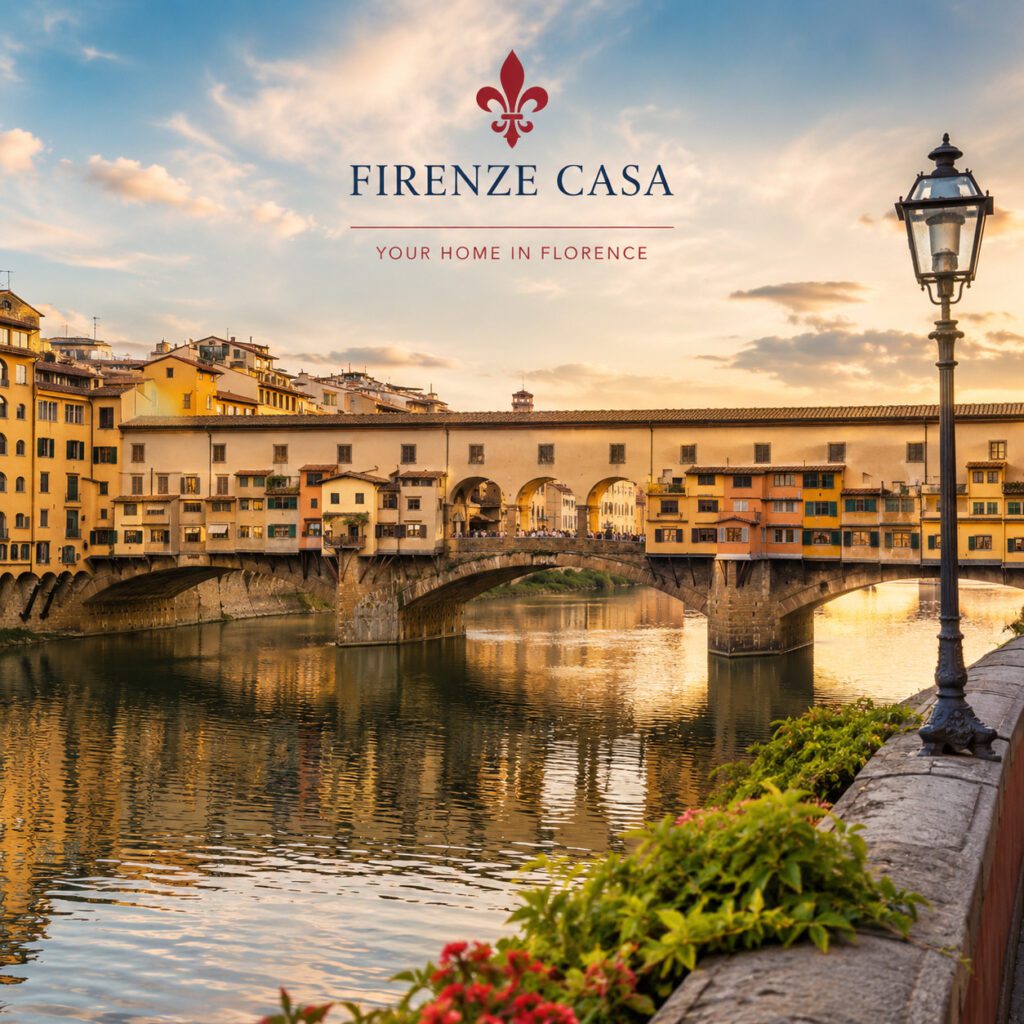
The shops are among the most distinctive features of Ponte Vecchio. They appear to cling to both sides of the bridge, with small rooms and projecting wooden structures extending over the river.
In medieval Florence, bridges were valuable commercial spaces. Shops on Ponte Vecchio were occupied by butchers, fishmongers, tanners and other traders whose work involved water, waste and strong smells.
The location offered an obvious practical advantage: unwanted materials could be removed directly into the river. However, the noise, odours and waste produced by these trades became increasingly incompatible with the prestigious character that the Medici wished to give the area.
In 1593, Grand Duke Ferdinando I de’ Medici ordered the butchers and other food traders to leave Ponte Vecchio. Their shops were subsequently occupied by goldsmiths, silversmiths and jewellers.
This decision transformed the identity of the bridge. More than four centuries later, Ponte Vecchio is still known for its jewellery shops, gold displays and traditional workshops.
To understand the family behind this transformation, read our future guide to the Medici family and the Florence they created.
The Vasari Corridor: A Private Route Above Florence
One of the most fascinating features of Ponte Vecchio is not at street level but above it.
In 1565, Grand Duke Cosimo I de’ Medici commissioned the architect Giorgio Vasari to create an elevated passage between Palazzo Vecchio, the seat of government, and Palazzo Pitti, the family’s residence on the opposite side of the Arno.
The result was the Vasari Corridor, an enclosed passage running through the Uffizi complex, across Ponte Vecchio and onward through buildings and private properties towards Palazzo Pitti and the Boboli Gardens.
The corridor allowed the Medici ruler and his family to move between their residence and the centre of government without mixing with the crowds below. It also offered greater security at a time when political rivalries and assassination attempts were genuine concerns.
Above Ponte Vecchio, the pale exterior of the corridor forms the uppermost level of the bridge. Its small windows provide views of the Arno and the surrounding city.
Learn more about the route in our future article: The Vasari Corridor: The Medici Passage Above Florence.
The corridor begins within the Uffizi complex. You can prepare for your museum visit with our guide to the Uffizi Gallery in Florence.
The Windows Above the Bridge
Visitors looking at Ponte Vecchio from the riverbanks may notice that some windows in the Vasari Corridor are larger than others.
The larger central windows were created during the 20th century, replacing smaller Renaissance openings. They provide an expansive view along the Arno, particularly towards Ponte Santa Trinita.
This section of the bridge demonstrates how Ponte Vecchio has continued to evolve. Although the medieval structure remains recognisable, individual elements have been altered and adapted over time.
Why Was Ponte Vecchio Not Destroyed During the Second World War?
The survival of Ponte Vecchio during the Second World War is one of the most frequently told stories about the bridge.
In August 1944, German forces retreating from Florence destroyed the other historic bridges across the Arno to slow the advance of Allied troops. Ponte Vecchio itself was left standing.
Instead of demolishing the bridge, German forces destroyed the medieval buildings and streets immediately surrounding both entrances. The resulting piles of rubble made the bridge difficult to cross while preserving its main structure.
A popular story claims that Adolf Hitler personally ordered Ponte Vecchio to be spared because he had admired it during a visit to Florence. This explanation has been repeated for decades, but a conclusive written order directly proving the story has not been established.
Other accounts have credited Gerhard Wolf, the German consul in Florence, or individual officers and local resistance members with helping to preserve the bridge. The precise chain of decisions remains uncertain.
The destruction around Ponte Vecchio dramatically changed the neighbouring streets. After the war, these areas were reconstructed in a style intended to respect the scale and character of the historic centre without simply reproducing every lost medieval building.
Ponte Vecchio and the Floods of the Arno
The River Arno has shaped Florence economically, geographically and culturally. It has also repeatedly threatened the city.
The flood of 1333 destroyed the bridge that preceded the present Ponte Vecchio. Later floods tested the new structure, but the broad medieval arches proved remarkably resilient.
On 4 November 1966, the Arno burst its banks and caused one of the greatest cultural disasters in the modern history of Florence. Water, mud and oil flooded churches, libraries, museums, homes and shops throughout the city.
The shops on Ponte Vecchio suffered severe damage. Doors, furniture, merchandise and fittings were swept away or covered in mud, yet the main structure of the bridge survived.
The disaster led to an extraordinary international rescue effort. Volunteers known as the “Mud Angels” came to Florence to help recover paintings, books, manuscripts and other cultural treasures.
Read more in our future article about the 1966 flood of Florence and the Mud Angels.
Ponte Vecchio Today
Today, Ponte Vecchio remains one of the busiest and most recognisable places in Florence. Jewellery shops continue the tradition established at the end of the 16th century, displaying gold, watches, gemstones and handcrafted pieces behind their historic shutters.
The bridge is closed to ordinary motor traffic and forms an important pedestrian route between Piazza della Signoria, the Uffizi and the Oltrarno district.
During the day, the central section is often filled with visitors, street musicians and people stopping to admire the river. Early in the morning, however, Ponte Vecchio has a completely different atmosphere. The shutters are still closed, deliveries are taking place and the bridge feels much closer to the everyday Florence experienced by local residents.
In the evening, the warm façades and shop windows reflect the changing light over the Arno. This is one of the most atmospheric moments to visit, although the best overall view of the bridge is found from a short distance away.
The Best Views and Photo Locations
Ponte Vecchio is beautiful from many angles, but the bridge itself is not always the best place from which to photograph it. The following locations offer some of the most memorable perspectives.
| Location | Best Time | Why Visit? |
|---|---|---|
| Ponte Santa Trinita | Sunset or blue hour | The classic complete view of Ponte Vecchio with the Arno and surrounding buildings. |
| Lungarno degli Archibusieri | Early morning | A close view of the eastern side of the bridge and its projecting shops. |
| Lungarno Anna Maria Luisa de’ Medici | Morning or late afternoon | A riverside perspective near the Uffizi with attractive reflections. |
| Lungarno Torrigiani | Late afternoon | A quieter view from the Oltrarno side of the river. |
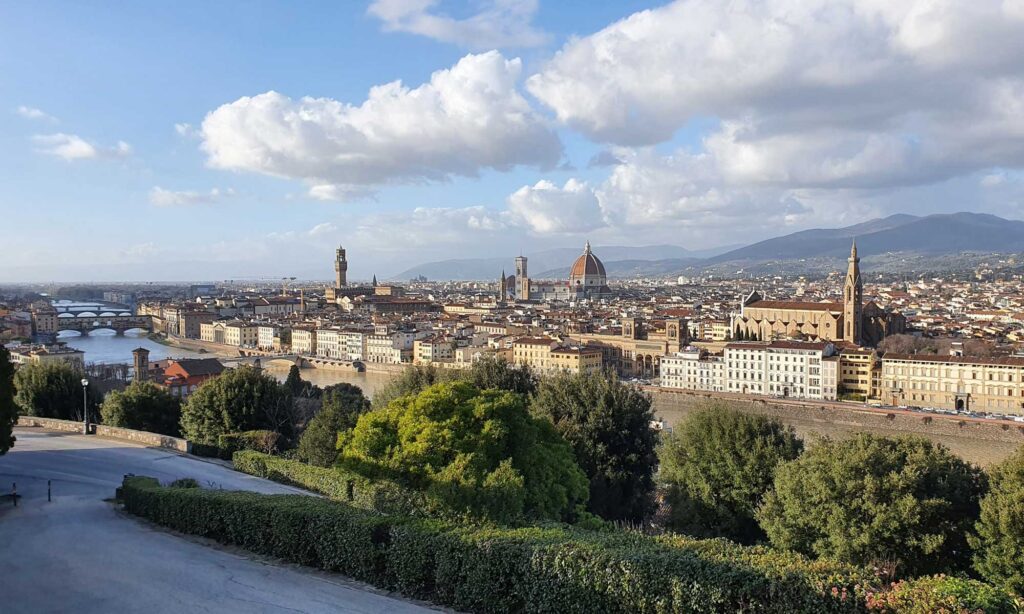
| Piazzale Michelangelo | Sunset | A wide panorama showing Ponte Vecchio within the larger cityscape. |
| On Ponte Vecchio | Before 8:00 a.m. | The best opportunity to experience the bridge without the largest crowds. |
Practical Tips for Visiting Ponte Vecchio
- Visit early: The bridge becomes very busy from late morning onwards.
- Return at sunset: The changing light over the Arno creates a completely different atmosphere.
- Walk to Ponte Santa Trinita: This is the best location for the classic view of Ponte Vecchio.
- Look above the shops: The enclosed structure is the Vasari Corridor.
- Explore both riverbanks: The streets of the Oltrarno reveal a quieter and more local side of Florence.
- Do not stop only for photographs: Notice the arches, shop extensions, shutters and changing architectural details.
A Short Walk from Piazza della Signoria to Oltrarno
Ponte Vecchio can easily be included in one of the most rewarding walks through the historic centre of Florence.
- Begin in Piazza della Signoria.
- Walk past Palazzo Vecchio and enter the courtyard between the two wings of the Uffizi.
- Continue towards the Arno along Lungarno degli Archibusieri.
- Cross Ponte Vecchio and look up at the Vasari Corridor.
- Continue into the Oltrarno towards Palazzo Pitti.
- Explore the artisan streets around Santo Spirito.
This route connects the political centre of Medici Florence with the family’s residential palace and follows much of the same path as the Vasari Corridor above.
For more ideas, discover our future guide to the most beautiful walks through historic Florence.
Ponte Vecchio and the UNESCO World Heritage Site
Ponte Vecchio forms part of the Historic Centre of Florence, which has been recognised as a UNESCO World Heritage Site since 1982.
The Ponte vecchio bridge contributes to the unique character of the city not only as an individual monument, but also as part of the wider relationship between the River Arno, the medieval street plan, the Uffizi, Palazzo Pitti and the historic districts on both banks.
Its survival allows visitors to experience a connection between medieval commerce, Renaissance political power and modern city life in one compact location.
Discover why the entire historic centre is internationally protected in our guide: Why Florence Is a UNESCO World Heritage Site.
Why Ponte Vecchio Is More Than a Tourist Attraction
Ponte Vecchio is often photographed as a romantic symbol of Florence, but its true importance lies in the many layers of history contained within it.
Its foundations recall the Roman origins of the city. Its arches reveal medieval engineering. Its shops tell the story of Florentine commerce. The Vasari Corridor reflects the power and concerns of the Medici rulers. Its survival through war and flooding demonstrates both good fortune and remarkable resilience.
Few monuments bring together so many aspects of Florence in one place.
To cross Ponte Vecchio is not simply to walk from one side of the Arno to the other. It is to pass through centuries of Florentine history.
Discover More of Florence
Continue exploring the history, culture and landmarks of Florence with our Firenze Casa guides:
- Why Florence Is a UNESCO World Heritage Site
- The Uffizi Gallery: What to Know Before Your Visit
- The Medici Family and the Florence They Created
- The Vasari Corridor: The Medici Passage Above Florence
- Palazzo Vecchio: Power and Politics in Renaissance Florence
- The Most Beautiful Walks Through Historic Florence
- The 1966 Flood of Florence and the Mud Angels