
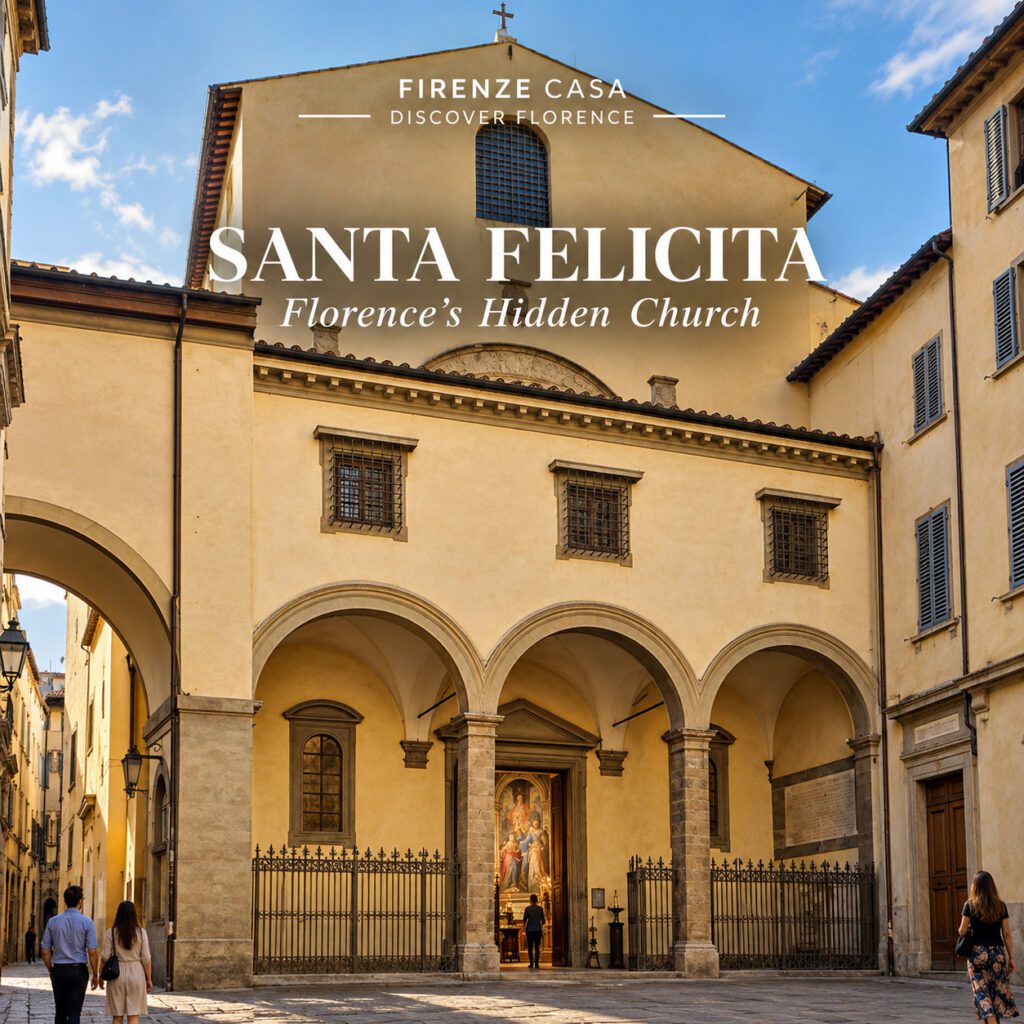
Thousands of visitors walk past Santa Felicita without realising what lies inside. Standing just beyond Ponte Vecchio on the way towards Palazzo Pitti, this relatively small church contains one of the great masterpieces of Florentine Mannerism, an architectural connection with Brunelleschi and an extraordinary reminder of how the Medici moved through Florence above the streets.
Santa Felicita Florence is therefore an ideal stop for travellers who enjoy discovering important places without adding another major museum to their itinerary. You need relatively little time, there is no long detour, and the Capponi Chapel alone makes entering worthwhile.
Location: Piazza Santa Felicita, Oltrarno
Nearest landmark: Ponte Vecchio
Essential masterpiece: Pontormo’s Trasporto di Cristo, commonly called the Deposition
Historic chapel: Barbadori-Capponi Chapel
Architectural connection: Filippo Brunelleschi
Medici connection: Vasari Corridor
Best for: Renaissance art, hidden Florence and a short cultural stop on the way to Palazzo Pitti
Time needed: About 15–30 minutes for most visitors
Why Visit Santa Felicita?
Santa Felicita is not a church that requires an hour-long visit. Its appeal is more concentrated.
Enter the church and look immediately to the right. The Capponi Chapel contains Pontormo’s extraordinary Trasporto di Cristo, one of the defining works of Florentine Mannerism. Nearby is Pontormo’s Annunciation, while the chapel itself has an earlier history: originally built as the Barbadori Chapel, it was designed by Filippo Brunelleschi in the early 15th century before later becoming the Capponi Chapel.
Then look upward and towards the entrance. The Vasari Corridor passes through the church complex, recalling the period when the Medici could attend services from a privileged position without joining the congregation below.
Few small churches in Florence bring architecture, painting and political history together so efficiently.
If you are walking from Ponte Vecchio towards Palazzo Pitti, do not simply continue along Via de’ Guicciardini. Santa Felicita requires only a short stop and contains far more than its modest exterior suggests.
Where Is Santa Felicita?
The church stands on Piazza Santa Felicita in the Oltrarno, only a few steps after crossing Ponte Vecchio from the historic centre.
This location makes Santa Felicita particularly easy to include in a day of sightseeing. Cross the Ponte Vecchio, continue into the Oltrarno and stop at the church before walking onwards to Palazzo Pitti.
Because Florence’s historic centre is so compact, there is little reason to make a separate journey specifically for the church. Instead, integrate it naturally into a walk across the Arno.
Uffizi → Ponte Vecchio → Santa Felicita → Palazzo Pitti → Santo Spirito creates an excellent progression from Florence’s monumental centre into the Oltrarno.
One of Florence’s Oldest Christian Sites
Santa Felicita has a much longer history than its present appearance suggests. Archaeological excavations carried out in the 20th century uncovered remains of an early Christian basilica and burial ground beneath the church. The finds point to a Greek-speaking Christian community of Syrian origin living in this part of Roman Florence.
The location itself is even older. Archaeologists also discovered traces of the Roman Via Cassia beneath the site, placing Santa Felicita close to one of the important ancient routes leading through the area south of the Arno.
The first surviving written reference to Santa Felicita dates from 972. Significantly, the document already described it as an ancient cemetery basilica, confirming that the church had a long history even by the 10th century.
The early church did not survive unchanged. Over the centuries, successive generations rebuilt and transformed the complex, leaving layers of architecture from different periods. As a result, the modest church visitors enter today conceals almost two millennia of religious history.
Santa Felicita is not simply an old Renaissance church. Archaeological remains beneath the complex preserve evidence of early Christianity in Florence, while traces of the Roman Via Cassia reach back even further into the city’s ancient past.
Tradition connects the early Christian community south of the Arno with merchants from the eastern Mediterranean who settled in this part of Roman Florence. An early church probably existed here by the late fourth or early fifth century.
The site changed repeatedly over the following centuries. A medieval church replaced the earlier building, and another reconstruction followed during the Gothic period.
Much of what visitors see today, however, reflects an extensive eighteenth-century rebuilding led by architect Ferdinando Ruggieri. This explains why Santa Felicita does not immediately look like a surviving medieval church despite its ancient origins.
Santa Felicita is a good example of how Florentine churches developed in layers. Ancient origins, medieval remains, Renaissance chapels, Medici interventions and eighteenth-century reconstruction coexist within the same building.
The Barbadori Chapel and Brunelleschi
The most important architectural story begins before Pontormo entered the church. During the early fifteenth century, the Barbadori family commissioned Filippo Brunelleschi to create a chapel here. The project belongs to the period when Brunelleschi was developing the architectural ideas that would transform Renaissance Florence.
The chapel subsequently passed to the Capponi family and underwent significant alterations. As a result, visitors should not expect to find a completely preserved Brunelleschian interior. Nevertheless, its origins make Santa Felicita an important stop in the story of the architect. This is why the church also appears in our Brunelleschi Florence Walking Tour.
The chapel demonstrates something especially characteristic of Florence: a single space can preserve traces of several major artistic generations.
Pontormo Transforms the Capponi Chapel
In 1525, Lodovico Capponi acquired patronage of the chapel and commissioned Jacopo Pontormo to redecorate it. Pontormo worked here during the following years and created an ensemble that became one of the landmarks of Florentine Mannerism. His pupil and close collaborator Agnolo Bronzino was also associated with the decoration.
The surviving works include the famous altarpiece, the Annunciation and figures of the Evangelists in the pendentives. Part of the original decoration has been lost, so the chapel visitors see today does not reproduce Pontormo’s complete sixteenth-century conception.
Yet what survives is exceptional.
After entering Santa Felicita, turn immediately to the chapel on your right. Give yourself a moment before concentrating on individual details. Pontormo designed an emotional environment, not simply an isolated painting.
Pontormo’s Deposition – Or Is It?
The great altarpiece is usually known as Pontormo’s Deposition. You will see that title in countless books, guides and museum discussions.
However, the name is not entirely precise.

The painting does not clearly show Christ being removed from the Cross. There is no visible cross dominating the scene, and the figures appear to carry Christ’s body. For this reason, the work is also called the Entombment or, more accurately in Italian, the Trasporto di Cristo – the transportation or carrying of Christ.
The uncertainty is actually appropriate for Pontormo. The painting refuses to explain its space and action in conventional terms.
Why the Painting Is So Extraordinary
Stand in front of the altarpiece and compare it mentally with the balanced compositions normally associated with the Florentine Renaissance. Pontormo does something radically different.
The figures overlap and twist around one another. There is almost no convincing ground beneath them, so several bodies appear to float. Christ himself seems strangely weightless despite being carried by other figures.
Then there are the colours: luminous pinks, blues, greens and oranges that seem detached from ordinary reality. Instead of using colour simply to describe clothing and bodies, Pontormo uses it to create emotion.
Faces and gestures intensify the effect. Grief moves through the group, yet the scene remains strangely quiet and suspended.
This combination helps explain why the painting still feels remarkably modern almost five centuries after its creation.
Ignore the subject for a few seconds and look only at colour and movement. Follow the pink, blue and green forms around the composition. Pontormo uses colour almost as an architectural structure holding the figures together.
The Annunciation
Do not leave after looking at the famous altarpiece.

Pontormo’s Annunciation forms another important part of the chapel decoration. The Virgin and the Angel Gabriel occupy the side wall and belong to the same extraordinary artistic environment.
Because the Trasporto di Cristo commands so much attention, visitors can easily overlook the surrounding works. Yet seeing them together makes the chapel much easier to understand.
Pontormo was not simply asked to provide an impressive altarpiece. He was shaping an entire sacred space.
Pontormo and Bronzino
The chapel also connects two of the most important painters of Florentine Mannerism.
Agnolo Bronzino was Pontormo’s pupil, collaborator and one of the artists most deeply influenced by him. Giorgio Vasari attributed one of the Evangelists in the chapel to the younger painter, although questions of attribution have continued to attract scholarly discussion.
The connection is particularly useful for visitors interested in sixteenth-century Florence. Pontormo’s emotionally unstable compositions and extraordinary colours helped open a path that Bronzino later transformed into the polished elegance associated with the Medici court.
Santa Felicita therefore offers a physical link between two generations of Florentine Mannerism.
The Vasari Corridor Crosses Santa Felicita
Santa Felicita acquired another extraordinary feature in 1565.
Cosimo I de’ Medici commissioned Giorgio Vasari to create an elevated passage linking the political centre around Palazzo Vecchio with the family residence at Palazzo Pitti. The resulting Vasari Corridor passes through the Uffizi, crosses the Arno above Ponte Vecchio and continues through the Oltrarno.
Its route directly involves Santa Felicita.
The grand-ducal family could use a protected viewing position connected with the corridor to attend religious services while remaining separated from the congregation below. They did not need to descend into the church and mix with ordinary worshippers.
This unusual arrangement turns Santa Felicita into much more than an art-historical stop. It illustrates how architecture expressed political and social hierarchy in Medici Florence.
The Vasari Corridor is easy to miss when concentrating on Pontormo. Look at the upper part of the church and then examine the exterior when you leave. The elevated structure makes Santa Felicita part of one of Florence’s most extraordinary architectural routes.
Why the Medici Route Matters Here
The location of Santa Felicita was remarkably convenient for the ruling family.
After Eleonora di Toledo acquired Palazzo Pitti in 1549, the Medici court increasingly centred its residential life on the southern side of the Arno. Government, however, remained connected with Palazzo Vecchio and the administrative complex around the Uffizi.
The Vasari Corridor physically joined these worlds.
Santa Felicita lay almost directly on the route. Consequently, politics, residence and religion could all become part of the same protected grand-ducal network.
Continue from the church towards Palazzo Pitti and this geography becomes immediately understandable. What appears today to be a pleasant tourist walk once formed part of the infrastructure of Medici power.
What Else Should You See Inside?
Pontormo is the principal reason most art lovers enter Santa Felicita, but he is not the church’s only interest.
The complex preserves medieval and later artworks that reveal its long history. The fourteenth-century chapter house contains surviving frescoes associated with Niccolò di Pietro Gerini, while other works in the church span subsequent centuries of Florentine art.
The main chapel also connects Santa Felicita with the Guicciardini family. The historian and statesman Francesco Guicciardini, one of the major political writers of Renaissance Italy, was buried here.
These elements reward a slower visit, although first-time travellers should not feel obliged to examine every chapel. Pontormo, the Brunelleschi connection and the Vasari Corridor provide the essential experience.
Concentrate on three things: the Capponi Chapel, Pontormo’s paintings and the visible route of the Vasari Corridor. Fifteen focused minutes here can be more rewarding than rushing through another large museum.
Santa Felicita and the Oltrarno
Crossing Ponte Vecchio changes the character of a walk through Florence. You leave the dense museum district around Piazza della Signoria and enter the Oltrarno – literally the area “beyond the Arno”.
Santa Felicita stands almost at the threshold of this transition.
Continue further and monumental Florence gradually mixes with residential streets, workshops, churches and neighbourhood squares. Palazzo Pitti remains a major attraction, but nearby streets also lead towards Santo Spirito and quieter parts of the district.
This makes Santa Felicita an excellent starting point for exploring the Oltrarno rather than simply crossing it on the way to another attraction.
How to Include Santa Felicita in Your Florence Itinerary
For most travellers, Santa Felicita works best as part of another route rather than as a destination requiring a separate excursion.
With Ponte Vecchio and Palazzo Pitti
This is the easiest combination. Cross Ponte Vecchio, visit Santa Felicita and then continue to Palazzo Pitti. The church adds only a short interruption to the route.
With the Vasari Corridor
If you are exploring or visiting the Vasari Corridor, Santa Felicita provides one of the best places to understand how the elevated passage interacted with existing buildings and with Medici court life.
With a Brunelleschi Walk
Visitors interested in architecture can include the Barbadori-Capponi Chapel in a wider exploration of Brunelleschi’s Florence. Our Brunelleschi walking route provides the broader context.
With a Pontormo Art Walk
Santa Felicita is the essential stop. Combine it with Pontormo’s works at Santissima Annunziata and the Uffizi to follow his development from the early Renaissance environment towards the radical language of Mannerism.
Practical Information
Address: Piazza Santa Felicita 3, Florence.
Santa Felicita remains an active church rather than a conventional museum. Opening hours can therefore change because of religious services, holidays or other circumstances.
There is normally no need to reserve a separate visit simply to enter the church. However, anyone travelling specifically to see Pontormo should check current opening information shortly before visiting.
Accessibility is possible via a side entrance, although the historic setting presents some practical limitations and assistance may be required.
Do not plan Santa Felicita as the only purpose of a tightly scheduled journey. Churches occasionally close for services or other reasons. Place it within a Ponte Vecchio, Palazzo Pitti or Oltrarno walk so that a changed opening time does not disrupt your day.
Is Santa Felicita Worth Visiting?
Yes – particularly because the investment of time is so small.
Santa Felicita is not comparable with Santa Croce or Santa Maria Novella in scale. Nor should it be. Its attraction lies in the concentration of history within a modest space.
You can see one of Pontormo’s greatest masterpieces, stand inside a chapel associated with Brunelleschi, trace the route used by the Medici and then step back outside only moments from Ponte Vecchio.
For travellers staying several days in Florence, places like Santa Felicita also provide an important counterbalance to the major museums. The city becomes more interesting when famous masterpieces are encountered unexpectedly within churches and neighbourhood streets rather than exclusively in galleries.
Why Santa Felicita Is One of Florence’s Best Small Discoveries
Santa Felicita illustrates one of the pleasures of exploring Florence slowly.
From outside, there is little to suggest that the church contains such an extraordinary combination of art and history. Yet behind its entrance are traces of early Christianity, medieval Florence, Brunelleschi’s architectural experiments, Pontormo’s revolutionary painting and the ceremonial world of the Medici.
Its location makes the discovery even better. You do not need to travel to the edge of the city or sacrifice half a day. Santa Felicita stands directly between two of Florence’s most visited landmarks.
That is precisely why it deserves attention: one of Florence’s most rewarding hidden churches is hiding in plain sight.
Frequently Asked Questions
Where is Santa Felicita in Florence?
Santa Felicita stands in the Oltrarno just south of Ponte Vecchio. It lies directly on the walking route from the bridge towards Palazzo Pitti.
What is Santa Felicita famous for?
The church is best known for Pontormo’s Capponi Chapel, especially the painting commonly called the Deposition. It is also associated with Brunelleschi and the Vasari Corridor.
Is Pontormo’s Deposition still in Santa Felicita?
Yes. The famous altarpiece remains in the Capponi Chapel, the historic setting for which Pontormo created it.
Did Brunelleschi design Santa Felicita?
No. Brunelleschi is associated with the original Barbadori Chapel rather than the entire church. The church itself has a much longer and more complex architectural history.
Does the Vasari Corridor pass through Santa Felicita?
Yes. Its route passes through the church complex and provided the Medici with a privileged position from which they could attend religious services separately from the congregation.
How long should I spend at Santa Felicita?
For most visitors, 15–30 minutes is enough. Art lovers interested in Pontormo, Brunelleschi or Mannerism may want to stay longer.
What should I combine with Santa Felicita?
Ponte Vecchio and Palazzo Pitti are the most natural combination. You can also continue towards Santo Spirito for a longer exploration of the Oltrarno.
Further Reading on Firenze Casa
- The History of Ponte Vecchio – Florence’s Most Famous Bridge
- Vasari Corridor – The Secret Passage of the Medici
- Brunelleschi Florence Walking Tour – In His Footsteps
- Palazzo Pitti – Grand Ducal Palace of Florence
- The Medici Family – The Dynasty That Shaped Florence
- Giorgio Vasari – Artist, Architect and Chronicler
References
- Comune di Firenze – FeelFlorence, Chiesa di Santa Felicita
- Regione Toscana – Visit Tuscany, Church of Santa Felicita in Florence
- Gallerie degli Uffizi – History of the Vasari Corridor
- Arcidiocesi di Firenze – Santa Felicita
- Giorgio Vasari – Lives of the Most Excellent Painters, Sculptors, and Architects
- Palazzo Strozzi – Documentation on Pontormo and the Capponi Chapel

