
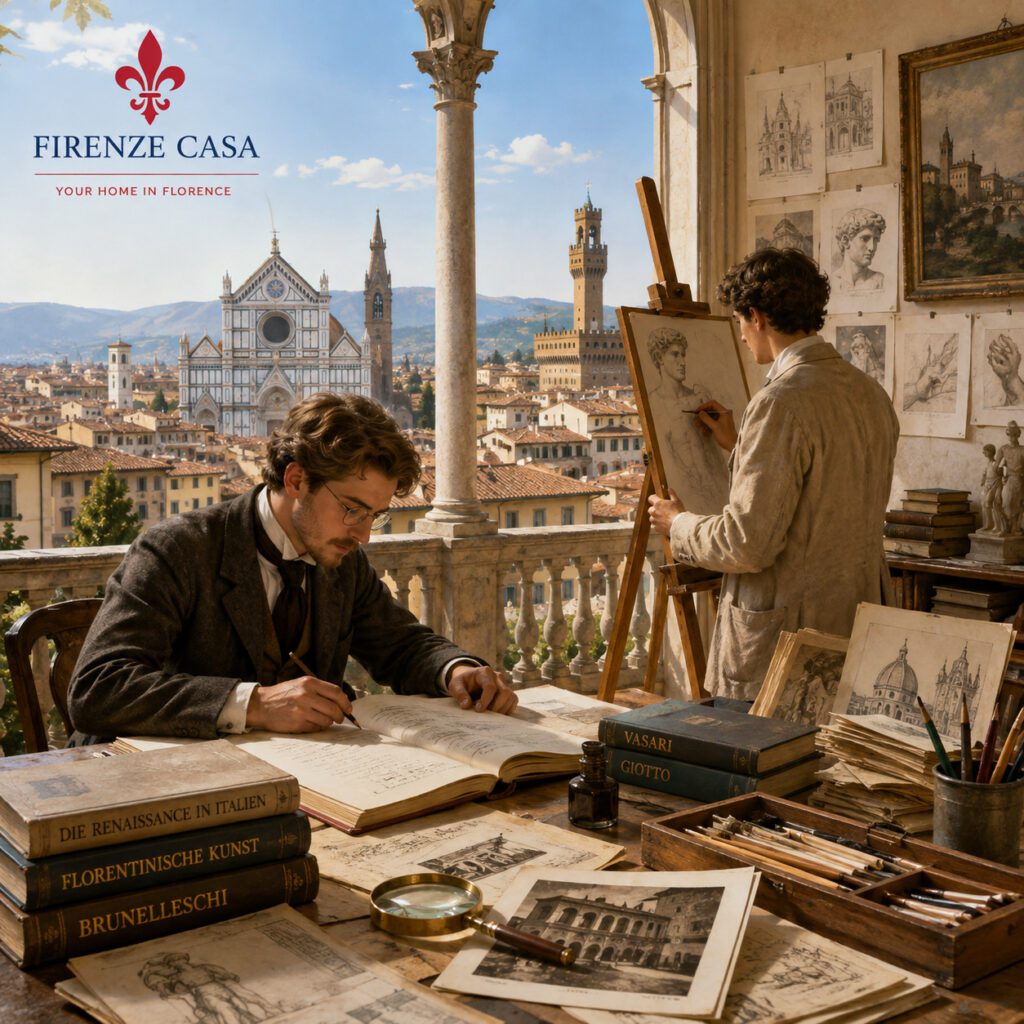
The Germans in Florence played an important role in the city’s international cultural and intellectual history. Artists travelled south to study Renaissance masterpieces, scholars examined churches, archives and collections, while museum specialists and art historians helped establish Florence as one of the world’s great centres for the study of Italian art.
The relationship developed over centuries but became particularly strong during the eighteenth and nineteenth centuries. For generations of German-speaking artists and scholars, Florence was more than a beautiful destination. It was an extraordinary place where painting, sculpture, architecture and documentary history could be studied together in their original setting.
Main period: 18th–early 20th centuries
Key contribution: Art, scholarship and Renaissance research
Important artists: Adolf von Hildebrand and Hans von Marées
Important scholars: August Schmarsow and Aby Warburg
Major museum figure: Wilhelm von Bode
Key institution: Kunsthistorisches Institut in Florenz
Modern artistic legacy: Villa Romana
Why it matters: German-speaking scholars helped shape modern approaches to Renaissance art history
The German story forms one of the principal chapters in our Foreigners Who Shaped Florence – Complete Guide.
Why Did Germans Come to Florence?
Florence possessed something that increasingly fascinated northern European travellers: an extraordinary concentration of medieval and Renaissance art preserved within the places for which it had originally been created.
Paintings remained in churches and chapels, sculptures occupied public spaces and palaces preserved architecture, decoration and family history. Within a relatively compact city, visitors could encounter several centuries of European art.
For German artists and intellectuals, Italy also carried an almost mythical cultural significance. The journey south promised classical antiquity, Renaissance art, Mediterranean landscapes and a world very different from northern Europe.
Rome remained the principal destination for many travellers, but Florence increasingly became essential in its own right.
The German relationship with Florence was particularly intellectual. Generations came not only to admire the city, but to draw, document, compare and understand its art.
Florence and the German Fascination with Italy
The German fascination with Italy extended far beyond Florence. Writers, painters, architects and musicians repeatedly travelled south, creating an enduring cultural phenomenon often described by the term Italiensehnsucht – a longing for Italy.
Johann Wolfgang von Goethe’s Italian journey became its most famous literary expression. Goethe’s strongest associations lie with Rome and other parts of Italy rather than Florence, but the cultural ideal embodied by his travels influenced generations of German-speaking visitors.
Italy came to represent direct access to antiquity, art, landscape and a different rhythm of life.
Florence occupied a special place within this imagined geography because the Renaissance seemed present almost everywhere: in churches, streets, palaces, museums and public sculpture.
For generations of German artists and scholars, travelling to Italy formed part of an artistic education. Florence offered something no academy north of the Alps could reproduce: direct access to works by Giotto, Masaccio, Donatello, Botticelli and Michelangelo.
German Artists Discover Renaissance Florence
Artists arriving from German-speaking Europe encountered Florence as both museum and classroom.
They studied perspective, composition, anatomy and the relationship between painting, sculpture and architecture. Churches were especially important because works could be examined within their original architectural and religious settings.
Santa Maria Novella, Santa Croce, San Marco and the Brancacci Chapel offered very different lessons, while the Uffizi allowed visitors to compare Florentine masters with painters from other Italian regions and northern Europe.
Copying celebrated works remained an accepted method of artistic training. Drawing in churches, museums and sculpture collections therefore became part of everyday study.
From Renaissance Masters to Early Florentine Art
Not every German artist responded to Florence in the same way. Some admired the harmony and balance associated with the High Renaissance, while others became increasingly interested in medieval and early Renaissance painting.
During the nineteenth century, European appreciation expanded beyond the most famous masters. Giotto, Fra Angelico, Masaccio and other earlier painters acquired renewed importance.
This change influenced the development of art history itself. Florence was no longer understood only through Michelangelo, Raphael or Leonardo, but increasingly as the product of artistic development across generations.
German-speaking scholars became deeply involved in reconstructing that history.
Arnold Böcklin and the German-Speaking Artistic World
One of the most fascinating German-speaking artists associated with Florence was Arnold Böcklin.
Böcklin was Swiss, born in Basel in 1827, and should therefore not be described as a German artist. However, he belonged to a broader German-language artistic world connecting Switzerland, Germany, Austria and Italy.
He spent important periods in Florence and eventually died near the city in Fiesole in 1901.
His life illustrates an important feature of nineteenth-century Florence: artistic communities frequently crossed modern national boundaries. Language, training and professional networks could matter as much as nationality.
Böcklin is buried at the Cimitero Evangelico agli Allori, another important site in the history of international Florence.
Arnold Böcklin was Swiss, not German. His presence belongs here because nineteenth-century German-speaking artistic networks often crossed the borders between Germany, Switzerland and Austria.
Adolf von Hildebrand – A German Sculptor in Florence
The German sculptor Adolf von Hildebrand developed an especially strong relationship with Florence.
Born in Marburg in 1847, he spent many years in Italy and became closely connected with German-speaking artists and intellectuals living in Florence.
Renaissance sculpture strongly influenced his ideas about form, proportion and the relationship between sculpture and architecture.
Florence therefore provided more than historical models. It became a place where Hildebrand could think about the future of modern sculpture.
His experience demonstrates how Renaissance Florence entered contemporary debates about artistic theory rather than remaining merely an object of admiration.
Florence influenced foreign artists through its entire urban environment. Sculpture, architecture, piazzas and palaces offered lessons about proportion and space that could never be fully understood from reproductions alone.
Hans von Marées and the Florentine Artistic Circle
Hans von Marées was another important German artist connected with the intellectual world of Florence.
Born in 1837, he spent much of his mature career in Italy and looked to Italian art not simply for subjects but for fundamental principles of composition and monumental painting.
His friendships connected him with Adolf von Hildebrand and the art theorist Konrad Fiedler.
These relationships turned Florence into a place of debate. German-speaking artists were not merely copying Renaissance works; they were asking how the principles they found in Florence might contribute to modern art.
Collectors, Connoisseurs and Art History
The German presence in Florence also included collectors, museum specialists and connoisseurs.
The city’s antique dealers, private collections, churches and historic palaces offered ideal conditions for studying paintings, sculpture and decorative arts.
During the nineteenth century, art history was becoming a professional academic discipline. Attribution, provenance, stylistic analysis and documentary research acquired increasing importance.
Florence offered scholars something exceptional: original works, surviving architecture and extensive archives could all be studied within the same city.
German museum professionals consequently developed particularly strong connections with Florence.
Wilhelm von Bode and Florence
Wilhelm von Bode became one of the most influential European museum figures of his generation.
As a leading figure in Berlin’s museums, he played a major role in developing collections of Renaissance sculpture and painting.
Florence formed an important part of his scholarly world. Bode belonged to circles of academics, collectors and artists who met in the city to discuss paintings, sculpture, prints, antiquities and questions of attribution.
Such networks contributed to an increasingly ambitious idea: German art-historical scholarship in Florence needed a permanent institutional base.
The Birth of the Kunsthistorisches Institut in Florenz
The creation of the Kunsthistorisches Institut in Florenz represents the most important institutional legacy of the Germans in Florence.
The idea developed gradually during the late nineteenth century. Scholars recognised that serious research into Italian art required sustained access to Florence’s monuments, archives and collections.
A permanent institute could provide resources individual travellers could not easily create: a specialised library, photographic material, scholarly exchange and continuity between generations of researchers.
An art-historical congress in Nuremberg supported the idea in 1893, and the institute was founded in Florence in 1897.
The German fascination with Florence eventually created a permanent institution. More than a century after its foundation, the Kunsthistorisches Institut continues to make Florence an international centre of art-historical research.
August Schmarsow and a Classroom Called Florence
One of the important figures in the development of German art-historical study in Florence was August Schmarsow.
During the winter semester of 1888–1889, Schmarsow conducted teaching in Florence itself. Rather than examining Renaissance art primarily through reproductions, students could study original buildings, sculptures and paintings directly.
Among the young scholars associated with this Florentine teaching environment was Aby Warburg, who later became one of the most influential figures in modern art history and cultural studies.
The principle was simple but powerful: Florence itself became the classroom.
Aby Warburg and Renaissance Florence
Aby Warburg developed an intense scholarly relationship with Florentine Renaissance culture.
Born into a wealthy banking family in Hamburg, Warburg approached art through questions that extended beyond traditional stylistic analysis.
He studied the survival of classical imagery, gesture, symbolism and cultural memory. Florence offered exceptionally rich material because artworks could be examined together with patronage, family networks, festivals, clothing, commerce and religion.
Warburg therefore treated paintings and sculptures not as isolated masterpieces but as parts of a wider cultural system.
Florence as a Cultural Laboratory
For Warburg, Renaissance Florence demonstrated how classical antiquity had been rediscovered, reinterpreted and integrated into Christian and civic society.
Merchant families commissioned chapels and paintings, artists combined classical imagery with contemporary themes and political identity became visible through artistic patronage.
Studying Florence therefore meant studying the interaction between art and society.
This approach anticipated many questions that remain central to cultural and art history today.
German Scholarship and the Medici
The Medici family naturally became an important subject for German scholars.
The dynasty’s political history, patronage and extensive surviving documentation provided exceptional material for research.
Historians examined relationships between banking, politics and artistic commissions. They reconstructed networks connecting artists, patrons and institutions and studied how architecture and art expressed family identity.
This work contributed to a broader interpretation of Renaissance Florence in which art became inseparable from economic, political and social history.
That connection is also central to our article on How Banking Financed the Renaissance.
Why Florence Became an Art-Historical Laboratory
Few European cities offer such a dense combination of artworks, architecture and documentary evidence.
A scholar researching a Florentine family might visit its palace in the morning, examine a chapel commissioned by the same family later that day and then consult archival material concerning the commission.
Paintings could be connected with contracts. Sculptures could be studied beside contemporary architecture, while family relationships could be reconstructed through documentary records.
German scholars recognised these possibilities early in the development of professional art history.
Florence allowed scholars to study art, architecture, archives and urban history together. The city itself became a research environment rather than simply a collection of separate monuments.
The Kunsthistorisches Institut Today
The Kunsthistorisches Institut in Florenz has evolved far beyond its nineteenth-century origins.
Since 2002, it has formed part of the Max Planck Society. Its research now extends well beyond traditional studies of Renaissance Florence and includes broader international and transcultural approaches to art and architecture.
The institute maintains a major specialist library and Photothek and supports researchers from around the world.
Its continued presence demonstrates the durability of the German scholarly relationship with Florence while also showing how that relationship became increasingly international.
What began with German artists and scholars meeting in Florence eventually developed into a research institute serving an international academic community.
German Writers and the Image of Florence
Visual artists and art historians were not alone in shaping German perceptions of Florence.
Writers and travellers described the city’s streets, museums, churches and surrounding landscape for readers north of the Alps.
Travel literature helped transform Florence into a cultural destination. Readers who had never seen Tuscany could imagine the Duomo, the Arno and Renaissance palaces through published accounts.
These descriptions also created expectations. Visitors increasingly arrived knowing which artists, monuments and historic periods they wanted to encounter.
In this way, scholarship and travel writing contributed to the development of modern cultural tourism.
The broader literary relationship with the city is explored in our Florence in Literature – Complete Guide.
German-Speaking Florence Was Larger Than Germany
A historical distinction is particularly important when discussing the nineteenth century.
Before German unification in 1871, travellers came from numerous German states. German-speaking visitors also arrived from Austria and Switzerland.
Artists and intellectuals frequently interacted through language, education and professional networks rather than nationality alone.
This explains why figures such as Swiss-born Arnold Böcklin belong naturally to the broader story of German-speaking artistic Florence even though they were not German nationals.
The distinction also prevents modern political borders from being projected too simplistically onto nineteenth-century cultural networks.
From Renaissance Admiration to Modern Art
The German relationship with Florence did not end with Renaissance scholarship.
Modern artists continued to come to Tuscany and respond to its landscape, architecture and artistic traditions. Some embraced historical models, while others deliberately moved away from them.
Florence nevertheless remained an important point of reference because artists could compare contemporary experimentation with centuries of artistic production.
The city therefore became both a place of historical study and a setting for modern creative work.
Villa Romana and the German Artistic Presence
One of the most enduring expressions of this modern artistic relationship is Villa Romana.
Established in the early twentieth century, it developed into an important place for artists living and working in Florence.
Its history reflects a significant change in the German relationship with the city. Florence was no longer only a destination for studying Renaissance masters.
It could also become a place where contemporary artists produced new work, met colleagues and participated in international exchange.
The centuries-old cultural dialogue therefore continued within modern artistic practice.
Where to Discover German Florence Today
Unlike some international communities, German Florence cannot be reduced to one district or monument.
The Uffizi, Bargello, Accademia and major churches preserve the works generations of artists and scholars travelled south to study. The historic centre itself remains part of the story because architecture, public sculpture and urban space played such an important role in their understanding of Florence.
The Kunsthistorisches Institut represents the enduring scholarly legacy, while Villa Romana continues the tradition of German artistic exchange with the city.
Visitors can therefore encounter this history almost everywhere, provided they look at Florence not only as tourists but occasionally as students of the city.
Try visiting one church or piazza as an art historian rather than rushing between famous masterpieces. Look at how sculpture, painting, architecture and urban space interact. This is precisely what made Florence so valuable to generations of foreign scholars.
How German Scholars Changed the Study of Florence
Perhaps the most important German contribution was not a building or artwork but a method of looking.
German-speaking scholars participated significantly in the development of art history as an academic discipline during the nineteenth and early twentieth centuries, and Florence became one of its most important testing grounds.
Researchers catalogued works, investigated archives, studied patronage and compared artistic styles. Photography later made systematic visual documentation possible on an unprecedented scale.
These methods helped establish many of the foundations of modern Renaissance scholarship.
Florence and the International History of Art
The story ultimately reaches beyond Germany.
The Renaissance originated within specific Florentine political, religious, economic and social conditions, but its later interpretation became an international scholarly project.
Italian, German, British, French, Swiss and American researchers all contributed to the enormous body of scholarship surrounding Florence.
The city consequently became both an object of study and a meeting place for scholars themselves.
This international network is part of the broader history explored in our Foreigners Who Shaped Florence – Complete Guide.
Frequently Asked Questions About the Germans in Florence
Why did German artists travel to Florence?
Florence offered direct access to an exceptional concentration of medieval and Renaissance painting, sculpture and architecture. Artists could study original works by Giotto, Masaccio, Donatello, Botticelli, Michelangelo and many others within their historical settings.
Why was Florence important to German art historians?
The city combined surviving artworks and architecture with extensive documentary archives. Scholars could therefore connect paintings and sculptures with patrons, contracts, family networks and historical events.
What is the Kunsthistorisches Institut in Florenz?
The Kunsthistorisches Institut in Florenz is an important research institute for art and architectural history. Founded in 1897, it has belonged to the Max Planck Society since 2002 and today serves an international scholarly community.
Did Aby Warburg study Florence?
Yes. Florence became central to Warburg’s research into Renaissance culture, classical imagery, patronage and cultural memory. He was also associated with the Florentine teaching environment created by August Schmarsow.
Was Arnold Böcklin German?
No. Arnold Böcklin was Swiss. He belongs to this wider story because he participated in the German-speaking artistic world that connected Switzerland, Germany, Austria and Italy during the nineteenth century.
Were all German-speaking artists in Florence German?
No. German-speaking artistic and intellectual circles also included people from Switzerland and Austria. Language and professional networks often crossed modern national borders.
Is the German cultural presence in Florence still visible?
Yes. The Kunsthistorisches Institut remains the clearest scholarly example, while Villa Romana continues the tradition of artistic exchange between German-speaking Europe and Florence.
Why the Germans in Florence Still Matter
The Germans in Florence still matter because their history reveals a particularly intellectual form of cultural exchange. German artists came to study Renaissance masters, museum specialists examined Florentine collections and scholars used the city’s archives to develop increasingly sophisticated ways of interpreting art.
Figures such as Hildebrand, Marées, Schmarsow and Warburg demonstrate how Florence influenced both artistic practice and art-historical theory. Eventually, this sustained engagement became institutionalised through the Kunsthistorisches Institut.
The relationship continues today. German-supported research remains deeply embedded within Florence’s international academic landscape, while Villa Romana maintains a living connection with contemporary artistic practice.
Perhaps the most important legacy is less visible. Generations of scholars helped teach later audiences to see Florence not simply as a collection of beautiful masterpieces, but as a complex historical city in which art, politics, religion, commerce, patronage and everyday life were closely interconnected.
German Florence is ultimately a story about learning how to look. The greatest legacy was not one monument but a tradition of studying the city as a connected cultural system.
Further Reading on Firenze Casa
Continue exploring Florence’s international communities and the cultural networks surrounding Renaissance art:
- Foreigners Who Shaped Florence – Complete Guide
- The British in Florence – Writers, Artists and Collectors
- The Swiss in Florence – Entrepreneurs, Cafés and Confectioners
- The French in Florence – Politics, Art and Cultural Influence
- The Americans in Florence – Collectors, Writers and Historic Villas
- Florence in Literature – Complete Guide
- The Medici Family: The Dynasty That Shaped Florence
- How Banking Financed the Renaissance
- Cimitero Evangelico agli Allori – Florence’s International Cemetery
References
- Kunsthistorisches Institut in Florenz – History of the Institute and Its Foundation
- Max Planck Society – Kunsthistorisches Institut in Florenz
- Kunsthistorisches Institut in Florenz – Historical Material on August Schmarsow, Wilhelm von Bode and the Institute’s Early Scholarly Networks
- Villa Romana, Florence – Institutional History and German Artistic Exchange in Florence
- Warburg Institute – Biographical and Scholarly Material on Aby Warburg
- Biographical Studies on Adolf von Hildebrand and Hans von Marées
- Historical Studies on German-Speaking Artists and Artistic Communities in Nineteenth-Century Florence
- Studies on German Art History and the Rediscovery of the Italian Renaissance
- Historical Studies on Foreign Artists, Collectors and Scholars in Nineteenth-Century Florence

