
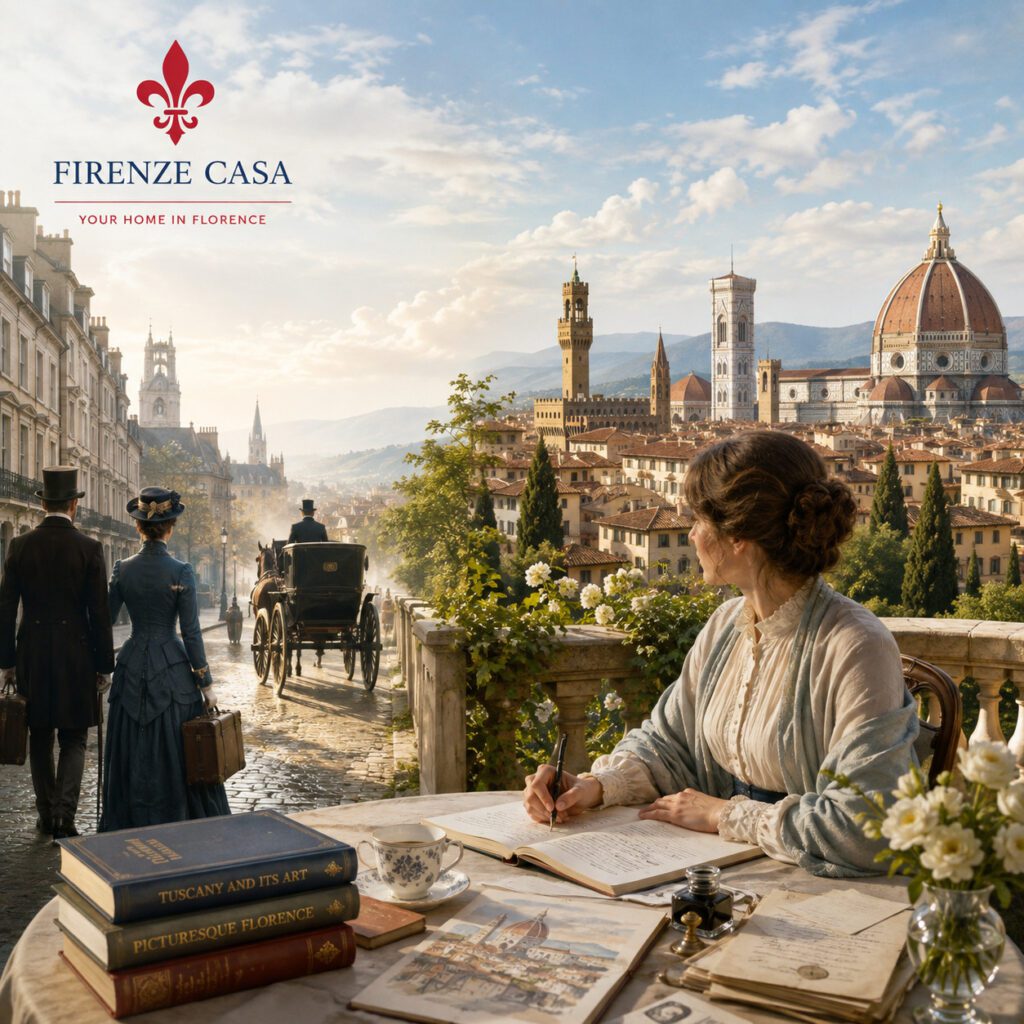
The British in Florence created one of the city’s most distinctive international communities. From the Grand Tour to the twentieth century, British writers, artists, collectors and long-term residents came to Tuscany in search of Renaissance art, intellectual freedom, a milder climate and a different way of life.
By the nineteenth century, a recognisable Anglo-Florentine world had emerged. British residents lived in apartments in the historic centre, rented or bought villas in the surrounding hills, collected art, founded institutions and wrote books that introduced Florence to readers throughout the English-speaking world.
Main period: 18th–early 20th centuries
Key figures: Elizabeth Barrett Browning, Robert Browning, Walter Savage Landor, Herbert Percy Horne and Harold Acton
Literary landmark: Casa Guidi
Historic cemetery: Cimitero degli Inglesi
Collector legacy: Museo Horne and Museo Stibbert
Important institution: British Institute of Florence
Residential landscape: Oltrarno, Bellosguardo and villas in the Florentine hills
Why it matters: British residents helped shape the international literary and cultural image of Florence
The British story forms one of the principal chapters in our Foreigners Who Shaped Florence – Complete Guide.
How the British Came to Florence
British travellers had visited Italy for centuries, but their numbers increased substantially with the rise of the Grand Tour. From the seventeenth and eighteenth centuries onward, wealthy young travellers crossed continental Europe as part of their cultural education.
Rome offered antiquity, Venice spectacle and Florence an extraordinary concentration of Renaissance painting, sculpture and architecture. The Uffizi, churches, palaces and private collections allowed visitors to encounter works previously known only through prints, copies or written descriptions.
Florence also occupied a convenient position on the route through Italy. Travellers could continue south towards Rome or cross the Apennines towards Bologna and northern Europe.
Yet the city gradually became more than a stop along the way. Some visitors returned repeatedly, while others rented homes for entire seasons and eventually established permanent social networks.
From the Grand Tour to an Anglo-Florentine Community
During the nineteenth century, Florence developed one of the most important British expatriate communities in Italy.
Several factors made the city attractive. Renaissance art was immediately accessible, the surrounding countryside offered villas and gardens, and the climate appeared gentler than that of Britain.
Florence also offered a degree of social flexibility. Writers, independent women, artists and unconventional intellectuals could create lives that differed from expectations at home.
As the community expanded, an infrastructure developed around it. Churches, cemeteries, booksellers, libraries and social networks allowed British residents to maintain connections with their own culture while becoming part of Florentine life.
The most interesting Anglo-Florentine stories begin where British and Florentine life overlap. Writers, collectors and residents did not simply recreate Britain in Tuscany; many became deeply involved with the city around them.
Florence Through British Eyes
British travellers did more than observe Florence. They interpreted it for readers abroad.
Diaries, letters, poems, novels and travel books helped create an international image of Renaissance Florence associated with beauty, artistic genius and historical drama.
The surrounding hills created another powerful image: villas among olive trees and cypresses with views towards the Duomo and the Arno valley.
Long before modern travel photography made Florence instantly recognisable, literature shaped how potential visitors imagined the city.
This wider literary relationship is explored in our Florence in Literature – Complete Guide.
Elizabeth Barrett Browning and Robert Browning
No history of the British in Florence is complete without Elizabeth Barrett Browning and Robert Browning.
The couple married secretly in London in 1846 after Elizabeth’s father opposed the relationship. They left Britain and eventually settled in Florence, where they found a home in the Oltrarno.
For Elizabeth, Florence represented more than escape from family restrictions. Italian politics fascinated her, and the Risorgimento became an important part of her writing.
Her collection Casa Guidi Windows connected the intimate perspective of her Florentine home with the political hopes and disappointments surrounding Italian unification.
Casa Guidi
The Brownings’ apartment became known as Casa Guidi. Located near Palazzo Pitti, it provides one of the most intimate literary connections in Florence.
Unlike a grand palace associated with rulers or bankers, Casa Guidi evokes domestic life. Rooms, furniture, books and personal objects preserve the atmosphere in which two major Victorian poets lived and worked.
The location is equally important. The Oltrarno placed the Brownings close to Palazzo Pitti, the Boboli Gardens and Santo Spirito, in a neighbourhood with a strong local identity.
Casa Guidi demonstrates why Florence became so important to foreign writers. Literature, private life and the political history of nineteenth-century Italy came together inside the same rooms.
Elizabeth Barrett Browning and the Risorgimento
Elizabeth Barrett Browning followed Italian politics closely and responded to the movement towards national unification with genuine emotional involvement.
She observed public demonstrations and political change from a city undergoing profound transformation. Her writing reflected both enthusiasm for Italian independence and disappointment when events failed to match idealistic expectations.
This engagement challenges the idea that foreign residents lived entirely within isolated expatriate circles. At least some became deeply involved in the political future of the country they had chosen as their home.
Walter Savage Landor and Literary Florence
Walter Savage Landor belonged to an earlier generation of Anglo-Florentine literary culture.
The poet and essayist spent important periods of his life in Italy and developed a particularly strong connection with Florence. Tuscany offered him landscape, classical associations and distance from British society.
Landor’s story also demonstrates how literary reputation accumulated in Florence across generations. Earlier writers helped establish the city as an intellectual destination for those who followed.
British Women and Life in Florence
The Anglo-Florentine community included many independent and intellectually active women.
Florence could provide opportunities for personal reinvention that were more difficult within the social structures of Victorian Britain. Women wrote, collected art, hosted salons, travelled independently and participated in international intellectual life.
Elizabeth Barrett Browning remains the best-known example, but she belonged to a broader history of women who used residence abroad to create lives that differed from expectations at home.
For some, Florence offered not simply beautiful surroundings but greater personal and intellectual freedom.
The British and Florence’s Villas
While some British residents preferred apartments in the historic centre, others moved into the surrounding hills.
Bellosguardo, Fiesole and other elevated areas offered gardens, privacy, cooler summer air and panoramic views while remaining close to the city.
Many properties already carried Renaissance or Medici histories. Foreign residents therefore lived inside the architectural landscape they had travelled to admire.
The combination of historic villa, Italian garden and panoramic setting became one of the enduring images of expatriate Florence.
The broader villa landscape is explored in our Historic Villas of Florence and Fiesole – Complete Guide.
Bellosguardo and the View of Florence
Bellosguardo became particularly associated with foreign writers and residents. Its position southwest of the historic centre offers broad views across Florence and the surrounding hills.
The landscape appealed strongly to Romantic and Victorian sensibilities. From villa terraces, Florence could be experienced both as a real city and as an idealised Renaissance panorama.
Such views appeared repeatedly in memoirs, paintings and travel descriptions, reinforcing international fascination with life in the Florentine hills.
British Collectors and Renaissance Florence
Art collecting became another important element of the British presence.
Wealthy visitors encountered a flourishing market for paintings, sculpture, furniture, manuscripts and decorative arts. Some collected primarily for private enjoyment, while others approached the subject with serious scholarly ambition.
This activity had complex consequences. Important works left Italy and entered collections abroad, contributing to the dispersal of Italian cultural heritage.
At the same time, collectors and scholars helped create international interest in artists and periods that had previously received comparatively little attention.
Florence became a meeting place for collectors, dealers, restorers and emerging art historians.
Herbert Percy Horne – Collector and Scholar
Herbert Percy Horne represents one of the most important British collector-scholars associated with Florence.
Born in London, Horne developed interests in architecture, design, literature and Renaissance art before establishing a strong connection with the city.
He acquired Palazzo Corsi in Via de’ Benci and assembled an important collection of paintings, sculpture, furniture and decorative arts.
Horne’s interests extended far beyond ownership. He studied Renaissance culture seriously and created a collection shaped by a highly personal understanding of Florentine art and domestic life.
His legacy survives in the Museo Horne, where the collection remains displayed within the atmosphere of a Renaissance palace.
Museo Horne turns the story of foreign collecting into something tangible. A British scholar’s fascination with Renaissance Florence eventually created a museum that became part of the city’s public cultural heritage.
Frederick Stibbert and an Extraordinary Collection
Frederick Stibbert represents a more complex Anglo-Florentine identity.
Born in Florence to an English father and Italian mother, he inherited considerable wealth and devoted much of his life to collecting armour, weapons, costumes, paintings and decorative arts from Europe, the Islamic world and Japan.
The resulting Museo Stibbert is one of Florence’s most unusual museums. Its theatrical displays and extraordinary range differ dramatically from institutions such as the Uffizi or Bargello.
Stibbert demonstrates how difficult it can be to draw a strict boundary between foreign and Florentine identities. Born in Florence but connected with Britain, he belonged to both cultural worlds.
Artists Between Britain and Florence
British artists also travelled to Florence to study Renaissance masters and experience Italian architecture, landscape and light.
Museums and churches functioned as extraordinary classrooms. Copying celebrated works formed part of artistic education, while sketching buildings and landscapes created visual records of the journey.
Florence also brought British artists into contact with American, German, French and Italian colleagues. Studios, cafés and private homes became spaces of international exchange.
This cosmopolitan artistic environment formed an important part of nineteenth-century Florence.
The English Cemetery – A Map of International Florence
Few places tell the story of Anglo-Florentine life as vividly as the Cimitero degli Inglesi at Piazzale Donatello.
Its familiar name reflects the strong British presence, but the cemetery was never exclusively English. It was established by Florence’s Swiss Reformed community for non-Catholic residents and contains graves representing several nationalities.
Elizabeth Barrett Browning is its most famous British resident, while Walter Savage Landor and other figures associated with Florence’s international community are also buried there.
The cemetery belongs to the wider history explored in our Historic Cemeteries in Florence – Complete Guide.
Why It Became an Island
The cemetery originally stood outside Florence’s city walls near Porta a’ Pinti.
The redevelopment associated with Florence’s years as capital of Italy dramatically changed the surrounding landscape. Giuseppe Poggi’s broad avenues replaced much of the former wall system, while the cemetery remained in place.
Roads now circulate around the raised site, giving it the unusual appearance of a green island within the modern city.
The “English Cemetery” was created by Florence’s Swiss Reformed community and contains people from many countries. Its familiar name reflects the particularly strong British presence rather than exclusive British ownership.
From the English Cemetery to Agli Allori
As Florence expanded, new regulations eventually prevented regular burials from continuing at the cemetery near Porta a’ Pinti.
The Cimitero Evangelico agli Allori was therefore established outside the growing city and continued Florence’s international and non-Catholic burial tradition.
Its graves preserve another remarkable collection of cultural biographies, including writers, artists, historians, collectors and long-term foreign residents.
Together, the two cemeteries form an unusual historical archive of the city’s international population.
The British and Florentine Social Life
Foreign residents needed spaces in which to meet, exchange news and maintain social connections.
Private drawing rooms and villa salons played an important role, but public places mattered too. Cafés, reading rooms and booksellers created opportunities for interaction between visitors and residents.
Some British residents remained largely within English-speaking circles. Others developed close relationships with Italian artists, intellectuals and political figures.
The most interesting Anglo-Florentine stories usually emerged where these worlds intersected.
The British Institute of Florence
The founding of the British Institute of Florence in 1917 gave the long relationship between Britain and Florence a permanent institutional expression.
The Institute developed educational and cultural activities that strengthened connections between British and Italian life. Language teaching, art history, lectures, events and a major library became central parts of its work.
Its collections include important material relating to British travellers and long-term residents in Florence.
More than a century after its foundation, the Institute remains active, demonstrating that the Anglo-Florentine relationship is not merely a nineteenth-century historical curiosity.
The Harold Acton Library
The Institute’s Harold Acton Library occupies historic rooms in Palazzo Lanfredini overlooking the Arno.
Its collections include English and Italian literature, history, art history and travel writing.
Particularly relevant to the history of the British in Florence are materials documenting travellers and residents who created the city’s Anglo-Florentine world.
Harold Acton and the Anglo-Florentine Tradition
Harold Acton belonged to a later generation of cosmopolitan Florence.
A writer, historian and aesthete, he grew up at Villa La Pietra, one of the great international cultural residences in the Florentine hills.
His life reflected an identity that was neither simply British nor simply Italian. Like several long-established Anglo-Florentine families, Acton’s world combined languages, traditions, collections and social networks spanning multiple countries.
This hybrid identity became increasingly characteristic of families that had lived in Florence for generations.
The term is useful because it describes something more complex than expatriate life. For long-established families, Britain and Florence could become overlapping parts of the same cultural identity.
What the British Left Behind in Florence
The British legacy in Florence cannot be reduced to a single monument.
Writers left books and literary associations. Collectors created museums and collections. Long-term residents restored historic villas, while Protestant communities established cemeteries and cultural organisations developed permanent institutions.
British writers and travellers also helped communicate Florence to an international audience. Their descriptions encouraged generations of readers to imagine the city before seeing it for themselves.
Florence influenced British culture, and British residents in turn contributed to the international reputation of Florence.
Where You Can Discover British Florence Today
Visitors can still follow the Anglo-Florentine story through a network of places across the city.
Casa Guidi provides the clearest connection with Elizabeth Barrett Browning and Robert Browning. The English Cemetery preserves the nineteenth-century expatriate community, while Agli Allori continues that story into later generations.
Museo Horne reveals the collecting world of Herbert Percy Horne, while Museo Stibbert provides another remarkable example of an identity bridging Britain and Florence.
The British Institute represents the continuing intellectual connection between the two countries. Beyond the historic centre, Villa La Pietra and the landscapes around Bellosguardo evoke the residential world that attracted generations of British residents.
Together, these places reveal an almost hidden layer of Florence.
Combine Casa Guidi in the Oltrarno with the British Institute beside the Arno. On another day, visit the English Cemetery at Piazzale Donatello. Even these three places reveal literature, expatriate life and the institutions created by Florence’s British community.
The Anglo-Florentine Landscape
The British relationship with Florence also helped shape international ideas about Tuscany.
Writers and residents described villas, olive groves, gardens and distant views of the Duomo with an enthusiasm that influenced later generations.
The Florentine hills became associated with a particular ideal of cultivated life: books on a terrace, Renaissance art nearby and the Tuscan countryside outside the window.
This image could be highly romanticised and reflected the experience of a relatively privileged group. Nevertheless, it became extraordinarily influential.
Modern international fascination with restoring a Tuscan villa or living among olive trees has deep historical roots in this expatriate culture.
Were the British Really Part of Florence?
Not every British resident became integrated into Florentine society. Expatriate communities could be socially exclusive, and wealth often allowed residents to maintain lifestyles far removed from those of ordinary Florentines.
Yet complete isolation was impossible. Foreign residents employed local workers, rented or purchased Florentine property, worked with dealers and craftsmen and participated in cultural life.
Some learned Italian and formed close relationships with local intellectuals, artists and political figures. Others left collections, buildings or institutions that eventually became part of Florence’s public cultural heritage.
The result was not complete assimilation but a complex and long-lasting process of cultural exchange.
Frequently Asked Questions About the British in Florence
Why did so many British people settle in Florence?
Florence offered exceptional access to Renaissance art, a relatively mild climate, attractive living conditions and an established international community. The Grand Tour introduced generations of British travellers to the city, and some later chose to remain for extended periods or permanently.
Who were the most famous British writers in Florence?
Elizabeth Barrett Browning and Robert Browning are the best-known literary couple associated with the city. Walter Savage Landor also had a strong connection with Florence, while many other British writers and travellers contributed to Anglo-Florentine literary culture.
Where did Elizabeth Barrett Browning live in Florence?
Elizabeth Barrett Browning and Robert Browning lived at Casa Guidi in the Oltrarno, close to Palazzo Pitti.
Why is there an English Cemetery in Florence?
The cemetery was established in the nineteenth century to provide burial space for non-Catholic residents. Florence’s Swiss Reformed community created it, and people of many nationalities were buried there, although the strong British presence produced its familiar name.
Which Florence museums have connections with British collectors?
Museo Horne preserves the collection of British scholar and collector Herbert Percy Horne. Museo Stibbert reflects the extraordinary collecting interests of Frederick Stibbert, who was born in Florence to an English father and Italian mother.
Does a British community still exist in Florence?
Yes. Florence remains home to British residents and cultural connections. The British Institute of Florence, founded in 1917, continues language teaching, cultural programmes, art history activities and library services.
Why the British in Florence Still Matter
The British in Florence still matter because their history reveals how the city continued to evolve long after the Renaissance. Writers, artists, collectors and residents added new layers to Florence’s literary, intellectual and cultural life.
The Brownings became inseparable from literary Florence. Herbert Horne’s collection entered the city’s museum landscape, while the English Cemetery became part of its historic geography. The British Institute remains an active cultural institution more than a century after its foundation.
The relationship was never entirely simple. Wealth and expatriate privilege could create distance from ordinary Florentine life, and international collecting sometimes removed works from Italy.
Yet the exchange was enduring. Florence transformed the lives and work of British residents, while those residents helped communicate, study and preserve an international image of Florence that still influences how the city is understood today.
Anglo-Florentine history reveals another Florence: not a city frozen in its Renaissance past, but a place that continued to absorb new people, ideas and cultural identities across the centuries.
Further Reading on Firenze Casa
Continue exploring Florence’s international communities, writers, cemeteries and historic villas:
- Foreigners Who Shaped Florence – Complete Guide
- Elizabeth Barrett Browning in Florence – A Life of Poetry and Quiet Transformation
- Cimitero degli Inglesi Florence – Quiet Historic Site
- Cimitero Evangelico agli Allori – Florence’s International Cemetery
- Historic Cemeteries in Florence – Complete Guide
- Historic Villas of Florence and Fiesole – Complete Guide
- Villa La Pietra – Florence’s Historic Acton Family Estate
- Florence in Literature – Complete Guide
- Quiet Florence – The Best Places We Never Queued For
References
- The British Institute of Florence – Archives, Library Collections and Historical Material on the Anglo-Florentine Community
- Casa Guidi – Historical Material Relating to Elizabeth Barrett Browning, Robert Browning and Their Florentine Residence
- Historical and Biographical Studies on Elizabeth Barrett Browning, Robert Browning and Walter Savage Landor
- Comune di Firenze – Historical Information on the Cimitero degli Inglesi
- Historical Studies on the Cimitero Evangelico agli Allori and Florence’s International Protestant Communities
- Museo Horne – Historical and Biographical Material on Herbert Percy Horne and His Collection
- Museo Stibbert – Historical and Biographical Material on Frederick Stibbert and His Collections
- Historical Studies on British Collectors, Expatriates and Villa Culture in Nineteenth- and Early Twentieth-Century Florence
- Historical Material on Harold Acton, Villa La Pietra and the Later Anglo-Florentine Community

