
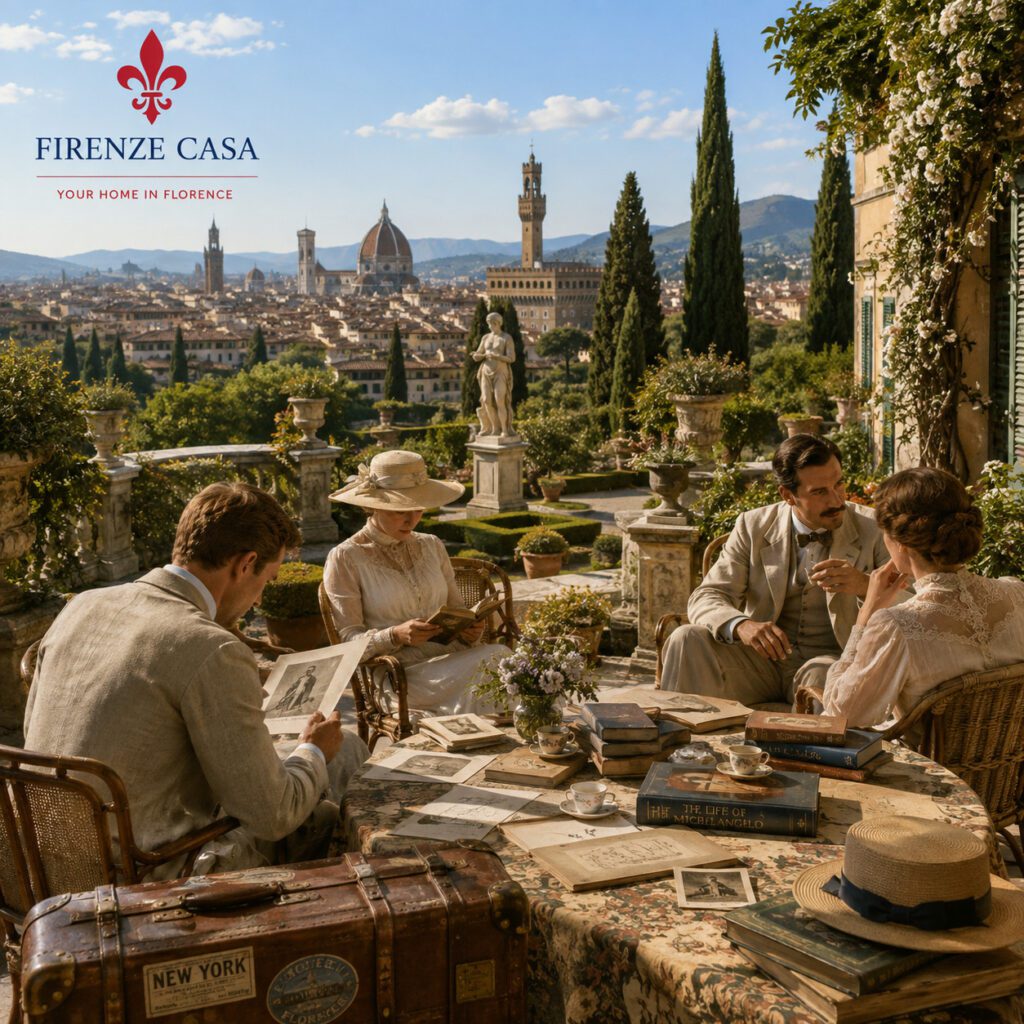
Americans in Florence became an increasingly visible presence during the nineteenth and early twentieth centuries. Writers came searching for the Italy of history and imagination, wealthy travellers discovered Renaissance art, and collectors and scholars established homes in villas overlooking the city.
Some stayed for months, others for decades. American collectors acquired important works of art, writers transformed Florence into literature and scholars contributed to the emerging study of Renaissance culture. Several historic villas eventually became centres of international intellectual life, leaving a legacy that continues in Florence today.
Main period: 19th–early 20th centuries
Key writers: Henry James and Edith Wharton
Important collectors: Charles Loeser and Bernard Berenson
Major historic villa: Villa I Tatti
Academic legacy: Harvard University Center for Italian Renaissance Studies
Collector legacy: Loeser Collection in Palazzo Vecchio
Residential landscape: Settignano, Fiesole and the Florentine hills
Why it matters: American writers, collectors and scholars helped shape the international understanding of Renaissance Florence
The American story forms one of the principal chapters in our Foreigners Who Shaped Florence – Complete Guide.
Why Americans Fell in Love with Florence
During the nineteenth century, increasing numbers of Americans travelled to Europe. For wealthy families, artists and intellectuals, the journey could represent education, social status and personal discovery at the same time.
Italy occupied a special place within this experience. Rome offered antiquity, Venice seemed almost fantastical and Florence represented the Renaissance.
The city was also manageable in scale. Visitors could walk between churches, galleries, palaces and historic squares while encountering works by Giotto, Donatello, Botticelli and Michelangelo within a relatively compact area.
Beyond the historic centre lay another attraction: the villas, gardens and landscapes of the Florentine hills.
The American relationship with Florence combined admiration with participation. Some visitors came as tourists, but others became serious collectors, scholars and long-term residents who made Florence part of their intellectual lives.
Florence and the American Grand Tour
The European Grand Tour had originally been associated mainly with wealthy British travellers. During the nineteenth century, affluent Americans increasingly adopted their own version of the journey.
Florence became one of its essential destinations. Visitors toured the Uffizi, admired Michelangelo, explored Santa Croce and wandered through streets shaped by centuries of history.
Guidebooks helped organise these experiences, while improved transport, hotels and established foreign communities made longer stays increasingly practical.
Some Americans returned repeatedly. A smaller number became so attached to Tuscany that they established permanent or semi-permanent homes around Florence.
By the late nineteenth century, Florence had become one of Europe’s great international residential cities. British and American residents lived alongside artists, scholars and collectors from across the continent.
American Writers Discover Florence
For American writers, Florence offered far more than picturesque scenery. The city raised questions about history, identity and the differences between the New World and Europe.
American society appeared young beside Florentine palaces and churches. Families in Tuscany could trace their histories across centuries, while paintings and sculptures remained in buildings created for them generations earlier.
This contrast fascinated writers. Florence consequently became both a physical setting and an intellectual idea within American literature.
The broader relationship between the city and international writers is explored in our Florence in Literature – Complete Guide.
Henry James and Florence
Few American writers developed a richer literary relationship with Florence than Henry James.
Born in New York in 1843, James spent much of his adult life in Europe and repeatedly visited Italy. Florence appears throughout his travel writing and fiction.
James observed monuments, streets and social life with extraordinary attention. For him, Italy also provided a setting in which Americans could encounter the complexity of European culture.
His characters frequently discover that beauty and history are accompanied by unfamiliar social conventions and moral ambiguities. Florence therefore became an ideal stage for exploring the encounter between America and Europe.
The Portrait of a Lady and Florence
Henry James’s novel The Portrait of a Lady provides one of the strongest literary connections between American culture and Florence.
Its protagonist, Isabel Archer, is a young American woman who travels to Europe. Important parts of the novel unfold in Florence and its surroundings.
The city becomes more than a beautiful backdrop. It represents both the attraction and the complexity of the Old World confronting an independent American consciousness.
Through James, Florence entered one of the defining works of nineteenth-century American literature.
Henry James used Florence to explore a recurring nineteenth-century theme: what happens when the confidence and freedom associated with the New World encounter the beauty, history and social complexity of Europe?
Edith Wharton and the Italian Garden
Edith Wharton belonged to a later generation of American writers deeply interested in European culture. Her relationship with Italy included a particular fascination with architecture and historic gardens.
In Italian Villas and Their Gardens, published in 1904, Wharton examined the design principles behind Italy’s great villa gardens. Tuscany formed an important part of that world.
Her approach went beyond picturesque admiration. Wharton considered the relationship between architecture, terraces, vegetation, sculpture and landscape.
Her writing helped introduce American readers to the sophistication of historic Italian garden design and contributed to a renewed international fascination with the Tuscan villa.
From Travellers to Collectors
Some wealthy Americans did more than admire Florentine art. They began collecting it.
During the late nineteenth and early twentieth centuries, the international market for Renaissance paintings, sculptures, furniture and decorative arts expanded dramatically.
Florence became one of its major centres. Dealers, scholars, restorers and collectors interacted within a sophisticated network in which attribution and provenance could have enormous financial importance.
American fortunes created a new generation of buyers capable of assembling extraordinary collections.
American Collectors and Renaissance Florence
The rise of American collecting coincided with the development of major museums in cities such as Boston and New York.
Renaissance Florence carried enormous prestige. A painting, sculpture or piece of decorative art associated with Tuscany could connect a new American collection with centuries of European culture.
Yet motivations varied considerably. Some buyers primarily sought beautiful objects and social prestige, while others developed serious scholarly expertise.
Several Americans living around Florence eventually became respected connoisseurs in their own right.
Charles Loeser – Collector and Connoisseur
Charles Alexander Loeser represents one of the most interesting American collecting stories in Florence.
Born in New York in 1864, Loeser settled in Florence and assembled an important collection of Renaissance and later art.
He lived at Villa Torri Gattaia in the hills above the city. His collection reflected sustained engagement with Italian art rather than the purchases of a passing visitor.
Loeser became part of Florence’s international world of collectors, dealers and scholars. His legacy remains visible because important works from his collection eventually entered the collections of Palazzo Vecchio.
When visiting Palazzo Vecchio, remember that not everything in Florence’s museums arrived there during the Renaissance. Later collectors also helped shape the collections visitors encounter today.
Bernard Berenson – An American Authority on Renaissance Art
No figure better represents the scholarly side of the American presence than Bernard Berenson.
Born in Lithuania in 1865, Berenson emigrated to the United States as a child and later studied at Harvard. His intellectual life eventually became inseparable from Italian Renaissance painting.
Berenson developed exceptional expertise in attribution: the complex process of determining who created a particular artwork.
At a time when Renaissance paintings were moving rapidly through the international art market, such expertise carried enormous cultural and financial influence.
Berenson and the Study of Renaissance Painting
Berenson travelled extensively through Italy studying paintings directly. His method depended heavily on close visual comparison between works attributed to different artists and workshops.
Florence became central to this research.
He published influential studies of Italian painters and developed a reputation as one of the leading connoisseurs of his generation. Collectors and dealers sought his opinions when evaluating works offered on the international market.
His career also illustrates how closely scholarship, collecting and commerce could become intertwined during this period.
Villa I Tatti – An American Home Above Florence
Berenson’s most enduring physical legacy is Villa I Tatti, situated in the hills east of Florence.
Bernard and Mary Berenson lived there for decades, transforming the property into an extraordinary combination of home, library, art collection and garden.
The villa became a meeting place for scholars, writers, collectors and intellectuals from many countries.
Surrounded by Tuscan landscape yet closely connected with Florence, I Tatti represented the international villa culture of the early twentieth century at its most intellectually ambitious.
Villa I Tatti did not disappear with the expatriate world that created it. Berenson left the property to Harvard University, and it became the Harvard University Center for Italian Renaissance Studies.
Mary Berenson and the Intellectual Life of I Tatti
The story of I Tatti cannot be told through Bernard Berenson alone.
Mary Berenson played an important role in the social and intellectual world surrounding the villa. Together, the Berensons created an environment in which conversation, scholarship and collecting constantly overlapped.
Guests arrived from across Europe and the United States. Art historians met writers, collectors and museum professionals, while discussions moved between Renaissance painting and contemporary cultural questions.
I Tatti therefore became much more than a private residence.
The Gardens of Villa I Tatti
The gardens form another important part of the identity of Villa I Tatti.
Formal terraces, clipped vegetation and architectural elements connect the house with the surrounding Tuscan landscape.
The garden reflects the renewed international fascination with Italian Renaissance garden design around the beginning of the twentieth century.
This interest was shared by figures such as Edith Wharton and by wealthy foreign residents who restored historic villas throughout Tuscany.
The Florentine hills consequently became important sites for the modern rediscovery and reinterpretation of Italian villa culture.
Historic Villas and the American Dream of Tuscany
For wealthy Americans, acquiring or renting a villa outside Florence offered a very different experience from staying in a city hotel.
The villas combined architecture, gardens and landscape. Many stood on hillsides overlooking olive groves, cypress trees and the distant city.
Living there allowed foreign residents to imagine themselves participating in a centuries-old Tuscan tradition.
Restoration often followed, sometimes involving substantial investment in gardens, furnishings and historic interiors.
This broader architectural landscape is explored in our Historic Villas of Florence and Fiesole – Complete Guide.
Why the Florentine Hills Attracted Foreign Residents
Settignano, Fiesole and other hills surrounding Florence offered an ideal compromise between city and countryside.
Residents could reach Florence’s museums, libraries and social life while living among gardens, olive groves and agricultural landscapes.
The views also mattered. From these elevations, Florence appeared framed by the surrounding Tuscan countryside, creating precisely the relationship between city and landscape celebrated by writers and painters.
That attraction remains remarkably easy to understand today.
Fiesole and the Florentine hills reveal why foreign residents often preferred living just outside the historic centre. Florence remained close, while gardens, views and quieter surroundings offered an entirely different experience of Tuscany.
American Women and Florence
Women played an important role within the American expatriate world.
Writers, collectors, patrons and independent travellers found in European cities opportunities that could differ from expectations at home.
Florence offered access to art, languages and international society, while long stays could provide intellectual independence as well as social freedom.
Women participated actively in writing, collecting, patronage and the preservation of historic houses and gardens.
Their experiences form an essential part of the wider story of Americans in Florence.
Art Dealers, Advisers and the International Market
Florence’s attraction for American collectors stimulated a complex commercial world.
Dealers searched for Renaissance paintings and decorative objects. Scholars examined them, restorers prepared them and advisers helped wealthy clients decide what to purchase.
Works could then travel from Tuscan palaces and private collections to New York, Boston and other American cities.
Many major American museum collections cannot be understood without this period of intense transatlantic collecting.
Florence and the Rise of American Museum Collections
The transformation of American museums around 1900 created enormous demand for European art.
Collectors and curators wanted institutions capable of standing alongside the great museums of Europe. Italian Renaissance works became particularly desirable.
Florence therefore became part of a much larger cultural project across the Atlantic.
Objects that had spent centuries in Italy entered collections intended to educate a growing American public about European art and history.
The Complicated Legacy of Collecting
Modern visitors may view this period differently from collectors living more than a century ago.
The international movement of art helped create remarkable museum collections and stimulated serious scholarship. At the same time, artworks were often separated from the architectural and historical settings for which they had originally been created.
Understanding this tension is important.
The American relationship with Florence was culturally productive, but it was also connected with great wealth, the international art market and changing attitudes towards cultural heritage.
When visiting a Renaissance chapel, notice how painting, architecture and sculpture form a single environment. This helps explain what can be lost when an artwork is removed from its original setting and displayed independently.
American Scholarship Takes Root in Florence
The expatriate era eventually produced permanent academic institutions.
The transformation of Villa I Tatti into a Harvard centre for Renaissance studies is perhaps the most important example.
Researchers from around the world now come to the Florentine hills to study Italian Renaissance history, literature and art.
A private American villa therefore evolved into an international scholarly institution.
American Universities and Florence
During the twentieth century, Florence also became an important destination for American university programmes.
Students could study Renaissance art and architecture directly rather than encountering them exclusively through textbooks or lecture slides.
The city itself became a classroom, much as it had for generations of earlier artists and scholars.
This educational presence created a new chapter in the history of Americans in Florence.
From Grand Tour to Study Abroad
The transformation is striking.
Nineteenth-century Americans arrived after long journeys across the Atlantic and through Europe. Florence was accessible mainly to those with substantial time and financial resources.
Modern students can reach the city within hours and spend a semester studying many of the same churches, paintings and streets.
The social circumstances have changed dramatically, yet the underlying attraction remains familiar: Florence offers direct contact with history.
American Culture in Florence Today
The American presence is now woven into the international character of the city.
Researchers work in libraries and archives, students attend universities and specialist programmes, and travellers continue to visit the museums and monuments that fascinated Henry James and Bernard Berenson.
At the same time, institutions created from earlier American connections preserve an important historical legacy.
The relationship has therefore evolved from elite travel and collecting into broader educational and cultural exchange.
Where to Discover American Florence
The traces of American Florence are spread across the city and surrounding hills rather than concentrated in a single neighbourhood.
Villa I Tatti
Villa I Tatti remains the most important single place associated with American Renaissance scholarship in Florence.
Its significance lies not only in the building, garden or collection but in the intellectual tradition created there.
Berenson’s private passion for Renaissance painting ultimately produced an institution that continues to support scholarship generations later.
Palazzo Vecchio
Visitors to Palazzo Vecchio can encounter part of Charles Loeser’s legacy through works associated with his collection.
The connection provides an excellent reminder that Florence’s museum collections have histories extending far beyond the Renaissance itself.
The Historic Centre
The streets, churches and piazzas of central Florence evoke the city encountered by Henry James and generations of American travellers.
Viewing these places through literary descriptions adds another layer to monuments that may already feel familiar.
The Florentine Hills
A journey towards Settignano or Fiesole helps explain the attraction that historic villas held for foreign residents.
From these hills, the relationship between Florence and its surrounding landscape becomes particularly clear.
Combine time in the historic centre with an excursion into the hills above Florence. The contrast between monumental Florence and the quieter villa landscape helps recreate the two worlds experienced by many American writers and collectors.
How Americans Helped Shape the International Image of Florence
Writers such as Henry James introduced Florence to readers through literature. Collectors carried Renaissance art into American homes and museums, while scholars such as Berenson helped define how generations understood Italian painting.
These activities influenced the city’s reputation abroad.
Florence increasingly became associated not simply with travel but with cultural education. To know Florence was to engage with one of the major foundations of European art history.
This idea became particularly influential within American universities and museums.
From Visitors to Custodians
The most interesting American stories often involve people who moved beyond tourism.
They learned Italian, studied archives, restored villas, assembled libraries and developed specialist knowledge. Some spent much of their lives in Tuscany.
The distinction between foreign visitor and local resident consequently became less clear.
Florence had become a second intellectual and cultural home.
Frequently Asked Questions About the Americans in Florence
Why did Americans come to Florence in the nineteenth century?
Florence attracted American travellers because of its Renaissance art, architecture, history and surrounding Tuscan landscape. Wealthy visitors increasingly included the city on extended European journeys.
Which American writer is most closely associated with Florence?
Henry James developed one of the strongest literary relationships with Florence. The city appears in both his travel writing and fiction, including important sections of The Portrait of a Lady.
Who was Bernard Berenson?
Bernard Berenson was an American art historian and connoisseur who became a leading authority on Italian Renaissance painting. He lived for many years at Villa I Tatti outside Florence.
What is Villa I Tatti?
Villa I Tatti was the home of Bernard and Mary Berenson. Berenson left the property to Harvard University, and it became the Harvard University Center for Italian Renaissance Studies.
Who was Charles Loeser?
Charles Loeser was an American collector who settled in Florence and assembled an important art collection. Part of his legacy can still be encountered in Palazzo Vecchio.
Why were historic villas important to American expatriates?
Villas around Florence offered historic architecture, gardens, Tuscan landscapes and proximity to the city’s museums and intellectual life. They became an important part of the international ideal of living in Tuscany.
Is there still a significant American presence in Florence?
Yes. American universities, students, scholars and cultural institutions remain an important part of Florence’s international community today.
Why the Americans in Florence Still Matter
The Americans in Florence still matter because their history shows how travel can evolve into scholarship, collecting, preservation and lasting cultural exchange.
Writers such as Henry James transformed Florence into literature. Collectors such as Charles Loeser assembled works that later entered public institutions, while Bernard and Mary Berenson created an intellectual world at Villa I Tatti that ultimately became part of Harvard University.
The relationship also had contradictions. International collecting helped stimulate scholarship and create major museums, but it could remove artworks from their original Florentine settings.
Yet the most enduring American legacies moved beyond private ownership. Villas became research centres, libraries supported new generations of scholars and Florence became an important destination for American education.
The American relationship with the city therefore extends far beyond tourism. It belongs to the history of literature, collecting, art history, historic villas and the continuing international rediscovery of Renaissance Florence.
The American story in Florence is ultimately one of transformation: travellers became residents, collectors became scholars and private villas became institutions whose influence continues long after their founders disappeared.
Further Reading on Firenze Casa
Continue exploring Florence’s international communities, literature, collectors and historic villas:
- Foreigners Who Shaped Florence – Complete Guide
- The British in Florence – Writers, Artists and Collectors
- The Swiss in Florence – Entrepreneurs, Cafés and Confectioners
- The Germans in Florence – Artists, Scholars and Renaissance Culture
- The French in Florence – Politics, Art and Cultural Influence
- Florence in Literature – Complete Guide
- Historic Villas of Florence and Fiesole – Complete Guide
- Villa La Pietra – Florence’s Historic Acton Family Estate
References
- Harvard University Center for Italian Renaissance Studies, Villa I Tatti – Historical Material on Bernard and Mary Berenson and Villa I Tatti
- Harvard University – Biographical and Institutional Material on Bernard Berenson
- James, Henry – Italian Hours
- James, Henry – The Portrait of a Lady
- Wharton, Edith – Italian Villas and Their Gardens
- Musei Civici Fiorentini – Historical Information on the Charles Loeser Collection and Palazzo Vecchio
- Historical Studies on American Collectors and the International Art Market in Nineteenth- and Early Twentieth-Century Florence
- Studies on Bernard Berenson and Italian Renaissance Connoisseurship
- Studies on Anglo-American Expatriate Communities in Florence and Tuscany
- Historical Studies on Foreign-Owned Villas and Gardens in the Florentine Hills

