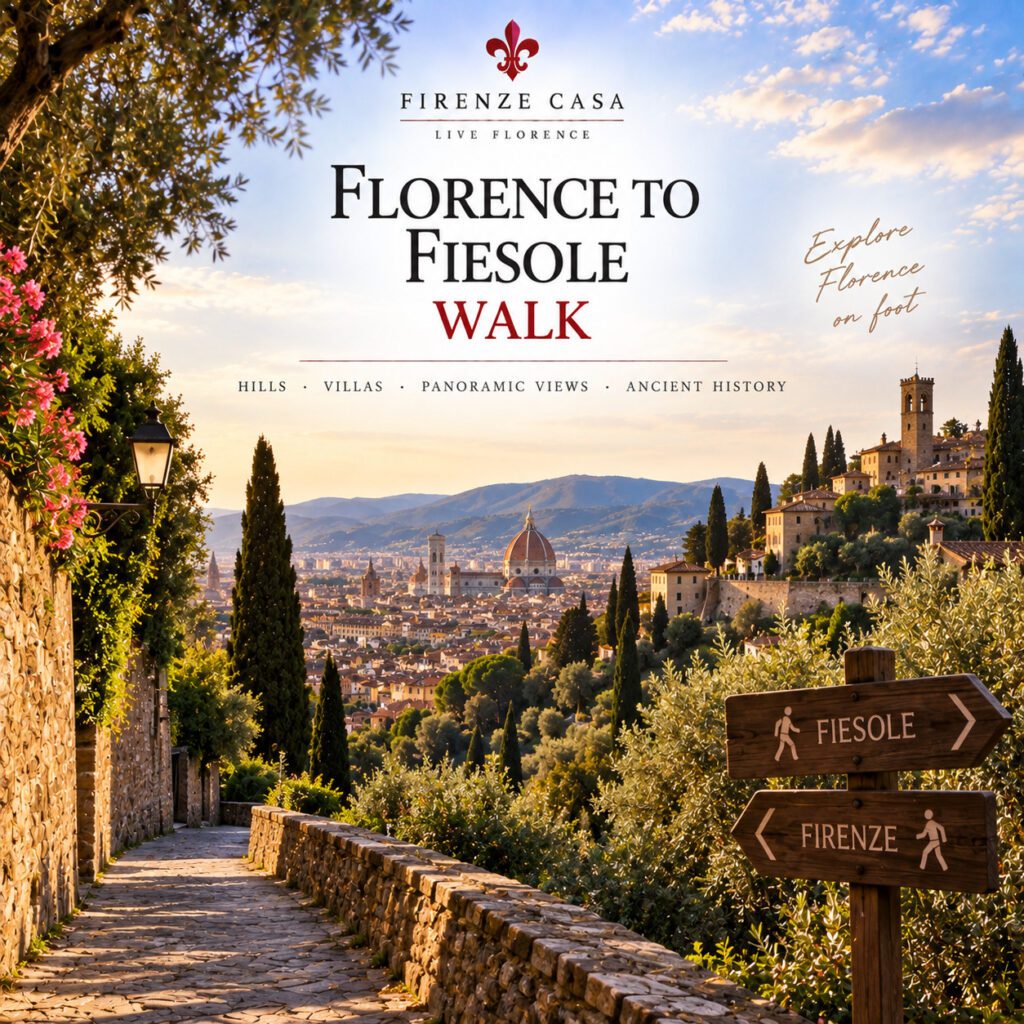
Leave the city behind on this Florence to Fiesole Walk, climbing from the northern edge of Florence into the hills that have framed the city for centuries. As the streets rise, dense urban Florence gradually gives way to villas, gardens, stone walls, olive trees and increasingly wide views across the valley.
Fiesole is close enough to Florence to feel connected to the city, yet its history and landscape are distinctly its own. This walk turns the journey between the two into part of the experience, revealing how Florence sits within a much larger Tuscan landscape rather than existing in isolation from it.
Distance:
Walking time:
Recommended time:
Start:
Finish:
Character: Hillside walk · Historic roads · Villas · Tuscan landscape · Panoramic views · Ancient Fiesole
Difficulty:
Walking Route Map
The map will show the final walking route from Florence to Fiesole, together with the numbered stops described below.
[WP Go Maps route will be added here]
The Walking Tour
1. The Northern Edge of Florence
Begin on the northern side of Florence, where the compact historic city gradually opens towards the hills. The change is not immediate. Urban streets continue northwards, but the slopes ahead increasingly dominate the view.
This geographical relationship is easy to overlook when exploring the historic centre. Florence lies in a basin framed by hills, and Fiesole occupies one of the most prominent positions above it. Walking there makes this relationship physically tangible.
Look back regularly during the climb. The view changes gradually, and some of the most interesting perspectives appear long before you reach Fiesole.
2. From the City towards the Hills
As the route begins to rise, Florence slowly changes character. Apartment buildings and busy streets become less dominant, while gardens, walls and larger properties begin to appear.
This transition is one of the reasons to walk rather than simply take the bus. The journey reveals the point at which urban Florence begins to merge with the landscape of the surrounding hills.
3. The Historic Roads to Fiesole
Routes between Florence and Fiesole existed long before modern roads and public transport. For centuries, people moved between the city and the hill settlements along roads that climbed through cultivated land, villas and religious properties.
Walking these slopes therefore follows a much older geographical connection. Florence and Fiesole have always been close neighbours, but the difference in elevation gives the journey between them a surprisingly distinct character.
Fiesole should not be thought of simply as a viewpoint above Florence. It is an ancient settlement with a history older than Roman Florentia, and the roads between the two places connect two very different chapters of Tuscan history.
4. Via Vecchia Fiesolana and the Hillside Landscape
The historic approach towards Fiesole passes through a landscape very different from central Florence. Stone walls, gates, villas and gardens line sections of the hillside, while glimpses between buildings reveal the valley below.
The route also demonstrates how intensely these hills have been shaped by people. What may initially appear to be a natural Tuscan landscape is actually the result of centuries of cultivation, building, terracing and careful management of the slopes.
5. Villas and Gardens above Florence
The hills between Florence and Fiesole have long attracted wealthy families, scholars, artists and foreign residents. Villas offered cleaner air, gardens and views while remaining remarkably close to the city.
High walls often conceal the properties themselves, but entrances, cypresses, garden vegetation and occasional views provide clues to the historic villa landscape. This quieter architectural world forms an important counterpart to the palaces of central Florence.
The high stone walls are part of the character of the route. Watch for gateways, old entrances, cypress-lined drives and glimpses into gardens – small details that reveal the historic villa landscape hidden behind them.
6. Views Back towards Florence
With increasing elevation, Florence begins to appear below. The Duomo is usually the easiest landmark to identify, but the wider view gradually reveals the scale of the city and the mountains and hills surrounding it.
From above, the relationship between Florence and the Arno valley becomes much clearer. The historic centre occupies only a small part of the modern urban area, while the surrounding landscape explains why particular roads, settlements and defensive positions developed where they did.
Do not wait for one supposedly perfect viewpoint. The pleasure of this walk lies in the changing perspectives – Florence repeatedly disappears behind walls and vegetation before reappearing from a different angle.
7. Approaching Fiesole
As the route approaches Fiesole, the character changes again. The hillside settlement becomes more concentrated and the streets begin to lead towards the historic centre of the town.
The arrival feels very different from reaching another district of Florence. Despite the short geographical distance, Fiesole has its own identity, history and relationship with the surrounding countryside.
8. Piazza Mino da Fiesole
Piazza Mino da Fiesole forms the civic and historic heart of the town. After the climb, the open square provides a natural place to pause and orient yourself before exploring Fiesole’s monuments.
The cathedral, historic buildings and streets around the piazza immediately establish that Fiesole is much more than a panoramic suburb of Florence. This was an important settlement centuries before Florence rose to dominance in the valley below.
9. Cathedral of San Romolo
The Cathedral of San Romolo is one of the principal landmarks of Fiesole. Its Romanesque character and tall campanile contribute strongly to the appearance of the historic centre.
After the Renaissance architecture of Florence, the cathedral introduces a different visual language. Its restrained forms suit the older and more compact character of the hill town.
Florence and Fiesole are separated by only a few kilometres, but their historic centres tell very different stories. The contrast becomes particularly clear when arriving on foot rather than travelling directly between them.
10. The Archaeological Area
Fiesole’s archaeological area reveals the ancient history beneath the modern town. The Roman theatre is its most immediately recognisable monument, accompanied by remains that document Fiesole’s importance in antiquity.
The site also places the relationship between Florence and Fiesole into a much longer historical perspective. Long before Renaissance Florence became one of Europe’s great cultural centres, this hill had already been occupied for centuries.
11. The Roman Theatre
The Roman theatre is one of Fiesole’s most atmospheric ancient monuments. Built into the natural slope, it demonstrates how Roman builders used the hillside itself as part of the architecture.
Its position also reinforces one of the recurring themes of the walk: landscape and settlement are inseparable here. The hill shaped not only the views but the development of Fiesole itself.
12. The Etruscan and Roman Heritage of Fiesole
Fiesole’s history extends beyond its Roman remains. The town developed from an important Etruscan settlement, and traces of this earlier period survive within the archaeological landscape.
This makes Fiesole an especially rewarding conclusion to a walk from Florence. The journey does not simply lead from city to countryside; it connects Florence with a settlement whose origins reach much further back into the history of Tuscany.
Fiesole helps place Florence in perspective. The hill town was already important in the Etruscan and Roman worlds, long before medieval and Renaissance Florence came to dominate the region.
13. The Climb above Piazza Mino
For a final change of perspective, continue above the main square into the higher part of Fiesole. The streets become quieter and the views increasingly open towards Florence and the surrounding countryside.
After walking uphill from the city, this final ascent feels like the natural culmination of the route. Florence now lies clearly below, embedded within the wider Tuscan landscape through which the walk has gradually climbed.
14. View over Florence
Finish at one of Fiesole’s elevated viewpoints. From here, Florence can be seen not as a collection of individual monuments but as an entire city occupying the valley below.
The Duomo remains the visual anchor, but the broader panorama is equally important. Hills, settlements, vegetation and the urban plain combine to show why the geography of Florence has played such an important role in its development.
Having reached this point on foot makes the view especially rewarding. The landscape below is no longer simply a panorama – it is the route you have just travelled.
Walk It in the Opposite Direction
This route works particularly well in reverse. Instead of climbing from Florence, take a bus to Fiesole, explore the historic centre and then walk downhill towards the city.
The downhill version is physically easier and has another important advantage: Florence increasingly appears ahead as you descend. The changing views become a continuous part of the walk rather than something you repeatedly turn around to see.
If you prefer to avoid a sustained uphill walk, travel to Fiesole by bus and walk back towards Florence. You still experience the historic hillside route, but with less climbing and frequent views towards the city ahead.
Optional Detours
Convent of San Francesco
Above the centre of Fiesole, the Convent of San Francesco rewards an additional climb. Its elevated setting offers a quieter atmosphere and provides another perspective over the surrounding landscape.
Museo Bandini
Visitors interested in medieval and Renaissance art can extend their time in Fiesole with the Museo Bandini. Its collection adds an artistic dimension to a route otherwise dominated by landscape, archaeology and architecture.
Badia Fiesolana
Another possible extension leads towards the Badia Fiesolana, an important religious complex on the slopes below Fiesole. Its architecture and long history provide an additional connection between the hill town and Renaissance Florence.
Where to Pause Along the Way
This walk rewards frequent short pauses rather than a single long stop. As the route climbs, changing views back towards Florence provide natural opportunities to rest and understand the landscape.
Piazza Mino is the obvious place for a longer break after reaching Fiesole. It also provides a convenient base from which to decide how much of the archaeological area and upper town you want to explore.
The higher viewpoints above the piazza make an especially satisfying final pause before returning to Florence.
Make This Walk Your Own
For a landscape-focused walk, concentrate on the climb itself and the changing views between Florence and Fiesole. Villas, gardens, stone walls and the surrounding hills become the main attractions.
History enthusiasts should allow more time after arriving in Fiesole. The cathedral, archaeological area and Roman theatre transform the route into a journey between two historic settlements rather than simply a panoramic walk.
For an easier version, begin in Fiesole and walk downhill towards Florence. This option preserves much of the character of the route while reducing the physical demands of the ascent.
This route is less about moving from monument to monument and more about experiencing a gradual transition. City streets become hillside roads, the skyline falls below you and Florence slowly becomes part of a much larger landscape.
Why This Walk Is Worth It
The Florence to Fiesole Walk is one of the best ways to understand the geographical setting of Florence. Leaving the historic city on foot reveals how quickly the dense urban landscape gives way to villas, gardens, stone walls and cultivated hillsides.
The changing views provide a perspective that cannot be experienced from the streets of the centre. Florence gradually becomes a city in a valley rather than a collection of individual monuments, while the surrounding Tuscan landscape becomes increasingly important.
Fiesole then adds an entirely different historical dimension. Its Etruscan and Roman heritage reminds visitors that the story of this landscape began long before Renaissance Florence. Whether walked uphill from Florence or downhill from Fiesole, the route connects two places whose histories have been intertwined for centuries.
Further Reading on Firenze Casa
Internal links to related Firenze Casa articles will be added here after completion of the Walking Tours cluster.
References
- Comune di Fiesole – historical and cultural information on Fiesole and its monuments.
- Musei di Fiesole – historical information on the archaeological area, Roman theatre and ancient Fiesole.
- FeelFlorence – cultural and visitor information on Fiesole and the hills surrounding Florence.
- Comune di Firenze – historical information on Florence’s northern districts and hillside landscape.
- UNESCO – historical documentation on the Historic Centre of Florence and its surrounding landscape.