
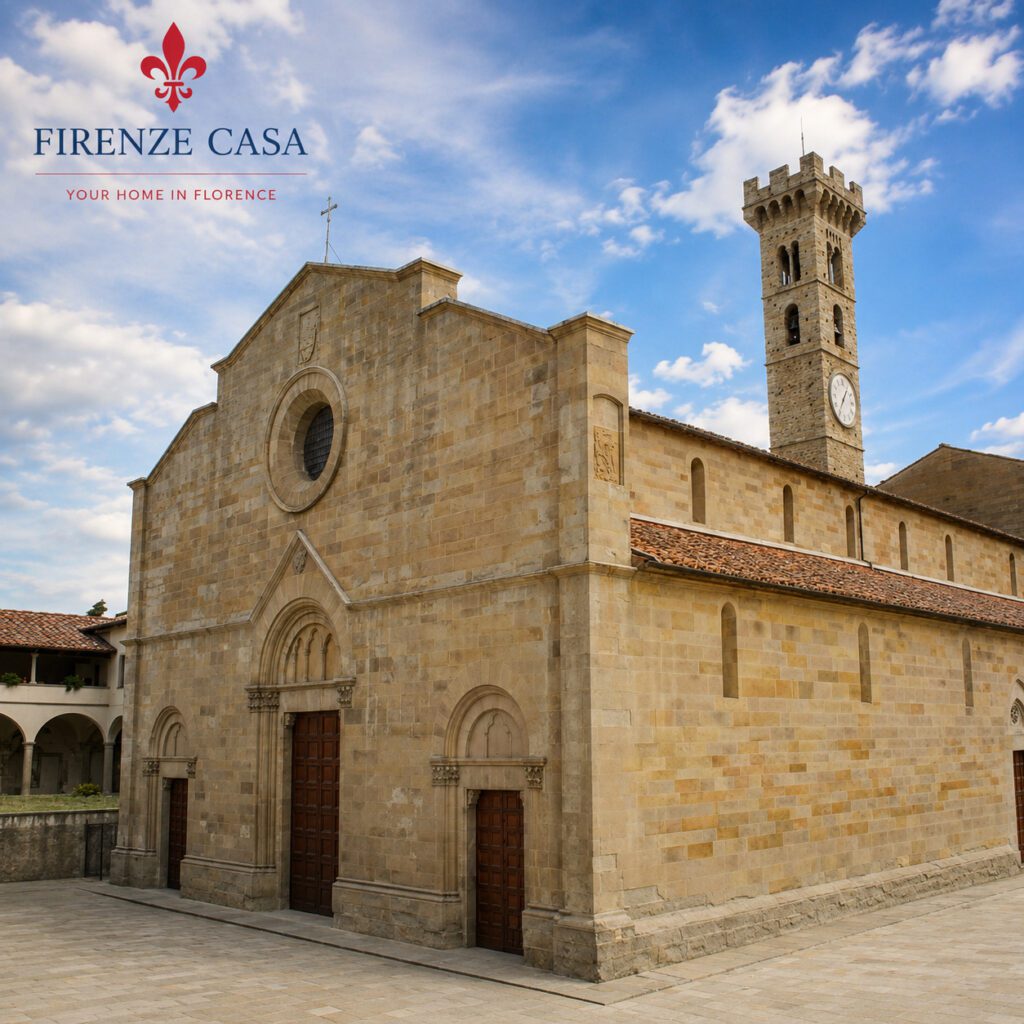
The Cathedral of Fiesole stands at the historic heart of this ancient hill town above Florence. Dedicated to San Romolo, the patron saint of Fiesole, the cathedral combines Romanesque architecture, medieval religious history and remarkable Renaissance art in one surprisingly understated building.
Visitors arriving in Piazza Mino da Fiesole may initially overlook the cathedral’s importance. Its restrained stone architecture is very different from the monumental churches of central Florence. Yet this simplicity is precisely part of its appeal. The Duomo reflects the older and quieter character of Fiesole itself.
The Cathedral of Fiesole is easy to combine with the Roman Theatre and Archaeological Area. Together, they reveal two very different chapters of Fiesole’s history within a relatively small area.
The Cathedral at the Heart of Fiesole
The Cathedral of Fiesole, officially the Cattedrale di San Romolo, occupies a prominent position close to Piazza Mino, the town’s central square. Its origins date to the 11th century, although later centuries brought several alterations and restorations.
The construction of San Romolo marked a major shift in the religious centre of Fiesole. The earlier episcopal complex was associated with the site of the Badia Fiesolana, making the two buildings closely connected chapters in the religious history of the town.
Despite later modifications, the medieval Romanesque structure of San Romolo remains clearly visible. Its solid proportions, stone surfaces and tall bell tower give the building an almost fortress-like appearance.
Who Was San Romolo?
The cathedral is dedicated to San Romolo, traditionally regarded as the first bishop and patron saint of Fiesole. His story forms an important part of the town’s religious identity.
According to Christian tradition, Romolo was an early missionary associated with the establishment of Christianity in the area. Over the centuries, devotion to him became closely linked with Fiesole and its episcopal history.
The connection remains alive today. San Romolo is still celebrated as the patron saint of Fiesole, and his feast on 6 July remains an important local religious occasion.
The remains traditionally associated with San Romolo and four companions are kept in the cathedral crypt. The crypt therefore remains an important religious space rather than simply an architectural curiosity.
Romanesque Architecture in the Hills Above Florence
The architectural character of the Cathedral of Fiesole differs considerably from the elaborate Renaissance churches encountered in Florence. Its strength lies in clarity, proportion and structural simplicity.
Inside, three naves divide the church. Columns and arches establish a steady rhythm leading towards the elevated presbytery. The arrangement preserves much of the atmosphere associated with medieval Tuscan church architecture.
Wooden roof structures and restrained stone surfaces reinforce this impression. Rather than overwhelming visitors with decoration, the interior directs attention towards space, structure and individual works of art.
The Bell Tower
The cathedral’s tall bell tower is one of the most recognizable landmarks in central Fiesole. Its origins date to the 13th century, although it underwent reconstruction during the 17th century.
From various points around the town, the tower rises above the roofs and helps define Fiesole’s distinctive skyline. It also creates an interesting visual link between the religious centre of the town and the surrounding Tuscan landscape.
The Crypt of the Cathedral of Fiesole
One of the most atmospheric parts of the Cathedral of Fiesole lies beneath the presbytery. Here visitors encounter the cathedral’s elegant crypt, a space that feels considerably older and more intimate than the church above.
The crypt illustrates how medieval churches often developed vertically as well as horizontally. Sacred spaces could occupy different levels, each serving a particular liturgical or devotional purpose.
Its association with San Romolo gives the space additional significance. The saint’s remains, together with those traditionally attributed to four companions, are preserved here.
Do not leave after seeing only the main nave. The crypt is one of the most memorable parts of the cathedral and helps reveal the building’s medieval character.
The Salutati Chapel and Mino da Fiesole
The cathedral also contains an important Renaissance contrast to its Romanesque architecture. In the presbytery is the chapel dedicated to Bishop Leonardo Salutati.
Salutati served as Bishop of Fiesole during the 15th century and commissioned an elegant funerary chapel that reflects the artistic culture of Renaissance Florence.
The chapel contains sculptural work by Mino da Fiesole, one of the notable Tuscan sculptors of the period. Born nearby, Mino developed a reputation for refined marble portraits, tomb monuments and religious sculpture.
The presence of his work creates a fascinating dialogue between two periods. Medieval architecture provides the setting, while Renaissance sculpture introduces the artistic language that transformed Florence and its surroundings during the 15th century.
A Renaissance Layer Inside a Medieval Cathedral
This juxtaposition makes the cathedral especially interesting. Fiesole was never frozen in a single historical period. Instead, successive generations adapted its buildings while preserving important elements of the past.
The Cathedral of Fiesole therefore tells several stories simultaneously. Its structure recalls medieval Tuscany, while the Salutati Chapel demonstrates the artistic connections between Fiesole and Renaissance Florence.
Mino da Fiesole’s presence here is particularly appropriate. The sculptor’s name itself reflects his connection with the town, while his career eventually took him far beyond Tuscany.
Fiesole and Its Ancient Religious History
The cathedral stands within a town whose history reaches much further back than Christianity. Fiesole developed as an important Etruscan settlement before becoming part of the Roman world.
Its strategic hilltop position allowed control over routes through this part of Tuscany. The nearby archaeological area of Fiesole preserves evidence of both Etruscan and Roman occupation.
This long chronology makes a walk through central Fiesole particularly rewarding. Within a short distance, visitors can move from ancient archaeological remains to a medieval cathedral and Renaissance works of art.
The Cathedral and the Badia Fiesolana
The religious history of Fiesole becomes even clearer when the cathedral is considered together with the Badia Fiesolana.
The site of the Badia played an important role in the earlier episcopal history of Fiesole before San Romolo became the cathedral in the 11th century. The construction of the new cathedral in the centre of Fiesole marked an important shift in the religious geography of the town.
Centuries later, the Badia acquired another remarkable chapter when Cosimo de’ Medici supported its transformation during the Renaissance. Today, the complex is associated with the European University Institute.
Visiting both sites therefore provides an unusually broad journey through Fiesole’s history, from medieval ecclesiastical institutions to Renaissance patronage and modern European academic life.
What to Look for Inside the Cathedral
The Cathedral of Fiesole rewards slow observation. Instead of approaching it as a church dominated by one spectacular masterpiece, look at the relationship between architecture, sculpture and history.
- The Romanesque arrangement of the three naves
- The elevated presbytery
- The medieval crypt beneath the presbytery
- The Chapel of Bishop Leonardo Salutati
- The sculptures associated with Mino da Fiesole
- The contrast between medieval stone architecture and Renaissance decoration
These elements reveal how the building changed over centuries while retaining its fundamental medieval identity.
Exploring Piazza Mino and Central Fiesole
The cathedral’s location makes it an ideal starting point for exploring Fiesole on foot. Piazza Mino forms the social and geographical centre of the town, while several important sights lie nearby.
The Roman Theatre and archaeological zone are only a short walk away. They preserve remains of the ancient settlement, including the theatre, baths and an Etruscan-Roman temple.
From the centre, visitors can also walk uphill towards San Francesco in Fiesole. The climb is short but steep, and viewpoints along the route reveal magnificent panoramas towards Florence and the surrounding countryside.
For a half-day in Fiesole, combine the Cathedral of San Romolo, the archaeological area and Roman Theatre, Piazza Mino and San Francesco. Together they provide an excellent introduction to the town.
Why Visit the Cathedral of Fiesole?
Florence naturally attracts visitors with some of the world’s most celebrated churches. Fiesole offers something different.
The Duomo of San Romolo feels quieter and more closely connected to the everyday life of its town. Its architecture does not compete with the scale of Florence Cathedral or Santa Croce. Instead, it preserves the atmosphere of an old Tuscan episcopal centre.
The cathedral also helps explain why Fiesole deserves more than a brief stop for panoramic views. This small hill town contains layers of history ranging from the Etruscans and Romans to medieval bishops, Renaissance patrons and modern institutions.
Visiting the Cathedral from Florence
Fiesole lies only a few kilometres northeast of central Florence and can easily be visited as a half-day excursion. Public transport connects Florence with the centre of Fiesole, while the journey itself gradually climbs into the hills.
Once in Fiesole, most major sights can be explored on foot. The cathedral occupies a central position, making orientation particularly easy.
Visitors should remember that San Romolo remains an active place of worship. Religious services and celebrations can affect access, so respectful behaviour and appropriate clothing are recommended.
Fiesole is particularly pleasant in the morning or later afternoon, when you can combine its monuments with a walk through the town and views across the hills towards Florence.
A Different Perspective on Florence
Visiting the Cathedral of Fiesole also changes the way you understand Florence itself. Long before Florence became the dominant city of the region, Fiesole already occupied an important strategic position in northern Tuscany.
The two cities eventually developed very different identities. Florence expanded along the Arno and became one of Europe’s great commercial and artistic centres. Fiesole retained the atmosphere of a smaller hill town shaped by ancient remains, religious institutions and villas overlooking the valley.
The Duomo of San Romolo stands at the centre of that story. Modest in scale but rich in history, it connects medieval Fiesole with the Renaissance world of Florence and with traditions that remain alive in the town today.
Frequently Asked Questions About the Cathedral of Fiesole
When was the Cathedral of Fiesole built?
The Cathedral of San Romolo dates to the 11th century. Later alterations and restorations changed parts of the building while preserving its fundamental Romanesque character.
Who is San Romolo?
San Romolo is traditionally regarded as the first bishop and patron saint of Fiesole. His feast is celebrated in the town on 6 July.
What can you see inside the Cathedral of Fiesole?
Highlights include the Romanesque nave, medieval crypt and the Renaissance Salutati Chapel. The cathedral also contains important sculpture associated with Mino da Fiesole.
Where are the remains of San Romolo kept?
The remains traditionally associated with San Romolo are preserved in the cathedral crypt. The crypt is one of the most atmospheric parts of the church.
What is the connection between the Cathedral and Badia Fiesolana?
The site of the Badia was associated with the earlier episcopal centre of Fiesole. San Romolo subsequently became the town’s cathedral during the 11th century.
What can you visit near the Cathedral of Fiesole?
The Roman Theatre and Archaeological Area are only a short walk away. San Francesco, Piazza Mino and the historic centre can also easily be combined with a cathedral visit.
Is the Cathedral of Fiesole worth visiting?
Yes. Its Romanesque architecture, crypt and Renaissance art reveal an important part of Fiesole’s history that is very different from the monumental churches of Florence.
Further Reading on Firenze Casa
Continue exploring Fiesole and the hills above Florence:
- Fiesole – History, Etruscans and the Hills Above Florence
- Badia Fiesolana – A Renaissance Monastery near Florence
- Roman Theatre and Archaeological Area of Fiesole
- San Francesco in Fiesole
- Etruscan Fiesole – Origins of the Ancient Hill Town
- The Renaissance in Florence – Art, Architecture and a New World
References
- Comune di Fiesole – official information and cultural heritage resources
- FeelFlorence – Cattedrale di San Romolo
- Diocese of Fiesole – Cathedral of San Romolo
- Comune di Fiesole – celebrations and traditions of San Romolo
- FeelFlorence – Archaeological Museum and Archaeological Area of Fiesole
- Comune di Fiesole – Badia Fiesolana

