
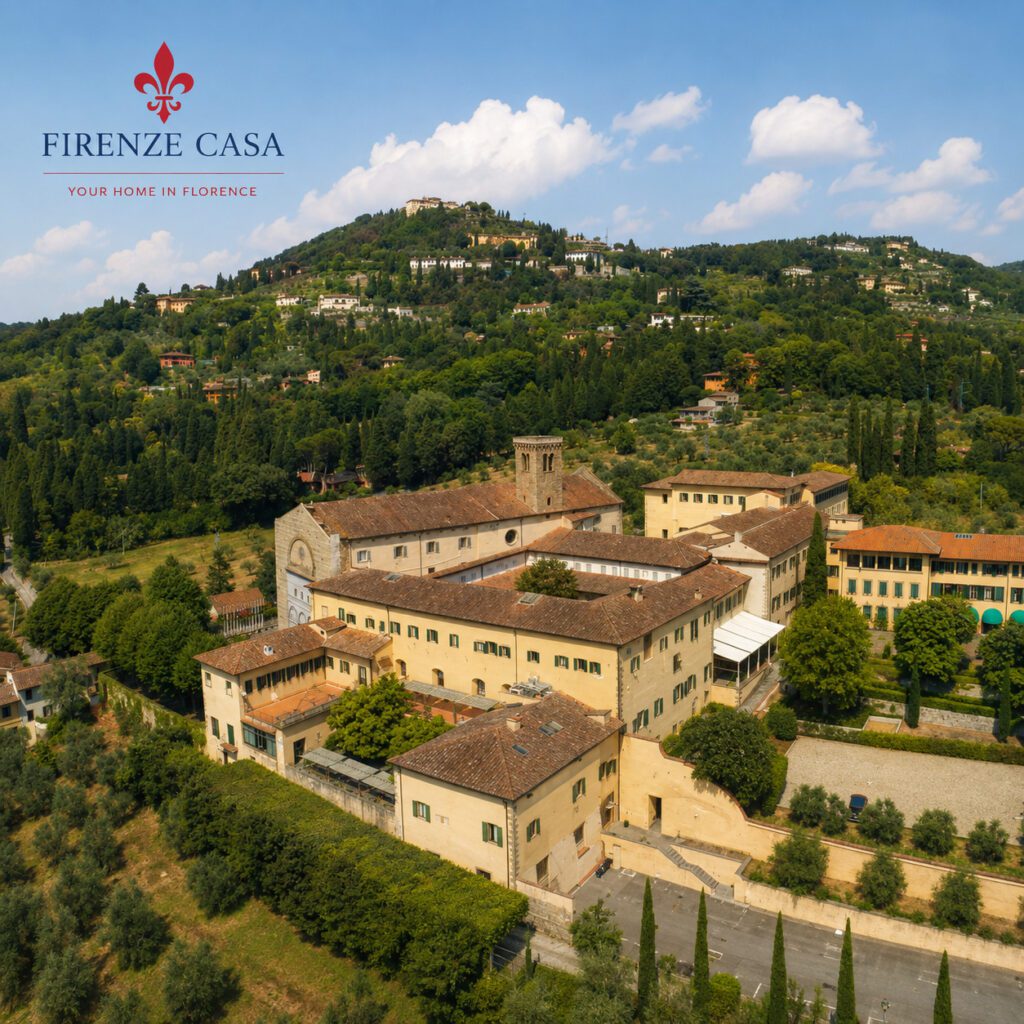
Badia Fiesolana stands on the hillside between Florence and the historic centre of Fiesole. Its quiet stone buildings tell a remarkable story that stretches from medieval Christianity to Medici patronage, Renaissance architecture and modern European academic life.
Visitors travelling directly from Florence to Piazza Mino can easily pass the monastery without realising its importance. Yet the Badia belongs to the essential historic sites of Fiesole. It also reveals how closely the hill town became connected with the cultural world of Renaissance Florence.
🌿 Why Visit the Badia Fiesolana?
The Badia offers something very different from the crowded monuments of central Florence. Medieval religious history, Medici ambition and Renaissance architecture meet in a peaceful hillside setting only a short distance from the city.
The Origins of the Badia Fiesolana
The history of the Badia Fiesolana reaches deep into the Middle Ages. The site served an important religious role long before the Renaissance transformed Florence and the surrounding hills.
An early cathedral of Fiesole stood in this area before the episcopal centre moved to the present Cathedral of San Romolo on Piazza Mino in the eleventh century. The old religious complex subsequently developed into a monastic institution.
This early history explains why the Badia occupies such an important position in the religious landscape of Fiesole. It connects the later Renaissance monastery with a Christian tradition that reaches much further into the past.
From Cathedral to Monastery
The movement of the cathedral to the centre of Fiesole changed the function of the earlier complex. Religious communities continued to use the site, and over time the buildings evolved into the monastery now known as the Badia Fiesolana.
The word badia itself means abbey. Like the Badia Fiorentina in central Florence, the name reflects the monastic history of the institution rather than the architectural appearance of a conventional parish church.
For centuries, the community occupied a strategic location between Florence and Fiesole. The road through San Domenico connected the city in the Arno Valley with the older hill town above.
💡 Did You Know?
The religious importance of the site predates the present Cathedral of San Romolo on Piazza Mino. The Badia therefore preserves part of the early Christian history of Fiesole that visitors may otherwise overlook.
The Romanesque Façade of the Badia Fiesolana
One of the most striking features of the Badia is its façade. White and green marble forms geometric patterns that immediately recall medieval Tuscan architecture.
Only part of the intended decorative programme survives. This gives the façade an unusual appearance: the lower section displays elaborate marble decoration, while the upper part remains comparatively simple.
The contrast makes the church particularly memorable. It also allows visitors to see different phases of the building’s long architectural history at once.
The marble vocabulary recalls other important religious buildings in Florence and Fiesole. Yet the scale and hillside setting give the Badia a much quieter character.
Cosimo de’ Medici and the Transformation of the Badia
The most important transformation of the Badia Fiesolana came during the fifteenth century. At this point, the monastery entered directly into the cultural world of the Medici family.
Cosimo de’ Medici became a major patron of the complex. His support belonged to a much broader programme of religious, architectural and intellectual patronage that helped shape Renaissance Florence.
Cosimo financed monasteries, churches, libraries and works of art while cultivating relationships with religious communities and humanist scholars. Such projects expressed personal devotion, but they also strengthened the cultural prestige of the Medici family.
At the Badia Fiesolana, this patronage helped transform an ancient religious institution into a Renaissance monastic complex.
🏛️ Medici Florence Beyond the City Walls
The Medici did not shape Florence only through urban palaces and churches. Their patronage extended into the surrounding hills, where monasteries, villas and religious institutions became part of the cultural landscape of Renaissance Tuscany.
Renaissance Architecture at the Badia Fiesolana
The fifteenth-century rebuilding gave the monastery much of its present architectural character. The design reflects the new Renaissance preference for proportion, clarity and harmonious spaces.
Rather than relying on the dramatic verticality of Gothic architecture, the monastic buildings use balanced forms and repeated architectural elements. Courtyards and communal spaces create an atmosphere suited to study, prayer and contemplation.
The result connects the Badia with the architectural revolution taking place in Florence below. Renaissance ideas did not remain confined within the city walls. They spread into villas, monasteries and religious complexes throughout the surrounding landscape.
Was Brunelleschi the Architect of the Badia?
The architectural history of the Badia has long attracted discussion because its Renaissance forms resemble the language associated with Filippo Brunelleschi and his circle.
Older accounts frequently connected Brunelleschi directly with the fifteenth-century transformation. Modern scholarship has treated individual attributions more cautiously, and Michelozzo has also played an important role in discussions of the complex.
For visitors, the exact attribution matters less than the broader historical context. The Badia clearly belongs to the architectural culture that emerged in Florence during the generation of Brunelleschi, Michelozzo and Cosimo de’ Medici.
Its proportions, monastic layout and restrained elegance reflect that changing Renaissance understanding of architectural space.
The Cloister and Monastic Life
The cloister is one of the most atmospheric parts of the Badia. Arcades frame a quiet central space and create a clear boundary between communal architecture and the outside world.
Such spaces formed an essential part of monastic life. Monks could move between church, living quarters, study areas and communal rooms while remaining within the protected environment of the monastery.
The architecture encouraged regularity and contemplation. Repeated arches and measured proportions created an ordered setting that reflected the rhythm of religious life.
👀 What to Notice
Look at the relationship between the cloister and the surrounding buildings. The Badia is best understood as an entire monastic environment rather than simply as a church with adjoining rooms.
The Badia Fiesolana and Renaissance Humanism
The monastery’s importance extended beyond religious architecture. Fifteenth-century Florence developed an extraordinary intellectual culture in which classical texts, philosophy, theology and humanist scholarship interacted closely.
Cosimo de’ Medici actively supported this world. He collected manuscripts, encouraged scholars and financed institutions where religious and intellectual life could develop together.
The hills around Florence provided an ideal environment for these activities. They offered relative tranquillity while remaining close to the political and cultural centre of the city.
The Badia therefore belongs to a broader landscape of Renaissance learning that connected Florence with Fiesole and the surrounding villas.
San Domenico and the Road Between Florence and Fiesole
The location of the Badia is essential to understanding it. The complex stands near San Domenico, below the historic hilltop centre of Fiesole.
This position places it along the historic route connecting Florence and Fiesole. Travellers moving between the city and the hill town passed through an area filled with religious institutions, villas and cultivated land.
Even today, travelling through San Domenico reveals how quickly the dense urban environment of Florence gives way to a greener hillside landscape.
The Badia sits precisely within this transition.
How the Badia Connects Fiesole and Renaissance Florence
The Badia Fiesolana illustrates an important point about Fiesole. The town did not simply preserve an ancient past separate from Florence.
By the Renaissance, the relationship between the two places had become increasingly close. Florentine families built villas in the hills, religious institutions received patronage from wealthy citizens and intellectual life moved regularly between city and countryside.
The Medici presence at the Badia demonstrates this connection particularly clearly.
Ancient Fiesole looked down towards a younger settlement in the Arno Valley. Centuries later, Renaissance Florence had become the dominant cultural and political power, while the hills around Fiesole offered places for retreat, learning and patronage.
The European University Institute and the Badia Today
The story of the Badia does not end with the Renaissance. Today, the complex has acquired an entirely different intellectual role through its association with the European University Institute.
The institute is an international centre for postgraduate and postdoctoral research in the social sciences and humanities. Its presence has returned scholarship and intellectual exchange to the historic buildings in a modern European context.
This creates a remarkable continuity. A site once associated with monastic study and Renaissance patronage now participates in contemporary academic life.
📚 From Monastery to European Scholarship
Few historic sites around Florence connect such different intellectual worlds. Medieval religious life, Renaissance humanism and modern European research have all left their mark on the Badia Fiesolana.
Can You Visit the Badia Fiesolana?
The Badia differs from a conventional tourist attraction because parts of the historic complex serve contemporary institutional functions.
Visitors should therefore not assume that every part of the monastery is freely accessible at all times. Access arrangements can vary according to institutional activities and events.
The church and exterior remain historically interesting even when access to other areas is limited. Anyone planning a special visit should check current information beforehand.
What to See Around the Badia Fiesolana
The surrounding area contains several places that make the Badia particularly easy to include in a wider exploration of Fiesole.
San Domenico lies nearby, while the road continues uphill towards Piazza Mino and the Cathedral of San Romolo. From there, visitors can continue to the Roman Theatre and Archaeological Area of Fiesole.
Visitors can then continue further towards San Francesco in Fiesole for one of the finest elevated views towards Florence.
The journey therefore creates a natural historical sequence: Renaissance connections around San Domenico and the Badia, medieval Christianity around the cathedral and much older Etruscan history in Fiesole and the Roman archaeological zone.
Badia Fiesolana and the Fiesole Landscape
The landscape surrounding the monastery deserves attention in its own right. Olive trees, villas, stone walls and wooded hills form part of the historic relationship between Florence and its countryside.
Wealthy Florentine families increasingly valued the hills around Fiesole as places of retreat. The elevation offered cooler summer temperatures, cleaner air and extensive views while remaining close to the city.
Religious institutions occupied the same landscape for different reasons. Quiet hillside locations encouraged contemplation and separation from the bustle of urban life.
The Badia brings these worlds together: monastery, Renaissance patronage, landscape and intellectual retreat.
🌿 Firenze Casa Tip
Do not think of the Badia as an isolated monument. Its location between Florence and Fiesole is part of the experience. The surrounding road through San Domenico reveals the transition from the city to the historic Tuscan hill landscape particularly well.
Frequently Asked Questions About Badia Fiesolana
What is the Badia Fiesolana?
Badia Fiesolana is a historic monastic complex on the hillside between Florence and Fiesole. Its history combines medieval religious traditions with Renaissance architecture and Medici patronage.
How old is the Badia Fiesolana?
The religious history of the site reaches back to the Middle Ages, before the cathedral of Fiesole moved to Piazza Mino. The complex was substantially transformed during the Renaissance.
What did the Medici have to do with the Badia?
Cosimo de’ Medici became an important patron of the monastery during the fifteenth century. His support helped transform the ancient religious site into a Renaissance monastic complex.
Did Brunelleschi design the Badia Fiesolana?
The attribution is not certain. Brunelleschi has traditionally been associated with the Renaissance rebuilding, while Michelozzo has also figured prominently in discussions of its architecture.
Can you visit the Badia Fiesolana?
Parts of the complex have contemporary institutional uses, so access can vary. Visitors planning to see the interior should check current arrangements before making a special trip.
What is the Badia Fiesolana used for today?
The historic complex is associated with the European University Institute. This gives the former monastery a modern academic role while continuing its long connection with learning.
What can you see near the Badia Fiesolana?
The Cathedral of San Romolo, Fiesole’s archaeological area and San Francesco are all nearby. Together they make it easy to explore the medieval, Roman and Renaissance layers of Fiesole.
Why the Badia Fiesolana Is Worth Discovering
The Badia will never compete with the Duomo or Santa Croce in scale or fame. That is precisely why it adds something valuable to a visit to the Florence region.
Its history stretches from the medieval Church of Fiesole into the Renaissance world of Cosimo de’ Medici. Architecture demonstrates the changing artistic ideals of fifteenth-century Tuscany, while the monastery’s modern academic role adds an unexpected final chapter.
Above all, the Badia helps explain the close relationship between Florence and Fiesole.
Florence shaped Renaissance culture in the valley below, but that culture extended far beyond the city walls. Villas, monasteries and intellectual communities spread through the surrounding hills.
Badia Fiesolana remains one of the clearest places to see that wider Renaissance landscape.
Further Reading on Firenze Casa
- Fiesole – History, Etruscans and the Hills Above Florence
- Roman Theatre and Archaeological Area of Fiesole
- Cathedral of Fiesole – The Duomo of San Romolo
- San Francesco in Fiesole
- Etruscan Fiesole – Origins of the Ancient Hill Town
- The Medici Family – The Dynasty That Shaped Florence
- The Renaissance in Florence – Art, Architecture and a New World
References
- Comune di Fiesole – Badia Fiesolana.
- European University Institute – Badia Fiesolana and historical campus information.
- Diocesi di Fiesole – History of the Diocese and early cathedral tradition.
- Comune di Fiesole – Historical and cultural heritage of Fiesole.
- Touring Club Italiano – Firenze e dintorni.
- Studies on Medici patronage and Renaissance architecture in Florence and Fiesole.

