
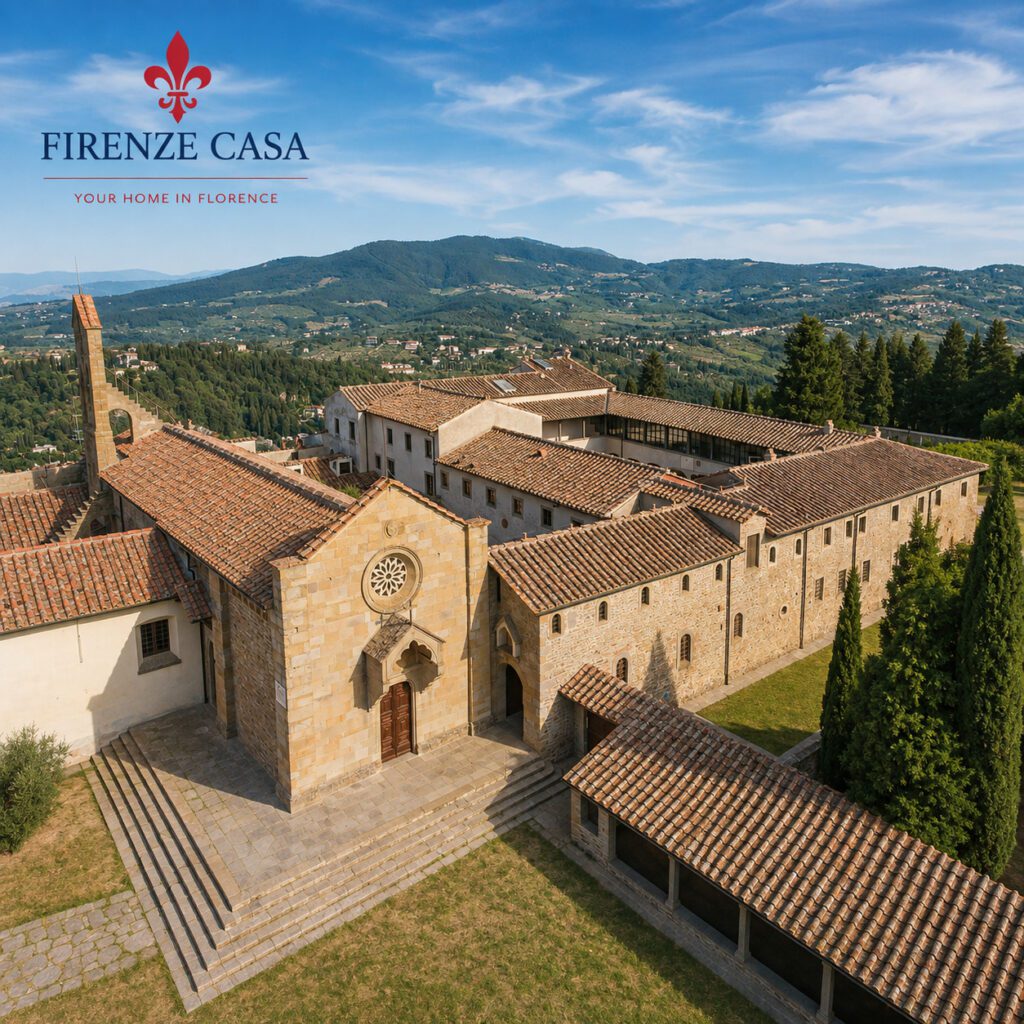
San Francesco in Fiesole stands on one of the highest points of the historic hill town above Florence. Reached by a short but steep climb from Piazza Mino, the Franciscan complex rewards visitors with a peaceful church, centuries of religious history and beautiful views across the Tuscan landscape.
While many visitors come to Fiesole for its Etruscan and Roman remains, San Francesco reveals another side of the town. Its quiet courtyards, modest architecture and elevated position create a striking contrast with the monumental churches of central Florence.
It is also one of those places where the journey forms part of the experience. As you climb above the centre of Fiesole, the streets become quieter and the surrounding landscape gradually opens below you.
Firenze Casa Tip
Do not visit San Francesco only for the monastery. Take your time on the climb from Piazza Mino and stop at the viewpoints along the way. The changing perspectives towards Florence are part of the experience.
High Above the Centre of Fiesole
San Francesco occupies the hill traditionally associated with the ancient acropolis of Fiesole. Its position immediately explains why this small religious complex feels so different from the churches below.
The walk begins close to Piazza Mino, the heart of modern Fiesole. From there, Via San Francesco climbs steeply towards the monastery. Although the distance is short, comfortable shoes are useful because of the gradient and historic paving.
At the top, the atmosphere changes noticeably. The central square feels surprisingly distant, despite being only a few minutes away.
The History of San Francesco in Fiesole
The history of San Francesco in Fiesole is closely connected with the religious development of the hill above the town. Before the Franciscans established themselves here, the site had already served religious purposes.
The present complex developed during the Middle Ages and became associated with the Franciscan order. Over subsequent centuries, the friars expanded and adapted the buildings while preserving the modest character expected of a Franciscan community.
This simplicity remains one of the site’s greatest attractions. San Francesco was not designed to compete with the grand basilicas of Florence. Instead, architecture, landscape and religious life form a much quieter ensemble.
Did you know?
The hill occupied by San Francesco forms part of the ancient upper area of Fiesole. Visiting the monastery therefore adds another historical layer to a town whose story reaches back to the Etruscans.
The Church of San Francesco
The church itself reflects the restrained architectural language associated with Franciscan spirituality. Its relatively simple exterior gives little indication of the atmosphere found inside.
The interior is intimate rather than monumental. Stone, wood and historic artworks create a setting that encourages visitors to look slowly rather than search for one spectacular masterpiece.
Several works of art testify to the long history of the church and its relationship with Florentine artistic culture. Yet they remain integrated into a space whose overall character is one of simplicity.
A Different Kind of Florentine Church
After visiting Florence’s great basilicas, San Francesco can feel remarkably modest. That difference is precisely what makes it interesting.
Here, architecture does not dominate the visitor. The small scale makes it easier to imagine the building as part of a functioning religious community rather than primarily as a monumental attraction.
The Franciscan Convent
The convent adjoining the church preserves the intimate scale of a traditional Franciscan monastery. Cloistered spaces, small rooms and simple architectural details reflect the daily life of the friars who lived here.
Parts of the complex allow visitors to understand how prayer, work and communal life once fitted together within a relatively compact space. Rather than presenting history through monumental halls, the monastery tells its story through corridors, cells, courtyards and small devotional spaces.
What to notice
Look beyond individual artworks and observe the scale of the rooms and cloisters. San Francesco is particularly interesting as an example of how a religious community actually lived.
A Place of Silence Above Florence
One of the strongest impressions at San Francesco comes not from an individual artwork but from the atmosphere of the site.
The elevated location separates the monastery from the activity around Piazza Mino below. Sounds become softer, vegetation becomes more prominent and the landscape takes over.
This relationship between architecture and nature is characteristic of many religious sites in the hills of Florence. At San Francesco, however, the transition from town centre to secluded hillside monastery happens within only a few minutes.
The Views from San Francesco in Fiesole
For many travellers, the panoramic setting is one of the highlights of a visit to San Francesco in Fiesole. The hill offers broad perspectives across the surrounding countryside and towards Florence.
Fiesole rises above the Arno valley, and its elevated position has shaped the town throughout its history. From viewpoints near San Francesco, the geographical relationship between Fiesole and Florence becomes particularly clear.
The dense urban fabric of Florence occupies the valley below, while wooded slopes, villas, gardens and olive groves surround Fiesole. This contrast helps explain why the hills became a preferred retreat for wealthy Florentine families over the centuries.
Firenze Casa Insight
The view is more than a beautiful panorama. From the hills of Fiesole, you can understand the geography of Florence in a way that is almost impossible from inside the historic centre.
From Ancient Fiesole to the Franciscans
San Francesco becomes even more interesting when placed within the wider history of Fiesole. The town was already important long before medieval Florence emerged as the dominant centre of the region.
Etruscan communities occupied the hill, and the Romans later developed Fiesole with a theatre, baths, temples and other public structures. Important remains survive in today’s Roman Theatre and Archaeological Area of Fiesole.
Christian institutions subsequently reshaped the town. The Cathedral of San Romolo became its episcopal centre, while monasteries and convents occupied other important locations.
San Francesco represents another chapter in this long transformation. Its hilltop setting connects medieval Christian Fiesole with a landscape that had been significant for many centuries before the Franciscans arrived.
San Francesco and the Cathedral of Fiesole
The relationship between San Francesco and the Cathedral of San Romolo is particularly easy to appreciate on foot.
The cathedral stands close to Piazza Mino at the heart of the town, while San Francesco rises above it on the hill. Walking between them creates a natural journey through two different expressions of religious architecture.
The cathedral reflects the institutional importance of the bishopric. San Francesco feels more secluded and contemplative. Visiting both provides a much fuller picture of Fiesole’s Christian heritage.
What to See at San Francesco
Although the complex is relatively small, several elements deserve attention:
- The historic Church of San Francesco
- The Franciscan convent and its intimate monastic spaces
- The cloister and architectural details
- Historic religious artworks
- The elevated setting above Fiesole
- The panoramic viewpoints along the approach
Allow enough time to enjoy the surroundings rather than treating San Francesco as a quick sightseeing stop.
Walking Up from Piazza Mino
The most rewarding way to reach San Francesco is on foot from Piazza Mino. The climb is steep in places, but relatively short.
As you ascend, turn around occasionally. Each section of the route reveals a slightly different perspective across Fiesole and towards the valley. At the top, spend some time exploring the church and monastery before returning to the centre.
Practical Tip
The climb is short but quite steep. In summer, visiting in the morning or later afternoon is usually more pleasant than walking uphill during the hottest part of the day.
Combine San Francesco with the Archaeological Area
San Francesco fits naturally into a half-day exploration of Fiesole. Start around Piazza Mino and visit the Cathedral of San Romolo before exploring the nearby archaeological area.
The Roman Theatre is one of the most impressive surviving monuments of ancient Fiesole. Together with the baths, temple remains and evidence of earlier Etruscan settlement, it reveals how important the town was in antiquity.
Afterwards, climb towards San Francesco. Following this route creates an almost chronological journey through the town, from ancient Fiesole to medieval Christianity and the later Franciscan tradition.
San Francesco and the Hills of Fiesole
Fiesole has always been closely connected with its landscape. The surrounding hills contain historic villas, gardens, monasteries and old routes linking settlements outside Florence.
San Francesco provides an excellent introduction to this relationship. From here, Fiesole no longer feels simply like a small town overlooking Florence. Instead, it becomes part of a much larger cultural landscape of olive groves, cypress trees, historic estates and wooded hills.
The same relationship between settlement and landscape can be explored more broadly in our guide to the Hills of Florence.
Why San Francesco in Fiesole Is Worth Visiting
There are more famous churches in Tuscany and more celebrated viewpoints around Florence. Yet few places combine history, landscape and tranquillity as naturally as San Francesco.
The monastery does not require a long visit. Its appeal comes from the combination of the climb, the historic buildings, the Franciscan atmosphere and the surrounding landscape.
For travellers who want to experience Fiesole beyond its Roman Theatre and central square, it is one of the town’s most rewarding places.
A Firenze Casa Favourite
San Francesco is a perfect example of why Fiesole deserves more than a quick visit for the view. History, architecture and the Tuscan landscape come together here within a few minutes’ walk of the town centre.
Frequently Asked Questions About San Francesco in Fiesole
Where is San Francesco in Fiesole?
San Francesco stands on the hill above Piazza Mino in the historic centre of Fiesole. It is reached by a short but steep uphill walk.
Why is San Francesco in Fiesole worth visiting?
The monastery combines Franciscan history, a peaceful atmosphere and panoramic views. It also offers a quieter contrast to Fiesole’s archaeological attractions.
Is the walk to San Francesco difficult?
The walk is relatively short but steep, with historic paving in places. Comfortable shoes are recommended, especially during hot weather.
What can you see at San Francesco?
Visitors can explore the historic church, convent spaces and cloister. The elevated setting and viewpoints along the approach are also an important part of the visit.
Can you see Florence from San Francesco?
Yes. Viewpoints around the hill provide broad perspectives towards Florence, the Arno valley and the surrounding Tuscan landscape.
What should you combine with San Francesco?
The Cathedral of San Romolo and the Roman Theatre and Archaeological Area are the most natural combination. Together they reveal several different periods of Fiesole’s history.
How much time do you need at San Francesco?
The complex itself does not require a long visit, but allow extra time for the climb and viewpoints. It works particularly well as part of a half-day exploration of Fiesole.
Further Reading on Firenze Casa
- Fiesole – History, Etruscans and the Hills Above Florence
- Roman Theatre and Archaeological Area of Fiesole
- Cathedral of Fiesole – The Duomo of San Romolo
- Etruscan Fiesole – Origins of the Ancient Hill Town
- Badia Fiesolana – A Renaissance Monastery near Florence
- The Hills of Florence – Exploring the City Above the Arno Valley
References
- Comune di Fiesole – cultural heritage and visitor information
- Convento di San Francesco, Fiesole – historical and religious information
- FeelFlorence – Fiesole and the Florentine hills
- Comune di Fiesole – Archaeological Area of Fiesole
- Diocese of Fiesole – religious heritage of Fiesole
- Touring Club Italiano – Firenze e dintorni

