
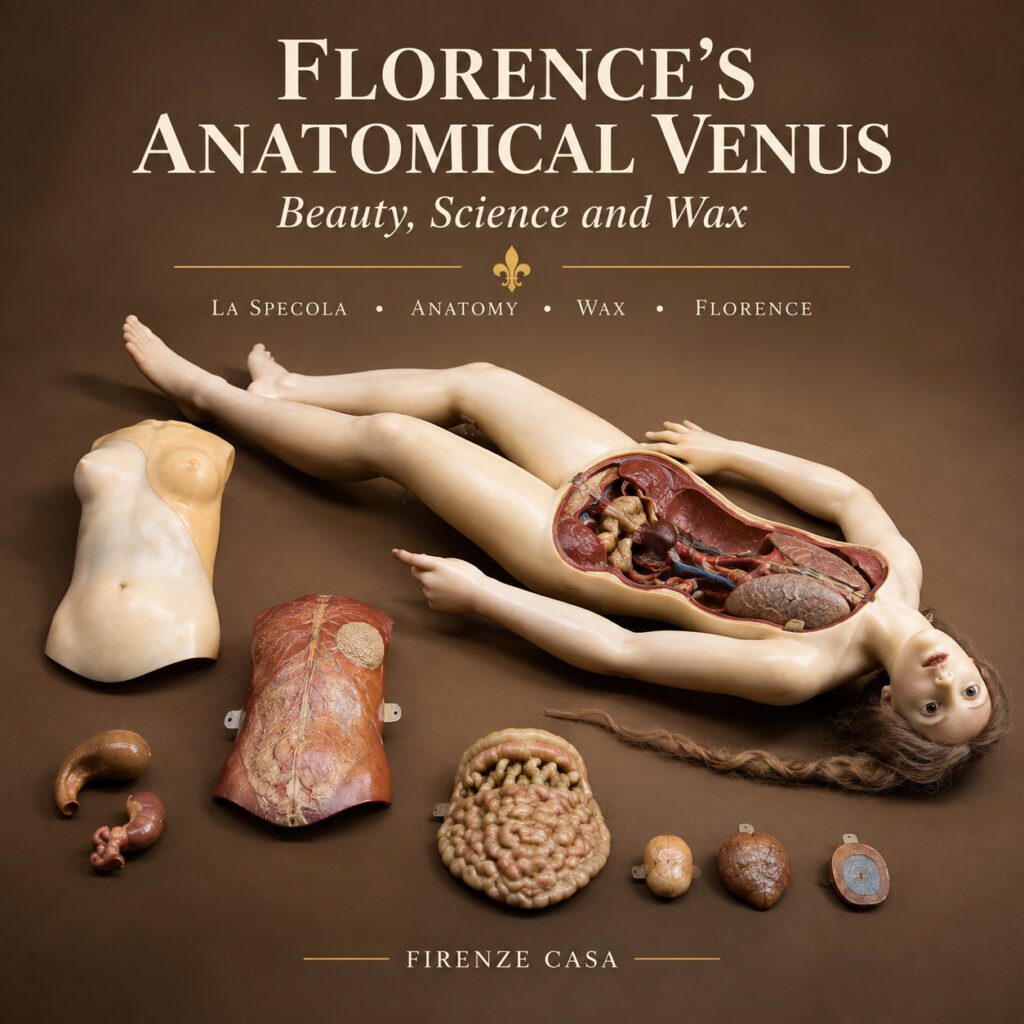
She appears to be sleeping. Her head rests gently to one side, her features look calm, and at first glance nothing suggests that this elegant woman exists to reveal the inside of the human body.
Florence’s Anatomical Venus is one of the most extraordinary objects at La Specola, Florence’s historic natural history museum. Created in wax in the 18th century, she brings together art, anatomy and Enlightenment science in a remarkable way.
Travellers should know one important detail before going: the historic anatomical wax collection does not form part of the ordinary museum route. If you specifically want to see the Venus, plan your visit accordingly.
What: Florence’s famous dismountable anatomical wax Venus
Where: La Specola, Via Romana 17, Florence
Area: Oltrarno, near Palazzo Pitti and the Boboli Gardens
Created: Florentine ceroplastic workshop, 18th century
Why it is special: Removable layers reveal the internal organs and a small fetus
Access: Guided tour required for the historic anatomical wax collection
What Is Florence’s Anatomical Venus?
The Anatomical Venus – known simply as La Venere – belongs to La Specola’s remarkable collection of anatomical wax models. Unlike an ordinary sculpture, the Venus comes apart in layers. Removing sections of the wax body progressively reveals deeper anatomical structures and eventually even a small fetus.
The University of Florence describes it as the only dismountable wax figure of its kind in the museum. This feature makes the experience very different from looking at a conventional anatomical model: the Venus combines an idealised female appearance with an extraordinarily detailed representation of the body beneath the skin. That contrast still gives the figure much of its power today.
Why Does She Look So Beautiful?
The most striking thing about the Florence Anatomical Venus is that she does not resemble a cadaver. Her face appears peaceful and her hair carefully arranged. Visually, her body belongs to the world of sculpture and idealised beauty rather than to the anatomy theatre.
Then the body opens. Beneath that serene exterior lie layers of organs and anatomical structures that help viewers understand the internal human body. Modern visitors may find this combination of beauty and dissection surprising, but in 18th-century Florence, art, craftsmanship and scientific observation often existed side by side.
Do not concentrate only on the exposed anatomy. First look at the face, hair, pose and surface of the figure. The tension between the peaceful appearance of the woman and the anatomical purpose of the model helps make the Venus so memorable.
Why Was an Anatomical Venus Made of Wax?
Today, medical students and doctors can study the body using photographs, digital models, CT, MRI and three-dimensional reconstructions. None of these possibilities existed in the 18th century. Human dissection played an essential role in anatomical study, but a cadaver offered only a temporary opportunity for examination. A carefully constructed wax model solved that problem: students could study anatomy repeatedly and in three dimensions.
Florence developed exceptional expertise in this demanding craft. The ceroplastic workshop associated with La Specola began producing anatomical waxes in 1771. Anatomists and skilled modellers worked together, translating observations from dissections into durable three-dimensional teaching objects.
They used beeswax as the principal material and added other substances and pigments to reproduce the colours and textures of different tissues. The result went far beyond decorative sculpture: these models represented a sophisticated form of scientific visualisation.
Florence and the Art of Ceroplastics
The Anatomical Venus forms part of a much larger Florentine achievement. La Specola preserves 513 cases containing human anatomical waxes, with around 1,400 individual pieces. Visitors encounter complete figures as well as detailed representations of organs, muscles, vessels, nerves and individual anatomical regions.
For almost a century, the Florentine workshop developed techniques that influenced anatomical modelling far beyond Tuscany. Institutions elsewhere in Europe commissioned Florentine anatomical waxes, including the famous collection created for the Josephinum in Vienna. Important names associated with the Florentine school include Giuseppe Ferrini, Felice Fontana, Clemente Susini and, later, Egisto Tortori.
The Venus therefore belongs not only to the history of medicine but also to Florence’s wider tradition of highly specialised craftsmanship. If this aspect of the city interests you, our Florence Museums Guide introduces several other collections where art, science and craftsmanship intersect.
Art or Medical Model?
The most interesting answer is: both. The Anatomical Venus served as a means of understanding the human body, while its makers relied on techniques associated with sculpture, colour and artistic representation. This combination helps explain why La Specola feels so different from Florence’s great Renaissance museums.
At the Uffizi or Palazzo Pitti, artists represent the human body through painting and sculpture. At La Specola, artistic skill explains what lies beneath its surface. The purpose changes, but the Florentine fascination with observing and representing the human body remains.
The anatomical waxes belong to the history of visualising the invisible. Long before modern medical imaging, Florentine anatomists and wax modellers faced the same fundamental problem: how can we make the complex structures inside the human body visible and understandable?
Can You See the Anatomical Venus Today?
Yes – but this is the most important practical point when planning your visit. At present, visitors can enter the historic anatomical wax collection at La Specola only on a guided tour. An ordinary museum ticket alone will therefore not take you into these rooms.
The current museum schedule lists guided visits from Tuesday to Sunday at 11:00, 12:00 and 15:00. Each group can include a maximum of 15 visitors. The museum currently charges an additional €3 per person for the guided visit on top of normal admission, and you can purchase the supplement at the museum ticket office on the day of your visit.
Access arrangements may change, so check the official La Specola website shortly before going, especially if seeing the Anatomical Venus is your main reason for visiting.
If the Anatomical Venus is a priority, organise your day around one of the guided-tour times rather than treating La Specola as a spontaneous museum visit. With only 15 places per group, access is more limited than for the museum’s ordinary collections.
Where Is La Specola?
You will find La Specola at Via Romana 17 in the Oltrarno district, a short walk from Palazzo Pitti and the Boboli Gardens. The location makes it easy to include the museum in an Oltrarno day instead of crossing Florence simply to visit one attraction.
From central Florence, La Specola is also pleasant to reach on foot. If you are staying at Firenze Casa, the walk offers a natural transition from the monumental Renaissance centre towards the quieter streets around Via Romana.
What Should You Combine with the Anatomical Venus?
Palazzo Pitti makes the most obvious combination. Both places reveal aspects of Florence beyond the familiar story of early Renaissance painting, although from completely different perspectives. In good weather, the Boboli Gardens can complete the day. Remember that Boboli is large and hilly, so visiting all three places works best if you enjoy a fairly full programme.
For a more relaxed day, visit La Specola and the Anatomical Venus in the morning, have lunch in the Oltrarno and choose either Palazzo Pitti or Boboli for the afternoon. Travellers with a particular interest in science may prefer to explore more of Florence’s scientific heritage. Our Florence Museums Guide can help you compare the city’s different collections before deciding how to use your time.
How Much Time Should You Allow?
If your main interest is the Anatomical Venus and the historic wax collection, do not calculate your visit purely from the guided-tour duration. Leave some time for the rest of La Specola as well. The museum contains extensive zoological collections and other scientific material, making it much more than an anatomical museum.
Most visitors will get more from La Specola by treating it as a genuine museum visit rather than making a quick stop for one famous object.
Is the Anatomical Venus Suitable for Children?
That depends very much on the child. The waxes have a scientific and educational purpose rather than an intention to shock. Nevertheless, they show the human body in considerable anatomical detail, including internal organs and reproductive anatomy.
Some children may find them fascinating, while others may feel uncomfortable or disturbed by what they see. Parents should therefore consider a child’s age and sensitivity. The elegant appearance of the Venus should not create the expectation of a conventional art museum experience.
Is the Anatomical Venus Worth Seeing?
Visitors interested in medicine, anatomy, science, craftsmanship or unusual museums will find plenty to discover here, but its appeal reaches beyond those subjects. Florence is so strongly associated with Renaissance painting and sculpture that visitors can easily overlook the city’s scientific history. The Anatomical Venus reveals another Florence – one where artists, craftsmen and scientists worked together to understand the natural world.
Photographs also struggle to convey the full effect. Seeing the serene female figure and then discovering what lies beneath its surface creates an unusual encounter between beauty and anatomy. That tension makes Florence’s Anatomical Venus far more than a medical curiosity.
Frequently Asked Questions
Where is the Anatomical Venus in Florence?
You can see the Anatomical Venus at La Specola, the Natural History Museum at Via Romana 17 in Florence’s Oltrarno district.
Can visitors see the Anatomical Venus?
Yes. Guided visits currently provide access to the historic anatomical wax collection. Check the museum’s latest arrangements before travelling, as access and tour times may change.
Is the Anatomical Venus made from a real body?
No. The Anatomical Venus is a wax model. Florentine craftsmen based their anatomical models on close observation and dissections to reproduce human structures with remarkable accuracy.
Why can the Venus be taken apart?
Removing successive layers reveals progressively deeper structures of the body. La Specola describes the Venus as the museum’s only dismountable wax figure, with the deepest layers revealing even a small fetus.
Is La Specola close to Palazzo Pitti?
Yes. La Specola stands on Via Romana in the Oltrarno, close to Palazzo Pitti and the Boboli Gardens. You can therefore combine these attractions easily without crossing the city.
Do I need a separate ticket for the anatomical waxes?
Under the current arrangements, the museum charges a supplement for the guided visit to the historic anatomical wax collection in addition to normal admission. Check the official museum information shortly before your visit for the latest details.
Further Reading on Firenze Casa
- La Specola Florence – Natural History Museum – our complete guide to the museum, its collections and scientific history.
- Florence Museums – Complete Guide – compare Florence’s major and lesser-known museums and decide which best fit your interests.
- Palazzo Pitti – Grand Ducal Palace of Florence – explore the great historic palace only a short walk from La Specola.
- Boboli Gardens Florence – Medici Garden Guide – practical information for combining La Specola with Florence’s most famous historic garden.
- Arcetri – Galileo and the Stars Above Florence – discover another fascinating chapter in Florence’s scientific history.
References
- Università degli Studi di Firenze, Sistema Museale di Ateneo. Anatomical Wax Models – Natural History Museum.
- Università degli Studi di Firenze, Sistema Museale di Ateneo. La Specola – Natural History Museum: Visitor Information.
- Università degli Studi di Firenze, Sistema Museale di Ateneo. Waxworks – Natural History Museum.
- Poggesi, Marta. “The Anatomical Wax Collection.” In Giovanni Barsanti and Guido Chelazzi (eds.), Il Museo di Storia Naturale dell’Università degli Studi di Firenze: Le collezioni della Specola: zoologia e cere anatomiche. Firenze University Press, 2009.
- Ebenstein, Joanna. The Anatomical Venus: Wax, God, Death & the Ecstatic. Thames & Hudson, 2016.
- Maerker, Anna. “Anatomy and Public Enlightenment: The Florentine Museo La Specola.” In Samuel J. M. M. Alberti and Elizabeth Hallam (eds.), Medical Museums: Past, Present, Future. Royal College of Surgeons of England, 2013.

