
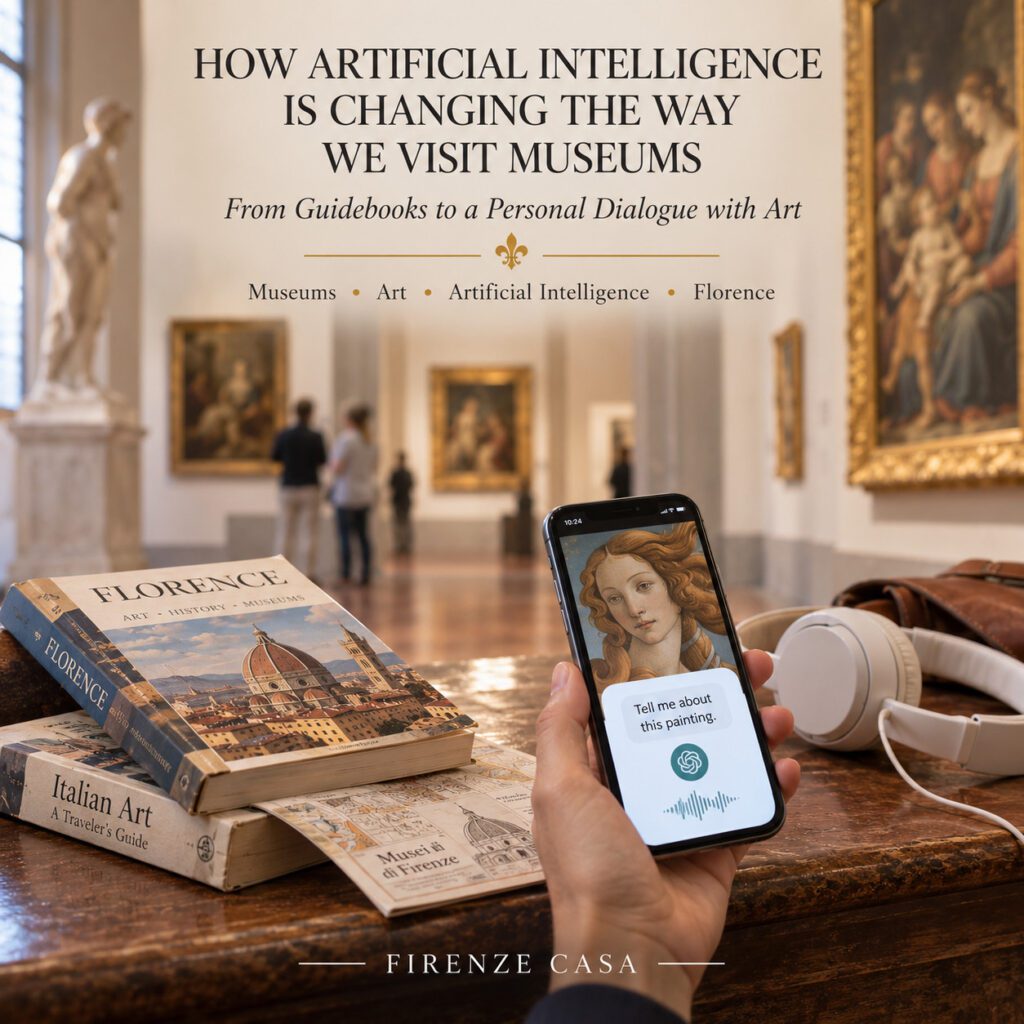
For decades, visiting a museum followed a familiar pattern. Travellers consulted a guidebook, read about the most important works before arriving, perhaps marked a few masterpieces they did not want to miss and later rented an audio guide at the entrance.
This worked remarkably well, but it also determined much of what visitors learned. Guidebooks had limited space, audio guides covered selected works, and museum labels were often brief. If an unexpected painting, sculpture or object attracted attention, there was usually little opportunity to learn more while standing in front of it.
Smartphones began to change that experience by making information easier to access. Artificial intelligence in museums is now changing something more fundamental: visitors can ask questions about the artwork directly in front of them and follow their own curiosity rather than relying entirely on information selected in advance.
For travellers planning a stay in Florence, this can be particularly useful. The city contains an extraordinary range of collections, from Renaissance painting and sculpture to science, natural history and modern art. Artificial intelligence can help before entering a museum, while exploring its galleries and even afterwards, when an unexpected discovery deserves further investigation.
Before your visit: Choose the right museum, identify essential works and plan your time.
Inside the museum: Ask about an artwork, artist, object or historical context when something catches your attention.
For difficult art: Ask what to look for and why a work matters before deciding what you think about it.
Afterwards: Follow connections between artists, museums and places elsewhere in Florence.
Most important: Use AI as an additional source of context – not as a substitute for looking at the original.
How Museum Visits Worked for Decades
Before smartphones and instant access to digital information, preparing for a museum visit usually began at home or in a hotel room. Travellers opened a guidebook, read a few pages about the museum and identified the works considered essential. In Florence, that might mean Botticelli’s Birth of Venus at the Uffizi, Michelangelo’s David at the Accademia or Donatello’s sculptures at the Bargello.
Once inside, the museum itself largely determined what happened next. Visitors followed room numbers, consulted printed plans, read wall texts and perhaps listened to an audio guide. These resources provided valuable information, but someone had already decided which objects deserved a detailed explanation.
An unfamiliar painting could still attract attention. A small sculpture might seem more interesting than the famous masterpiece beside it. But unless the guidebook happened to mention it or an audio-guide number appeared next to it, there was often little more to discover at that moment.
The usual solution was simple: look for a few seconds and move on.
What Artificial Intelligence Changes
Artificial intelligence reverses part of that relationship. The museum, guidebook and curator still provide the essential scholarly framework, but visitors can now decide where they want additional information.
A painting does not have to be famous enough to appear in a guidebook. A sculpture does not need an audio-guide number. If something attracts attention, it can become the starting point for a conversation.
Questions can be remarkably simple: Who created this? What is happening in the scene? Why is this work important? What should I look at? Why does this object belong in the museum?
The answers can then lead to more specific questions. A visitor might want to understand a hand gesture in a Renaissance painting, an unfamiliar symbol, the unusual surface of a sculpture or why a contemporary installation consists of seemingly ordinary objects.
This is perhaps the most important change. For decades, museum interpretation was largely predetermined. Today, visitors can increasingly follow their own curiosity.
Use AI Before Choosing a Museum in Florence
The first useful application of AI actually happens before the museum visit begins. Florence has far more museums than most travellers can realistically visit during one stay, and choosing the right ones matters more than trying to see them all.
Our Florence Museums – Complete Guide provides an overview of the city’s major and lesser-known collections. Once the possibilities are clear, artificial intelligence can help narrow them according to personal interests and available time.
Someone fascinated by Renaissance painting will make different choices from a visitor interested in sculpture, Galileo, natural history or twentieth-century art. Instead of simply asking which museums are “best”, it is more useful to ask which collections fit the subjects that genuinely interest you.
Before choosing a museum, ask three questions: What interests me most? Which works should I absolutely not miss? How much time can I realistically spend there? This usually creates a better itinerary than simply working through a list of Florence’s most famous museums.
Prepare for the Most Important Works
Artificial intelligence does not make preparation unnecessary. In many ways, it can make preparation better.
Before visiting the Uffizi, for example, a traveller can identify the essential works for a two-hour visit and learn enough about Botticelli, Leonardo, Michelangelo or Raphael to recognise why particular paintings matter. Before entering the Accademia, understanding how Michelangelo approached the human figure can change the experience of seeing David for the first time.
The difference is that preparation no longer needs to become an exhaustive art-history lesson. A short overview can provide enough context to make the visit meaningful while leaving room for discovery.
Useful questions include: “Which five works should I not miss?”, “What should I understand before seeing them?” and “Which details should I look for when I am standing in front of them?”
This transforms preparation from memorising information into learning how to look.
Your Phone Can Become a Personal Museum Companion
The most significant change begins once visitors are inside the museum. When an unfamiliar painting or object attracts attention, there is no longer any need to wait until returning home to investigate it.
If photography is permitted, take a photograph of the work and another of its museum label. The combination can provide the artist, title, date, collection and sometimes an inventory number – valuable information for identifying the object correctly.
Then ask about what you are seeing.
The first explanation does not need to be long. In fact, shorter answers usually work better inside a museum. Ask for the essential story, why the work matters and two or three details worth examining on the original.
An AI museum guide is therefore different from a conventional audio guide. The audio guide follows a prepared programme; AI allows the visitor to determine where the conversation goes next.
Unlike a Guidebook, AI Can Adapt to You
There is another important difference between traditional museum guides and artificial intelligence. A guidebook, wall text or audio guide gives essentially the same explanation to every visitor. It cannot know how much you already understand, which aspects interest you most or whether its explanation is too simple or too complicated.
An audio guide may provide an excellent five-minute introduction to a painting, but the communication moves in only one direction. You can listen, pause or continue to the next work, but you cannot interrupt and ask: “Why is that figure important?”, “What does this symbol mean?” or simply, “I did not understand that – can you explain it more simply?”
Artificial intelligence can turn that one-way explanation into a conversation. A visitor with little knowledge of art can ask for a simple explanation without specialist terminology. Someone who already knows the basic story can ask about technique, iconography, provenance or competing interpretations. A child, a medical doctor, an architect and an art historian could therefore stand in front of the same object and ask completely different questions.
The level of detail can change as well. You might begin with: “Explain this painting to me in three sentences.” If something catches your attention, you can then ask for more. If the answer becomes too complicated, ask for a simpler explanation. If it remains too superficial, ask to go deeper.
A traditional guide tells you what its author decided to explain. AI allows you to decide what you want to understand, how deeply you want to explore it and which question should come next. That personalisation may be one of the most important changes AI brings to the museum experience.
Photograph the Label as Well as the Artwork
Photographing the museum label is a small habit that can considerably improve the experience. Images alone can be ambiguous, particularly when museums contain several works by the same artist or visually similar objects.
A label provides context and reduces the risk of discussing the wrong artwork. It also creates a useful record for later. After leaving the museum, visitors can return to the photographs and continue exploring the works that interested them most.
Always respect the museum’s current photography rules. Some collections permit non-flash photography, while temporary exhibitions, individual lenders or particular objects may have different restrictions. Signs and instructions from museum staff should always take precedence.
When photography is permitted, take two photographs: one of the artwork and one of its label. The second image may seem unimportant at the time, but it can make identifying and researching the work much easier later.
Ask One of the Simplest Questions: What Should I Look At?
One of the most useful questions in a museum is also one of the simplest: What should I look at?
This changes the relationship between information and observation. Instead of reading a long biography while barely looking at the artwork, visitors can direct their attention towards a gesture, reflection, colour, symbol, surface or compositional detail.
The explanation then becomes something that can be tested against the original. Look at the detail, consider why it matters and then step back to see whether it changes the impression of the whole work.
This approach works particularly well with sculpture. At the Bargello Museum, for example, sculptures reward movement. Instead of looking only from the front, visitors can walk around them and consider how pose, surface and viewpoint change the experience.
Modern Art May Benefit Most
Modern and contemporary art may be one of the areas where artificial intelligence can change the museum experience most profoundly.
Renaissance art usually offers even inexperienced visitors an immediate point of entry. Technical skill is visible. Human figures are recognisable. Biblical, mythological or historical scenes may become understandable with relatively little background information.
Modern and contemporary art can be more difficult. A monochrome surface, an industrial object, a pile of everyday materials or a seemingly simple installation may offer few immediate clues about why it belongs in a museum.
Without context, the natural reaction can be to look briefly, wonder what it means and continue into the next room.
Artificial intelligence offers another possibility. Visitors can ask why the artist chose those materials, what was happening in art at the time, whether the work responded to a political or cultural event, and what they should notice before deciding what they think about it.
Florence provides an excellent opportunity to try this approach. After spending time with Renaissance art, visit the Museo Novecento. Its twentieth-century and contemporary collections use artistic languages very different from those of Botticelli, Donatello or Michelangelo.
Ask: “I know very little about this artist. Explain why this work matters, then give me three things to look at while I am standing in front of it.” Understanding the context does not mean that you have to like the work.
Two Examples: When Context Changes What You See
The difference becomes particularly clear when looking at two very different works of modern and contemporary art. Both can be visually striking without any explanation, but understanding their context changes the experience of standing in front of them.
Picasso’s Guernica: Learning How to Read the Painting
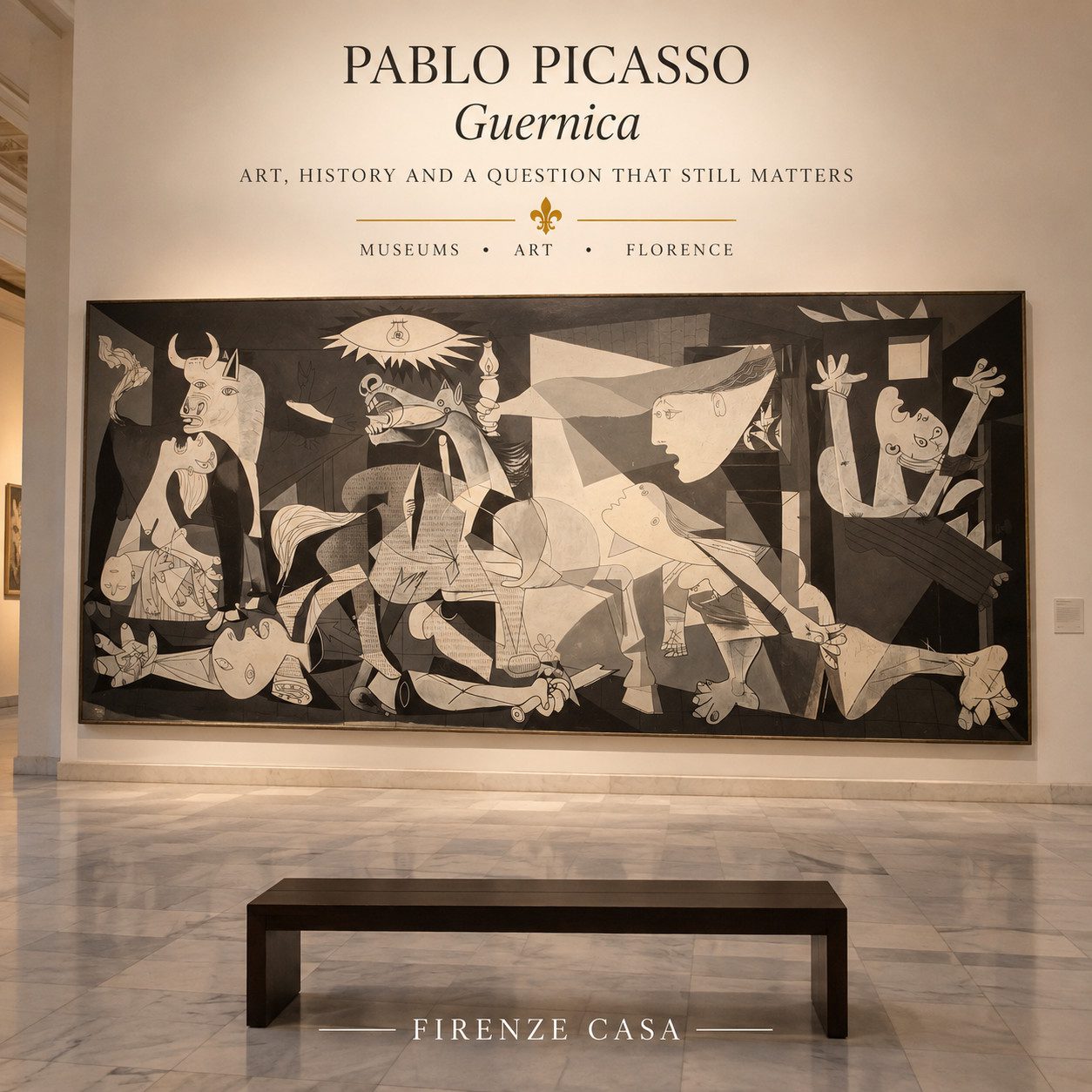
Pablo Picasso’s Guernica is immediately overwhelming. Its enormous scale, restricted palette and fractured figures communicate violence and suffering even before a visitor knows anything about its history. Yet much of what makes the painting extraordinary becomes clearer once its context is understood.
Knowing that Picasso created the work in 1937 after the bombing of the Basque town of Guernica during the Spanish Civil War changes the way the painting can be approached. AI can then help direct attention back towards the original: Why is the painting almost entirely black, white and grey? What might the horse and bull represent? Why do the figures appear fragmented? What role do the electric light, the screaming mother and the fallen body play in the composition?
The purpose is not to provide a single definitive interpretation. Some of Guernica’s symbols remain open to debate. Instead, a short explanation gives visitors enough historical and visual context to spend more time looking at the painting and to recognise details they might otherwise miss.
Félix González-Torres: When a Pile of Sweets Becomes an Artwork
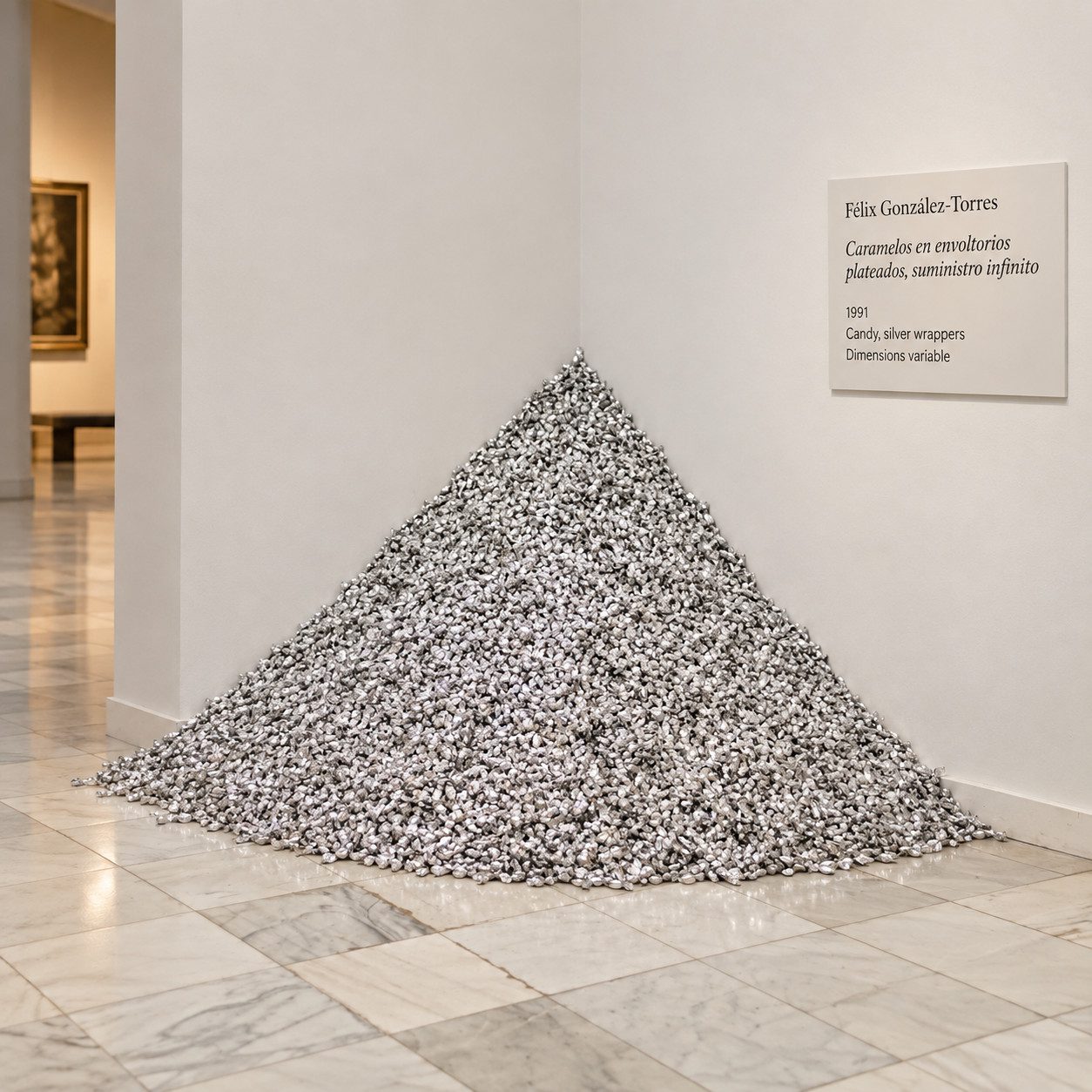
Félix González-Torres offers an almost opposite example. Encounter “Untitled” (Lover Boys) from 1991 without any explanation and the first reaction may simply be: why is there a pile of sweets on the museum floor?
The installation consists of candies in silver wrappers arranged in a pile, with dimensions that vary according to the installation. The work specifies an ideal weight of 355 lb and an endless supply of candies. Rather than creating a single fixed object that must remain unchanged, González-Torres made replenishment part of the work itself.
Once that idea is understood, the questions change. What happens to an artwork when its physical form can change? Is the work the pile of candies, the artist’s instructions, the possibility of depletion and replenishment, or the ideas suggested by its title, “Lover Boys”? Why use something as ordinary and temporary as candy?
This is precisely where artificial intelligence can be useful in a museum. It can turn the initial question – “Why is this art?” – into several more interesting questions. The visitor still decides whether the work is moving, convincing, puzzling or even irritating, but that judgment is now based on a better understanding of what the artist is asking us to consider.
With Guernica, AI can help decode a visually overwhelming painting by connecting details with history. With González-Torres’s “Untitled” (Lover Boys), it can reveal the concept behind an installation that might otherwise be dismissed as a pile of sweets. In both cases, the goal is the same: understand enough to look again – and then form your own opinion.
Understanding Art Is Not the Same as Liking It
This distinction is important. Artificial intelligence should not tell visitors whether an artwork is beautiful, good or worthy of admiration. Those judgments remain personal.
What AI can provide is context. It can explain an artistic movement, identify references, clarify unfamiliar terminology and suggest details that deserve closer attention.
After receiving that information, attention should return to the original artwork. Sometimes understanding the context completely changes the experience. Sometimes a work remains unappealing even after its meaning becomes clearer. Both reactions are legitimate.
AI does not need to tell us what to think about art. It can give us enough context to decide what we think about it ourselves.
Connect One Florence Museum with Another
One of the pleasures of Florence is discovering that museums do not exist in isolation. Artists, patrons, scientific discoveries and historical events repeatedly connect one collection with another.
If Michelangelo’s David at the Accademia Gallery raises questions about representations of David, the Bargello provides an opportunity to compare works by Donatello and Verrocchio.
If Renaissance science becomes unexpectedly fascinating, the Museo Galileo opens another side of Florence through astronomy, measurement and scientific instruments. Visitors interested in the relationship between science, craftsmanship and the human body can continue at La Specola and its remarkable tradition of anatomical wax modelling.
AI can help identify these connections while they are still fresh. A simple question such as “Where else in Florence can I see work by this artist?” can turn one museum discovery into the starting point for the following day.
Let an Unexpected Discovery Change the Plan
Traditional travel planning often works from a checklist: Uffizi on one day, Accademia on another, Palazzo Pitti afterwards. Planning remains important, especially when timed tickets are involved, but not every hour in Florence needs to be predetermined.
An unexpected object may provide a reason to change what comes next. A sculpture can lead to a church where the artist worked. A portrait may create curiosity about the Medici family. A scientific instrument can lead towards Galileo. A twentieth-century painting may inspire a visit to a museum that was not originally on the itinerary.
This is where artificial intelligence can connect the museum with the city outside. Instead of asking only about the object, ask where its story continues in Florence.
Our Walking Tours of Florence – Complete Guide follows a similar principle by connecting monuments, artists, neighbourhoods and historical periods rather than treating Florence as a collection of unrelated attractions.
Do Not Spend the Museum Visit Looking at Your Phone
There is an obvious danger in using technology inside museums. A tool intended to enrich the experience can easily begin to dominate it.
The purpose of asking about a painting is to look at the painting more closely, not to spend several minutes reading a screen while the original hangs unnoticed nearby.
A useful rhythm is simple: look, ask, read briefly, then look again.
The final step is the most important. The phone should direct attention back towards the artwork rather than compete with it.
Keep explanations short while standing in front of an artwork. If an answer becomes too detailed, ask: “Explain this in three points I can see in the work in front of me.” Then put the phone away and look again.
Remember That Artificial Intelligence Can Be Wrong
AI can provide remarkably useful explanations, but it can also misunderstand an image, confuse similar works or present uncertain information too confidently. Museum labels, official collection catalogues and specialist scholarship therefore remain important.
This is another reason to photograph the label and provide the artist, title and date whenever possible. For an obscure object or disputed interpretation, ask what is known with certainty and what remains debated.
If a detail is important, verify it against the museum’s own information. Artificial intelligence works best as an additional layer of interpretation rather than as the sole authority.
A Simple AI Routine for a Florence Museum Visit
Using artificial intelligence in museums does not require complicated prompts. A few straightforward questions cover most situations:
- Before visiting: “I have two hours in this museum. Which works should I prioritise and why?”
- Before entering a room: “What should I know before seeing these works?”
- In front of an artwork: “Explain this work in a way I can understand while looking at it.”
- For closer observation: “Give me three details to look for.”
- For modern art: “Why was this considered significant when it was created?”
- For comparison: “How does this differ from the artist’s other work?”
- For Florence connections: “Where else in Florence can I see something related to this?”
- When uncertain: “Which parts of this interpretation are established facts and which are debated?”
The best questions often emerge from the object itself. Visitors do not need to know specialist art-historical terminology. A simple question about something genuinely noticed in the work can be more rewarding than requesting a long general explanation.
Choosing the Right Florence Museum Still Matters Most
Artificial intelligence cannot solve the most common museum problem in Florence: there is simply too much to see. Trying to visit every important collection can turn a cultural holiday into a sequence of queues, tickets and increasingly tired afternoons.
Start with personal interests. Choose the Uffizi for Renaissance painting, the Accademia if Michelangelo’s David is a priority, the Bargello for sculpture, Museo Galileo for science, La Specola for natural history and anatomical waxes, or Museo Novecento when you want to explore Florence beyond the Renaissance.
For quieter collections and more intimate spaces, our guide to Small Museums in Florence Worth Discovering introduces alternatives to the city’s most famous galleries.
Travellers staying in Florence for several days have the advantage of not needing to compress everything into a single museum marathon. A museum in the morning, time to absorb what has been seen and another part of the city later in the day often creates a richer experience than moving directly from one major collection to the next.
What Artificial Intelligence Cannot Replace
No artificial intelligence can reproduce the scale of Michelangelo’s David when it first comes into view at the Accademia. It cannot recreate the physical presence of a Donatello bronze, the surface of an old painting or the strange beauty of an eighteenth-century wax model at La Specola.
Nor can it replace curatorial scholarship. Museums preserve objects, research them, establish provenance, conserve fragile materials and develop interpretations from evidence accumulated over generations.
The strength of AI for travellers lies somewhere else. It can make access to knowledge more immediate, conversational and responsive. Instead of waiting until after the holiday to investigate something fascinating, visitors can begin asking questions while the object is still in front of them.
From Guidebooks to Conversations
Over several decades, the tools surrounding museum visits have changed dramatically. Printed guidebooks made collections understandable before visitors arrived. Audio guides brought expert explanations directly into the galleries. Smartphones made enormous amounts of information accessible almost anywhere.
Artificial intelligence introduces another step. For the first time, the explanation does not always have to be chosen in advance.
The famous masterpiece can receive attention, but so can the small painting beside it. An unfamiliar name on a label can open an entirely new story. A difficult contemporary installation can become approachable enough to deserve a second look.
This does not make guidebooks, audio guides, curators or human guides obsolete. Each offers something different. What artificial intelligence adds is the ability to respond immediately to individual curiosity.
Perhaps that is the most significant change in the way museums can be experienced today. Visitors no longer have to follow only the questions that someone anticipated before they arrived. They can ask their own.
Florence rewards curiosity more than checklists. Prepare enough to recognise what matters, but leave room for an unexpected painting, sculpture or object to change the day. Artificial intelligence is most useful when it helps visitors follow that curiosity rather than replacing it.
Frequently Asked Questions
How can artificial intelligence help during a museum visit?
AI can help identify essential works before a visit, explain unfamiliar objects inside the museum and suggest details worth examining. It can also connect an artwork with other museums, monuments or places elsewhere in Florence.
Can AI identify paintings in a museum?
It can often help, but image identification is not infallible. Include the museum label, artist, title or inventory information whenever possible and verify important details against official museum information.
Is AI useful for visitors who know little about art?
Yes. One of its most useful roles is explaining unfamiliar terminology and historical context in everyday language. Asking what to look for can make an artwork more approachable without requiring previous knowledge of art history.
Can artificial intelligence help explain modern art?
It can explain historical context, artistic ideas, materials and visual details that may not be immediately obvious. Understanding those elements does not require visitors to like the work; it simply provides more information on which to form an opinion.
Should AI replace a museum audio guide?
No. They serve different purposes. An audio guide provides carefully curated interpretation, while AI is particularly useful for spontaneous questions about works that may not be included in the official commentary.
Which Florence museum should I visit first?
That depends on your interests and available time. Our Florence Museums – Complete Guide compares collections devoted to Renaissance art, sculpture, science, natural history, modern art and smaller specialist subjects.
Further Reading on Firenze Casa
- Florence Museums – Complete Guide – choose the museums that best match your interests and the time available during your stay.
- Museo Novecento Florence – Modern Art – an excellent place to experiment with looking more closely at modern and contemporary art.
- Bargello Museum Florence – Renaissance Sculpture – discover Donatello, Michelangelo and the development of Florentine sculpture.
- Museo Galileo Florence – Science and Discovery – explore Florence through astronomy, scientific instruments and Galileo’s discoveries.
- La Specola Florence – Natural History Museum – discover anatomical waxes, zoology and Florence’s scientific heritage.
- Small Museums in Florence Worth Discovering – explore quieter alternatives to Florence’s most famous galleries.
- Walking Tours of Florence – Complete Guide – continue stories discovered inside museums through Florence’s streets.
References
- UNESCO & International Council of Museums (ICOM). UNESCO-ICOM Global Survey on Artificial Intelligence in Museums. 2026.
- Wada, Karino. Generative AI in Art Museum Interpretation: Examining Museum Institutional Perspectives and Implementations. MuseumsForward, University of Washington, 2026.
- Making Art Accessible: How Prompted AI Use for Simplifying Art Descriptions Enhances Museum Visit Satisfaction. Journal of Retailing and Consumer Services, Vol. 89, Article 104600, 2026.
- Mazzanti, Paolo, Andrea Ferracani, Marco Bertini and Filippo Principi. Reshaping Museum Experiences with AI: The ReInHerit Toolkit. Heritage, Vol. 8, No. 7, Article 277, 2025.
- American Alliance of Museums, Center for the Future of Museums. The Four Illusions of AI: Implications for Museum Practice. 2026.

