
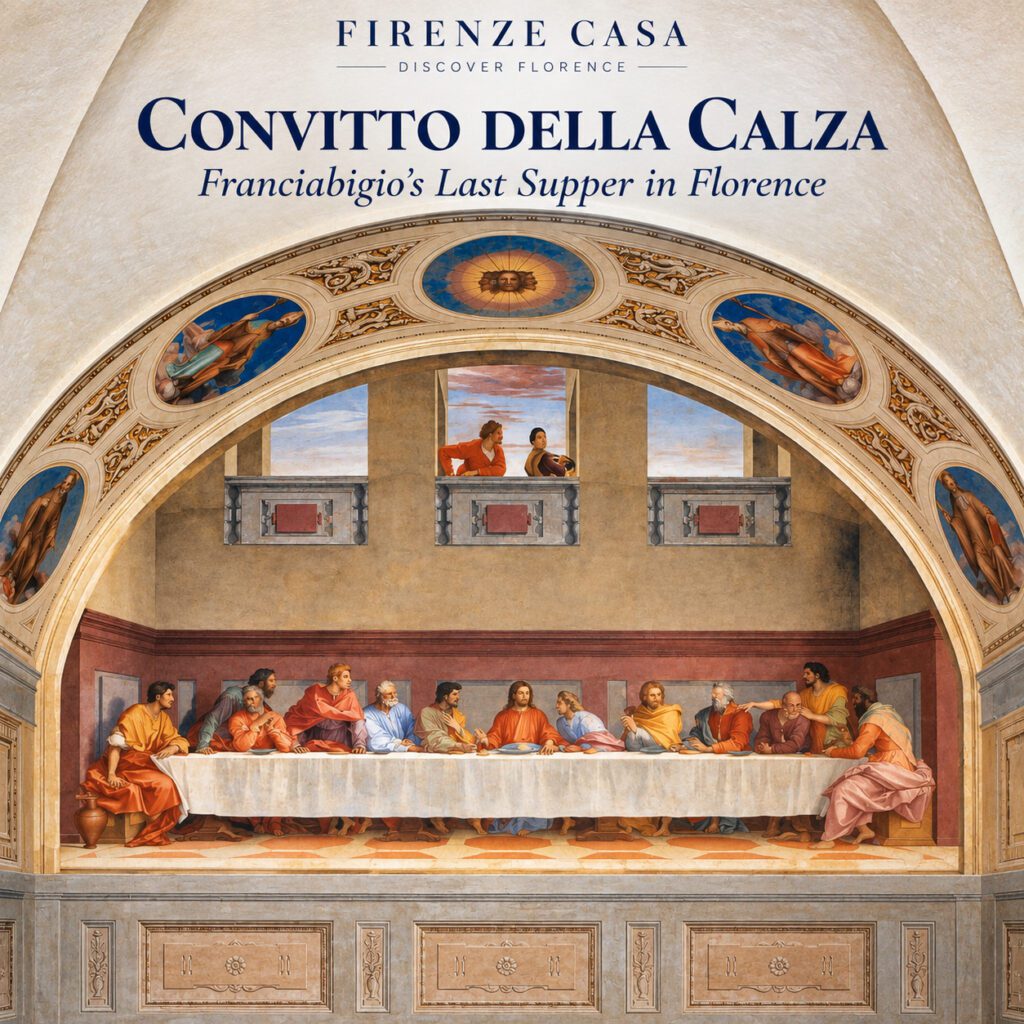
Convitto della Calza stands beside Porta Romana at the southern edge of Florence’s historic Oltrarno. Behind its modest exterior lies a former religious complex with a quiet cloister, a small church and one exceptional Renaissance treasure: Franciabigio’s monumental Last Supper of 1514.
For travellers, the fresco is the main reason to know this place. It remains in the historic refectory for which the artist created it. Access, however, has changed over time and may be restricted. If seeing the fresco matters to you, confirm current visiting arrangements before making a special journey.
Location: Piazza della Calza 6, beside Porta Romana
Area: Southern Oltrarno
Origins: Medieval hospital and religious complex
Main highlight: Franciabigio’s Last Supper
Date of fresco: 1514
Also known as: Cenacolo della Calza
Best for: Renaissance painting, hidden Florence and repeat visitors
Access: Check current arrangements before visiting
Is Convitto della Calza Worth Visiting?
Yes, but mainly for travellers with a particular interest in Renaissance painting. The Convitto della Calza is not comparable with the Uffizi, Santa Croce or Florence’s great basilicas. Its appeal is much more focused.
The principal reason to visit is Franciabigio’s Last Supper. The fresco belongs to Florence’s remarkable tradition of monumental Last Suppers painted for monastic dining rooms.
The location also makes the site useful when exploring the southern Oltrarno. Porta Romana, the Boboli Gardens and Giardino Torrigiani are all nearby. This makes the Convitto easier to include in an existing itinerary than to treat as a separate destination.
Choose the Convitto della Calza if you enjoy Renaissance frescoes, historic refectories or places beyond Florence’s standard museum circuit. On a short first visit to the city, consider it optional rather than essential.
From Medieval Hospital to Convitto della Calza
The history of the complex began long before Franciabigio arrived. A medieval hospital dedicated to San Giovanni Battista once occupied the site near the southern entrance to Florence.
This location made practical sense. Religious hospitals near city gates could offer assistance and accommodation to pilgrims and travellers approaching Florence.
Different religious communities subsequently occupied the complex. The Ingesuati arrived during the 16th century and eventually gave the site its familiar name.
The unusual name comes from part of the habit worn by the Ingesuati. A long piece of cloth associated with their hood or mantle resembled a calza. The nickname became attached to the complex and eventually to Piazza della Calza itself.
A Religious Complex Beside Porta Romana
The location still helps visitors understand the site’s original function. Porta Romana stands only moments away and once formed one of the principal entrances through Florence’s defensive walls.
Today, busy roads surround the gate. In earlier centuries, however, this was the point where the city ended and routes continued towards the countryside and Siena.
The Convitto therefore occupied an important threshold between Florence and the world outside its walls. Religious institutions, hospitals and places for travellers often developed around such gateways.
Our Dan Brown’s Inferno Florence – Locations & Story also explores Porta Romana and explains how the surviving gate still helps visitors understand the boundaries of medieval Florence.
Pause at Porta Romana before approaching the Convitto. The relationship between gate, old city wall and religious complex makes much more sense when you first understand that this was once the edge of Florence.
The Cenacolo della Calza
The artistic heart of the complex is its former refectory, usually called the Cenacolo della Calza. Here the religious community ate together beneath a monumental representation of Christ’s final meal with the Apostles.
Florentine monasteries often decorated their refectories with scenes of the Last Supper. The subject created a direct connection between the biblical meal and the communal meals taking place in the room below.
Florence preserves several outstanding examples of this tradition. Artists including Andrea del Castagno, Domenico Ghirlandaio, Perugino and Andrea del Sarto created monumental Last Suppers for religious communities across the city.
The Cenacolo della Calza belongs to this wider artistic landscape, but far fewer travellers know about it.
Franciabigio’s Last Supper of 1514
Franciabigio painted the Last Supper at the Convitto della Calza in 1514. The fresco stretches across the end wall of the historic refectory and remains the site’s outstanding work of art.
Franciabigio, whose full name was Francesco di Cristofano, belonged to the generation of Florentine painters working alongside Andrea del Sarto. He developed a particular reputation for fresco painting and portraiture.
In the Cenacolo della Calza, he depicts the tense moment after Christ announces that one of the Apostles will betray him. The figures react individually rather than forming a static row.
Judas rises abruptly from his seat. Other Apostles turn towards one another in surprise, while gestures and glances create movement across the long table.
Do not concentrate only on Christ at the centre. Follow the reactions along the table. Franciabigio uses hands, faces and turning bodies to transform a symmetrical composition into a scene filled with psychological tension.
A Florentine Response to Leonardo’s Last Supper
One reason the fresco interests art historians is its relationship with the wider Renaissance tradition of the Last Supper. Leonardo da Vinci had transformed the subject in Milan only a few years earlier.
News and images of Leonardo’s revolutionary composition circulated among artists. Franciabigio also emphasised the Apostles’ emotional reactions to Christ’s announcement of the betrayal.
Yet the Florentine painter created his own interpretation. His figures have a solid physical presence, while the architecture and landscape organise the scene with Renaissance clarity.
The result fits naturally into Florence’s tradition of painted refectories while also reflecting the artistic changes taking place around 1500.
Florence’s Last Suppers are especially rewarding because many remain connected with former convents and refectories. Seeing several of them reveals how different Renaissance artists repeatedly reinvented the same subject.
The Landscape Behind the Apostles
The fresco rewards closer inspection beyond the figures. Openings behind the Apostles reveal architecture, sky and landscape, extending the painted room beyond the wall.
These details also create an intriguing connection with the area surrounding the convent. The landscape evokes the Florentine walls and the territory near the old southern gateway.
For modern visitors, this produces an unusual dialogue between painting and place. Step outside after seeing the fresco and Porta Romana is still there, although modern Florence has expanded far beyond the medieval boundary.
The Cloister and Church of San Giovanni Battista della Calza
The fresco should not completely overshadow the rest of the complex. A historic cloister preserves the quieter atmosphere of the former religious institution.
The adjoining Church of San Giovanni Battista della Calza is modest compared with Florence’s monumental basilicas. Its restrained character reflects the site’s religious history rather than grand civic patronage.
Together, church, cloister and refectory make the Convitto more interesting than a single detached artwork. They help visitors understand the environment in which Franciabigio’s fresco originally functioned.
If access allows, look at the complex as a whole rather than rushing directly to the fresco. The quiet architectural spaces explain why a monumental Last Supper belonged here in the first place.
Planning Your Visit
The Convitto della Calza stands at Piazza della Calza 6, immediately inside Porta Romana. It is easy to reach on foot while exploring the southern Oltrarno.
The important issue is access. Public information about the complex has changed, and different sources may show different visiting arrangements. Do not rely on an old timetable found in a guidebook or search result.
If the Cenacolo is an important part of your plans, contact the current venue or check its official information shortly before visiting. This is especially important if you are travelling across Florence specifically to see Franciabigio’s fresco.
If you are staying at Firenze Casa, it makes more sense to incorporate the Convitto into an Oltrarno day than to make a separate return journey. The surrounding area contains enough to build a rewarding half-day or full-day route.
Address: Piazza della Calza 6, Florence
Area: Porta Romana / southern Oltrarno
Main reason to visit: Franciabigio’s 1514 Last Supper
Planning advice: Confirm access before making a special journey. Current arrangements can change.
Combine the Convitto with Porta Romana and Boboli
The location makes itinerary planning particularly easy. From Piazza della Calza, walk through Porta Romana and continue along Via Romana towards Palazzo Pitti.
The Boboli Gardens lie nearby and provide a complete change of atmosphere. The former convent offers a concentrated encounter with Renaissance painting, while Boboli unfolds across a vast landscape of terraces, sculpture and gardens.
Travellers interested in less obvious places can also explore Giardino Torrigiani. High walls conceal one of Florence’s largest private historic gardens only a short distance from Porta Romana.
If you want to continue deeper into the neighbourhood, our Oltrarno Walking Tour: Santo Spirito & San Frediano provides a natural framework for exploring this side of Florence.
A good sequence is Convitto della Calza → Porta Romana → Boboli Gardens → Palazzo Pitti. If you plan to spend two or three hours in Boboli, keep the rest of the route flexible rather than trying to add too many smaller sights.
Convitto della Calza or Florence’s More Famous Last Suppers?
If you have a particular interest in Renaissance painting, Florence’s historic refectories can become an itinerary of their own. Each artist approached the same biblical subject differently.
Andrea del Castagno’s dramatic Last Supper at Sant’Apollonia ranks among the most important examples. Ghirlandaio created elegant versions at Ognissanti and San Marco, while Andrea del Sarto painted his celebrated fresco at San Salvi.
Perugino’s Last Supper at Fuligno offers another comparison. Franciabigio’s work at the Calza belongs to a slightly later artistic world and shows how the tradition continued into the early 16th century.
You do not need to see every Florentine cenacolo. However, comparing two or three can provide a much richer understanding of Renaissance painting than simply adding another large museum to your itinerary.
If you have limited time, prioritise the major museums and churches. If Renaissance fresco painting particularly interests you, Florence’s historic Last Suppers offer one of the city’s most rewarding specialist themes.
Frequently Asked Questions About Convitto della Calza
What is the Convitto della Calza?
It is a historic religious complex beside Porta Romana in Florence. Its long history includes use as a hospital, convent and ecclesiastical institution.
Why is Convitto della Calza famous?
Its main artistic treasure is Franciabigio’s monumental Last Supper of 1514. The fresco remains in the historic refectory.
What is the Cenacolo della Calza?
The name refers to the former refectory and, by extension, Franciabigio’s Last Supper inside it. Cenacolo is commonly used in Florence for historic representations of the Last Supper.
Can I visit Franciabigio’s Last Supper?
Access arrangements have changed over time. Check directly with the current venue before visiting, especially if the fresco is your main reason for going.
Where is the Convitto della Calza?
It stands at Piazza della Calza 6 beside Porta Romana, at the southern edge of Florence’s historic Oltrarno.
Is it worth visiting on a first trip to Florence?
It is optional for most first-time visitors. Prioritise it if you have a strong interest in Renaissance frescoes or want to explore quieter places around Porta Romana.
What can I combine with the Convitto della Calza?
Porta Romana, the Boboli Gardens, Palazzo Pitti and Giardino Torrigiani are all nearby. The site also fits naturally into a wider exploration of the Oltrarno.
Why Convitto della Calza Is Worth Knowing
Convitto della Calza deserves attention because an important Renaissance fresco survives in the place for which an artist created it. Franciabigio’s Last Supper gains meaning from the former refectory around it.
The location beside Porta Romana adds another layer. Here, visitors can still understand the relationship between a religious institution, an old city gate and the landscape beyond Florence’s former walls.
This is not a place every traveller needs to visit. That selectivity is part of its appeal. For visitors interested in Renaissance painting or the quieter edges of the Oltrarno, the Cenacolo della Calza offers a rewarding reason to explore beyond Florence’s familiar monuments.
Further Reading on Firenze Casa
- Oltrarno Walking Tour: Santo Spirito & San Frediano
- Boboli Gardens – Florence’s Great Medici Garden
- Giardino Torrigiani – Hidden Private Garden in Florence
- Palazzo Pitti – Grand Ducal Palace in Florence
- Hidden Gems in Florence – Complete Guide
- Neighbourhoods of Florence – Complete Guide
- Dan Brown’s Inferno Florence – Locations & Story
References
- Comune di Firenze / FeelFlorence – Cenacolo della Calza.
- Ministero della Cultura – Catalogo Generale dei Beni Culturali, Ultima Cena by Franciabigio.
- Della Calza – Historical complex and Last Supper.
- VisitFlorence – Cenacolo della Calza and Florence’s historic Last Suppers.
- Historical and art-historical studies on Franciabigio and the former religious complex of San Giovanni Battista della Calza.

