
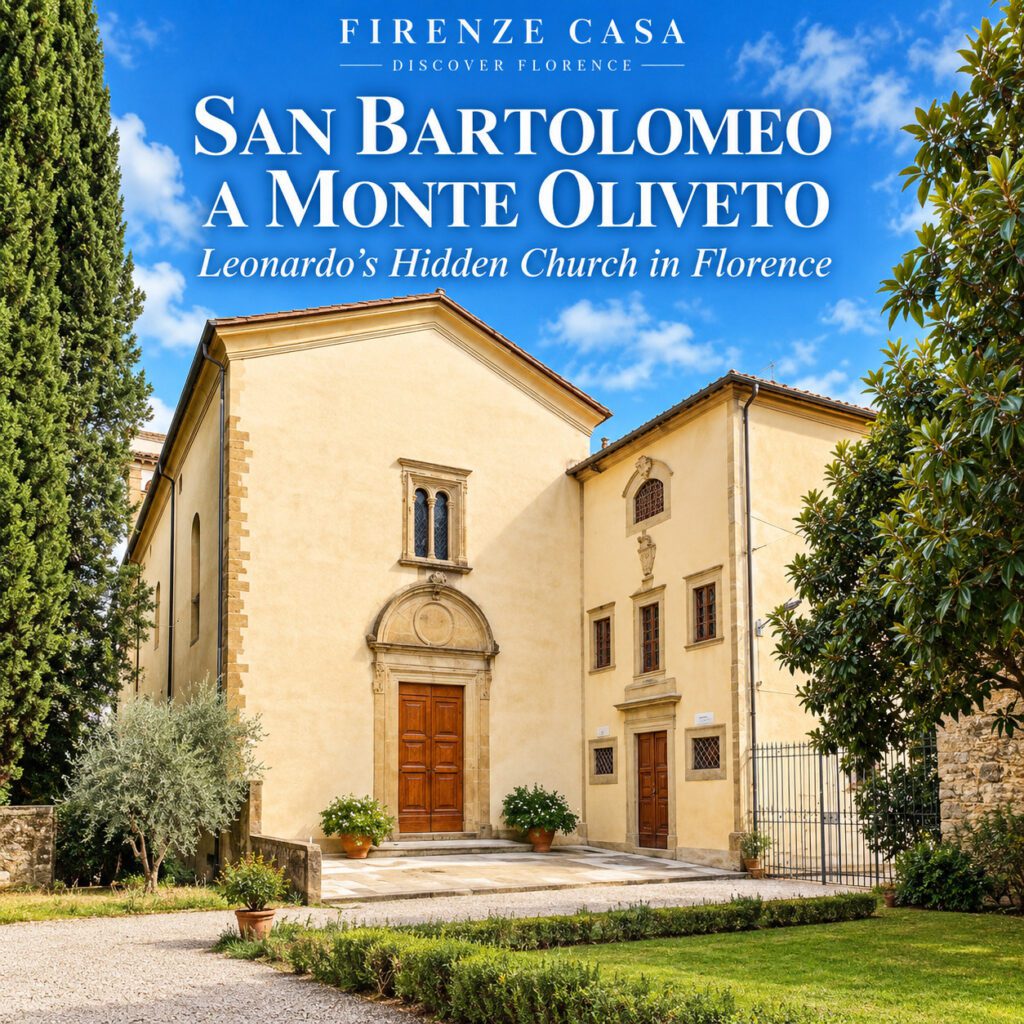
San Bartolomeo a Monte Oliveto is one of Florence’s lesser-known Renaissance discoveries. The quiet church stands above San Frediano on the lower slopes towards Bellosguardo, away from the city’s main sightseeing routes.
Its modest appearance hides an extraordinary artistic connection. Leonardo da Vinci’s famous Annunciation, now displayed in the Uffizi Gallery, originally belonged to this church. Inside, visitors can also discover Renaissance frescoes and a detached Last Supper by Sodoma.
Location: Via Monte Oliveto, above San Frediano
Founded: 1334
Religious order: Olivetan Benedictines
Renaissance highlight: Portal associated with Michelozzo
Famous former artwork: Leonardo da Vinci’s Annunciation
Still inside: Sodoma’s detached Last Supper and other historic paintings
Best for: Leonardo enthusiasts, Renaissance art and quieter Florence
Is San Bartolomeo a Monte Oliveto Worth Visiting?
For most first-time visitors, San Bartolomeo a Monte Oliveto is not an essential Florence sight. The major basilicas and museums should come first if you have only two or three days.
With more time, the calculation changes. The church offers an unusual connection with Leonardo, Renaissance architecture and Florentine monastic history. Its location also takes you beyond the busiest streets of the historic centre.
It is particularly worthwhile if you have already seen Leonardo’s Annunciation in the Uffizi. Visiting the place for which the painting was originally created adds historical context that a museum display cannot provide.
Choose San Bartolomeo a Monte Oliveto if you enjoy Leonardo, Renaissance painting or quiet historic churches. Skip it on a very short first visit unless one of these subjects particularly interests you.
A Monastery on the Hillside Above Florence
The history of San Bartolomeo a Monte Oliveto began in 1334. An Olivetan Benedictine monk from the Abbey of Monte Oliveto Maggiore founded the religious community here.
The location lay outside the dense medieval city. Even today, climbing from San Frediano towards Monte Oliveto creates a noticeable transition from urban Florence to the quieter slopes around Bellosguardo.
The monastery expanded and changed over the following centuries. Wealthy patrons and religious communities gradually filled the church with paintings, frescoes and altarpieces.
The setting is part of the experience. San Bartolomeo feels different from churches around the Duomo because it belongs to the transition between historic Florence and the surrounding hills.
Michelozzo and the Renaissance Portal
The exterior may appear restrained, but the entrance deserves a closer look. The Renaissance portal dates from the 15th century and is traditionally associated with Michelozzo.
FeelFlorence dates its completion to 1472. Its clear architectural forms introduced Renaissance language into a complex with medieval origins.
Michelozzo ranks among the architects who helped define 15th-century Florence. His career developed within the same world of patronage that transformed churches, convents and palaces across the city.
Pause at the entrance before going inside. The portal provides a compact example of Renaissance architectural order within a much older religious foundation.
Leonardo’s Annunciation and San Bartolomeo
The most remarkable chapter in the church’s artistic history concerns Leonardo da Vinci. His celebrated Annunciation once stood here before entering the Uffizi collection.
Leonardo painted the work as a young artist during the 1470s. The scene shows the Archangel Gabriel kneeling before the Virgin Mary in an elegant garden. A distant landscape opens behind them towards mountains and water.
The painting already reveals Leonardo’s intense observation of nature. Flowers cover the foreground, while the angel’s wings reflect his study of birds. Atmospheric distance gradually softens the landscape behind the figures.
Today, visitors encounter the painting in the Uffizi. Knowing its original location changes the way we understand it. Leonardo did not create the Annunciation as an isolated museum masterpiece. It belonged to a religious setting and formed part of the visual culture of this Olivetan community.
If you visit the Uffizi, look at Leonardo’s Annunciation with San Bartolomeo in mind. The painting’s present museum setting is very different from the quiet religious complex for which it was originally intended.
How the Annunciation Reached the Uffizi
Leonardo’s painting remained associated with Monte Oliveto for centuries. During the 19th century, it left the church and entered the Florentine state collections.
The work moved to the Uffizi in 1866. It eventually became one of the museum’s most celebrated early Leonardo paintings.
Today, the Uffizi displays it together with other works connected with Leonardo’s Florentine career. These include the Adoration of the Magi and Verrocchio’s Baptism of Christ, on which the young Leonardo collaborated.
This makes San Bartolomeo a particularly interesting example of a wider Florentine story. Many masterpieces now seen in museums originally belonged to churches, monasteries and confraternities across the city.
Florence’s museums make more sense when you know where their paintings came from. Visiting original locations such as Monte Oliveto connects famous artworks with the neighbourhoods and religious communities that commissioned them.
Sodoma’s Last Supper
Leonardo’s painting has left the church, but San Bartolomeo still preserves important Renaissance art. One highlight is a detached Last Supper by Giovanni Antonio Bazzi, better known as Sodoma.
Sodoma created the fresco in 1515. It belongs to the rich Florentine tradition of Last Suppers painted for religious communities and monastic dining spaces.
The work provides an interesting comparison with better-known Florentine cenacoli. Ghirlandaio’s Last Supper at Ognissanti belongs to the previous generation. Other refectories around Florence reveal how repeatedly artists returned to the same subject.
You do not need to visit every historic Last Supper in Florence. However, travellers interested in Renaissance painting can build a fascinating specialist itinerary around several of them.
Sodoma’s Last Supper gives the church artistic value even though Leonardo’s famous painting is now in the Uffizi. Look beyond the Leonardo connection when you enter.
What Else to See Inside
The interior preserves works from several periods rather than presenting a single unified Renaissance programme. This reflects the long history of the monastery and later changes to the church.
Bernardino Poccetti contributed fresco decoration. Other works connect the church with artists including Passignano, Poppi and Simone Pignoni.
Some artworks that once belonged to Monte Oliveto now survive elsewhere. Napoleonic suppressions and later institutional changes dispersed parts of the historic collection.
This makes the church an interesting example of how Florentine religious interiors evolved. What visitors see today represents only part of the artistic environment that once existed here.
San Bartolomeo and the Story of Dispersed Florentine Art
Florence’s museums contain countless works that once stood inside churches and monasteries. San Bartolomeo a Monte Oliveto provides an especially clear example.
Leonardo’s Annunciation is now in the Uffizi. Other works associated with the complex entered public collections after religious suppressions and changes in ownership.
Santi di Tito painted an important Entry of Christ into Jerusalem for the church’s high altar. That work later entered the Galleria dell’Accademia.
Following these movements can transform a museum visit. Instead of seeing paintings as isolated masterpieces, travellers begin to understand them as parts of Florence’s churches, neighbourhoods and religious institutions.
The removal of artworks from churches was not unusual. Suppressions, political change and the growth of public museums redistributed religious art throughout Florence during the 18th and 19th centuries.
Planning Your Visit
San Bartolomeo a Monte Oliveto stands on Via Monte Oliveto, above the San Frediano area. Reaching it requires more effort than visiting churches in the flat historic centre.
The church remains an active place of worship. FeelFlorence currently lists regular public opening periods, but religious activities and local arrangements can change. Check current information shortly before making a special journey.
There is no reason to cross Florence solely to tick another church off a list. The visit works much better as part of an exploration of San Frediano, Monte Oliveto or the Bellosguardo slopes.
If you are staying at Firenze Casa, allow enough time for the journey across the Arno and combine several places in this part of Florence. The route becomes much more rewarding when the walk itself forms part of the experience.
Address: Via Monte Oliveto, Florence
Area: Above San Frediano, towards Bellosguardo
Main reasons to visit: Leonardo connection, Sodoma’s Last Supper, Renaissance architecture
Access: Active church; check current arrangements before visiting
Good to know: The approach involves walking uphill.
Combine It with San Frediano
The most practical approach starts in San Frediano. Our Santo Spirito & San Frediano Walking Tour explores the neighbourhood’s churches, artisan traditions and historic streets.
Porta San Frediano provides a useful geographical reference. From the old city gate, you leave the dense historic neighbourhood and gradually climb towards Monte Oliveto.
This extension changes the character of the walk. San Frediano feels urban and lived-in, while the slopes above it begin to reveal the greener landscape around Bellosguardo.
If you enjoy exploring Florence on foot, this transition can be as rewarding as the church itself.
Do not treat San Bartolomeo as an isolated destination. Explore San Frediano first and then continue uphill. This turns a small church visit into a more varied walk from historic neighbourhood streets towards the quieter Florentine hills.
Continue Towards Bellosguardo
Travellers who enjoy walking can continue towards Bellosguardo. The hillside takes its name from the beautiful views that open across Florence and the surrounding landscape.
This area feels remarkably different from the monumental centre. Villas, gardens and quieter roads replace the dense medieval street pattern around the Duomo.
FeelFlorence specifically includes San Bartolomeo a Monte Oliveto within its exploration of the wider Isolotto, Legnaia and Bellosguardo area. The church therefore works particularly well as a cultural stop within a longer hillside walk.
Comfortable shoes are useful. The reward is a side of Florence that many short-stay visitors never encounter.
Leonardo Before and After Your Visit
If Leonardo provides your main reason for visiting, consider seeing the Annunciation in the Uffizi before coming to Monte Oliveto. You will then arrive already knowing the painting that once belonged here.
The opposite sequence also works. Visit the church first and then look for the painting during a later Uffizi visit. Its original setting will still be fresh in your mind.
Either approach creates a useful connection between museum and city. Florence becomes more interesting when artworks lead you back into the places from which they came.
When you see Leonardo’s Annunciation in the Uffizi, remember Monte Oliveto. The quiet hillside church gives the famous museum painting an unexpected geographical home within Florence.
Frequently Asked Questions About San Bartolomeo a Monte Oliveto
Where is San Bartolomeo a Monte Oliveto?
The church stands on Via Monte Oliveto above San Frediano. It lies on the lower slopes towards Bellosguardo, southwest of Florence’s historic centre.
Why is San Bartolomeo a Monte Oliveto famous?
The church is closely associated with Leonardo da Vinci’s Annunciation. It also preserves Renaissance art, including Sodoma’s detached Last Supper.
Is Leonardo’s Annunciation still inside the church?
No. The painting moved to the Uffizi in the 19th century and is now one of the museum’s major Leonardo works.
Did Leonardo paint the Annunciation for this church?
The Uffizi identifies the painting as coming from the Church of Monte Oliveto. Its long association with this religious complex makes the church an important place in the early history of the work.
What can I still see inside?
The church preserves Sodoma’s Last Supper, frescoes associated with Bernardino Poccetti and other historic paintings.
Is the church worth visiting on a first trip to Florence?
It is optional for most first-time visitors. Prioritise it if Leonardo, Renaissance painting or quieter hillside churches particularly interest you.
What should I combine with the church?
San Frediano is the most natural starting point. Travellers who enjoy longer walks can continue towards Bellosguardo after visiting the church.
Why San Bartolomeo a Monte Oliveto Is Worth Knowing
San Bartolomeo a Monte Oliveto is worth knowing because it reconnects one of Leonardo’s famous paintings with the Florence that produced it. The Annunciation now attracts visitors from around the world in the Uffizi, while its former church remains far outside the usual tourist circuit.
Sodoma’s Last Supper, Michelozzo’s Renaissance portal and the surviving artworks give the church additional reasons to visit. The quieter hillside setting adds another dimension.
This is not a church every traveller needs to see. For visitors with enough time and a genuine interest in Renaissance art, however, it provides something increasingly valuable in Florence: a meaningful connection between a world-famous masterpiece and an almost overlooked place.
Further Reading on Firenze Casa
- Santo Spirito & San Frediano Walking Tour
- Renaissance Masters Florence Walking Tour
- Chiesa di Ognissanti – Botticelli’s Church in Florence
- San Miniato al Monte – Romanesque Basilica in Florence
- Walking Tours of Florence – Complete Guide
- Florence Walking Routes – Explore the City by Theme
References
- Comune di Firenze / FeelFlorence – Chiesa di San Bartolomeo a Monte Oliveto.
- Gallerie degli Uffizi – Leonardo da Vinci and the provenance of the Annunciation.
- Ministero della Cultura – Catalogo Generale dei Beni Culturali.
- Opificio delle Pietre Dure – conservation documentation relating to San Bartolomeo a Monte Oliveto.
- Historical and art-historical studies on the Olivetan monastery, Leonardo da Vinci, Michelozzo and Sodoma.

