
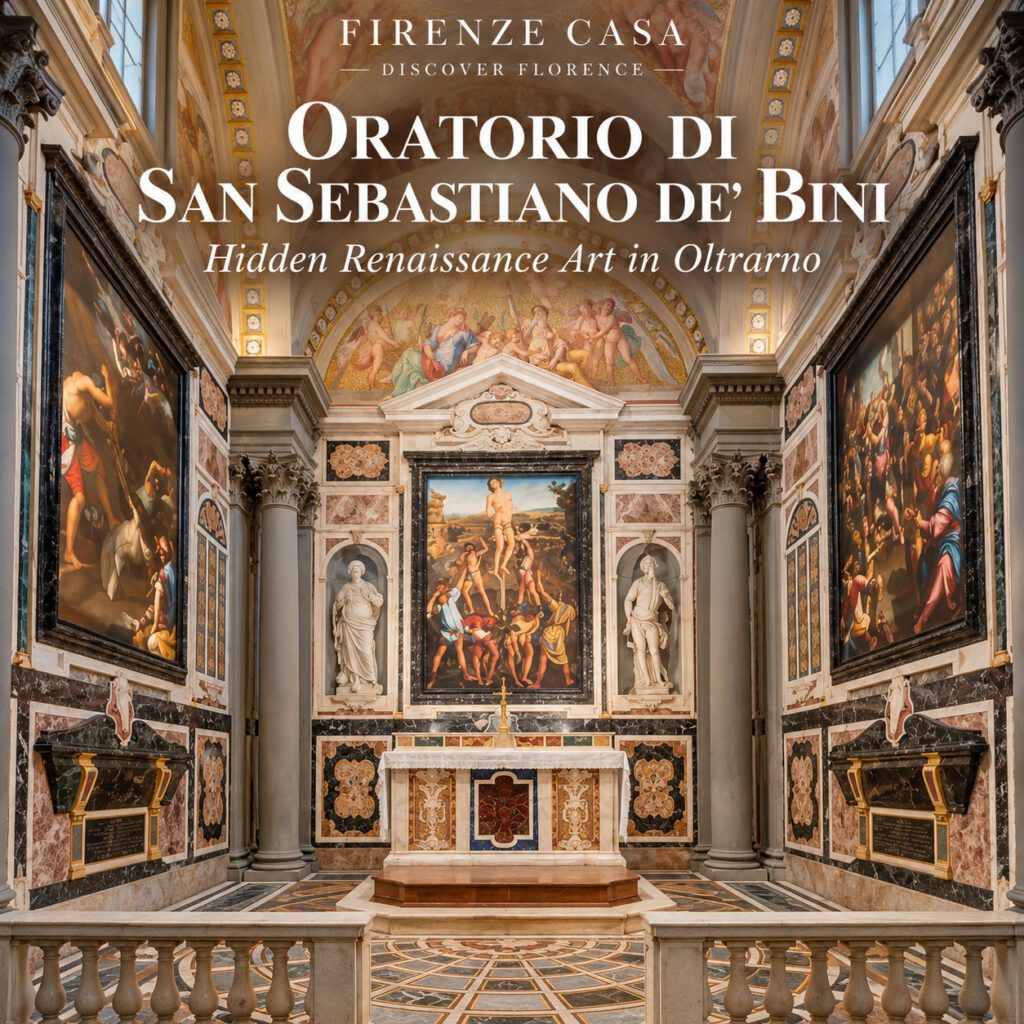
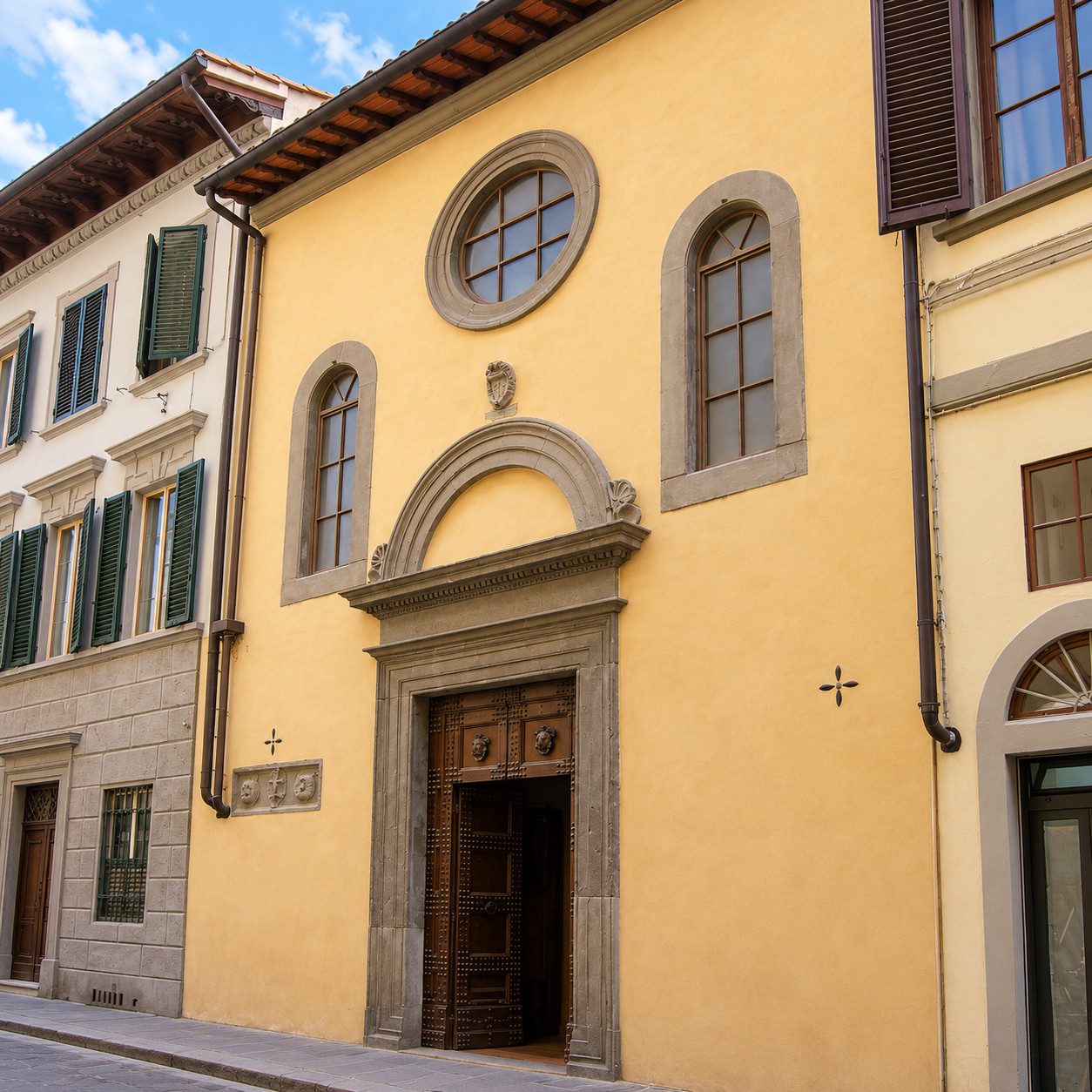
Behind a remarkably modest façade in the Oltrarno, the Oratorio di San Sebastiano de’ Bini preserves an unexpected concentration of Florentine art. Its small interior brings together Renaissance architecture, sculpture, painting and sacred objects connected with several centuries of religious life.
The building is also more than an art collection. Its history began with hospitality for poor travellers and pilgrims, while the Bini family later transformed it into a richly furnished religious space. Today, the oratory houses a small parish museum of sacred art that rewards visitors who enjoy discovering Florence beyond its famous monuments.
Site: Oratorio di San Sebastiano de’ Bini
Area: Oltrarno, Florence
Origins: documented from the 13th century
Historic function: shelter for the poor and pilgrims
Highlights: Renaissance chapel, works connected with Filippino Lippi, Giovanni Bilivert and the Ghiberti tradition
Best for: Renaissance art, small historic interiors and hidden Florence
Allow: around 20–30 minutes when accessible
From Medieval Shelter to Sacred Art Museum
The history of the Oratorio di San Sebastiano de’ Bini reaches back much further than its Renaissance appearance suggests. A small institution described as a spedaluzzo is documented here from 1287. It provided shelter for poor people and pilgrims travelling through Florence.
The Bini family, who owned property in this part of the city, supported the institution. It was connected with the Arcispedale di Santo Spirito in Saxia in Rome, part of a wider tradition of religious hospitality and charitable care. The building continued to serve a hospital or shelter function into the 18th century.
Medieval hospitals were not hospitals in the modern sense. Many offered food, shelter and assistance to travellers, pilgrims and the poor. The history of San Sebastiano therefore reveals a side of Florence that visitors can easily miss when concentrating only on palaces and major churches.
The building eventually developed into an important repository of sacred art. The parish museum opened in 2002 after works historically associated with the oratory had been restored and rearranged. Other objects from nearby churches were also incorporated into the collection, creating a small survey of religious art spanning several centuries.
The Renaissance Chapel of the Bini Family
The artistic centre of the oratory is its main chapel. Its Renaissance architecture is closely associated with the wooden architectural setting created by Baccio d’Agnolo for the Bini family during the early 16th century.
Bernardo di Piero Bini appears to have commissioned the ensemble between about 1520 and 1525. His burial in the chapel reinforces the close connection between family patronage, religious devotion and artistic display.
The elaborate wooden ancona resembles the façade of a small Renaissance temple. Fluted architectural elements, an entablature and triangular pediment provide a carefully ordered setting for paintings produced by different artists.
Do not look only at the individual paintings. Step back and consider the entire altar ensemble. Architecture, painting and family patronage were conceived to work together, making the chapel an unusually intimate example of Florentine Renaissance design.
The Madonna dell’Umiltà – A Painting Lost and Recovered
At the centre of the ensemble is the Madonna dell’Umiltà, attributed to Rossello di Jacopo Franchi. Its history adds an unexpected modern chapter to the story of the oratory.
The painting was stolen in 1931. After disappearing for decades, it resurfaced on the art market and was recovered in 1971, allowing it eventually to return to its historic context.
Other paintings complete the ensemble. Works associated with Pier Francesco Foschi depict Saint Peter Martyr and Saint Bernard. The lower part includes a Pietà and predella scenes attributed to the Master of Serumido, an anonymous Florentine painter whose activity is particularly connected with the Oltrarno.
The recovery of the Madonna dell’Umiltà is part of a wider story of artworks removed from Florentine churches and later rediscovered. Seeing such a work again within its historic setting offers a very different experience from encountering it in an isolated museum display.
San Sebastian and Filippino Lippi
One of the most intriguing ensembles in the Oratorio di San Sebastiano de’ Bini centres on its patron saint. A wooden statue of Saint Sebastian is attributed to sculptor Leonardo del Tasso, while its painted decoration has been connected with Filippino Lippi.
Painted panels depicting Saint John the Evangelist and Mary Magdalene, also associated with Filippino Lippi, once accompanied the figure. Together, they help explain why this small oratory deserves attention from visitors interested in Florentine Renaissance art.
Filippino Lippi is much better known for completing the celebrated fresco cycle in the Brancacci Chapel at Santa Maria del Carmine. Encountering his artistic world in a much smaller setting provides an interesting contrast with that famous masterpiece.
Giovanni Bilivert and the 17th-Century Interior
The oratory continued to acquire important works after the Renaissance. During the 17th century, painter Giovanni Bilivert designed an elaborate tabernacle for Saint Sebastian. He incorporated earlier paintings into the new architectural setting rather than simply replacing them.
Bilivert also painted the Guardian Angel, signed and dated 1626. A lunette with an angel holding a candle and cherub heads is likewise connected with his work and with the patronage of Pietro Bini.
These additions show how the interior evolved gradually. Instead of representing one perfectly preserved moment, the oratory records changing artistic tastes and devotional practices over several centuries.
Ghiberti’s Legacy and Other Sacred Art
Another notable object is a painted relief of the Madonna and Child, traditionally connected with the workshop or artistic tradition of Lorenzo Ghiberti. Its intimate image belongs to a type of devotional sculpture that circulated widely in Renaissance Florence.
A painted wooden crucifix provides another important sculptural element. Its attribution has varied in the literature, with connections proposed to the wider Donatellian tradition and, more specifically, to Baccio da Montelupo. For visitors, its importance lies above all in seeing how sculpture formed part of the devotional environment of the oratory.
The collection also contains liturgical objects from neighbouring churches, including San Felice in Piazza and San Pier Gattolino. Among them are Florentine and Tuscan silver objects produced for religious use. Their presence gives the museum a broader role as a repository for the sacred heritage of this part of the Oltrarno.
Why the Oratory Is Worth Visiting
The Oratorio di San Sebastiano de’ Bini is not a substitute for Florence’s great churches. Visitors seeing the city for the first time should still prioritise major sites such as the Basilica di Santo Spirito and Santa Maria del Carmine and the Brancacci Chapel.
Its appeal is different. Here, several centuries of Florentine art and social history survive within a compact and comparatively little-known space. The medieval shelter, Bini family patronage, Renaissance chapel and later parish museum all belong to the same story.
It is therefore especially rewarding for travellers who have already seen Florence’s headline monuments and want to explore the quieter layers of the city.
Treat the oratory as part of an Oltrarno walk rather than planning an entire excursion around it. Combine it with Santo Spirito, Santa Maria del Carmine and the streets of San Frediano. This creates a much richer half-day route through the neighbourhood.
Planning Your Visit
Because this is a small religious and museum space rather than one of Florence’s major visitor attractions, access can be more limited. Opening arrangements may change because of religious activities, special events or organisational requirements.
Check current access before making a special journey. If the oratory is closed, the surrounding Oltrarno still offers enough important sites to make the walk worthwhile.
The area is particularly easy to explore on foot. Visitors staying around Santa Croce and the eastern historic centre can cross the Arno and gradually connect the oratory with Santo Spirito and San Frediano, turning the visit into a broader exploration of Florence south of the river.
A Suggested Oltrarno Combination
A practical route can begin around Piazza Santo Spirito and its basilica before continuing towards Santa Maria del Carmine. From there, explore the smaller streets of San Frediano and incorporate San Sebastiano de’ Bini when access permits.
This approach creates a useful contrast. Santo Spirito represents Brunelleschi’s monumental Renaissance architecture, the Brancacci Chapel presents some of the most influential painting of the 15th century, while San Sebastiano offers a far more intimate encounter with Florentine religious art.
For a longer route through the district, our Santo Spirito & San Frediano Walking Tour connects many of the surrounding sights.
Why San Sebastiano de’ Bini Is a Hidden Treasure
Florence’s fame rests on monumental masterpieces, but its artistic history was also created in small chapels, confraternities, hospitals and neighbourhood churches. The Oratorio di San Sebastiano de’ Bini preserves this more intimate scale exceptionally well.
Its quiet exterior gives almost no indication of what lies inside. That contrast is precisely what makes the visit memorable: a medieval place of hospitality evolved into a small repository of Renaissance and later Florentine art.
Further Reading on Firenze Casa
- The Most Beautiful Churches in Florence
- Basilica of Santo Spirito – Brunelleschi’s Renaissance Church
- Santa Maria del Carmine & Brancacci Chapel
- Santo Spirito – Florence’s Historic Oltrarno Quarter
- San Frediano – Florence’s Historic Artisan Quarter
- Florence Secrets and Traditions – Complete Guide
References
Comune di Firenze – cultural heritage and historic religious sites.
Archdiocese of Florence – information on churches and parish heritage.
Parish museum documentation for the Oratorio di San Sebastiano de’ Bini.
Italian cultural heritage catalogues and scholarly documentation on Florentine Renaissance painting, sculpture and sacred art.
Specialist literature on Baccio d’Agnolo, Filippino Lippi, Giovanni Bilivert and Florentine Renaissance art.

