
Benvenuto Cellini was one of Renaissance Florence’s most extraordinary artists. Sculptor, goldsmith, writer and larger-than-life personality, he created works of remarkable technical sophistication while leading a life almost as dramatic as his art.
For visitors, Benvenuto Cellini Florence is also an unusually easy story to explore on foot. His famous Perseus with the Head of Medusa still stands in the Loggia dei Lanzi, while the Bargello Museum reveals another side of Cellini as sculptor and master metalworker. Even the Ponte Vecchio preserves his memory.
Born: Florence, 1500
Died: Florence, 1571
Profession: Goldsmith, sculptor and writer
Most famous Florentine work: Perseus with the Head of Medusa
Main patron in Florence: Cosimo I de’ Medici
Where to see his legacy: Loggia dei Lanzi, Bargello Museum and Ponte Vecchio
Best for: Renaissance sculpture, Medici history and Florentine craftsmanship
Who Was Benvenuto Cellini?
Benvenuto Cellini was born in Florence in 1500. Although he eventually became famous as a sculptor, his artistic foundations lay in the demanding world of goldsmithing and metalwork. This training required precision, an understanding of metals and exceptional control over casting, engraving and decorative detail.
Florence had a long tradition of artists emerging from specialised workshops. Cellini belongs to this wider history of Florentine goldsmiths and jewellery making, in which craftsmanship and fine art were closely connected.
However, Cellini did not spend his entire career in his native city. He worked in Rome and later at the French court of Francis I, moving through a world of powerful patrons, artistic rivalries and court politics. His surviving works range from precious objects on an intimate scale to monumental bronze sculpture.

Benvenuto Cellini (1500–1571), Florentine goldsmith, sculptor and writer. His extraordinary career took him from the workshops of Florence to Rome and the French court before his return to Medici Florence.
Cellini connects two artistic worlds that visitors sometimes consider separately: the precision of the Renaissance goldsmith and the ambition of monumental sculpture. His career shows how skills developed at the workbench could eventually shape works designed for Florence’s most important public spaces.
Cellini Returns to Florence
After years away from Florence, Cellini returned to a city that had changed politically. The republican era had ended, and Duke Cosimo I de’ Medici was transforming Florence into the centre of an increasingly powerful territorial state.
Art played an important role in this transformation. Cosimo surrounded himself with painters, sculptors and architects, while major commissions helped communicate Medici authority. Cellini entered this competitive court environment alongside artists such as Bronzino, Baccio Bandinelli and Giorgio Vasari.
His greatest Florentine commission would place his work permanently at the political heart of the city.
Perseus with the Head of Medusa
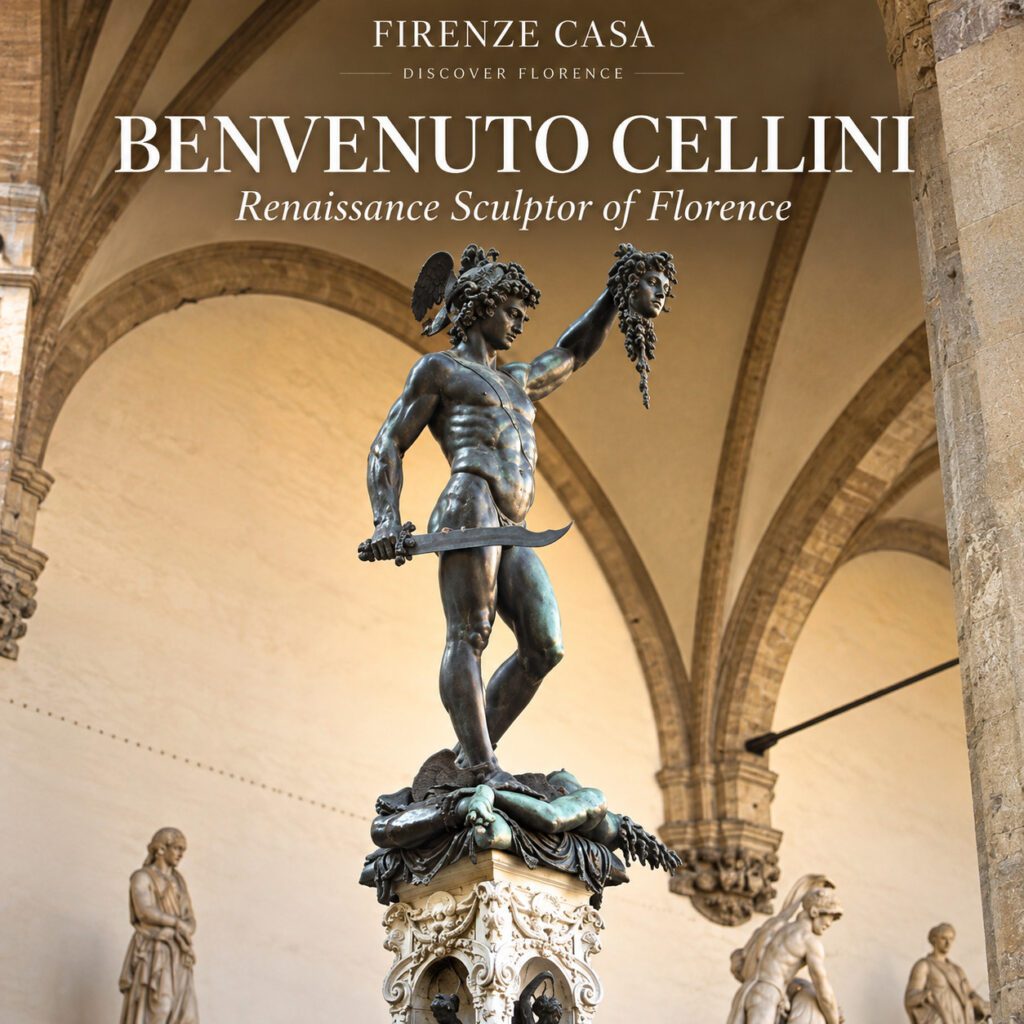
Cellini’s Perseus with the Head of Medusa is his defining work in Florence. Commissioned by Cosimo I de’ Medici, the monumental bronze was created during the 1540s and early 1550s and unveiled in 1554.
Perseus stands triumphantly above the body of Medusa and raises her severed head in one hand. The polished bronze, complex pose and dramatic subject demonstrate Cellini’s extraordinary command of metal casting on a monumental scale.
Yet the sculpture was more than an artistic display. Its position beside Palazzo Vecchio placed it directly within the political landscape created by Cosimo I. The victorious Perseus could therefore be understood as an image of decisive power and the defeat of disorder.
Do not examine only Perseus himself. Look at the richly decorated bronze base and then step back to consider the sculpture together with Palazzo Vecchio and the other statues around Piazza della Signoria. Its location is an essential part of its meaning.
Where to See Cellini’s Perseus
The original Perseus remains in the Loggia dei Lanzi on Piazza della Signoria. This makes it one of Florence’s great masterpieces that visitors can see without entering a museum or buying a ticket.
The setting is exceptional. The Loggia began as a space for civic ceremonies before becoming an extraordinary open-air display of sculpture. Cellini’s bronze occupies a prominent position beneath its arches, close to works representing different periods of Florentine sculpture.
Because the loggia is open towards the piazza, you can return at different times of day. Morning generally provides a calmer experience, while evening lighting gives the bronze and surrounding stone architecture a very different atmosphere.
Visit Piazza della Signoria early in the morning if you want time to study the Perseus without the largest daytime crowds. Then return after dark. Few Renaissance masterpieces in Florence are so easy to experience twice under completely different lighting conditions.
Cellini and Piazza della Signoria
Understanding Cellini’s masterpiece becomes easier when you consider the entire square. Palazzo Vecchio, the Loggia dei Lanzi and the surrounding sculptures created an extraordinary dialogue between government, history, mythology and public art.
Michelangelo’s David had already demonstrated how sculpture could acquire political meaning in this setting. Cellini’s Perseus entered the same charged environment under a very different political system: the Florence of Cosimo I rather than the earlier republic.
This makes Piazza della Signoria one of the best places to understand how Renaissance art functioned beyond churches and museums. Sculpture could communicate power directly within the everyday space of the city.
Cellini at the Bargello Museum
Visitors who want to understand Cellini beyond the Perseus should continue to the Bargello Museum. It is only a short walk from Piazza della Signoria and houses one of the world’s great collections of Renaissance sculpture and decorative arts.
The Bargello places Cellini within a much broader artistic story. Works associated with Donatello, Verrocchio, Michelangelo, Giambologna and other masters allow visitors to compare different generations of Florentine sculpture and metalwork.
This context is particularly valuable. Cellini did not work in isolation. Renaissance Florence encouraged competition between artists, and the Medici court intensified that rivalry by commissioning works from some of the most ambitious artists of the period.
Combine the Bargello with Piazza della Signoria and the Loggia dei Lanzi. The walk between them takes only a few minutes and connects museum sculpture directly with monumental art in its historic urban setting.
From Goldsmith to Monumental Sculptor
Cellini’s background as a goldsmith helps explain the extraordinary detail of his larger works. Goldsmiths learned to control precious materials carefully and to think simultaneously about modelling, surface, ornament and technical execution.
His career therefore provides an excellent introduction to an important feature of Renaissance Florence: the boundary between artist and craftsman was far less rigid than modern categories sometimes suggest.
The connection becomes particularly interesting when exploring Ponte Vecchio. The bridge later became famous for its goldsmiths and jewellers, preserving a craft tradition that forms part of the same wider Florentine culture of metalworking.
The Cellini Monument on Ponte Vecchio
There is another place where visitors encounter Benvenuto Cellini in Florence, although this time they see the artist rather than one of his great sculptures.
A bronze bust of Cellini stands on Ponte Vecchio. Installed centuries after his death, the monument celebrates him as one of Florence’s great masters of metalwork and reinforces the bridge’s association with goldsmiths and jewellers.
It is easy to overlook amid the crowds and shop windows. However, once you know Cellini’s background, the location makes sense: the sculptor whose Perseus dominates the Loggia dei Lanzi had begun his artistic career within precisely this broader tradition of working precious metals.
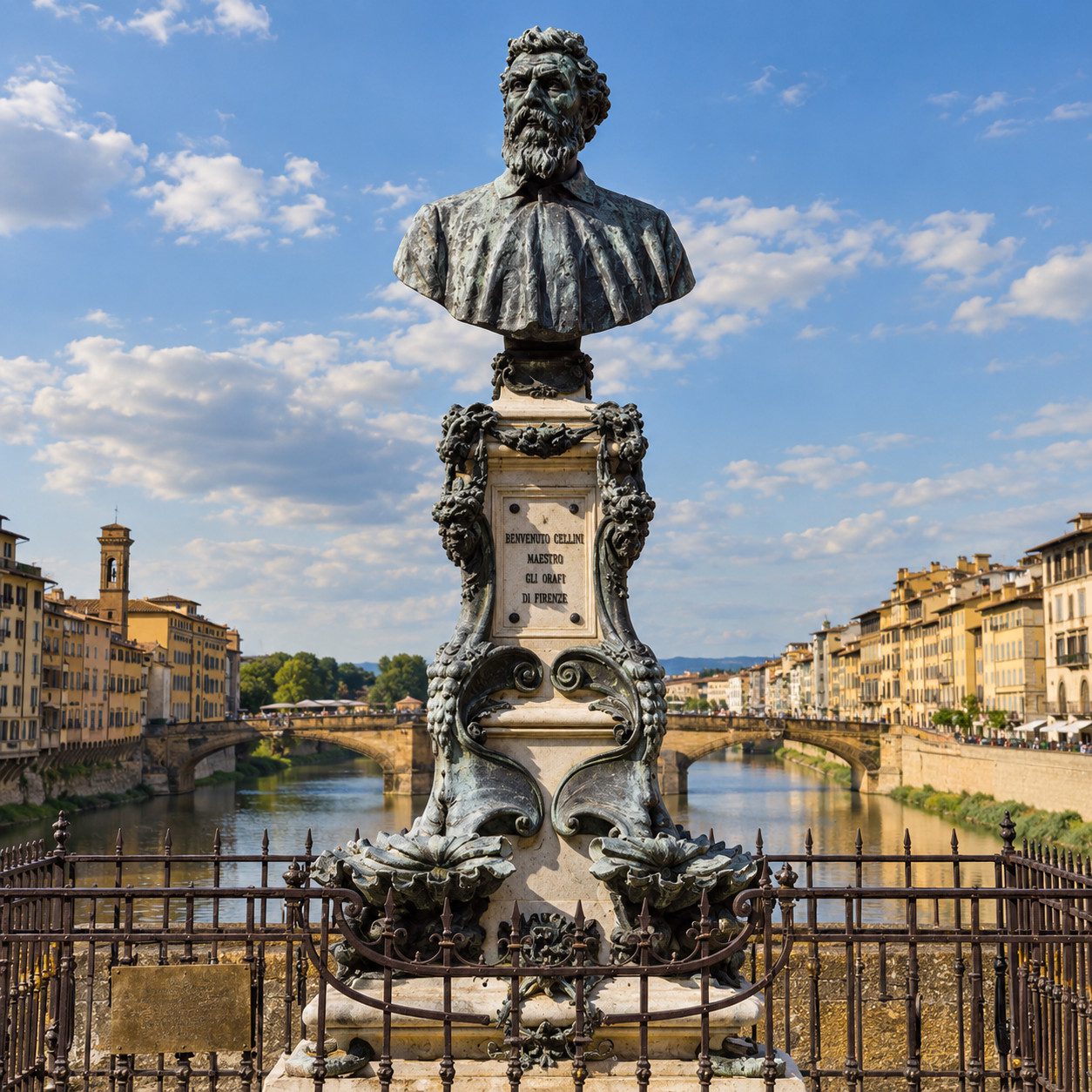
When crossing Ponte Vecchio, pause near the central opening of the bridge and look for Cellini’s bust. It provides a small but useful connection between Florence’s famous jewellery bridge and one of its greatest Renaissance metalworkers.
Cellini the Writer
Cellini left another remarkable legacy: his autobiography. Written with extraordinary confidence, it recounts his artistic ambitions, travels, disputes, encounters with powerful patrons and numerous dramatic episodes.
The book helped turn Cellini himself into a historical character almost as famous as some of his works. It also offers a vivid, highly personal view of the competitive artistic culture of sixteenth-century Italy.
However, readers should not treat every episode as neutral historical documentation. Cellini was telling his own story and carefully constructing his own image. That combination of autobiography, self-promotion and extraordinary anecdote is precisely what makes the work so fascinating.
A Complicated Renaissance Personality
Cellini’s brilliance should not turn the story of his life into a romantic tale of the misunderstood artist. His life involved violent conflicts, accusations, imprisonment and repeated disputes. He could be proud, confrontational and intensely conscious of his own talent.
These contradictions make him particularly revealing. The Renaissance workshop and court were not serene environments populated only by idealised geniuses. Artists competed for commissions, status, money and access to powerful patrons.
Cellini experienced that world at its most dramatic. His personality may have been exceptional, but the rivalries surrounding him belonged to the broader artistic culture of Medici Florence.
Following Benvenuto Cellini through Florence
You do not need a full day to explore Benvenuto Cellini Florence. His principal Florentine connections can form part of a compact walk through the historic centre.
Begin at the Bargello Museum if you want the artistic context first. From there, walk to Piazza della Signoria and spend time with the Perseus beneath the Loggia dei Lanzi. Afterwards, continue towards the Uffizi and the Arno before crossing Ponte Vecchio and finding Cellini’s monument.
This sequence works especially well because it moves from museum collection to public sculpture and finally to Florence’s continuing goldsmith tradition. It can also be incorporated into our Renaissance Masters of Florence – Art & Architecture Walk.
The Loggia dei Lanzi and Ponte Vecchio can be visited freely at any time, while the Bargello requires a separate museum visit. If your time in Florence is limited, see the Perseus first. Add the Bargello if Renaissance sculpture is one of your main interests.
Why Benvenuto Cellini Is Worth Discovering
Benvenuto Cellini brings together several stories that make Renaissance Florence so compelling. He was a craftsman who became a monumental sculptor, a Florentine who worked for European courts and an artist whose most famous public work also communicated political power.
Above all, his legacy remains unusually accessible. You can stand beneath the Loggia dei Lanzi and examine the same monumental bronze that entered Piazza della Signoria during the rule of Cosimo I. A few minutes away, the Bargello places Cellini within the wider development of Renaissance sculpture. Then Ponte Vecchio recalls the goldsmith tradition from which his career emerged.
Following these connections turns Cellini from a name in an art-history book into part of the city itself. For travellers who enjoy understanding why Florence looks the way it does, that makes him one of the most rewarding Renaissance personalities to discover.
Frequently Asked Questions
Who was Benvenuto Cellini?
Benvenuto Cellini was a Florentine goldsmith, sculptor and writer born in 1500. He became one of the most distinctive artistic personalities of the sixteenth century.
What is Benvenuto Cellini famous for in Florence?
His most famous Florentine work is Perseus with the Head of Medusa, the monumental bronze displayed in the Loggia dei Lanzi on Piazza della Signoria.
Can I see Cellini’s Perseus for free?
Yes. The sculpture stands in the open Loggia dei Lanzi and can be viewed directly from Piazza della Signoria without a museum ticket.
Where else can I discover Cellini in Florence?
Visit the Bargello Museum for Cellini within the wider history of Renaissance sculpture and look for his monument on Ponte Vecchio, which recalls his connection with Florentine goldsmithing.
Was Cellini a goldsmith or a sculptor?
He was both. Cellini trained and worked as a goldsmith before applying his exceptional knowledge of metalworking and casting to increasingly ambitious sculpture.
Further Reading on Firenze Casa
- Loggia dei Lanzi – Florence’s Open-Air Sculpture Gallery
- Bargello Museum – Renaissance Sculpture in Florence
- Goldsmiths of Florence – Ponte Vecchio Jewellery
- The Medici Family: The Dynasty That Shaped Florence
- Palazzo Vecchio – Florence’s Historic Government Palace
- The History of Ponte Vecchio: Florence’s Most Famous Bridge
- Renaissance Masters of Florence – Art & Architecture Walk
References
- Gallerie degli Uffizi – Loggia dei Lanzi and Benvenuto Cellini’s Perseus
- Museo Nazionale del Bargello – Benvenuto Cellini and Renaissance Sculpture
- Treccani – Dizionario Biografico degli Italiani: Benvenuto Cellini
- Cellini, Benvenuto – Vita di Benvenuto Cellini scritta da lui medesimo
- Cellini, Benvenuto – Trattati dell’oreficeria e della scultura
- Giorgio Vasari – Le vite de’ più eccellenti pittori, scultori e architettori
- Gallerie degli Uffizi – Historical Material on Cosimo I de’ Medici and Sixteenth-Century Florentine Art
- Museo Nazionale del Bargello – Collections of Renaissance Sculpture and Decorative Arts

