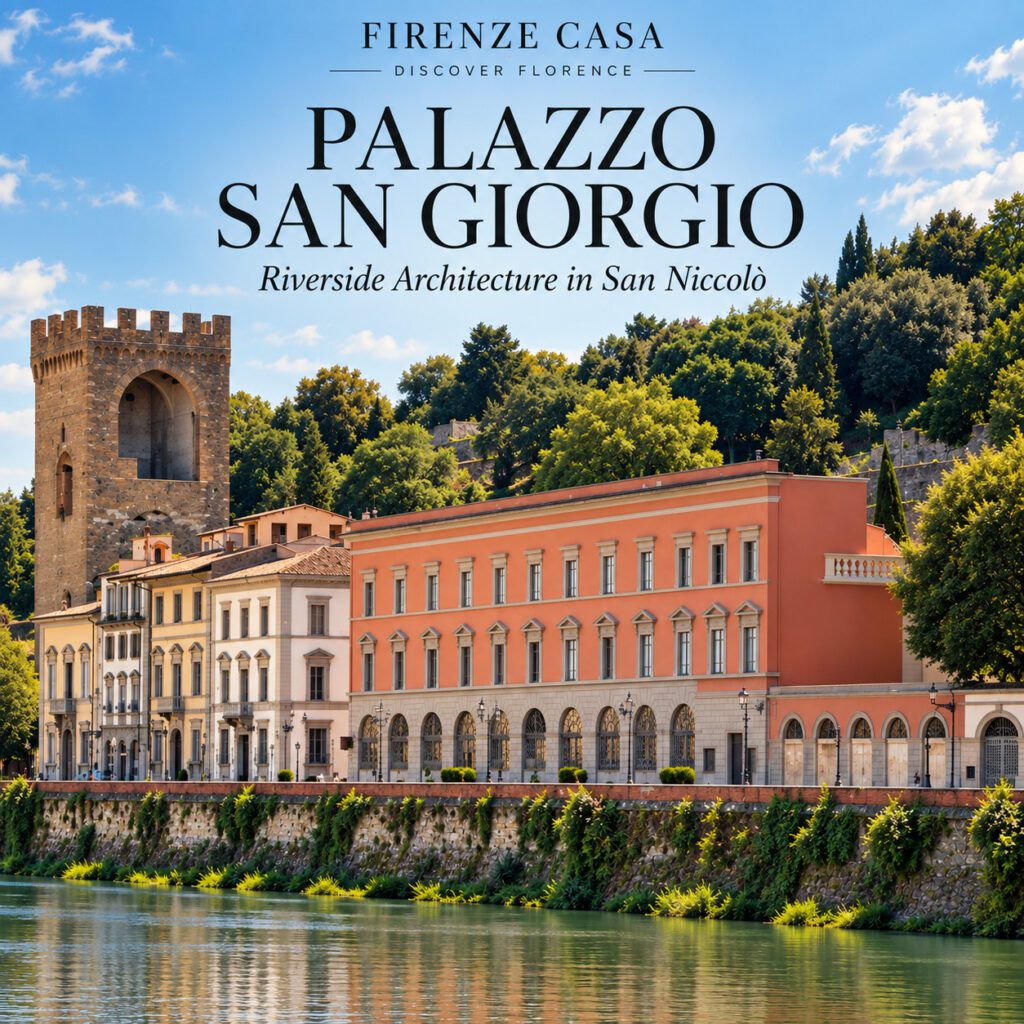
Palazzo San Giorgio is beginning a remarkable new chapter on the banks of the Arno. Standing on Lungarno Serristori in the eastern Oltrarno, Palazzo San Giorgio Florence developed from buildings historically connected with neighbouring Palazzo Serristori. Today, the restored building has a new cultural role.
From 28 September 2026, the palazzo becomes the new home of the Collezione Casamonti. As a result, modern and contemporary art now meets a historic riverside setting. For visitors, the building also fits naturally into a walk between the Arno, San Niccolò and the hills above Florence.
Building: Palazzo San Giorgio
Location: Lungarno Serristori 17, Florence
Area: Eastern Oltrarno / San Niccolò
Origins: Historically connected with the stables of Palazzo Serristori
Present building: 19th century
Today: New home of the Collezione Casamonti
Best combined with: San Niccolò · Museo Bardini · Arno riverside · Piazzale Michelangelo
Where Is Palazzo San Giorgio?
Palazzo San Giorgio stands at Lungarno Serristori 17 on the southern bank of the Arno. It lies east of Ponte alle Grazie, between the river and the historic San Niccolò area.
The location is particularly attractive because the monumental historic centre remains close, while the atmosphere already begins to change. Around Piazza della Signoria and Santa Croce, dense streets define the cityscape. Here, however, the river opens the view towards the Oltrarno and the slopes rising towards Piazzale Michelangelo.
Visitors do not need to plan a separate journey to reach the area. Instead, they can easily include Palazzo San Giorgio in a walk along the Arno or through San Niccolò.
If you are exploring eastern Florence, cross the Arno at Ponte alle Grazie rather than treating the Oltrarno only as the route to Piazzale Michelangelo. Palazzo San Giorgio and San Niccolò provide good reasons to spend some time at river level first.
From Palazzo Serristori’s Stables to Palazzo San Giorgio
The history of Palazzo San Giorgio is closely connected with neighbouring Palazzo Serristori. Originally, the site formed part of the service areas and stables associated with the much older palace complex.
During the 19th century, the property changed significantly. A more monumental building emerged along the Lungarno and gave this part of the riverfront a new architectural presence. Therefore, Palazzo San Giorgio belongs to a very different period from the Renaissance palaces for which Florence is famous.
That difference makes the building particularly interesting. During the 19th century, Florence expanded and modernised, while new residential and institutional buildings changed parts of the city. Palazzo San Giorgio reflects this transformation of the Arno riverfront.
Palazzo San Giorgio is not one of Florence’s great Renaissance family palaces. Instead, its architectural story belongs largely to the 19th-century transformation of the Lungarno and to the historic complex surrounding Palazzo Serristori.
Architecture Facing the Arno
The long façade towards the river gives Palazzo San Giorgio much of its character. In particular, a sequence of large arches creates a strong rhythm along the lower level. At the same time, these arches recall the building’s historical origins and establish an unusually open relationship with the Lungarno.
The architecture appears more restrained than the heavily rusticated façades of many Renaissance palaces. Nevertheless, its scale, riverside position and relationship with the neighbouring Serristori complex give the building a distinctive presence.
Moreover, Palazzo San Giorgio shows how Florence continued to develop long after the Renaissance. Along the Lungarni, medieval structures, Renaissance palaces, 19th-century buildings and modern interventions now form a varied architectural landscape.
A Major Restoration and New Use
The Florence-based architectural practice Archea Associati recently carried out an extensive restoration and adaptive reuse of Palazzo San Giorgio. The architects preserved important elements of the historic building while creating substantial spaces for contemporary cultural use.
For example, glass now fills the large arches facing the Lungarno. This solution allows natural light to enter the interior without disrupting the rhythm of the façade. Inside, contemporary exhibition spaces now interact with the historic architecture.
A new staircase connects the two principal exhibition levels. Rather than treating it as a purely functional element, the architects designed it as a sculptural feature within the museum interior.
Consequently, the project does not try to reconstruct an imaginary historic palace interior. Instead, visitors can clearly distinguish between the older architecture and the contemporary elements that support the building’s new purpose.
Before entering, look at the sequence of arches along the Lungarno. Inside, notice how the restoration combines the historic shell with deliberately contemporary exhibition architecture instead of imitating a 19th-century interior.
Palazzo San Giorgio and the Collezione Casamonti
The transformation of Palazzo San Giorgio is closely linked to its new cultural role. From 28 September 2026, the building becomes the permanent home of the Collezione Casamonti, assembled by Florentine gallerist and collector Roberto Casamonti.
Previously, visitors could see the collection at Palazzo Bartolini Salimbeni on Piazza Santa Trinita. However, the available space there limited the presentation. Different sections of the collection therefore appeared in rotation.
Palazzo San Giorgio changes the experience considerably. Around 250 works can now occupy 28 rooms on two levels. As a result, visitors can follow a much broader journey from the late 19th century to contemporary art.
The combination of architecture and art creates an intriguing contrast. A 19th-century Florentine building now provides the setting for works associated with artists such as Picasso, Kandinsky, de Chirico, Fontana, Burri, Warhol, Basquiat, Abramović, Kiefer and Cattelan.
Today, visitors experience the two together. Palazzo San Giorgio provides the architectural setting, while the Collezione Casamonti is the principal reason to enter. Our separate Firenze Casa guide to the collection focuses on the artworks, artists, tickets and practical museum visit.
Is Palazzo San Giorgio Worth Visiting?
Palazzo San Giorgio does not offer a historic palace interior comparable with Palazzo Vecchio, Palazzo Medici Riccardi or Palazzo Pitti. Therefore, visitors should not expect frescoed Renaissance rooms, princely apartments or a traditional palace museum.
Instead, its appeal lies in the relationship between historic architecture and contemporary reuse. Its position beside the Arno adds another attraction, while the art collection provides the main reason to explore the interior.
If architecture is your main interest, you can appreciate the exterior during a walk along Lungarno Serristori. However, travellers interested in modern and contemporary art should allow considerably more time and visit the Collezione Casamonti itself.
What to See Nearby
Palazzo San Giorgio sits in an excellent part of Florence for combining several different experiences within a relatively small area. Therefore, it works particularly well as one stop on a longer Oltrarno walk.
First, continue into San Niccolò for narrow streets, restaurants and traces of medieval Florence. The neighbourhood feels markedly different from the monumental centre across the river.
The Museo Bardini provides an especially interesting contrast with Casamonti. Stefano Bardini’s collection concentrates on older paintings, sculptures, furniture and decorative arts. Palazzo San Giorgio, by contrast, introduces visitors to modern and contemporary art.
Nearby, the Bardini Garden offers terraces, greenery and panoramic views. Afterwards, you can continue uphill towards the Rose Garden and Piazzale Michelangelo.
Closer to the river, the Porta San Niccolò preserves a striking reminder of Florence’s medieval fortifications. Thus, the immediate surroundings connect several centuries of Florentine history within a comfortable walking distance.
Collezione Casamonti → San Niccolò → Museo Bardini or Bardini Garden → continue uphill towards the Rose Garden and Piazzale Michelangelo if time and weather allow.
Practical Information
Address: Palazzo San Giorgio, Lungarno Serristori 17, Florence.
The publicly accessible cultural spaces inside Palazzo San Giorgio form part of the Collezione Casamonti. From 28 September 2026, the collection is scheduled to open Tuesday to Saturday from 10:00 to 13:00 and from 14:00 to 19:00. Last admission is 45 minutes before closing.
Palazzo San Giorgio functions primarily as the architectural setting for the collection rather than as a conventional historic-palace museum. Therefore, check the current museum arrangements before planning an interior visit.
For current opening hours, admission prices and detailed visitor advice, see our Collezione Casamonti – Florence’s New Art Museum guide.
Why Palazzo San Giorgio Is Worth Discovering
Palazzo San Giorgio represents a side of Florence that visitors can easily overlook. It is neither medieval nor Renaissance. Moreover, its importance does not depend on a famous dynasty or a sequence of historic masterpieces.
Instead, the building tells a story of continuous change. It developed from structures associated with Palazzo Serristori into a substantial 19th-century presence on the Lungarno. Today, it has entered another phase as a restored home for modern and contemporary art.
This evolution makes Palazzo San Giorgio particularly appropriate for the Collezione Casamonti. Florence is famous for preserving its past. Here, however, visitors can also see how historic architecture can acquire a convincing new cultural life.
Further Reading on Firenze Casa
- Collezione Casamonti – Florence’s New Art Museum
- San Niccolò – Florence’s Historic Riverside Quarter
- Museo Bardini Florence – Art and Antiquities
- Bardini Garden Florence – Wisteria & Panoramic Views
- Porta San Niccolò Florence – Medieval Tower
References
- Collezione Casamonti – official information on Palazzo San Giorgio and the new museum.
- Archea Associati – restoration and adaptive reuse project for Palazzo San Giorgio.
- Comune di Firenze / FeelFlorence – cultural and visitor information on the Collezione Casamonti and Palazzo San Giorgio.
- La Nazione – historical background on Palazzo San Giorgio and the former stables of Palazzo Serristori.
- La Repubblica Firenze – Palazzo San Giorgio, restoration and the new Collezione Casamonti.