

Agnolo Bronzino gave Medici Florence a face. His elegant portraits of Cosimo I de’ Medici, Eleonora di Toledo and their children helped create the sophisticated visual identity of the new ruling dynasty during one of the most important transformations in Florentine history.
For travellers, Agnolo Bronzino in Florence is particularly rewarding because several of his most important works remain in the city. The Uffizi holds outstanding portraits and religious paintings, while Palazzo Vecchio preserves the intimate chapel he decorated for Eleonora di Toledo. Together, these places reveal much more than a fashionable court painter: they introduce one of the defining artists of sixteenth-century Florence.
Full name: Agnolo di Cosimo di Mariano Tori
Known as: Bronzino
Born: 1503, Florence
Died: 1572, Florence
Style: Florentine Mannerism
Teacher: Jacopo Pontormo
Principal patrons: Cosimo I de’ Medici and the Medici court
Best places to see his work: Uffizi Gallery and Palazzo Vecchio
Who Was Agnolo Bronzino?
Agnolo di Cosimo was born in Florence in 1503. Today, almost everyone knows him by the nickname Bronzino, although the precise origin of that name remains uncertain.
His artistic development was closely connected with Jacopo Pontormo, one of the most original painters of early Florentine Mannerism. Bronzino worked with Pontormo while still young and absorbed important elements of his master’s sophisticated style.
However, Bronzino gradually developed an unmistakable artistic language of his own. His figures often appear extraordinarily controlled. Faces remain calm, surfaces seem almost polished and fabrics, jewellery and skin acquire remarkable precision.
This visual discipline eventually made him ideally suited to the world of Cosimo I de’ Medici.
Bronzino is easiest to appreciate after looking at earlier Florentine Renaissance painting. His world feels different: cooler, more formal and deliberately sophisticated. That difference is part of what makes sixteenth-century Florence so interesting.
From Pontormo to the Medici Court
Bronzino’s relationship with Pontormo was more than a conventional master-and-pupil connection. The two artists collaborated, and their styles could at times become remarkably close.
Yet Florence itself was changing around them. The republican political world of the early sixteenth century gradually gave way to hereditary Medici rule. After becoming Duke of Florence in 1537, Cosimo I de’ Medici began constructing a new political and cultural identity for his government.
Architecture, ceremonies, sculpture and painting all contributed to that process. Bronzino became one of the artists who helped give the emerging court its visual language.
His great portraits did not simply record appearances. They communicated authority, stability, refinement and dynastic continuity.
Bronzino and Cosimo I de’ Medici
Cosimo understood the political value of images. The young duke had inherited a state whose stability could not yet be taken for granted, and the new dynasty needed to present itself as permanent and legitimate.
Bronzino proved exceptionally well suited to that task.
His portraits of Cosimo show a ruler who appears composed and controlled. Armour could emphasise military authority, while other versions presented different aspects of ducal identity. Whatever the setting, Bronzino avoided casual spontaneity.
This restraint was deliberate. The sitter becomes an image of office as much as an individual personality.
The portraits belong to the wider transformation explored in our guide to the Medici family in Florence. Earlier Medici had exercised power while formally remaining private citizens. Under Cosimo, Florence developed a recognisable princely court.
When viewing a Bronzino portrait, examine the entire image. Armour, jewellery, clothing, furniture, posture and even the apparently simple background contribute to the sitter’s identity and status.
Eleonora di Toledo – Bronzino’s Most Famous Portrait
Bronzino’s best-known Medici image is probably his portrait of Eleonora di Toledo with her son Giovanni, painted around 1545 and now in the Uffizi.
Eleonora appears against a deep blue background wearing an exceptionally elaborate dress and precious jewellery. Her young son stands beside her. At first glance, the painting can look almost impossibly perfect.
Yet the portrait communicates much more than luxury.
Eleonora was the wife of Cosimo I, an influential political figure and the mother of the dynasty’s heirs. Her presence with Giovanni therefore presents both the duchess and the future of Medici rule.
Bronzino transforms fabric, pearls and jewellery into part of that political message. Eleonora appears composed, powerful and almost timeless rather than caught in an informal family moment.
If you see only one Bronzino portrait in Florence, make it Eleonora di Toledo with her son Giovanni. Stand close enough to study the extraordinary treatment of fabric and jewellery, then step back and notice how carefully Bronzino constructs Eleonora’s authority.
Portraiture as Political Communication
Modern visitors sometimes approach Renaissance portraits as if they were photographs of famous people. Bronzino’s paintings require a different way of looking.
At a court, a portrait could travel where the sitter could not. Images could enter other residences, accompany diplomatic negotiations, reinforce marriage arrangements or demonstrate dynastic status.
As a result, appearance mattered enormously. Clothing conveyed rank. Jewellery communicated wealth. A child’s presence could emphasise succession. Armour suggested military command.
Bronzino excelled at precisely this type of controlled representation.
That does not mean his portraits lack personality. Instead, individuality operates within an extraordinarily disciplined visual system. A raised eyebrow, the position of a hand or the way someone meets the viewer’s gaze can become surprisingly expressive.
Bia de’ Medici – A Very Different Portrait
One of Bronzino’s most memorable works at the Uffizi depicts the young Bia de’ Medici, Cosimo’s daughter born before his marriage to Eleonora.
Bia died while still a small child. Bronzino’s portrait dates from shortly after her death and may have drawn on a death mask, although the exact circumstances surrounding its creation remain debated.
The little girl appears against a deep blue background. She wears white, pearls and a medallion bearing the image of her father. Yet despite the formal clothing and dynastic jewellery, Bronzino gives her a striking sense of presence.
The result feels quite different from the monumental authority of Eleonora’s portrait. Seeing the two paintings helps reveal how Bronzino could adapt the language of court portraiture to different sitters and purposes.
Compare Bia de’ Medici with Eleonora and Giovanni. Similar blue backgrounds and luxurious details produce very different emotional effects. Looking at Bronzino through comparisons like this is often more rewarding than viewing each portrait in isolation.
The Chapel of Eleonora in Palazzo Vecchio
Bronzino was not only a portrait painter. One of the best places to understand his broader abilities is Palazzo Vecchio.
After Cosimo and Eleonora moved into the former republican government palace in 1540, parts of the building were transformed into a ducal residence. Eleonora received her own apartments and a small private chapel.
Bronzino decorated this chapel during the 1540s. Scenes associated with Moses cover the walls, while the compact space creates an unusually intimate encounter with his art.
The chapel is particularly valuable because it places Bronzino’s painting within the physical world of the Medici court. This was not a picture later transferred into a museum. The decoration belonged to Eleonora’s private environment.
For travellers interested in Bronzino, Palazzo Vecchio should therefore rank alongside the Uffizi.
Allow time for Eleonora’s rooms when visiting Palazzo Vecchio. The chapel is small compared with the Salone dei Cinquecento, but for understanding Bronzino and the Medici court it is one of the most important spaces in the palace.
Bronzino Was More Than a Court Portraitist
Bronzino’s reputation rests heavily on portraiture, but limiting him to portraits gives an incomplete picture of his career.
He also produced sophisticated religious paintings, altarpieces, frescoes and allegorical compositions. These works reveal the same fascination with precise contours, highly finished surfaces and carefully constructed figures that characterises his portraits.
At the Uffizi, the Holy Family with the Young Saint John, often called the Madonna Panciatichi, provides an excellent example. Bronzino combines monumental figures with remarkably polished colour and surfaces.
The painting also demonstrates his engagement with earlier Florentine masters, including Michelangelo. Rather than simply copying them, Bronzino transformed their influence into the elegant and highly artificial language associated with Mannerism.
Firenze Casa Art Story – Bronzino’s Saint Sebastian in Madrid
One of the most striking examples of Bronzino beyond court portraiture can be found outside Florence. His Saint Sebastian, today in Madrid’s Museo Nacional Thyssen-Bornemisza, transforms the traditional Christian martyr into an extraordinarily refined Mannerist figure.
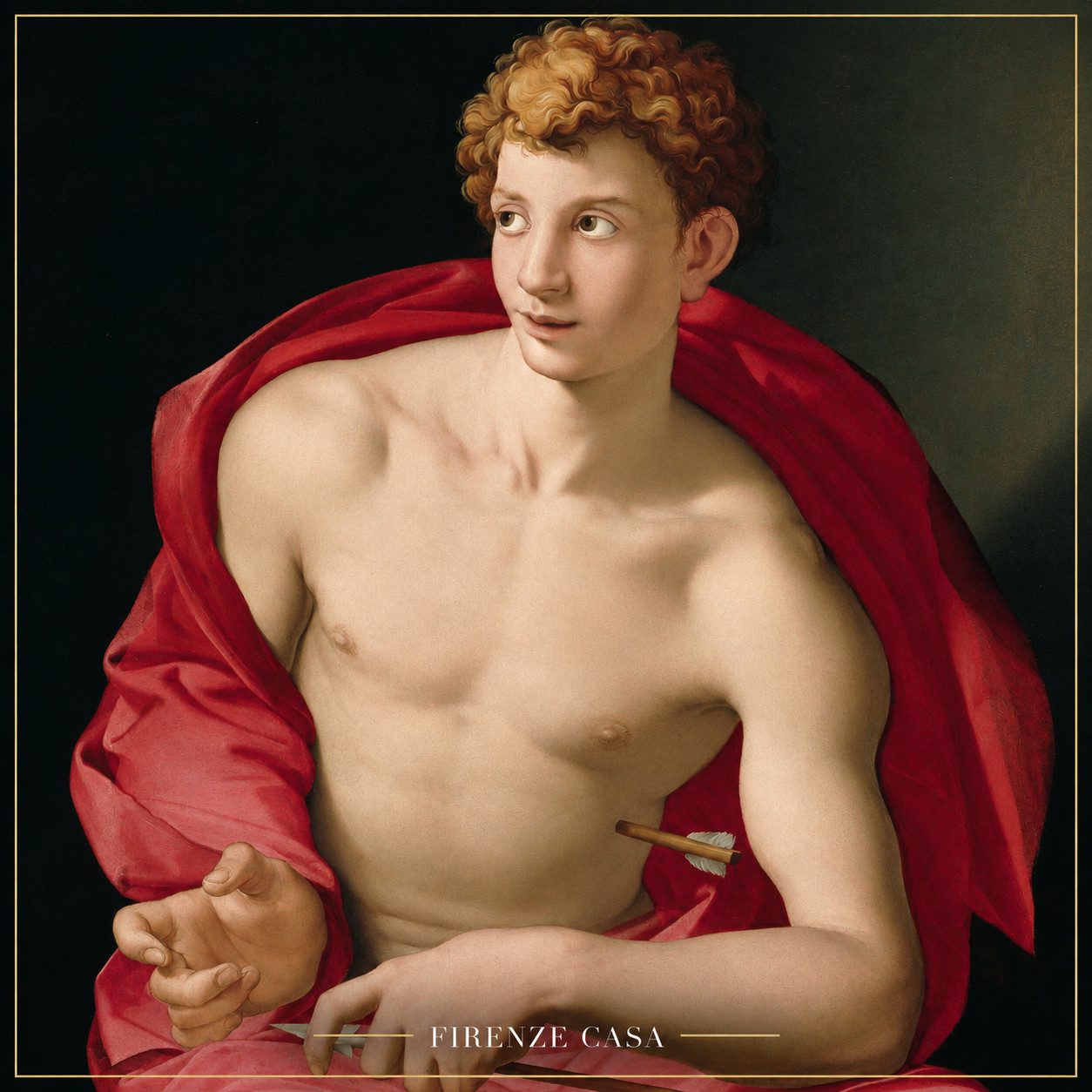 Rather than emphasising suffering, Bronzino presents a youthful, almost sculptural body wrapped in brilliant red drapery. The arrow identifies Sebastian and recalls his martyrdom, yet the calm expression and polished beauty of the figure dominate the composition.
The painting is particularly revealing because many of the qualities associated with Bronzino’s famous portraits remain visible even though the subject is entirely different: sharply controlled contours, smooth surfaces, idealised anatomy and an almost jewel-like treatment of colour.
For travellers who encounter the painting in Madrid, it offers an unexpected connection back to sixteenth-century Florence – and a fascinating comparison with the portraits and religious works by Bronzino that can be seen in the Uffizi.
What Is Mannerism?
Visitors frequently encounter the word Mannerism in Florence without a clear idea of what it means.
The term describes much Italian art created after the mature achievements of Leonardo, Michelangelo and Raphael. Instead of simply pursuing the balance and naturalism associated with the High Renaissance, artists experimented with greater sophistication, unusual proportions, complex poses and deliberately refined effects.
Bronzino’s art provides an excellent introduction.
His people can appear almost sculptural. Skin sometimes resembles polished alabaster. Colours remain exceptionally controlled, while expensive fabrics become intricate patterns of light and texture.
The effect can feel distant compared with the warmth of some earlier Renaissance paintings. That distance is not necessarily a weakness. It belongs to Bronzino’s artistic language.
Look for cool elegance, sharply defined contours, extraordinarily smooth surfaces, elaborate textiles and figures who seem perfectly composed even when the subject is emotionally charged. Once you recognise these qualities, Bronzino becomes surprisingly easy to identify.
The Panciatichi Portraits
Bronzino also painted people beyond the immediate Medici family. His portraits of the Florentine couple Bartolomeo and Lucrezia Panciatichi rank among his finest works.
Lucrezia appears seated in an elegant interior, dressed in rich red fabric and wearing jewellery that rewards close inspection. Yet Bronzino again balances luxury with extraordinary restraint.
Bartolomeo Panciatichi was a scholar, diplomat and official closely connected with Cosimo’s government. The portraits therefore extend Bronzino’s visual world beyond the ruling family into the sophisticated elite surrounding the Medici court.
Seeing these paintings alongside the Medici portraits helps visitors understand that Bronzino was creating not merely a family image but an aesthetic associated with an entire political and cultural environment.
Bronzino the Poet
There is another side of Bronzino that museum visitors can easily miss: he was also a poet.
He participated actively in Florence’s literary culture and wrote both serious and humorous verse. This was not entirely unusual in a city where artistic and literary circles overlapped, but Bronzino’s literary activity was substantial enough to form an important part of his intellectual identity.
His poetry also reminds us that the Medici court was more than a collection of painters and sculptors working for a duke. Writers, scholars, musicians and artists participated in overlapping networks of academies, friendships and patronage.
Bronzino therefore belonged to Florence’s intellectual culture as well as its visual one.
Bronzino, Vasari and the Artistic World of Cosimo I
Bronzino worked during the same extraordinary period in which Giorgio Vasari transformed major parts of Florence for Cosimo I.
Vasari designed the Uffizi, which began as government offices rather than an art museum. He also created the Vasari Corridor, physically linking the political centre around Palazzo Vecchio with the Medici residence across the Arno.
Bronzino performed a different but complementary role. Vasari helped create the architectural setting of Medici power; Bronzino helped create its human image.
Meanwhile, sculptors and architects such as Bartolomeo Ammannati and Benvenuto Cellini contributed monuments that transformed the city’s public spaces.
Seen together, their work explains why the Florence of Cosimo I feels different from the Florence of Lorenzo the Magnificent a century earlier.
When exploring sixteenth-century Florence, think of Vasari, Bronzino, Ammannati and Cellini as different voices within the same Medici transformation. Architecture, portraiture and public sculpture all helped communicate the identity of the new ducal state.
Where to See Bronzino in Florence
For most travellers, two places provide the essential Bronzino experience.
1. Uffizi Gallery
The Uffizi Gallery is the most important starting point. Its collection allows visitors to compare Bronzino’s Medici portraits, private portraiture and religious painting within the broader development of Florentine art.
Most importantly, do not rush through the sixteenth-century rooms after seeing Botticelli, Leonardo and Michelangelo. Bronzino belongs to the next chapter of the same story.
2. Palazzo Vecchio
At Palazzo Vecchio, seek out the Chapel of Eleonora. Here Bronzino’s art remains connected to the architecture and court environment for which it was created.
Combining these two places provides a much fuller understanding than seeing the portraits alone.
Visit Palazzo Vecchio first and see Eleonora’s private chapel. Then continue directly to the Uffizi next door and look for Bronzino’s portraits of the Medici family. The two sites are only minutes apart, making this one of the easiest artist-focused itineraries in Florence.
How Bronzino Changes the Way You See the Medici
Bronzino becomes particularly interesting when his portraits are compared with the buildings associated with his sitters.
See Eleonora’s portrait at the Uffizi, then remember that she lived in Palazzo Vecchio and acquired Palazzo Pitti. Look at Cosimo in armour, then walk through the political spaces from which he governed Florence.
The portraits begin to function almost as introductions to real people whose decisions changed the city.
This is why Bronzino matters beyond art history. He provides faces for the political transformation described in our Medici Florence walking tour.
For travellers staying at Firenze Casa near Santa Croce, both Palazzo Vecchio and the Uffizi are easily reached on foot. Visiting them together makes it possible to follow Bronzino’s Florence without creating a separate day devoted exclusively to the artist.
Is Bronzino Worth Seeking Out in Florence?
Absolutely, particularly if you already know the famous Florentine masters of the fifteenth and early sixteenth centuries.
Bronzino introduces another Florence: not the republican city of merchant patrons and early Renaissance experimentation, but the sophisticated ducal court of Cosimo I and Eleonora di Toledo.
His paintings also reward slow looking. At first they can seem almost too perfect. Then details emerge: the texture of a sleeve, the weight of a pearl necklace, a child’s restless fingers or the controlled expression of a ruler.
Few artists make the political culture of Medici Florence so immediately visible.
Why Agnolo Bronzino Matters
Agnolo Bronzino was one of the defining painters of sixteenth-century Florence and one of the great portraitists of European Mannerism.
Yet his importance in Florence goes further. Through his images of Cosimo I, Eleonora di Toledo and their children, he helped construct the public identity of a dynasty that was fundamentally changing the city.
His religious and allegorical works reveal another dimension of the same artistic language. Whether portraying a Medici ruler or Saint Sebastian, Bronzino combined idealised beauty, precise drawing and extraordinary technical control.
His paintings preserve faces, but they also preserve an idea of power and beauty: controlled, cultivated, refined and deliberately timeless.
Visit the Uffizi and Palazzo Vecchio with Bronzino in mind and the Medici court becomes less abstract. The rulers whose decisions shaped palaces, gardens, bridges and public monuments suddenly look back at you.
Frequently Asked Questions
Who was Agnolo Bronzino?
Agnolo Bronzino (1503–1572) was a Florentine painter, poet and leading representative of Mannerism. He became closely associated with Cosimo I de’ Medici and the Florentine court.
Why is Bronzino famous?
He is especially famous for highly refined portraits of the Medici family and Florentine elite, characterised by precise detail, elegant surfaces and controlled expressions.
What is Bronzino’s most famous painting?
His portrait of Eleonora di Toledo with her son Giovanni is among his best-known works. It is preserved in the Uffizi Gallery in Florence.
Where can I see Bronzino in Florence?
The Uffizi Gallery has an exceptional collection of his paintings. Palazzo Vecchio also preserves the Chapel of Eleonora, which Bronzino decorated for the duchess.
Was Bronzino a student of Pontormo?
Yes. Bronzino trained and worked closely with Jacopo Pontormo, whose influence was fundamental to his early artistic development.
Was Bronzino only a portrait painter?
No. Although his portraits are particularly famous, Bronzino also created religious paintings, frescoes and allegorical works. His Saint Sebastian in Madrid is a particularly striking example of his religious painting.
Further Reading on Firenze Casa
- Cosimo I de’ Medici – The Duke Who Transformed Florence
- The Medici Family – The Dynasty That Shaped Florence
- Palazzo Vecchio – Florence’s Historic Government Palace
- Uffizi Gallery – History and Medici Legacy
- Medici Florence – In the Footsteps of the Medici
- History of Florence – Complete Guide
References
- Gallerie degli Uffizi – Agnolo Bronzino and the Uffizi collections
- Gallerie degli Uffizi – Portrait of Eleonora di Toledo with her son Giovanni
- Gallerie degli Uffizi – Portrait of Bia de’ Medici
- Gallerie degli Uffizi – Portrait of Lucrezia Panciatichi
- Gallerie degli Uffizi – Holy Family with the Young Saint John (Madonna Panciatichi)
- Museo Nacional Thyssen-Bornemisza, Madrid – Agnolo Bronzino, Saint Sebastian
- Musei Civici Fiorentini – Palazzo Vecchio and the Chapel of Eleonora
- Treccani – Agnolo Bronzino
- Giorgio Vasari – Lives of the Most Excellent Painters, Sculptors, and Architects

