Palazzo Strozzi: History, Architecture & Exhibitions
Among the magnificent Renaissance palaces that define Florence, Palazzo Strozzi stands as one of the city’s greatest architectural achievements. Built as a symbol of wealth, ambition and political prestige, the palace reflects the fierce rivalry between two of Florence’s most influential families: the Strozzi and the Medici.
Today, Palazzo Strozzi is far more than a historic residence. It has become one of Italy’s leading cultural institutions, hosting internationally acclaimed art exhibitions while preserving one of the finest examples of Renaissance architecture. Whether you are passionate about history, architecture or contemporary art, Palazzo Strozzi is one of the most rewarding places to visit in Florence.
This guide explores the fascinating story behind the palace, its remarkable architectural design, its transformation into a world-class exhibition venue and why it remains an essential stop during any visit to Florence.
Historical Timeline of Palazzo Strozzi
| Year | Event |
|---|---|
| 1489 | Construction of Palazzo Strozzi begins under Filippo Strozzi the Elder. |
| 1491 | Filippo Strozzi dies before the palace is completed. |
| 1538 | Construction is largely completed by later generations of the Strozzi family. |
| 19th century | The palace undergoes restoration and preservation. |
| 1937 | Palazzo Strozzi becomes an important exhibition venue. |
| Today | It is one of Florence’s premier museums for international art exhibitions. |
The Story Behind Palazzo Strozzi
During the fifteenth century, Florence was one of Europe’s wealthiest and most influential cities. Prosperous merchant families invested enormous fortunes in banking, trade and magnificent architecture that demonstrated both their economic success and political influence.
Among these families, the Strozzi ranked among the richest. For decades they had competed with the Medici for financial and political power. Although the Medici increasingly dominated Florentine politics, the Strozzi remained determined to demonstrate that their family was every bit as influential.
Palazzo Strozzi became the ultimate expression of that ambition. Rather than constructing an ordinary family residence, Filippo Strozzi envisioned a palace that would rival—and perhaps even surpass—the finest buildings owned by the Medici.
Who Built Palazzo Strozzi?
The palace was commissioned by Filippo Strozzi the Elder, one of the wealthiest bankers of Renaissance Florence. After spending years in political exile because of conflicts with the Medici, he returned to Florence determined to restore both his family’s reputation and its position within the republic.
Construction officially began in 1489 after numerous surrounding buildings had been purchased and demolished to create an entire city block for the new palace. The sheer scale of the project reflected the enormous financial resources available to the Strozzi family.
Unfortunately, Filippo Strozzi died only two years after construction had begun and never saw his magnificent residence completed. His descendants continued the project for several decades, faithfully following the original vision.
A Palace Designed to Impress
Unlike many medieval residences, Palazzo Strozzi was conceived according to the new ideals of Renaissance architecture. Inspired by harmony, proportion and classical Roman design, every façade, window and cornice was carefully planned to create a sense of balance and elegance.
The palace occupies an entire city block and immediately commands attention through its impressive rusticated stone façade. Massive blocks of pietra forte give the building a powerful yet refined appearance, while the evenly spaced windows create perfect symmetry across all three floors.
The famous projecting cornice at the top of the building casts dramatic shadows across the façade, giving Palazzo Strozzi much of its distinctive character.
| Architectural Feature | Description |
|---|---|
| Rusticated Stone Façade | Massive stone blocks create strength and elegance. |
| Symmetrical Design | Perfectly balanced Renaissance proportions. |
| Large Cornice | One of the palace’s defining architectural elements. |
| Arched Windows | Provide rhythm and harmony across the façade. |
| Monumental Scale | The palace occupies an entire city block. |
The Architects Behind Palazzo Strozzi
Although the precise authorship of Palazzo Strozzi remains debated among historians, the project is generally associated with Benedetto da Maiano, while later phases involved distinguished Renaissance architects including Simone del Pollaiolo, known as Il Cronaca.
Rather than reflecting the ideas of a single architect, the palace evolved over several decades. The result is a remarkably unified masterpiece that perfectly embodies the ideals of the Florentine Renaissance.
Its harmonious proportions influenced numerous later palaces throughout Tuscany and remain an outstanding example of civic architecture from the late fifteenth century.
The Magnificent Courtyard
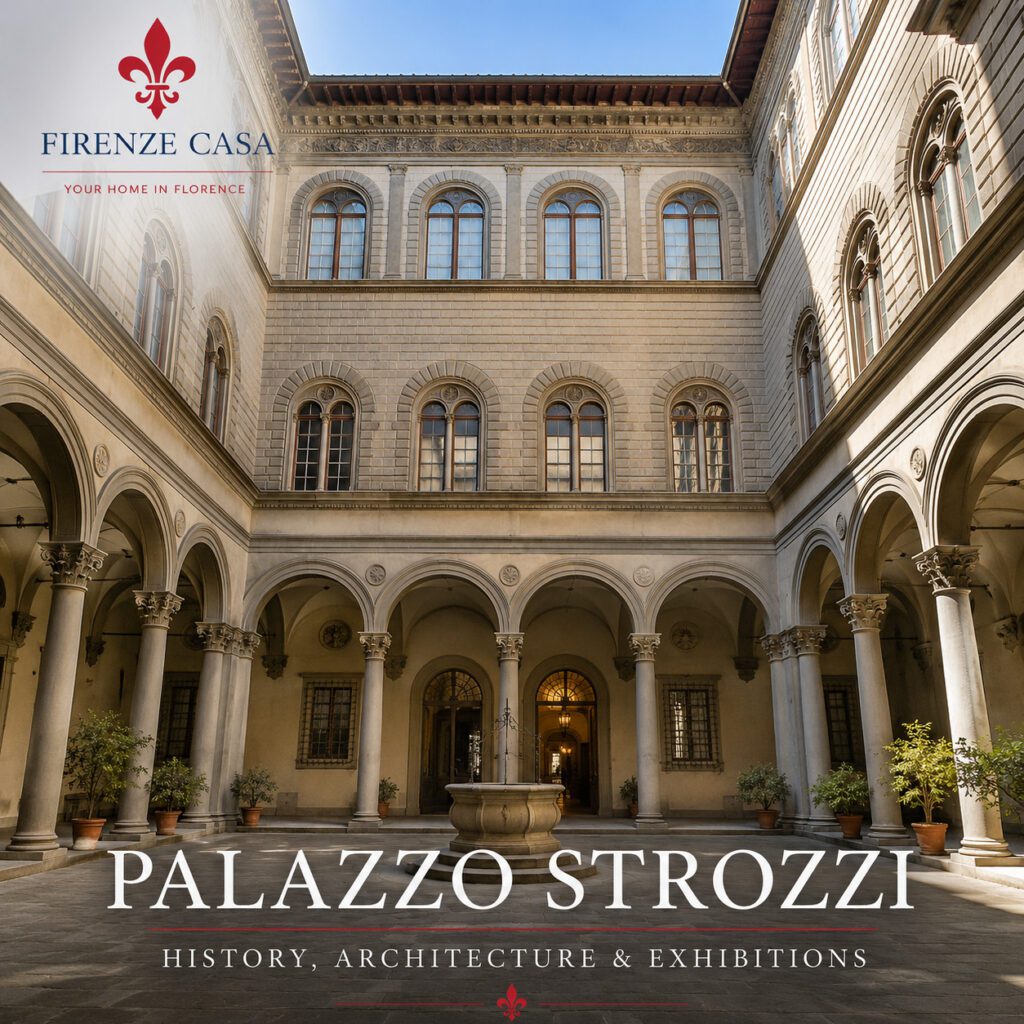
While the exterior impresses through its monumental appearance, many visitors consider the inner courtyard to be the true architectural highlight of Palazzo Strozzi.
Surrounded by elegant arcades supported by graceful Corinthian columns, the courtyard creates an atmosphere of remarkable tranquillity in the heart of Florence. The balanced geometry, soft natural light and restrained decoration demonstrate the Renaissance pursuit of mathematical perfection.
Today, the courtyard frequently hosts cultural events, concerts and temporary installations, allowing visitors to experience one of Florence’s finest Renaissance spaces much as guests of the Strozzi family would have done more than five centuries ago.
Firenze Casa Tip: Even if you are not planning to visit an exhibition, step into the courtyard of Palazzo Strozzi. It is freely accessible during opening hours and offers one of the most beautiful Renaissance architectural spaces in Florence.
Architecture That Inspired Generations
Palazzo Strozzi represents the maturity of Florentine Renaissance architecture. Unlike medieval palaces built primarily for defence, it expresses confidence, stability and civic pride. Every architectural detail contributes to a sense of order and harmony that became characteristic of the Renaissance.
Its influence extended well beyond Florence. Architects across Italy studied its balanced proportions, monumental façades and carefully designed interior spaces, making Palazzo Strozzi one of the defining buildings of Renaissance Europe.
From Noble Residence to Cultural Landmark
Following the decline of the Strozzi family’s political influence, Palazzo Strozzi gradually evolved from a private Renaissance residence into a public cultural institution. Over the centuries, the building served various administrative and civic functions, but its architectural integrity remained remarkably well preserved.
Today, the palace is managed by the Fondazione Palazzo Strozzi, which has transformed this Renaissance masterpiece into one of Italy’s most respected exhibition venues. Its mission combines the preservation of Florence’s artistic heritage with innovative exhibitions that connect Renaissance traditions with modern and contemporary art.
This successful balance between history and innovation has made Palazzo Strozzi one of the city’s most dynamic cultural destinations.
World-Famous Exhibitions Through the Years
Rather than maintaining a permanent museum collection, Palazzo Strozzi is internationally recognised for its temporary exhibitions. Over the past decades, it has welcomed masterpieces from some of the world’s leading museums while also presenting groundbreaking exhibitions by internationally acclaimed contemporary artists.
These carefully curated exhibitions have attracted hundreds of thousands of visitors and have firmly established Palazzo Strozzi as one of Europe’s leading cultural institutions.
| Artist / Exhibition | Significance |
|---|---|
| Donatello | Major exhibition celebrating one of the greatest sculptors of the Renaissance. |
| Verrocchio | Explored the workshop of Leonardo da Vinci’s master. |
| Ai Weiwei | Large-scale contemporary installations combining art and social commentary. |
| Anish Kapoor | Monumental sculptures and immersive artistic experiences. |
| Marina Abramović | Performance art by one of the world’s most influential contemporary artists. |
| Jeff Koons | Contemporary works displayed alongside Renaissance masterpieces. |
| Olafur Eliasson | Innovative installations exploring perception, light and nature. |
| Bill Viola | Video art inspired by Renaissance spirituality and human emotion. |
Each exhibition demonstrates Palazzo Strozzi’s unique ability to create a dialogue between Florence’s artistic past and today’s global art scene.
Visitor Information
📍 Address
Piazza degli Strozzi, 50123 Florence, Italy
🚶 Location
Historic Centre of Florence, just a short walk from Piazza della Repubblica and Florence Cathedral.
⏱ Suggested Visit
Allow approximately 1–2 hours.
🌐 Official Website
Visit the official website
🗺 View on Google Maps
Open in Google Maps
Why Visit Palazzo Strozzi?
Palazzo Strozzi offers far more than impressive architecture. It allows visitors to experience one of Florence’s finest Renaissance palaces while enjoying exhibitions that rank among the best in Italy.
The harmonious courtyard, elegant stone façades and beautifully proportioned interiors transport visitors back to the height of Renaissance Florence, while the constantly changing exhibition programme ensures that every visit offers something new.
Its central location also makes Palazzo Strozzi an ideal stop while exploring Florence’s historic centre.
Interesting Facts About Palazzo Strozzi
- Palazzo Strozzi occupies an entire city block in the historic centre of Florence.
- Construction continued for almost fifty years.
- Filippo Strozzi never saw his palace completed.
- The building is considered one of the finest examples of Renaissance civil architecture.
- The famous inner courtyard is freely accessible during opening hours.
- International exhibitions regularly feature loans from the world’s leading museums.
- Palazzo Strozzi successfully combines Renaissance history with contemporary culture.
Frequently Asked Questions
Who built Palazzo Strozzi?
The palace was commissioned by Filippo Strozzi the Elder, one of Florence’s wealthiest bankers and a leading rival of the Medici family.
Why is Palazzo Strozzi famous?
It is renowned for its magnificent Renaissance architecture and for hosting internationally acclaimed art exhibitions.
Can you visit the courtyard without buying a ticket?
Yes. The beautiful Renaissance courtyard is generally accessible during opening hours and is worth visiting even without attending an exhibition.
How long should I plan for a visit?
Most visitors spend between one and two hours exploring the palace and its exhibitions.
Is Palazzo Strozzi suitable for families?
Yes. The palace regularly offers educational programmes and family-friendly activities alongside its exhibitions.
The Legacy of Palazzo Strozzi
More than five centuries after construction began, Palazzo Strozzi remains one of Florence’s greatest architectural achievements. Built to reflect the ambition of one of the city’s most powerful families, it has evolved into a place where history, architecture and contemporary culture meet.
Whether admired for its elegant Renaissance design, its remarkable courtyard or its world-class exhibitions, Palazzo Strozzi continues to embody the creativity and cultural richness that have made Florence famous throughout the world.
Further Reading from Firenze Casa
- The Strozzi Family: Florence’s Greatest Rivals of the Medici
- The Medici Family: Florence’s Most Powerful Dynasty
- Palazzo Medici Riccardi: Where the Medici Empire Began
- Palazzo Pitti: The Ultimate Visitor’s Guide
- Palazzo Vecchio: A Complete Visitor’s Guide
- Piazza della Signoria: A Complete Visitor’s Guide
- Santa Maria Novella: A Complete Visitor’s Guide
- The Pazzi Family: Florence’s Most Famous Conspiracy
- Florence’s Symbols: The Lily & the Marzocco
- The Great Families of Renaissance Florence
References
- Fondazione Palazzo Strozzi
- Comune di Firenze
- Treccani – Palazzo Strozzi
- Visit Tuscany
- Encyclopaedia Britannica – Renaissance Architecture
- John M. Najemy – A History of Florence 1200–1575
- Christopher Hibbert – Florence: The Biography of a City
- Gene Brucker – Renaissance Florence
- Giorgio Vasari – Lives of the Most Excellent Painters, Sculptors and Architects