The Medici Family: The Dynasty That Shaped Renaissance Florence
No family is more closely associated with Florence than the Medici. Rising from successful bankers to rulers of Tuscany, the House of Medici transformed a prosperous medieval city into the cultural heart of the Renaissance. Through political influence, financial innovation, and extraordinary patronage of the arts, the Medici family shaped not only Florence but also the course of European history.
Today, their legacy can still be seen throughout Florence—from the magnificent Palazzo Medici Riccardi and the Basilica of San Lorenzo to the Uffizi Gallery, Palazzo Pitti, and the Medici Chapels. Whether you are passionate about Renaissance history, architecture, or art, understanding the Medici family offers one of the best ways to discover the true story of Florence.
The Rise of the Medici: A Timeline
The rise of the Medici from successful Florentine bankers to rulers of Tuscany unfolded over several centuries. This timeline highlights the decisive events that shaped the dynasty, Renaissance Florence, and the Grand Duchy of Tuscany.
| Year | Key Event |
|---|---|
| 1360 | Giovanni di Bicci de’ Medici Is Born The future founder of the Medici banking dynasty is born in Florence. |
| 1397 | The Medici Bank Is Founded Giovanni di Bicci establishes the financial institution that will create the foundation of the family’s wealth and influence. |
| 1429 | Cosimo Inherits the Family Leadership After Giovanni’s death, his son Cosimo de’ Medici assumes control of the bank and the family’s political interests. |
| 1433 | Cosimo Is Exiled The rival Albizzi faction succeeds in forcing Cosimo to leave Florence. |
| 1434 | Cosimo Returns to Florence Cosimo returns after only one year and becomes the dominant political figure in the Florentine Republic. |
| 1444 | Construction of Palazzo Medici Begins Michelozzo begins designing the palace that will become the political and cultural centre of Medici Florence. |
| 1469 | Lorenzo the Magnificent Takes Power Lorenzo de’ Medici becomes the unofficial leader of Florence and presides over its celebrated cultural golden age. |
| 1478 | The Pazzi Conspiracy Lorenzo survives an assassination attempt inside Florence Cathedral, but his brother Giuliano is killed. |
| 1492 | Death of Lorenzo the Magnificent Lorenzo’s death marks the end of one of the most influential periods in the history of Renaissance Florence. |
| 1494 | The Medici Are Expelled The family is driven from Florence, and the Florentine Republic is restored. |
| 1512 | The Medici Return to Power Supported by Spanish forces, the family regains control of Florence after eighteen years in exile. |
| 1513 | Giovanni de’ Medici Becomes Pope Leo X The election of the first Medici pope extends the family’s influence across Europe and the Catholic Church. |
| 1523 | Giulio de’ Medici Becomes Pope Clement VII A second Medici pope further strengthens the dynasty’s position in European politics. |
| 1537 | Cosimo I Becomes Duke of Florence The young Cosimo I begins transforming Florence from a republic into the capital of a hereditary territorial state. |
| 1549 | The Medici Acquire Palazzo Pitti Eleonora di Toledo, wife of Cosimo I, purchases the palace, which later becomes the principal residence of Tuscany’s rulers. |
| 1565 | The Vasari Corridor Is Built The elevated private passage connects Palazzo Vecchio with Palazzo Pitti through the Uffizi and across Ponte Vecchio. |
| 1569 | The Grand Duchy of Tuscany Is Established Cosimo I receives the title of Grand Duke of Tuscany, confirming the Medici as a recognised European ruling dynasty. |
| 1737 | The Medici Dynasty Comes to an End Gian Gastone de’ Medici dies without a male heir, ending almost three centuries of Medici rule. |
Experience the Medici Story in Florence
Many chapters of this timeline remain visible today. Palazzo Medici Riccardi, the Basilica of San Lorenzo, the Medici Chapels, Palazzo Vecchio, the Uffizi Gallery, Palazzo Pitti, and the Boboli Gardens can all be connected during a walk through Medici Florence.
The family’s greatest legacy, however, lies in its patronage of art and learning. Without the Medici, Florence would almost certainly never have become the birthplace of the Renaissance.
Why the Medici remain important today
- Created one of Europe’s largest banking networks.
- Ruled Florence and later Tuscany for nearly three centuries.
- Supported artists including Michelangelo, Botticelli, Donatello, Leonardo da Vinci, and many others.
- Produced two popes and two queens of France.
- Left behind many of Florence’s most famous museums, churches, and palaces.
From Mugello Farmers to Europe’s Wealthiest Bankers
The Medici family originated in the Mugello, a hilly region north of Florence. During the thirteenth and fourteenth centuries, family members gradually established themselves within the city’s commercial community, investing in banking, trade, and public service.
Florence itself was rapidly becoming one of Europe’s richest cities. The international wool trade, textile production, and expanding financial markets created enormous opportunities for ambitious merchants. The Medici recognised these opportunities earlier than most of their competitors.
Rather than relying solely on local business, they developed an international banking network with branches in cities including Rome, Venice, Milan, Geneva, Bruges, London, and Avignon. This geographical diversification made the Medici Bank remarkably resilient and allowed it to finance merchants, princes, bishops, and even the papacy.
The family’s reputation for reliability and financial expertise quickly established them as one of Europe’s leading banking houses.
Interesting fact
Unlike many medieval bankers, the Medici understood the importance of maintaining long-term relationships with powerful clients. Their success depended as much on trust and diplomacy as on financial skill.
Giovanni di Bicci de’ Medici: The Founder of the Dynasty
Although earlier generations laid the foundations, Giovanni di Bicci de’ Medici (1360–1429) is generally regarded as the true founder of the Medici dynasty. Through careful financial management, conservative lending practices, and an emphasis on discretion, he transformed the family business into Europe’s most respected banking institution.
Giovanni deliberately avoided public displays of wealth. Instead, he cultivated a reputation for moderation, generosity, and political neutrality. This strategy earned him widespread respect among Florence’s citizens while allowing the Medici to accumulate enormous economic influence.
One of his greatest achievements was securing the financial administration of the Papacy. Managing papal finances dramatically increased both the prestige and profitability of the Medici Bank and established long-lasting relationships with Rome.
When Giovanni died in 1429, he left not only immense wealth but also a carefully constructed political foundation that would enable his descendants to dominate Florence for generations.
Giovanni’s achievements
- Expanded the Medici Bank across Europe.
- Established the family’s relationship with the Papacy.
- Avoided unnecessary political conflicts.
- Created the financial foundations of Medici power.
Cosimo de’ Medici: Power Without a Crown
Giovanni’s son, Cosimo de’ Medici (1389–1464), elevated the family from wealthy bankers to the most influential political force in Florence. Although the republic officially remained independent, Cosimo exercised enormous authority behind the scenes, earning him the nickname Pater Patriae—the Father of the Fatherland.
Cosimo rarely held formal political office for extended periods. Instead, he governed through personal relationships, strategic alliances, and widespread public support. His ability to balance competing interests allowed Florence to enjoy decades of relative political stability.
In 1433, Cosimo’s rivals from the Albizzi family temporarily succeeded in having him exiled. The decision proved deeply unpopular. Within a year, Cosimo returned triumphantly to Florence, while many of his political opponents were themselves forced into exile. From that moment onward, Medici supremacy became increasingly secure.
Beyond politics, Cosimo became one of the Renaissance’s greatest patrons. He financed churches, monasteries, libraries, hospitals, and charitable institutions throughout Florence. His support for scholars helped preserve many classical Greek and Roman texts that might otherwise have disappeared.
He also commissioned Michelozzo to build Palazzo Medici Riccardi, the first great Renaissance palace in Florence. Its elegant but restrained architecture reflected Cosimo’s preference for understated power rather than extravagant display.
Where to experience Cosimo’s Florence today
- Palazzo Medici Riccardi
- Basilica of San Lorenzo
- The Medici Chapels
- Convent of San Marco
- Laurentian Library
Read more from Firenze Casa
- Cosimo de’ Medici: The Architect of Medici Power (coming soon)
- Palazzo Medici Riccardi: Home of the Medici (coming soon)
- The Basilica of San Lorenzo: The Medici Church (coming soon)
- The Medici Chapels: Art, Power and Dynasty (coming soon)
Lorenzo the Magnificent: Florence’s Golden Age
When Cosimo’s grandson Lorenzo de’ Medici (1449–1492) assumed leadership of Florence, the city entered what many historians consider its cultural golden age. Known as Lorenzo il Magnifico (“Lorenzo the Magnificent”), he combined political skill with an extraordinary appreciation for literature, philosophy, science, and the visual arts.
Unlike many rulers of his time, Lorenzo understood that culture itself could strengthen political influence. He surrounded himself with poets, philosophers, architects, and artists, transforming Florence into Europe’s intellectual capital during the Renaissance.
Under Lorenzo’s patronage, artists such as Sandro Botticelli, Domenico Ghirlandaio, Andrea del Verrocchio, and the young Michelangelo developed their talents. Humanist scholars gathered in Florence to translate and study classical Greek and Roman texts, while architects created buildings whose influence would spread throughout Europe.
Lorenzo also demonstrated remarkable diplomatic ability. Following the Pazzi Conspiracy in 1478 and the resulting conflict with the Kingdom of Naples and the Papacy, he personally travelled to Naples to negotiate peace. His success helped preserve Florence’s independence during one of its most dangerous political crises.
Lorenzo’s greatest achievements
- Protected Florence from external political threats through diplomacy.
- Supported some of the greatest artists of the Renaissance.
- Encouraged philosophy, literature, and scientific learning.
- Established Florence as Europe’s leading cultural centre.
Read more from Firenze Casa
- Lorenzo the Magnificent: Patron of Renaissance Florence (coming soon)
- The Pazzi Conspiracy: The Attack That Shook Renaissance Florence (coming soon)
The Medici and the Birth of Renaissance Art
Few families have influenced the history of art as profoundly as the Medici. Their patronage extended far beyond collecting beautiful objects. They actively financed artists, architects, sculptors, engineers, and scholars whose work transformed European culture.
Instead of commissioning only religious works, the Medici encouraged artists to study classical antiquity, anatomy, mathematics, and perspective. This intellectual environment helped create the artistic revolution now known as the Renaissance.
Among the artists associated with the Medici were Donatello, Fra Angelico, Filippo Lippi, Sandro Botticelli, Leonardo da Vinci, Michelangelo, Raphael, and many others. Some worked directly for the family, while others benefited from commissions financed by Medici allies or institutions supported by them.
Michelangelo’s relationship with Lorenzo the Magnificent was particularly significant. As a gifted young sculptor, Michelangelo lived for several years within the Medici household, where he received an education unlike that available anywhere else in Europe.
Artists supported by the Medici
- Donatello
- Botticelli
- Michelangelo
- Leonardo da Vinci
- Fra Angelico
- Filippo Lippi
- Verrocchio
- Raphael
Today, visitors can admire hundreds of masterpieces connected with Medici patronage in Florence’s churches, museums, and palaces.
The Medici Popes and the Queens of France
The influence of the Medici family eventually reached far beyond Florence. Through diplomacy, marriage, and ecclesiastical careers, members of the dynasty became some of the most powerful individuals in Europe.
Two Medici became popes. Giovanni de’ Medici was elected Pope Leo X in 1513, while Giulio de’ Medici became Pope Clement VII in 1523. Both pontificates left a lasting impact on Renaissance politics and the Catholic Church.
The family’s influence also extended to France. Catherine de’ Medici married King Henry II of France and later served as queen and regent during one of the country’s most turbulent periods. Decades later, Marie de’ Medici also became Queen of France through her marriage to King Henry IV.
Through these marriages and ecclesiastical appointments, the Medici transformed themselves from Florentine bankers into one of Europe’s most influential ruling dynasties.
The Medici on the European stage
- Pope Leo X
- Pope Clement VII
- Queen Catherine de’ Medici of France
- Queen Marie de’ Medici of France
Exile, Return, and the Changing Face of Florence
The Medici did not rule Florence continuously. Political upheavals repeatedly forced the family into exile, particularly during periods of republican revival. Following the French invasion of Italy in 1494, the Medici were expelled from Florence, allowing the republic to be restored under the influence of the Dominican preacher Girolamo Savonarola.
Savonarola condemned luxury, corruption, and secular art, encouraging public acts of religious devotion and moral reform. His famous “Bonfire of the Vanities” symbolised a dramatic but ultimately short-lived rejection of Renaissance culture.
After Savonarola’s execution in 1498, Florence gradually returned to a more traditional political course. In 1512, supported by Spanish forces, the Medici regained control of the city.
Although republican institutions formally survived for some years, Medici authority steadily increased until Florence evolved from a republic into a hereditary state ruled by the dynasty.
Cosimo I and the Grand Duchy of Tuscany
The transformation from influential Florentine family to hereditary rulers reached its climax under Cosimo I de’ Medici (1519–1574). Appointed Duke of Florence in 1537, Cosimo proved to be an exceptionally capable administrator, military leader, and statesman.
He strengthened government institutions, modernised taxation, expanded Tuscany’s territory, and invested heavily in infrastructure. Under his leadership, Florence became the capital of a powerful regional state rather than simply an independent city.
In 1569, Pope Pius V granted Cosimo the title of Grand Duke of Tuscany. This elevated the Medici to the rank of Europe’s recognised ruling dynasties and formally established the Grand Duchy of Tuscany.
Cosimo also initiated numerous building projects that continue to define Florence today. Giorgio Vasari designed the Uffizi as government offices, while the famous Vasari Corridor connected Palazzo Vecchio with Palazzo Pitti, allowing the ruling family to move safely across the city without entering crowded streets.
Major projects under Cosimo I
- The Uffizi
- The Vasari Corridor
- Expansion of Palazzo Pitti
- Development of the Boboli Gardens
- Modernisation of the Tuscan state
Read more from Firenze Casa
- Palazzo Pitti: A Complete Visitor’s Guide (coming soon)
- The Uffizi Gallery: Highlights for First-Time Visitors (already published)
- The Boboli Gardens: History, Art and Visitor Guide (coming soon)
The Medici Legacy You Can Still Experience Today
One of the greatest advantages of exploring Florence is that the Medici legacy remains remarkably intact. Few European dynasties have left behind such an extensive collection of palaces, churches, museums, libraries, and works of art that can still be visited today.
Rather than existing only in history books, the story of the Medici unfolds as you walk through the streets of Florence. Many of the city’s most famous landmarks were either commissioned, expanded, or transformed by members of the family.
| Medici Landmark | Why Visit |
|---|---|
| Palazzo Medici Riccardi | The first great Medici residence and the birthplace of their political power. |
| Basilica of San Lorenzo | The family’s parish church and one of Florence’s most important Renaissance monuments. |
| Medici Chapels | Magnificent mausoleum containing Michelangelo’s famous sculptures. |
| Palazzo Pitti | The grand ducal residence after the Medici purchased the palace in 1549. |
| Boboli Gardens | One of Europe’s finest Renaissance gardens, developed under Medici rule. |
| The Uffizi Gallery | Originally administrative offices created for Cosimo I and today one of the world’s greatest museums. |
| Palazzo Vecchio | Seat of Florentine government and later an important Medici residence. |
| Laurentian Library | Michelangelo’s architectural masterpiece preserving invaluable manuscripts collected by the Medici. |
A Self-Guided Medici Walking Tour
If you have one full day in Florence, you can easily follow the footsteps of the Medici family on foot. The route connects many of the city’s most important Renaissance landmarks while offering an excellent introduction to Florentine history.
- Palazzo Medici Riccardi – Begin where the Medici established their political headquarters.
- Basilica of San Lorenzo – Visit the family’s church and admire Brunelleschi’s architecture.
- Medici Chapels – Discover the magnificent tombs created by Michelangelo.
- Piazza del Duomo – Explore the religious heart of Florence.
- Piazza della Signoria – Learn how republican Florence gradually evolved into Medici rule.
- Uffizi Gallery – Admire masterpieces collected and commissioned by the Medici.
- Ponte Vecchio – Cross the Arno while imagining the hidden Vasari Corridor above.
- Palazzo Pitti – Finish your tour at the magnificent residence of the Grand Dukes of Tuscany.
- Boboli Gardens – End the day strolling through one of Europe’s most beautiful Renaissance gardens.
Interesting Facts About the Medici Family
Did you know?
- The Medici ruled Florence for almost three centuries.
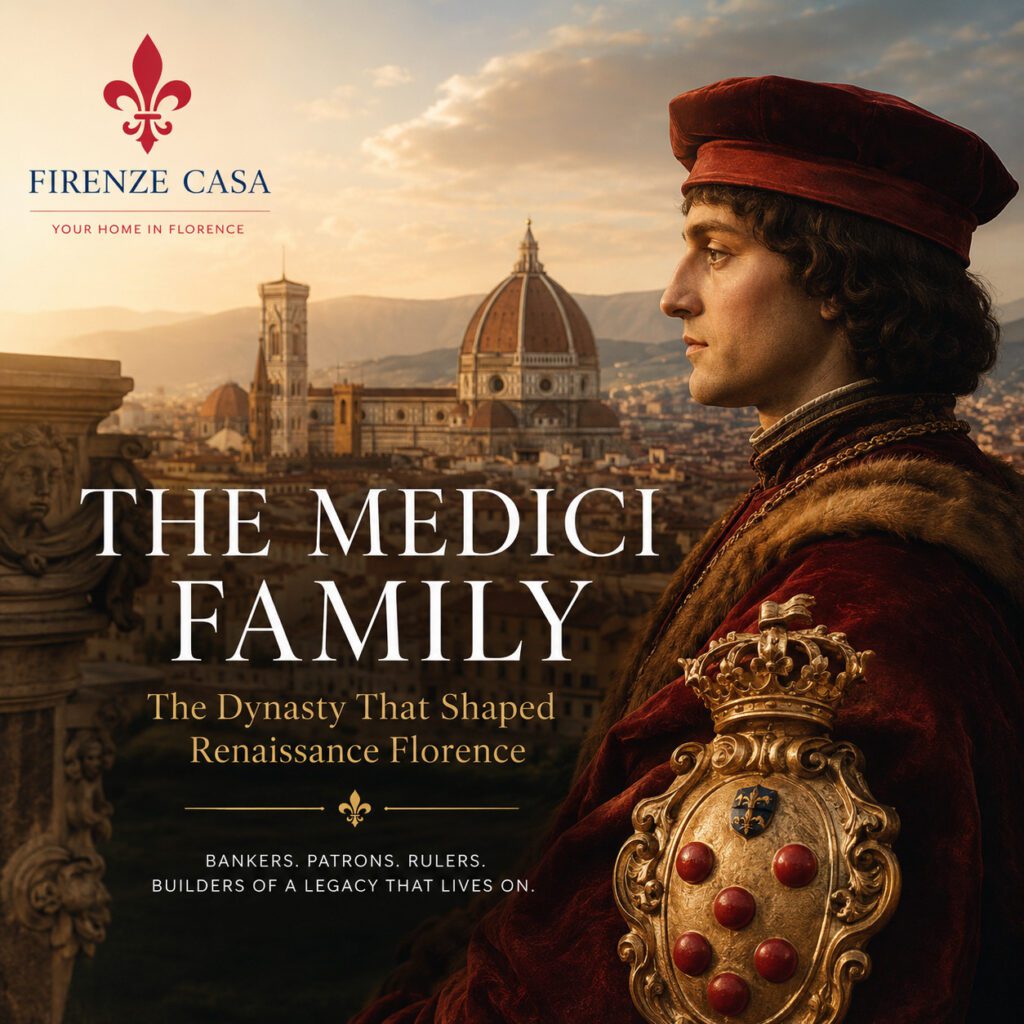
- The famous Medici coat of arms contains six red balls called palle.
- The Medici Bank became one of the most successful financial institutions in medieval Europe.
- Two Medici became popes.
- Two Medici became Queens of France.
- Michelangelo lived in the Medici household as a young artist.
- The Uffizi was originally designed as government offices, not an art museum.
- The Boboli Gardens became a model for many European palace gardens.
Why the Medici Continue to Fascinate Visitors
The story of the Medici is far more than the history of a wealthy banking family. It is the story of how commerce, politics, diplomacy, architecture, science, philosophy, and art combined to transform a medieval republic into the cultural centre of Renaissance Europe.
The family’s achievements continue to shape Florence today. Visitors who understand the Medici quickly discover that nearly every major monument, museum, and church tells part of their remarkable story.
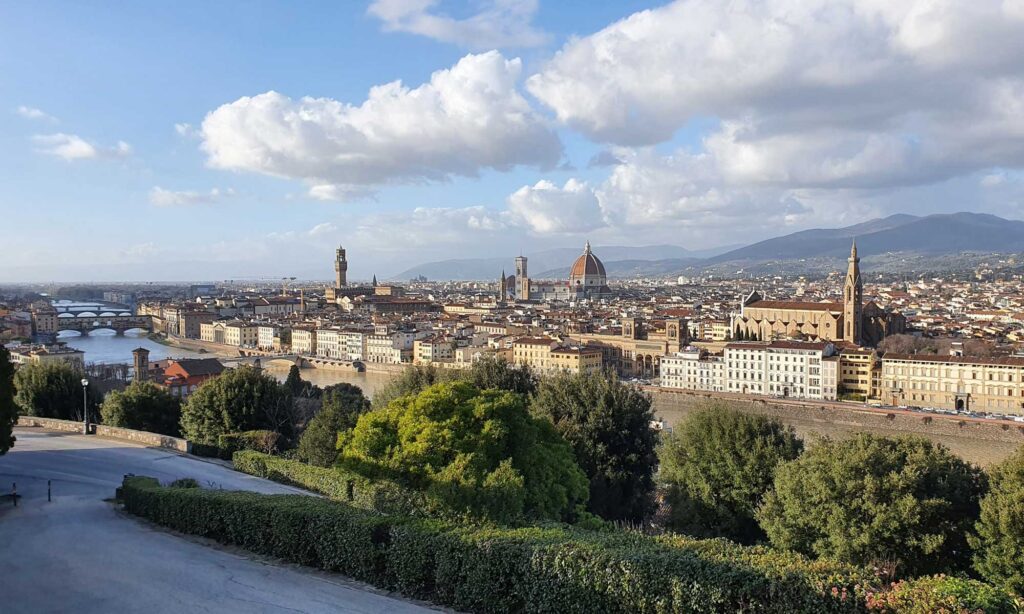
Whether you admire Michelangelo’s sculptures, stroll through the Boboli Gardens, visit Palazzo Pitti, or stand beneath the dome of Florence Cathedral, you are experiencing the city that the Medici helped create.
Frequently Asked Questions
Who were the Medici family?
The Medici were a powerful banking dynasty that ruled Florence and later the Grand Duchy of Tuscany. They became famous for their political influence and extraordinary patronage of Renaissance art.
Why were the Medici so important?
Their wealth financed artists, architects, scholars, churches, and public buildings that transformed Florence into the birthplace of the Renaissance.
Which artists worked for the Medici?
Among the artists associated with the Medici were Michelangelo, Botticelli, Donatello, Leonardo da Vinci, Fra Angelico, Verrocchio, and Raphael.
Where can visitors see Medici history in Florence?
The most important Medici sites include Palazzo Medici Riccardi, the Basilica of San Lorenzo, the Medici Chapels, Palazzo Pitti, the Boboli Gardens, Palazzo Vecchio, and the Uffizi Gallery.
Did the Medici still rule Florence today?
No. The Medici dynasty ended in 1737 with the death of Gian Gastone de’ Medici, the last Grand Duke of Tuscany from the Medici family.