
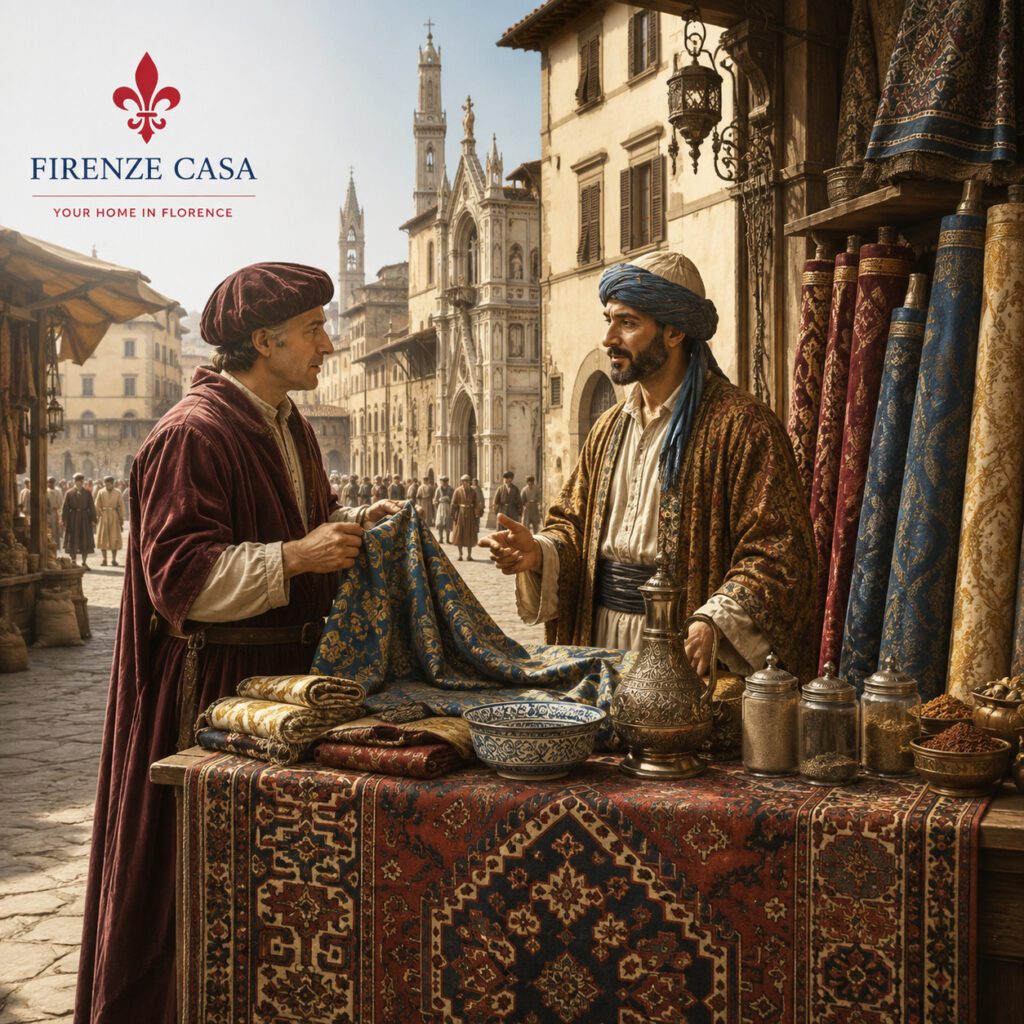
Florence and the Islamic world were connected far more closely than many visitors realise. Renaissance Florence stood far from the Mediterranean coast, yet its merchants, bankers and manufacturers participated in commercial networks that reached across the Mediterranean and into the Middle East.
Luxury textiles, carpets, dyes, spices, ceramics and other valuable goods travelled through these networks. Artistic forms, technologies and knowledge also crossed political and religious boundaries. Florence therefore did not develop its Renaissance culture in isolation, but as part of a much larger world of trade and exchange connecting Christian Europe with Muslim societies and other cultures around the Mediterranean and beyond.
Main period: Medieval and Renaissance Florence
Key connections: Trade, textiles, carpets, spices, ceramics and knowledge
Important regions: North Africa, Egypt, Anatolia, the Levant and the Ottoman world
Florentine industries: Wool, silk and banking
Artistic evidence: Imported carpets, luxury textiles and pseudo-Arabic decoration in European art
Economic link: International merchant and banking networks
Where to look: Uffizi, Bargello and Museo Stibbert
Why it matters: Florence developed within an interconnected Mediterranean and European world
This article explores one of the wider international networks behind Renaissance Florence. For the economic context, see our Birth of Modern Banking in Florence – Complete Guide.
Florence and the Mediterranean World
Florence had no seaport of its own. Nevertheless, geography did not prevent the city from becoming one of Europe’s great commercial centres.
Florentine merchants depended on maritime routes through Tuscan and other Italian ports and worked through commercial communities across the Mediterranean. Goods could therefore travel enormous distances before reaching workshops, markets and wealthy households in Florence.
Raw materials entered the city, while finished Florentine textiles and other products travelled in the opposite direction.
These networks linked Tuscany with regions governed by Muslim rulers as well as with European merchants trading extensively with them.
Renaissance Florence may appear deeply Tuscan today, but its prosperity depended on international connections. Merchants, bankers and manufacturers operated within networks stretching far beyond the city and the Italian peninsula.
A Mediterranean Economy Across Religious Boundaries
The medieval and Renaissance Mediterranean was not divided into completely separate Christian and Muslim economic worlds.
Religious differences mattered profoundly, and wars were frequent. Yet trade often continued despite political rivalry and military conflict.
Italian maritime powers such as Venice and Genoa developed especially extensive commercial relationships with ports in North Africa and the eastern Mediterranean. Merchants from other Italian cities participated in the wider networks these relationships supported.
Florence benefited from this commercial environment even when its merchants were not directly involved in every stage of a transaction.
The Mediterranean therefore functioned both as a frontier and as a meeting place.
Why International Trade Mattered to Renaissance Florence
The extraordinary wealth of Renaissance Florence rested on several industries. Banking was crucial, but textile production was equally important.
Florentine wool merchants imported raw materials, processed them through sophisticated urban workshops and sold valuable finished cloth across Europe and beyond.
Silk later became another prestigious Florentine industry.
Both depended on access to international markets, materials, dyes and commercial knowledge. Understanding the economic foundations of Florence therefore requires looking well beyond the city walls.
Florence’s Renaissance masterpieces were created within an economy built on international commerce. Behind many palaces, chapels and paintings stood merchants whose business networks reached across Europe and the Mediterranean.
Florentine Merchants and Muslim Trading Centres
Direct commercial contact between Florentines and Muslim societies varied considerably according to period and region, and much trade passed through intermediaries.
Nevertheless, Florentine commercial interests reached into a Mediterranean economy that included Egypt, North Africa, Ottoman territories and ports of the Levant.
Alexandria was particularly important within long-distance trade. For centuries, the Egyptian port served as a major gateway for commodities arriving from regions farther east.
Italian merchants could acquire spices, textiles and other valuable products there before distributing them through European markets.
Trade Despite Conflict
Christian and Muslim states fought numerous wars during the Middle Ages and Renaissance, but warfare rarely eliminated commercial exchange permanently.
Economic interests often encouraged rulers and merchants to maintain channels of communication. Treaties, diplomatic agreements and merchant privileges could regulate trade even between societies divided by religion and political rivalry.
This tension between conflict and cooperation was one of the defining characteristics of Mediterranean history.
Luxury Textiles and Florence
Textiles provide one of the most fascinating connections between Florence and the Islamic world.
Fine fabrics produced in the eastern Mediterranean and other Islamic regions had long enjoyed enormous prestige in Europe. Silk weaving techniques, decorative patterns and luxury materials travelled through international trade.
Florence eventually developed its own celebrated silk industry, producing sophisticated fabrics for wealthy customers and international markets.
Patterns That Travelled
Decorative motifs rarely respected political borders.
Stylised plants, geometric forms, medallions and repeating patterns circulated through textiles and other portable objects. Craftsmen encountered, adapted and transformed designs rather than simply reproducing them unchanged.
As a result, Renaissance decorative art can contain forms with long and complex histories involving Byzantine, Persian, Islamic, Mediterranean and European traditions.
Assigning one precise origin to every motif can therefore be misleading. Cultural exchange often developed gradually through generations of adaptation.
When visiting Florentine museums, pay attention to the textiles painted in portraits and religious scenes. Their elaborate designs often reveal a much wider world of luxury, trade and artistic exchange.
Islamic Textiles in Renaissance Paintings
Paintings provide remarkable evidence for the movement of luxury objects.
Renaissance artists represented expensive fabrics carefully because contemporary viewers recognised their value. Rich textiles communicated wealth, magnificence and status.
Some fabrics depicted in European paintings contain patterns related to textiles produced or developed within the Islamic world.
Such objects could appear in Christian religious settings without contradiction. Their rarity, craftsmanship and beauty made them desirable regardless of their geographic or religious origin.
Sacred Art and Imported Luxury
Modern viewers may instinctively assume that every object depicted within a Christian Renaissance painting belonged to Christian Europe.
That was not necessarily the case.
Churches and wealthy patrons accumulated textiles, ceramics and luxury objects from distant regions. Artists could then reproduce them within sacred scenes.
A Florentine altarpiece can therefore contain unexpected evidence of international commerce.
Oriental Carpets in Renaissance Florence
Carpets provide an especially visible example of cultural exchange.
Luxury carpets produced in Anatolia and other parts of the eastern Mediterranean reached European markets in significant numbers. Because they were expensive objects, European owners often displayed them on tables, chests or raised platforms rather than using them as ordinary floor coverings.
Renaissance painters sometimes represented these carpets with extraordinary attention to detail.
Why Art Historians Study Painted Carpets
Several historic carpet types are now known by the names of European painters who depicted similar designs.
Terms such as “Holbein carpet” and “Lotto carpet” belong to this art-historical classification system.
The carpets themselves were associated primarily with production in Anatolia and the wider Islamic world.
The terminology is a fascinating example of how an object can cross cultures and later acquire an entirely different scholarly name.
Next time you look at Renaissance painting, examine tables, platforms and the space beneath the main figures. A patterned carpet may preserve evidence of long-distance trade that is easy to overlook.
Arabic-Looking Script in Renaissance Art
One of the most intriguing traces of cultural contact appears in decorative forms resembling Arabic writing.
European artists sometimes copied or imitated Arabic-looking script without necessarily understanding its linguistic meaning. Art historians generally describe these decorations as pseudo-Arabic or pseudo-Kufic.
Such forms appeared in European art from the Middle Ages into the Renaissance.
Why Did Christian Artists Use Arabic-Looking Script?
Imported textiles, metalwork and other prestigious objects exposed European artists to Arabic calligraphy.
The visual appearance of the script could become associated with luxury, antiquity or eastern origins. Artists sometimes reproduced these forms decoratively without attempting to create meaningful Arabic inscriptions.
Visitors should therefore be cautious when interpreting them. Something that looks like Arabic may not contain actual Arabic words.
Pseudo-Arabic decoration appears in several forms of medieval and Renaissance European art. Its presence shows how visual motifs could travel independently of their original language or meaning.
Ceramics, Metalwork and Portable Luxury
Textiles were not the only objects crossing the Mediterranean.
Decorated ceramics, glass, metalwork and other luxury goods also travelled between regions. Italian craftsmen encountered imported objects and sometimes adapted techniques, shapes or decorative ideas.
Exchange moved in both directions. Italian products likewise entered markets throughout the Mediterranean.
It is therefore more useful to imagine interacting workshops and commercial networks than a simple one-way flow of influence.
Why Portable Objects Mattered
A building remains in one place, but a textile, ceramic bowl or metal vessel can travel thousands of kilometres.
Portable objects therefore played an especially important role in transmitting visual ideas.
A merchant could transport an object to another region, where craftsmen might study its materials, forms and decoration and reinterpret them within local traditions.
Artistic ideas could thus spread even when the artists themselves never travelled.
Spices and the Eastern Trade
Spices formed another important component of Mediterranean commerce.
Pepper, cinnamon, cloves and other valuable products reached Mediterranean markets through complex trade routes connecting Europe with Asia.
Muslim merchants and states controlled or participated in important parts of these networks at different times, while Italian merchants distributed many commodities into European markets.
More Than Flavour
Spices were valuable for more than cooking.
They were also used in medicine, perfumery and other crafts, while their cost and rarity could make them symbols of status.
Apothecaries sold a wide range of imported substances, connecting distant trade routes with everyday urban professions.
Florence’s powerful Arte dei Medici e Speziali, the guild associated with doctors and apothecaries, belonged to this sophisticated commercial and professional world.
Knowledge Across Cultural Boundaries
Cultural exchange involved ideas as well as goods.
During the medieval period, scholars writing in Arabic preserved, translated, interpreted and expanded important traditions of Greek philosophy, mathematics, astronomy and medicine.
Translations from Arabic into Latin helped transmit parts of this intellectual heritage into western European scholarly culture.
By the Renaissance, humanists increasingly sought Greek manuscripts directly as well. Nevertheless, Arabic intellectual traditions formed an important part of the much longer history through which ancient and scientific knowledge circulated.
Medicine, Mathematics and Astronomy
Avicenna, known in Arabic as Ibn Sina, had enormous influence on medieval European medicine. His Canon of Medicine became an important medical text within European universities.
Mathematical knowledge travelled through similarly interconnected traditions.
The numeral system commonly called Arabic numerals ultimately originated in India but reached western Europe through a long process of transmission in which scholars and merchants working within the Islamic world played an important role.
Knowledge moved through many societies and languages. Greek, Persian, Indian, Arabic, Jewish and Latin scholarly traditions interacted over centuries before Renaissance Europeans encountered many of these ideas.
Florence, Banking and International Commerce
Florence’s connections with distant markets also depended on sophisticated financial systems.
Florentine bankers created commercial networks across Europe, while instruments such as the bill of exchange allowed merchants to conduct business without transporting large quantities of coins across dangerous distances.
These financial methods facilitated long-distance commerce and helped integrate Florence into wider trading systems.
Banking and international trade therefore reinforced one another.
The Florin and International Trade
The gold florin became one of medieval Europe’s most trusted currencies.
First minted in Florence in 1252, the coin achieved broad recognition because of the reliability of its weight and gold content.
Its success demonstrates Florence’s international economic importance.
That importance should not be confused with control of Mediterranean commerce. Florence participated within a much larger system that also included Venice, Genoa, Muslim commercial centres and many other economic powers.
The Ottoman World and Renaissance Florence
The rise of the Ottoman Empire transformed the political geography of the eastern Mediterranean.
After the Ottoman conquest of Constantinople in 1453, European states had to adapt to an empire controlling vast territories and major commercial routes.
Conflict and commerce again existed side by side.
Italian states developed different diplomatic and economic relationships with the Ottoman court according to their own strategic interests.
Florence and Ottoman Diplomacy
Florentine rulers also recognised that diplomacy extended beyond the Christian states of Europe.
During the Medici period, political strategy increasingly operated on an international scale. Trade, diplomatic missions and exchanges of gifts could connect courts separated by profound religious differences.
These relationships remind us that Renaissance politics was not limited to rivalry between Florence, Venice, Milan, Rome and other Italian powers.
The Medici and Luxury from Distant Worlds
The Medici were collectors as well as bankers and rulers.
Their collections reflected the international character of elite Renaissance culture. Precious textiles, ceramics, unusual natural materials and luxury objects from distant regions could communicate knowledge, curiosity, wealth and status.
Foreign objects entered a courtly culture in which rarity itself carried significance.
Luxury as a Language of Power
Renaissance courts communicated through objects.
A rare textile, finely worked metal object or unusual imported material could function as a diplomatic gift. Its value derived not only from craftsmanship but also from the distance it had travelled and the networks required to obtain it.
Imported luxury therefore possessed political as well as artistic meaning.
What Florence Borrowed – and What It Created
It would be misleading to describe the Florentine Renaissance simply as a product of Islamic influence.
Florentine artists, architects and craftsmen developed distinctive traditions shaped by local institutions, patrons and artistic experimentation.
Yet it would be equally misleading to imagine Renaissance Florence as culturally isolated.
The more accurate picture lies between those extremes.
Florentine culture developed within overlapping networks of trade, diplomacy and scholarship. Imported objects introduced new materials and visual possibilities, while local craftsmen selected and transformed what they encountered.
Florentine products then entered international markets themselves.
Cultural exchange does not mean that Florentine artists simply copied Islamic art. They encountered objects and ideas through trade, adapted some of them and incorporated selected elements into their own artistic traditions.
Where to See These Connections in Florence
Visitors can still look for evidence of these international relationships in Florence’s museums and paintings.
The Uffizi Gallery is particularly rewarding. Look beyond faces and major figures to examine carpets, clothing, fabrics and decorative objects represented in Renaissance paintings.
The Museo Nazionale del Bargello provides another perspective through decorative arts and objects that place Florentine craftsmanship within wider artistic traditions.
Paintings throughout churches and museums likewise preserve visual evidence of luxury materials and designs travelling across cultural boundaries.
The Museo Stibbert
The Museo Stibbert offers a different kind of comparison.
Frederick Stibbert assembled extraordinary collections of European, Islamic and Asian arms, armour and decorative arts during the nineteenth century.
The museum does not document Renaissance exchange in a simple chronological way, but it provides an excellent opportunity to compare artistic traditions from different cultures within one collection.
Stibbert himself belongs to the international Florence explored in our guide to small museums in Florence worth discovering.
At the Uffizi, do not look only at the main figures. Examine carpets, clothing, table coverings and decorative objects. Small details can reveal the international world hidden inside a familiar Renaissance painting.
Islam and Florence Today
The historical relationship between Florence and the Islamic world should not be confused with the history of Florence’s modern Muslim community.
They are different subjects shaped by different historical circumstances.
The medieval and Renaissance story concerns trade, diplomacy, artistic exchange and the circulation of goods and knowledge between societies.
Modern Muslim life in Florence belongs to later patterns of migration, citizenship and religious life.
Nevertheless, the older history is important because it challenges the idea that interaction between Florence and Muslim societies is something entirely modern.
The Mediterranean has connected different peoples, religions and cultures for many centuries.
Interesting Facts About Florence and the Islamic World
- Florence participated in commercial networks extending across the Mediterranean.
- Luxury textiles were among the most important portable objects exchanged between regions.
- Florence developed one of Europe’s prestigious silk industries.
- Decorative motifs associated with Islamic textiles became part of wider Mediterranean luxury culture.
- European Renaissance art sometimes contains pseudo-Arabic or pseudo-Kufic decoration.
- Anatolian carpets became prestigious objects in Renaissance Europe.
- Several historic carpet types are now classified using the names of European painters who depicted similar designs.
- Spices reached European markets through complex networks involving Muslim and Christian merchants.
- Arabic-language scholarship played an important role in the transmission of medicine, philosophy, mathematics and astronomy.
- The numeral system used in Europe today reached the West through a long history of transmission involving India and the Islamic world.
- Florence’s gold florin became one of medieval Europe’s most important international currencies.
- Medici collections reflected the international character of Renaissance elite culture.
Frequently Asked Questions About Florence and the Islamic World
Did Renaissance Florence trade with the Islamic world?
Yes. Florence participated in Mediterranean commercial networks connecting European markets with North Africa, Egypt, Ottoman territories and the eastern Mediterranean. Some contacts were direct, while many involved intermediaries.
What goods reached Florence through these networks?
Luxury textiles, carpets, spices, ceramics, dyes and other valuable commodities circulated through Mediterranean trade. Routes and places of production varied considerably over time.
Did Islamic art influence Renaissance Florence?
Florentine artists and craftsmen encountered objects and decorative traditions associated with the Islamic world, particularly through textiles, carpets, ceramics and metalwork. They could adapt selected forms within their own artistic traditions, although influence was complex and rarely moved in only one direction.
Why does Arabic-looking writing appear in Renaissance art?
European artists sometimes imitated the visual appearance of Arabic script as decoration. These pseudo-Arabic or pseudo-Kufic forms often do not contain meaningful Arabic text.
Why are Oriental carpets visible in Renaissance paintings?
Imported carpets were valuable luxury goods and therefore communicated wealth and prestige. Artists frequently represented them on tables, platforms and other prominent surfaces.
What role did Arabic scholars play in European intellectual history?
Scholars working in Arabic preserved, translated and developed important traditions in philosophy, medicine, mathematics and astronomy. Latin translations of Arabic works later became influential within medieval European scholarship.
Where can visitors look for these connections in Florence?
The Uffizi is especially useful because Renaissance paintings often depict luxury textiles, carpets and imported objects. The Bargello and Museo Stibbert provide additional perspectives through decorative arts and international collections.
Why the Islamic World Matters to the Story of Florence
The Islamic world matters to the story of Florence because Renaissance Florence belonged to an interconnected commercial and cultural world. Its merchants needed international markets and foreign materials, while wealthy patrons desired rare textiles, carpets, spices and luxury objects from distant regions.
Objects crossed political and religious boundaries and carried visual ideas with them. Knowledge travelled too, often through multiple languages and scholarly traditions before reaching Renaissance Europe.
None of this diminishes the achievements of Florentine artists, architects, merchants or scholars. It places those achievements within a richer historical context.
Florence was exceptionally creative, but it was not isolated. Its prosperity and culture developed through interaction with Europe, the Mediterranean and societies far beyond Tuscany.
Seeing Florence this way transforms the Renaissance from an isolated European miracle into part of a much broader history of commerce, adaptation and cultural exchange.
Renaissance Florence was intensely local and profoundly international at the same time. Its distinctive culture emerged in Tuscany, but the materials, markets, objects and ideas surrounding it belonged to a much larger connected world.
Further Reading on Firenze Casa
Continue exploring Florence’s international economy, banking networks and cultural connections:
- History of Florence – Complete Guide
- The Birth of Modern Banking in Florence – Complete Guide
- The Florin – The Gold Coin That Changed Europe
- Bills of Exchange – The Origins of Cashless Payments
- How Banking Financed the Renaissance
- The Medici Family – The Dynasty That Shaped Florence
- Small Museums in Florence Worth Discovering
- Foreigners Who Shaped Florence – Complete Guide
References
- Mack, Rosamond E. – Bazaar to Piazza: Islamic Trade and Italian Art, 1300–1600
- Howard, Deborah – Venice and the East: The Impact of the Islamic World on Venetian Architecture 1100–1500
- Carboni, Stefano, ed. – Venice and the Islamic World, 828–1797
- Jardine, Lisa and Jerry Brotton – Global Interests: Renaissance Art Between East and West
- Brotton, Jerry – The Renaissance Bazaar: From the Silk Road to Michelangelo
- Goldthwaite, Richard A. – The Economy of Renaissance Florence
- Najemy, John M. – A History of Florence 1200–1575
- Spallanzani, Marco – Studies on Oriental Carpets and Islamic Objects in Medici Collections
- Gallerie degli Uffizi – Collections and Research on Renaissance Painting and Decorative Arts
- Museo Nazionale del Bargello – Collections of Renaissance and Decorative Arts
- Museo Stibbert – Collections of European, Islamic and Asian Arms, Armour and Decorative Arts

