
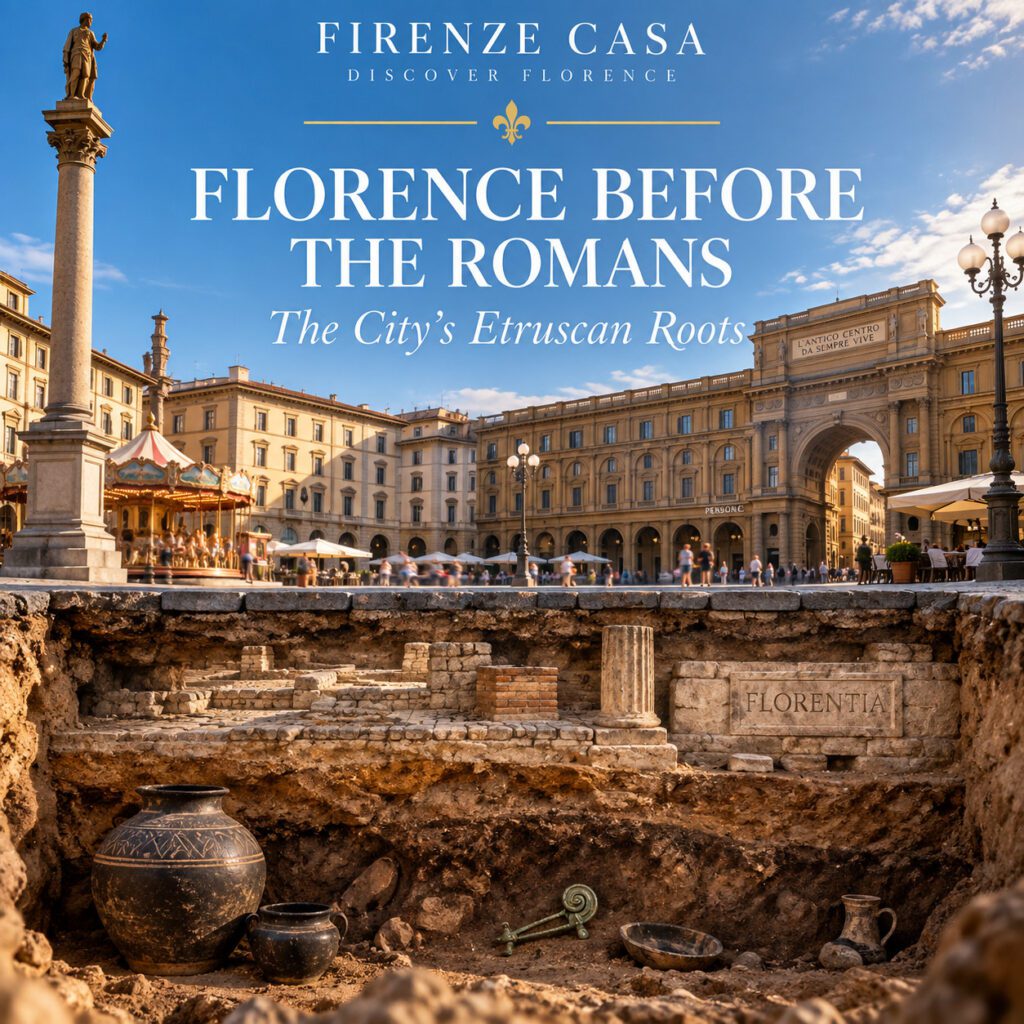
Florence before the Romans is one of the least visible chapters in the city’s history. Long before Roman Florentia developed beside the Arno, people already lived, travelled, worshipped and buried their dead within the landscape of the future city. Archaeological discoveries beneath modern Florence provide tantalising evidence of this much older world.
Yet the story requires some caution. Florence was not simply an Etruscan city that later became Roman. The important Etruscan urban centre of the area was Fiesole, strategically positioned on the hills above the valley. Down below, however, discoveries from Piazza della Repubblica, Piazza della Signoria and other parts of the historic centre demonstrate that the landscape of later Florentia was far from empty.
At a Glance
Period: Before the foundation of Roman Florentia
Older regional centre: Etruscan Fiesole, ancient Faesulae
Important discovery: Villanovan necropolis near Piazza della Repubblica
Other finds: Bronze votive figures, bucchero pottery and Etruscan funerary stones
Key question: The exact character of the pre-Roman settlement beneath Florence remains uncertain
Roman development: Florentia emerged in the Arno Valley during the late Republican and early Augustan period
Was There a Florence Before the Romans?
The answer depends on what we mean by Florence. The planned urban settlement that became Florentia belongs to the Roman period, and its street grid would eventually shape the historic centre. Nevertheless, archaeological discoveries show human activity in the area centuries before the Roman city developed.
This distinction matters. Archaeologists have found burials, pottery, votive objects and other evidence from pre-Roman periods within the modern city, but the extent and organisation of any settlement remain uncertain. We therefore cannot simply imagine a fully developed Etruscan Florence beneath the Roman one.
Instead, Florence before the Romans belonged to a broader landscape of settlements, routes, river crossings and agricultural territory. The most important nearby urban centre stood above the valley at Fiesole.
An Important Distinction
Archaeological evidence proves that people used the area of modern Florence before the Roman foundation of Florentia. It does not prove that a large Etruscan city already occupied the same site. The nature of the pre-Roman settlement remains one of the fascinating questions of Florentine archaeology.
The Arno Valley Before Florentia
The geography that later helped Roman Florence prosper was already important long before the Romans created their city. The Arno formed a natural corridor across northern Tuscany, while routes through the surrounding valleys connected communities on both sides of the Apennines.
The fertile plain offered agricultural possibilities, and river crossings provided natural points of communication. Hills surrounding the valley offered something different: visibility and defence. This contrast helps explain the very different locations of Etruscan Fiesole and later Roman Florence.
Fiesole occupied the heights. Florentia would eventually develop on the plain, where roads and the Arno created opportunities for transport, commerce and expansion. The two places therefore represent different approaches to the same landscape.
Fiesole – The Etruscan City Above Florence
To understand the Etruscan roots of Florence, it is necessary to look north towards Fiesole. Centuries before Florence became the dominant city of the region, an important settlement had developed on the hills overlooking the Arno Valley.
Ancient Fiesole, later known to the Romans as Faesulae, belonged to the wider Etruscan cultural world of central Italy. Its elevated position offered extensive views across the surrounding countryside and access to routes leading towards the Apennines. Archaeological remains, including sections of massive defensive walls, demonstrate the importance of the settlement before Roman rule transformed the region.
Fiesole should therefore not be described merely as an ancient suburb of Florence. It has its own history, considerably older than Roman Florentia. The relationship between the two places only changed gradually as the city in the valley increased in economic and political importance.
The early history of the hill settlement is explored in detail in Etruscan Fiesole – Origins of the Ancient Hill Town.
Look Towards the Hills
Standing in central Florence today, it is easy to assume that the valley has always been the natural centre of the region. In the Etruscan period, however, the important settlement stood above it at Fiesole. The famous city below was still centuries away.
Etruria – The World Around Ancient Florence
The Etruscan landscape extended far beyond Fiesole. Ancient Etruria originally referred to the territory associated with the Etruscans between the Arno and the Tiber, while Etruscan influence eventually reached well beyond this core area into northern and southern Italy.
During the seventh and sixth centuries BC, Etruscan culture became one of the most influential forces in central Italy. Major cities developed throughout the region, connected by trade, political alliances, religious traditions and shared artistic forms.
Fiesole stood on the northern edge of this cultural world. Its position close to routes crossing the Apennines made it strategically important within a broader network linking central Etruria with northern Italy.
From Etruria to Tuscany
The ancient name Etruria gradually gave way to the Roman and medieval term Tuscia. Over time, that name evolved into Toscana – Tuscany. The modern regional name therefore preserves a linguistic memory of the ancient Etruscan world.
A Necropolis Beneath Piazza della Repubblica
One of the most remarkable pieces of evidence for Florence before the Romans came to light in the very heart of the modern city. During extensive excavations between 1885 and 1893, archaeologists discovered a Villanovan necropolis near today’s Piazza della Repubblica.
The cemetery contained shaft graves dating to approximately the ninth and eighth centuries BC. Among the discoveries were characteristic biconical cinerary urns associated with cremation burials, together with grave goods placed beside the dead.
The Villanovan culture represents the Early Iron Age background from which Etruscan civilisation developed. These burials therefore take the history of human activity in central Florence back centuries before both Roman Florentia and the classical flowering of Etruscan civilisation.
The location makes the discovery particularly striking. Piazza della Repubblica later became the centre of Roman Florentia, then the site of Florence’s medieval Mercato Vecchio and finally the monumental square created during nineteenth-century redevelopment. Beneath these successive cities lay evidence of an even older landscape.
Why Were the Finds Discovered in the Nineteenth Century?
Many archaeological discoveries in central Florence resulted from the enormous transformations of the nineteenth century. When Florence became capital of the Kingdom of Italy between 1865 and 1871, construction and redevelopment began changing large areas of the city.
The subsequent demolition of Mercato Vecchio and reconstruction around Piazza della Repubblica exposed layers that had accumulated over many centuries. Archaeologists encountered Roman structures, medieval remains and much earlier evidence from the pre-Roman period.
The redevelopment destroyed parts of the historic city, but it also revealed archaeological information that had been hidden beneath streets and buildings. The transformation of Florence during this period is explored further in Florence as Capital of Italy – Firenze Capitale 1865–1871.
Layers Beneath the Square
Piazza della Repubblica brings together an extraordinary sequence of Florentine history: pre-Roman burials, the Roman forum, the medieval Mercato Vecchio and the nineteenth-century square visitors see today.
Pre-Roman Traces Around Piazza della Signoria
Piazza della Repubblica is not the only place where archaeologists found evidence from before Roman Florence. Small anthropomorphic bronze votive figures discovered in the area of Piazza della Signoria may indicate the presence of a sacred area.
Such objects are important because they suggest activity very different from the funerary evidence beneath Piazza della Repubblica. Votive figurines were generally associated with religious practice and offerings, although the surviving evidence does not allow us to reconstruct the site with certainty.
The discovery nevertheless adds another piece to the archaeological puzzle. The area that later became the political heart of medieval and Renaissance Florence had already attracted human activity long before Palazzo Vecchio or even Roman Florentia existed.
Bucchero – Etruscan Pottery Beneath Florence
Other discoveries provide clearer connections with Etruscan material culture. Archaeologists have recovered bucchero, the distinctive black pottery associated with the Etruscans, at several locations within central Florence.
Among the finds are inscribed bucchero cups from Via del Proconsolo and other ceramic material discovered within the historic centre. Individual objects cannot by themselves reveal the nature of the entire settlement, but they demonstrate contact with the Etruscan cultural world surrounding the Arno Valley.
Bucchero is particularly recognisable because of its dark, often highly polished surface. It became one of the characteristic ceramic products of Etruscan civilisation and circulated widely through trade and exchange.
The Fiesole Stones
Archaeological evidence from the later Etruscan period also includes examples of the so-called Fiesole stones. These sandstone funerary markers, often decorated in relief, take their modern name from an important centre of production associated with Fiesole.
Their presence in the wider Florentine area reinforces the relationship between the valley and the Etruscan world of the surrounding hills. At the same time, the evidence reminds us not to draw modern municipal boundaries onto the ancient landscape.
For the people who lived here more than two thousand years ago, the hills, valley and river formed parts of a connected territory rather than separate places called Florence and Fiesole in the modern sense.
Was Pre-Roman Florence an Etruscan Settlement?
This is the central question, and the most accurate answer is: we do not yet know exactly.
The archaeological record clearly demonstrates pre-Roman activity. There were burials, religious objects and material associated with Etruscan culture. However, archaeologists have not established the size, organisation or exact character of a settlement occupying the future site of Florentia.
It would therefore be misleading to describe Florence as a fully developed Etruscan city comparable with Fiesole, Volterra, Chiusi or other major centres. What we can say is more interesting: the Romans did not arrive in an empty landscape.
Their new city emerged within territory that already possessed routes, communities, burial places and cultural connections stretching back centuries.
What Archaeology Tells Us
The evidence supports a pre-Roman human presence in the area of Florence, including connections with Etruscan culture. It does not yet allow archaeologists to reconstruct a large Etruscan predecessor city beneath Florentia.
From the Etruscan Landscape to Roman Florentia
Roman expansion gradually transformed northern Etruria. Some Etruscan cities resisted Rome, while others negotiated alliances that allowed varying degrees of autonomy before becoming fully integrated into the Roman state.
Fiesole eventually came under Roman control, while a new settlement developed in the Arno Valley below. The precise circumstances surrounding the foundation of Florentia remain partly debated. Older traditions often present a simple story involving Julius Caesar and military veterans, while modern interpretations are more cautious about assigning one precise foundation event.
What is clear is that the Roman city developed during the late Republican and early Augustan period according to recognisably Roman urban principles. Its location close to the Arno and important land routes gave it advantages that would become increasingly important over time.
The next chapter of the story is explored in Roman Florence – Florentia and the Ancient City.
How Roman Florence Changed the Landscape
Florentia introduced an urban structure fundamentally different from the older settlement pattern of the region. Roman planners organised the city around intersecting streets, with the forum occupying the central area near present-day Piazza della Repubblica.
The cardo and decumanus structured movement through the settlement, while defensive walls enclosed the early city. Baths, temples, a theatre and other public buildings gradually created a recognisably Roman urban environment.
Yet the choice of location also demonstrates continuity. The Romans exploited the same geographical advantages that had made the Arno Valley useful before their arrival: movement along the river, routes across Tuscany and access to productive land.
Florence and Fiesole – From Hill to Valley
The contrast between Fiesole and Florence provides one of the best ways to understand the transformation. Etruscan Fiesole occupied a naturally defensible hilltop. Roman Florentia developed on relatively flat land beside transport routes.
Neither location was accidental. Each reflected different priorities and historical circumstances. Fiesole benefited from visibility and protection, while Florentia could exploit communications, commerce and an urban layout suited to Roman planning.
Over the following centuries, the balance gradually shifted towards Florence. The city beside the Arno eventually grew into the economic and political centre of the region, while ancient Fiesole became increasingly connected with its powerful neighbour below.
The Etruscans Return to Medici Florence
The Etruscan story acquired an unexpected new significance many centuries later. During the Renaissance and particularly under Cosimo I de’ Medici, Tuscany’s ancient Etruscan past became useful to the political identity of the Medici state.
Major archaeological discoveries encouraged fascination with ancient Etruria. The Chimera of Arezzo, discovered in 1553, became one of the most celebrated Etruscan works associated with Cosimo I and entered the Medici collections.
Scholars at the Medici court developed theories about the antiquity and importance of the Etruscans. Some of their ideas no longer correspond with modern archaeology, but politically they served an important purpose: ancient Etruria could provide the emerging Tuscan state with a prestigious history that predated Rome.
This connection became explicit in 1569, when Cosimo I received the title of Grand Duke of Tuscany. In Latin, he styled himself Magnus Dux Etruriae – Grand Duke of Etruria – deliberately linking the Medici state with the ancient Etruscan past. His successors continued to use the title.
Ancient History and Medici Politics
For Cosimo I, the Etruscans were more than an archaeological curiosity. Ancient Etruria offered the Medici state a prestigious Tuscan past. His title Magnus Dux Etruriae made that political connection explicit.
From Etruria to Tuscia and Toscana
The survival of the Etruscan name is not limited to archaeology. Under Roman rule, the region continued to be known as Etruria, while the term Tuscia gradually became increasingly common during the imperial and later periods.
The words Tusci and Tuscus were Roman names connected with the Etruscans. Over centuries, Tuscia evolved linguistically into Toscana, the Italian name for Tuscany.
The modern regional name therefore preserves one of the most enduring traces of Etruscan history. Visitors may think of Tuscany primarily through Renaissance Florence, medieval hill towns and the landscape of vineyards and olive groves, yet the very word Toscana reaches back towards the civilisation that occupied this territory long before Rome dominated the region.
Where to Discover the Etruscans in Florence Today
The pre-Roman layers beneath central Florence are difficult to experience directly because most archaeological remains are no longer visible. Piazza della Repubblica gives few clues that an Early Iron Age cemetery once existed beneath the modern cafés and paving.
For visitors interested in Etruscan civilisation, the most important destination within Florence is the Museo Archeologico Nazionale di Firenze. Its collections include major Etruscan works gathered from across Tuscany and provide the broader cultural context necessary to understand the discoveries made beneath Florence itself.
Among its masterpieces is the famous Chimera of Arezzo, one of the great surviving works of Etruscan bronze sculpture. The museum also preserves extensive collections of ceramics, bronzes, funerary objects and other archaeological material.
To experience an ancient settlement rather than a museum collection, however, travel to Fiesole. Its archaeological area and surviving Etruscan walls make the relationship between landscape and ancient settlement far easier to understand.
Reading Florence from the Ground Down
Florence is usually experienced chronologically from the Renaissance backwards: visitors begin with Brunelleschi, Michelangelo and the Medici, then discover medieval towers and eventually Roman Florentia. Archaeology reverses that perspective.
Under Renaissance palaces lie medieval structures. Beneath the medieval city appear Roman streets and buildings. Below even those layers, scattered discoveries reveal human activity stretching into the Iron Age and the Etruscan world.
This vertical history makes Florence particularly fascinating. The city did not replace its past once; it repeatedly built over it. Modern streets therefore preserve a geography shaped by many different Florences occupying the same relatively small area.
Firenze Casa Perspective
Florence is not only a city of monuments but also a city of layers. Piazza della Repubblica alone connects an Iron Age cemetery, Roman forum, medieval market and nineteenth-century square within essentially the same urban space.
What Florence Before the Romans Changes About the City
Understanding Florence before the Romans changes the familiar foundation story. Roman Florentia remains the crucial beginning of Florence as an organised urban centre, but it was not the beginning of human history in this landscape.
The burials beneath Piazza della Repubblica push that story back into the Early Iron Age. Etruscan objects demonstrate connections with a broader cultural world, while Fiesole reminds us that the most important ancient settlement initially stood above the valley rather than within it.
Roman Florence therefore represents both a beginning and a transformation. A new city appeared beside the Arno, but it emerged within a landscape that people had already inhabited and used for centuries.
Frequently Asked Questions About Florence Before the Romans
Was Florence founded by the Etruscans?
There is no firm evidence that a large Etruscan city occupied the site of later Florentia. Archaeological discoveries demonstrate pre-Roman activity and Etruscan cultural connections, but Roman Florentia represents the beginning of the clearly organised urban city.
What was in Florence before the Romans?
Archaeologists have discovered pre-Roman burials, votive objects, bucchero pottery and funerary stones within the modern city. A particularly important Villanovan necropolis dating to the ninth and eighth centuries BC was found near Piazza della Repubblica.
Was Fiesole an Etruscan city?
Yes. Fiesole developed as an important ancient settlement before Roman Florence. Its strategic hilltop position, archaeological remains and surviving defensive walls preserve evidence of its Etruscan past.
What was Etruria?
Etruria was the ancient territory associated with the Etruscans in central Italy. Its core extended broadly between the Arno and the Tiber, while Etruscan influence reached beyond this area at different periods.
What was the Villanovan culture?
The Villanovan culture developed in central and northern Italy during the Early Iron Age and represents the cultural background from which Etruscan civilisation emerged. Characteristic cremation burials with biconical urns have been discovered beneath central Florence.
Where were Etruscan finds discovered in Florence?
Important pre-Roman finds have been recorded around Piazza della Repubblica, Piazza della Signoria, Via del Proconsolo and other locations within the historic centre.
Where can I see Etruscan objects in Florence?
The Museo Archeologico Nazionale di Firenze contains one of Italy’s important collections of Etruscan antiquities, including the celebrated Chimera of Arezzo. Fiesole provides the best nearby opportunity to combine archaeological objects with the landscape of an ancient settlement.
Did the Medici collect Etruscan art?
Yes. Cosimo I de’ Medici took a particular interest in important archaeological discoveries, and the Chimera of Arezzo entered his collection after its discovery in 1553. Etruscan antiquity also acquired political and cultural significance within the Medici Grand Duchy.
Why is Tuscany connected with the Etruscans?
The connection survives even in the name. The Roman and medieval term Tuscia, derived from words used for the Etruscans, eventually developed into the Italian name Toscana.
Why Florence’s Etruscan Roots Still Matter
The Etruscan roots of Florence matter because they reveal that the history of the city does not begin neatly with one Roman foundation date. Florentia transformed the Arno Valley, but archaeology demonstrates that people had already been using this landscape for centuries.
Fiesole provides the clearest surviving connection with the Etruscan world, while discoveries beneath central Florence reveal fragments of a more elusive pre-Roman past. Together, they create a bridge between the ancient hill town and the Roman city that later developed below.
The story also continued long after antiquity. The Medici deliberately revived the idea of Etruria as part of Tuscan political identity, while the modern name Tuscany still preserves the linguistic memory of the ancient population. Florence’s Etruscan roots are therefore not confined to archaeology; they remain embedded in the identity of the region itself.
Look Beneath Florence
The Renaissance city is only the most visible layer. Beneath its streets lie traces of Roman Florentia, and beneath the Roman city archaeology reaches back towards an even older landscape connected with the Etruscans and the communities of the Arno Valley.
Further Reading on Firenze Casa
Continue exploring the ancient origins, archaeological layers and historical development of Florence and Fiesole:
- Etruscan Fiesole – Origins of the Ancient Hill Town
- Roman Florence – Florentia and the Ancient City
- Fiesole – History, Etruscans and Views
- Piazza della Repubblica – Florence’s Historic Central Square
- Florence as Capital of Italy – Firenze Capitale 1865–1871
- The Medici Family – The Dynasty That Shaped Florence
References
- Comune di Firenze / FeelFlorence – Archaeological Map of Florence: Pre-Roman and Roman Florence
- Comune di Firenze / FeelFlorence – Roman Florence
- Museo Archeologico Nazionale di Firenze – Etruscan Collections and Archaeological Finds
- Direzione regionale Musei nazionali Toscana – Archaeological Collections and Etruscan Heritage
- Historical and archaeological studies on pre-Roman Florence, Florentia and ancient Faesulae
- Studies on Villanovan burial practices and the development of Etruscan civilisation in northern Etruria
- Studies on Etruria, Tuscia and the historical origins of the name Tuscany
- Studies on Cosimo I de’ Medici, the title Magnus Dux Etruriae and the Renaissance reception of Etruscan antiquity

