
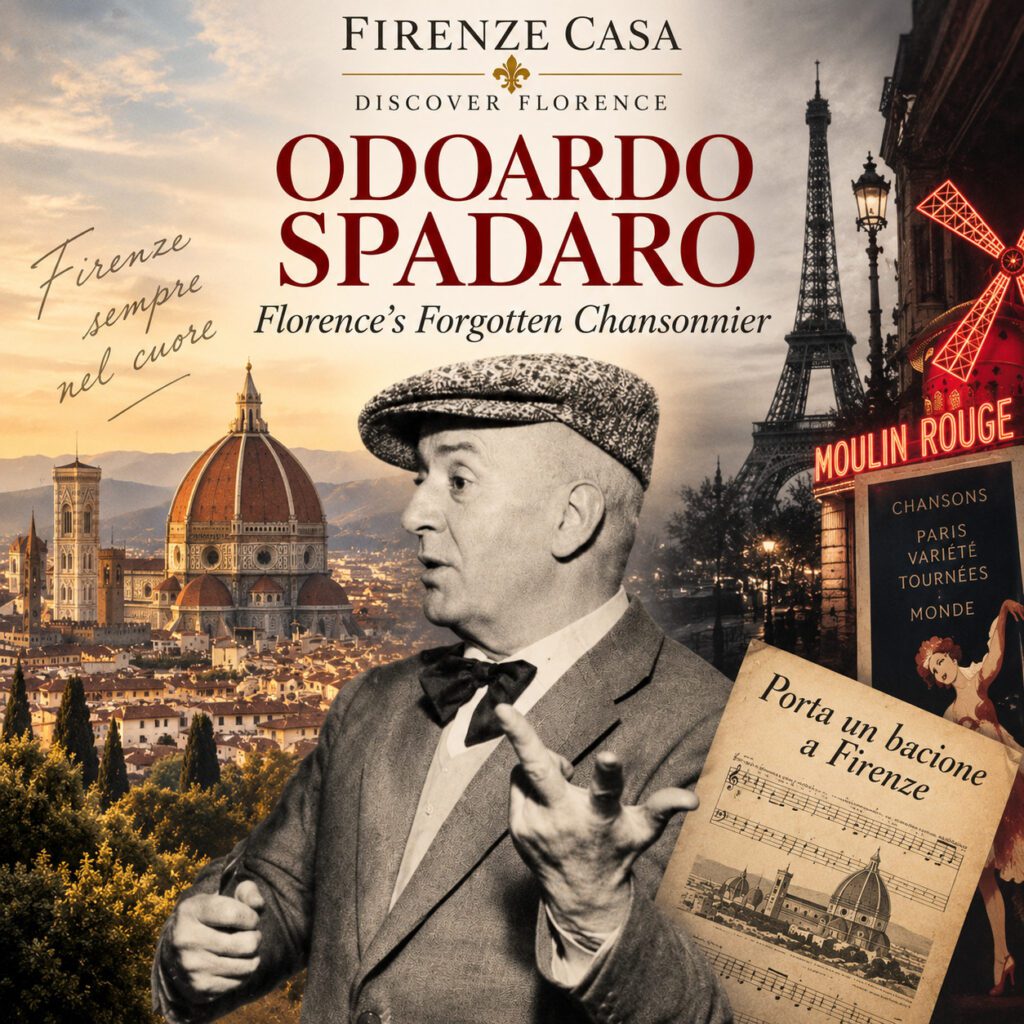
Florence remembers its Renaissance artists exceptionally well. Yet some Florentines who carried the name of the city far beyond Tuscany have almost disappeared from international memory. Odoardo Spadaro is one of them.
Born in the Oltrarno in 1893, Spadaro became a singer, songwriter, actor and celebrated stage performer. His career took him from Florence to Paris, London, North Africa and the Americas before eventually bringing him into Italian cinema. Today, however, his most enduring legacy is a song: Porta un bacione a Firenze, an affectionate musical message to Florence that outlived the international celebrity of the man who created it.
Born: Florence, 16 January 1893
Died: Florence, 26 June 1965
Profession: Singer, songwriter, actor and variety performer
Born in: Via Santo Spirito 31
International career: Paris, London, North Africa and the Americas
Famous song: Porta un bacione a Firenze
Burial: Cimitero delle Porte Sante, Florence
Who Was Odoardo Spadaro?
For visitors from North America, the word chansonnier may require some explanation. In early twentieth-century Europe, it described much more than a conventional singer. A chansonnier combined music, storytelling, humour, personality and theatrical performance, often establishing an unusually direct relationship with an audience.
Odoardo Spadaro belonged to this world. He sang and played the piano, performed comic sketches, parodied other entertainers and developed the sophisticated stage personality of a fantaisiste. His style emerged from the European tradition of music halls and variety theatres rather than from opera or classical concert music.
That distinction is important. Florence is internationally associated with Renaissance art and the origins of opera, but Spadaro represents another cultural Florence: popular, humorous, sentimental and distinctly twentieth-century.
Born in Florence’s Santo Spirito Quarter
Odoardo Spadaro was born on 16 January 1893 at Via Santo Spirito 31, in the Oltrarno. His father, Gustavo Adolfo Spadaro, was an army officer originally from Messina, while his mother, Mary Marchesini, came from a wealthy Florentine family and played the harp. His maternal grandmother was a pianist, so music formed part of his childhood environment.
The location of his birth is particularly appropriate. Santo Spirito developed a strong neighbourhood identity quite different from the monumental Florence around the Duomo and Piazza della Signoria. Artisans, residents, workshops, markets and popular traditions helped shape the Oltrarno, and Spadaro would later transform something of this Florentine character into an international stage persona.
Spadaro’s connection with Santo Spirito can still be found in the city. Florence approved a commemorative plaque for his birthplace at Via Santo Spirito 31, preserving a physical link between the internationally successful performer and the neighbourhood where his story began.
From Law Student to the Stage
Spadaro did not initially prepare for a professional career in entertainment. At his family’s request, he enrolled in law at the University of Florence. At the same time, he studied acting and diction with actor and playwright Luigi Rasi at the Royal School of Acting in Via Laura.
A successful comic monologue during a student performance in 1911 helped change his direction. Spadaro abandoned the expected legal career and entered the theatre, initially accepting small dramatic roles. He soon discovered, however, that conventional theatre did not make the best use of his talents.
Variety entertainment suited him much better. His performances combined imitation, comedy, piano playing, songs and visual humour. By the years surrounding the First World War, he had begun developing the versatile stage personality that would eventually take him far beyond Italy.
War, Music and His First Success
During the First World War, Spadaro served as a soldier and performed for troops in barracks, military hospitals and small theatres near the front. The experience produced one of his first important songs, Ninna nanna delle dodici mamme, which he presented in 1919.
The song revealed another side of an entertainer often associated with humour. Its melancholy tone reflected the loss experienced by mothers during the war and demonstrated Spadaro’s ability to move between comedy and sentiment. That mixture would remain an important characteristic of his later work.
Paris Changes Everything
In 1920, Spadaro made a decisive move to Paris. At first, success did not come easily. He was virtually unknown in France and his command of French was limited. After improving the language in Monte Carlo, however, he returned to Paris and gradually entered its flourishing entertainment world.
Engagements followed at venues including the Alhambra, Bobino, the Olympia and other theatres. Performances also took him to Marseille, London, Brighton and North Africa. Within a few years, the young Florentine had transformed himself into an international variety performer.
For modern visitors accustomed to thinking of Florence primarily as a destination that attracted foreign artists, Spadaro offers the opposite story. He was a Florentine who left Tuscany and carried elements of his city’s culture into the entertainment capitals of Europe.
Florence has attracted international writers, musicians and artists for centuries. Odoardo Spadaro represents the reverse journey: a Florentine performer who built an international career while retaining a strong cultural connection with his native city.
Odoardo Spadaro at the Moulin Rouge
By the middle of the 1920s, Spadaro had become an established figure in Parisian variety theatre. His appearance, hats and elegant stage personality sometimes led observers to compare him with Maurice Chevalier, one of the great French entertainers of the period.
A particularly remarkable moment came in 1927, when the Moulin Rouge engaged Spadaro as the principal fantaisiste in the revue Bonjour Paris. The production starred the legendary French entertainer Mistinguett. Among the younger performers appearing around the same period were Jean Gabin and Viviane Romance, both of whom would later become major stars of French cinema.
This part of Spadaro’s biography makes his later obscurity particularly surprising. He was not simply a local Florentine singer who became popular in Tuscany. For a period, he participated directly in one of Europe’s most glamorous entertainment cultures.
A Florentine on International Stages
Spadaro’s career also extended well beyond Paris. He appeared in Britain, Germany, North Africa and elsewhere, while tours later took him across the Atlantic. His performances belonged to an era when international entertainment travelled through theatres, music halls, ocean liners and touring companies rather than television or digital media.
Yet Florence remained part of his artistic identity. In 1929 he wrote the song Firenze, inspired by the death of his mother. During the following years, radio provided another medium through which his songs could reach audiences far beyond the theatre.
The Story Behind Porta un bacione a Firenze
Spadaro’s most enduring connection with his native city emerged from a journey to South America. During an American tour in the early 1930s, he encountered the world of Italian emigrants who had left their homeland but retained powerful emotional connections with it.
According to the story Spadaro later told, a young Florentine emigrant approached him when he was leaving Montevideo. Knowing that he was returning to Italy, she asked him to carry a kiss back to Florence for her.
The encounter inspired Porta un bacione a Firenze – literally, “Take a big kiss to Florence.” Spadaro reportedly developed the song during the return voyage to Italy aboard the ocean liner Conte Biancamano. It was later published in 1938 and became his signature work.
The idea behind Porta un bacione a Firenze is remarkably simple: someone far from home asks a traveller returning to Florence to deliver a kiss to the city. That combination of migration, homesickness and affection helped the song speak to Italians living far beyond Tuscany.
Why the Song Mattered to Italian Emigrants
For a modern American or Canadian reader, the historical context adds an important dimension. Millions of Italians emigrated between the late nineteenth and twentieth centuries, establishing communities throughout North and South America. Leaving Italy often meant travelling enormous distances with little expectation of frequent return visits.
A song about sending a greeting home therefore carried far more emotional weight than it might appear to today. Florence became not simply a geographical place but a memory: streets, family, language, food and familiar landscapes condensed into the idea of home.
Other singers subsequently performed Porta un bacione a Firenze, including Carlo Buti and Claudio Villa. As a result, the song gradually became larger than its creator. That success also helps explain the curious situation today: the melody and title remain part of Florentine cultural memory even though Odoardo Spadaro himself is far less widely remembered.
Spadaro and the Florentine Character
Spadaro’s performances often drew on humour, irony and an immediately recognisable Florentine identity. This was not the Florence of Michelangelo and the Medici presented to international tourists. Instead, it belonged to everyday speech, popular entertainment and the distinctive humour of the city.
The contrast is useful when exploring Florence today. The monumental centre preserves extraordinary art and architecture, while neighbourhoods such as Santo Spirito reveal another side of urban history. Spadaro belongs to that less formal cultural landscape.
Florence’s musical identity also continued long after his generation. A very different chapter can be found in the extraordinary relationship between the city and conductor Zubin Mehta, demonstrating how many forms Florence’s musical history has taken.
From Variety Theatre to Italian Cinema
After the Second World War, the entertainment world that had made Spadaro famous began to change. Traditional variety theatre declined as cinema, radio and eventually television transformed popular culture. Spadaro’s stage career gradually lost some of its earlier prominence, but he successfully moved into other media.
His later filmography is impressive. He appeared with Anna Magnani in Jean Renoir’s The Golden Coach (La carrozza d’oro, 1952) and later played the father of Marcello Mastroianni’s character in Pietro Germi’s celebrated Divorce Italian Style (Divorzio all’italiana, 1961). He also appeared in film alongside Jean-Paul Belmondo and worked in radio and television.
In 1956, Spadaro even performed his signature song in the film Porta un bacione a Firenze. His career therefore forms an intriguing bridge between European music-hall culture and the age of post-war Italian cinema. For more on the city’s relationship with the screen, see Movies Filmed in Florence – Famous Films and Locations.
Why Was Odoardo Spadaro Forgotten?
Calling Spadaro “forgotten” requires some qualification. He has never disappeared completely from Florentine cultural memory, and his songs continue to be performed. Nevertheless, his international reputation faded dramatically after his death.
Part of the explanation lies in the disappearance of the entertainment culture to which he belonged. Variety theatre depended heavily on personality, live performance and contemporary references. When that world declined, many performers who had once filled theatres became much less familiar to later generations.
His greatest song created another paradox. Porta un bacione a Firenze survived so successfully that it gradually detached itself from its author. The song became part of Florence’s musical identity while the biography of the man behind it receded from view.
Florence still remembers Spadaro. His name survives in commemorations, performances and the city’s street map, while his songs continue to appear in events celebrating traditional Florentine culture. The forgotten chansonnier has never entirely left his city.
Odoardo Spadaro Returns to Florence
Spadaro spent his later professional years largely in Rome. In 1965, however, serious illness brought his life back towards Florence. After treatment in Rome for throat cancer, his condition deteriorated. His final wish was to see his native city again.
On 19 June 1965, he was transferred by ambulance to the hospital at Careggi in Florence. He died there on 26 June, with his wife and close friends beside him.
The response of the city demonstrated how strongly Florentines still identified with him. Thousands gathered outside San Lorenzo for his funeral. Contemporary reports describe musicians singing Porta un bacione a Firenze as a final tribute before his burial.
Spadaro at the Cimitero delle Porte Sante
Odoardo Spadaro was buried at the Cimitero delle Porte Sante, the historic cemetery beside the Basilica of San Miniato al Monte. Its elevated position above Florence makes it one of the city’s most remarkable places of remembrance.
The cemetery contains the graves of numerous figures from Florentine cultural history. Spadaro therefore rests within sight of the city that inspired his most enduring work. Visitors can combine the cemetery with San Miniato al Monte and the panoramic walk above Florence.
Spadaro’s Florence can still be traced through the city. Begin in Via Santo Spirito in the Oltrarno and later climb to the Cimitero delle Porte Sante beside San Miniato al Monte. The route connects the neighbourhood where he was born with the place where he was finally laid to rest.
Where Florence Remembers Odoardo Spadaro Today
Florence has preserved several reminders of Spadaro. His birthplace in Via Santo Spirito is commemorated, and the city also has a Via Odoardo Spadaro. Cultural events continue to revive his songs and the world of traditional Florentine radio and entertainment.
This memory is not merely historical. In 2026, Florence’s summer cultural programme again included performances celebrating Spadaro and the popular Florentine entertainment tradition. More than sixty years after his death, his music therefore continues to return to the city’s public spaces.
For visitors, however, the most meaningful memorial may be less obvious. Walking through Santo Spirito while knowing Spadaro’s story adds another layer to the neighbourhood. The Oltrarno becomes not only a district of churches, artisans and restaurants but also the birthplace of an entertainer who once carried Florence onto international stages.
A Florentine Story That Deserves Rediscovery
Odoardo Spadaro Florence history stretches far beyond a single nostalgic song. His career connects the Oltrarno with Parisian music halls, transatlantic migration, early radio, European variety theatre and post-war Italian cinema. Few Florentine performers of his generation travelled through so many different cultural worlds.
Yet the emotional centre of his story remained remarkably constant. Whether performing in Paris or touring overseas, Spadaro repeatedly returned to Florence in his music. His most famous work transformed homesickness into a simple request: take a kiss back to the city.
That may ultimately explain why Porta un bacione a Firenze survived. The song does not require listeners to know Spadaro’s biography. Anyone who has lived far from a place they love can understand its idea.
Frequently Asked Questions
Who was Odoardo Spadaro?
Odoardo Spadaro was a Florentine singer, songwriter, actor and variety performer born in 1893. He became internationally successful in European music halls before developing a later career in Italian cinema, radio and television.
Where was Odoardo Spadaro born?
He was born at Via Santo Spirito 31 in Florence’s Oltrarno on 16 January 1893. The location connects his biography directly with one of the city’s most distinctive historic neighbourhoods.
What is Odoardo Spadaro’s most famous song?
His best-known song is Porta un bacione a Firenze. It was inspired by the idea of an emigrant asking someone returning to Italy to carry a kiss back to Florence.
Did Odoardo Spadaro perform outside Italy?
Yes. Spadaro developed an important international career, particularly in Paris, and also performed in Britain, Germany, North Africa and the Americas.
Did Odoardo Spadaro perform at the Moulin Rouge?
Yes. In 1927 he appeared at the Moulin Rouge in the revue Bonjour Paris alongside the celebrated French performer Mistinguett. The production also included future film stars Jean Gabin and Viviane Romance.
Was Odoardo Spadaro also a film actor?
Yes. His later career included appearances in important films such as Jean Renoir’s The Golden Coach and Pietro Germi’s Divorce Italian Style, in which he played the father of Marcello Mastroianni’s character.
Where is Odoardo Spadaro buried?
He is buried at the Cimitero delle Porte Sante beside San Miniato al Monte in Florence.
Why Odoardo Spadaro Is Worth Remembering
Florence has produced cultural figures whose names became universal. Others belonged so closely to a particular place and period that their reputations faded as the world around them changed. Odoardo Spadaro belongs to the second group.
Rediscovering him reveals a Florence rarely encountered in conventional guidebooks: the city of variety theatres, popular songs, radio personalities, emigrant nostalgia and sharp Florentine humour. It is a twentieth-century Florence that existed alongside the Renaissance monuments but told its stories through very different forms.
Perhaps the best way to remember Spadaro is therefore also the simplest. The next time you cross the Arno into Santo Spirito, remember that a boy born in one of these streets eventually reached the stages of Paris, travelled across the Atlantic and turned a stranger’s homesickness into one of Florence’s most enduring songs.
Further Reading on Firenze Casa
- Santo Spirito – Florence’s Historic Oltrarno Quarter
- Zubin Mehta and Florence – A Musical Bond
- Movies Filmed in Florence – Famous Films and Locations
- Cimitero delle Porte Sante – Florence’s Historic Cemetery
- San Miniato al Monte – Florence Above the City
References
Treccani – Dizionario Biografico degli Italiani: Odoardo Spadaro.
Comune di Firenze – Historical records and commemorative documentation concerning Odoardo Spadaro and Via Santo Spirito 31.
Comune di Firenze – Portale Giovani: cultural programmes and historical material concerning Odoardo Spadaro, Florentine popular music and Grillo Canterino.
Comune di Firenze – Stradario Storico: Via Odoardo Spadaro.
Borghini, Franco – Odoardo Spadaro, Florence, 1993.
Borgna, Gianni – Storia della canzone italiana, Rome-Bari, 1985.
Baldazzi, Gianfranco – La canzone italiana del Novecento, Rome, 1989.
Spadaro, Odoardo – A richiesta del pubblico, Florence-Rome, 1945.

