
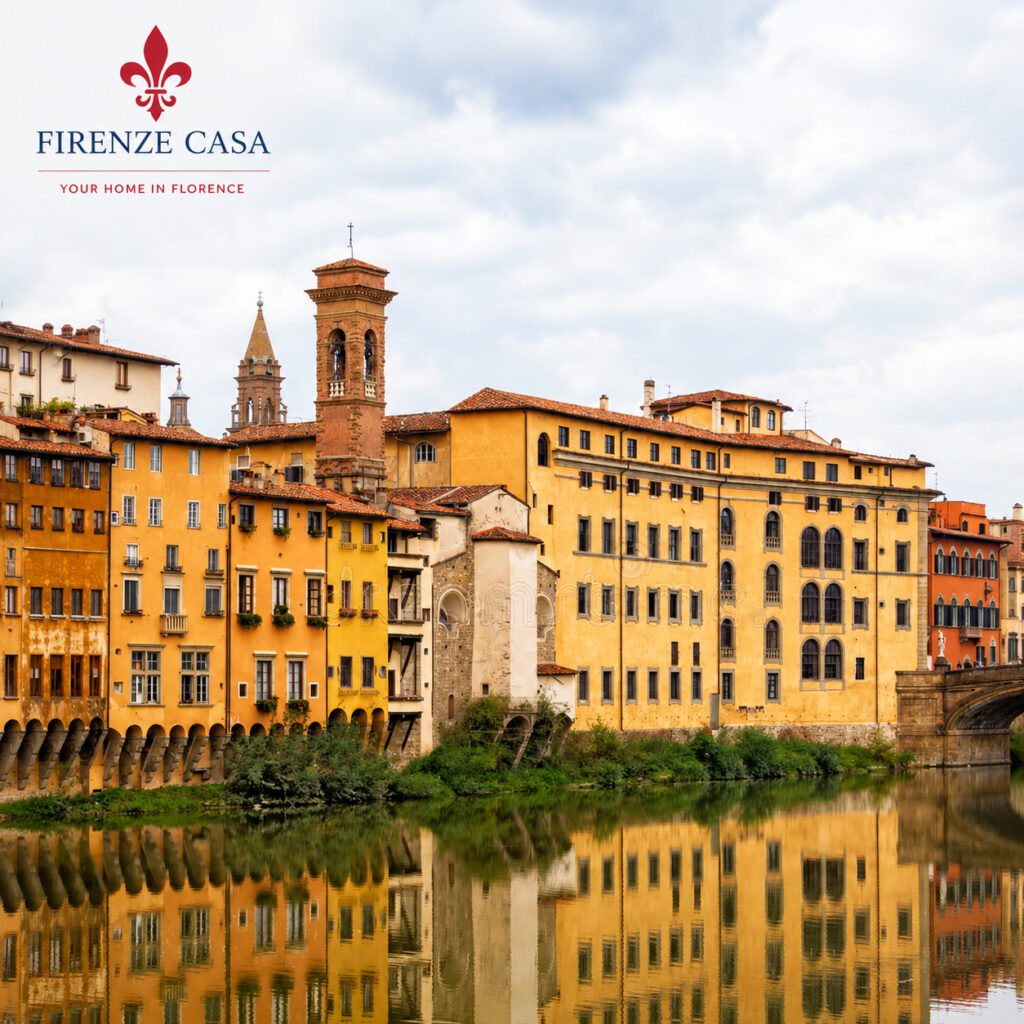
San Jacopo sopr’Arno Florence is one of the lesser-known historic churches of the Oltrarno. Standing close to the Arno and only a short walk from Ponte Santa Trinita, the church preserves traces of a history that reaches deep into medieval Florence.
Its riverside position gives San Jacopo a distinctive character, while the building itself reflects centuries of architectural change, religious life and the continual transformation of the neighbourhood south of the Arno. For visitors who already know Florence’s great basilicas, it offers a smaller and quieter encounter with the city – exactly the kind of place explored in our Florence Secrets and Traditions – Complete Guide.
Church: San Jacopo sopr’Arno
Location: Oltrarno, close to the Arno and Ponte Santa Trinita
Origins: medieval
Main interest: layered architecture and neighbourhood history
Setting: historic riverside Florence
Best combined with: Santo Spirito, Palazzo Pitti and a walk through the Oltrarno
Character: quiet, historic and closely connected with everyday neighbourhood life
Where Is San Jacopo sopr’Arno?
The church stands in the Oltrarno, the part of historic Florence located south of the Arno. Its position near the river explains the addition sopr’Arno, which distinguishes it from other churches dedicated to Saint James.
Although the neighbourhood lies remarkably close to the monumental centre, crossing the river often produces an immediate change in atmosphere. Narrow streets, workshops, small squares and historic buildings create a more residential character.
San Jacopo belongs naturally to this environment. The wider Oltrarno can be explored particularly well around Santo Spirito, where Renaissance architecture continues to coexist with cafés, markets, workshops and neighbourhood life.
An Ancient Church in the Oltrarno
The origins of San Jacopo reach back to the medieval period. Documentary references confirm that a church existed here many centuries before Florence reached the height of its Renaissance splendour.
The site therefore belongs to an earlier layer of the city’s development, when Florence was expanding around both banks of the Arno and religious institutions helped organise neighbourhood life.
Over the centuries, however, the church changed considerably. Renovations altered its appearance, while new artistic and architectural elements reflected changing tastes. San Jacopo should therefore not be understood as a building frozen in a single historical period but as a record of several phases of Florentine history.
Many small Florentine churches are historical palimpsests. Medieval foundations, Renaissance additions and later decoration can survive within the same building, revealing how Florence changed over centuries.
Why Is It Called San Jacopo sopr’Arno?
The name combines the dedication to Saint James with the church’s location beside the Arno. Jacopo is a traditional Italian form of James, while sopr’Arno refers directly to the river.
This geographical element is particularly appropriate because the relationship between the church and the Arno has defined the site throughout its history.
Before modern embankments transformed the riverbanks, Florence had a much more immediate relationship with the water. Buildings, streets and commercial activities developed close to the river. San Jacopo therefore preserves a name that reflects the geography of historic Florence as much as its religious identity.
The Church and Medieval Florence
Medieval Florence looked very different from the Renaissance city visitors imagine today. Towers belonging to powerful families punctuated the skyline, streets were narrower and neighbourhood identities were particularly strong.
Churches played an essential role within these communities, providing places for worship, burial, charitable activities and social interaction. San Jacopo developed within this urban world.
Its long history therefore provides a valuable connection with the Oltrarno before the construction of many of the district’s better-known Renaissance landmarks. The broader transformation from medieval settlement to Renaissance city can be followed in our History of Florence.
The Oltrarno Before the Renaissance
Today, the Oltrarno is associated with Palazzo Pitti, Santo Spirito and Renaissance palaces. Settlement south of the river, however, has much deeper roots.
Bridges connected both sides of Florence and encouraged development beyond the northern bank, while roads leading away from the city passed through neighbourhoods that gradually became integrated into urban Florence. Religious foundations followed this expansion.
Churches such as San Jacopo therefore became landmarks within communities developing outside the oldest Roman and medieval core. Understanding this process helps explain why the Oltrarno contains such a rich mixture of architectural periods.
A Church Shaped by Centuries of Change
San Jacopo sopr’Arno Florence changed repeatedly as generations adapted the building to new needs and artistic tastes. Its present appearance does not represent a single moment in history.
This process was common in Florence because churches remained active institutions and communities regularly restored, enlarged or redecorated them. Later interventions could transform interiors dramatically while older architectural elements survived elsewhere.
Looking carefully at a historic Florentine church can therefore reveal unexpected contrasts. San Jacopo is particularly interesting because its long history spans medieval, Renaissance and later periods.
Do not expect every part of San Jacopo to belong to the same period. Instead, look for contrasts between older architectural forms and later decoration. Those differences are part of the church’s story.
The Romanesque Heritage of San Jacopo
Among the most interesting aspects of San Jacopo is its connection with Florence’s Romanesque architectural tradition. Surviving elements recall the medieval origins of the church even though subsequent alterations changed much of the building.
Florentine Romanesque architecture often favoured clear geometry and carefully proportioned forms, with monumental examples surviving at the Baptistery and San Miniato al Monte.
Smaller churches interpreted these traditions more modestly, yet they formed an important part of the same architectural landscape. San Jacopo therefore broadens our understanding of medieval religious architecture beyond Florence’s best-known monuments.
The Tower of San Jacopo
The church’s bell tower forms another visible reminder of its long history. Towers once played a much greater role in Florence’s skyline than they do today, as medieval family towers, civic structures and church campanili rose above tightly packed streets.
Although many disappeared or were reduced in height, surviving towers still help visitors imagine the vertical character of earlier Florence.
The tower of San Jacopo contributes to this historic landscape of the Oltrarno and identifies the church within a dense neighbourhood where façades can otherwise blend into surrounding buildings.
San Jacopo and the Arno
The Arno has always shaped Florence. It provided water and supported economic activities, yet it also created a natural obstacle that bridges had to overcome. At the same time, the river could be dangerous, and floods repeatedly devastated streets, homes, churches and workshops along its banks.
San Jacopo’s location placed it directly within this relationship between city and river. The history of the church therefore cannot be separated entirely from the history of the Arno.
Modern embankments have changed how visitors experience the river today, while earlier Florentines lived much closer to its changing waters.
The Great Floods of Florence
Florence has experienced numerous destructive floods throughout its history. The most famous modern disaster occurred on 4 November 1966, when the Arno inundated large areas of the city.
Churches, libraries, museums, homes and businesses suffered enormous damage, while thousands of works of art and historic documents required urgent rescue and conservation. The low-lying Santa Croce district was particularly badly affected, and the flood damage to Cimabue’s Crucifix remains one of the most visible reminders of the catastrophe.
The disaster became an international cultural event because volunteers from many countries came to Florence to help save its heritage. They became known as the Angeli del Fango, or Mud Angels.
The flood also profoundly influenced modern conservation practice in Florence. Our guide to the Basilica of Santa Croce explores the impact of the 1966 disaster on one of the city’s most important churches.
The 1966 flood reached far beyond the immediate riverbanks. Its destruction triggered an enormous international conservation effort and profoundly influenced modern approaches to restoring damaged works of art.
Changing Religious Communities
Like many old Florentine churches, San Jacopo became connected with different religious and charitable institutions over the centuries. Responsibility for worship, maintenance and the use of religious spaces could change as communities themselves evolved.
These shifts are important because Florentine churches were never simply architectural monuments. They were active institutions embedded within neighbourhood life.
This smaller-scale religious world also survives in sites such as the Oratorio del Ceppo, where confraternity traditions reveal another layer of Florence beyond the monumental basilicas.
Inside San Jacopo sopr’Arno
The interior reflects the building’s complex history and has changed considerably since the medieval foundation of the church. Later decoration introduced new artistic languages while preserving the sacred function of the site.
The contrast between ancient origins and later interiors is therefore one of the most interesting aspects of a visit.
This pattern occurs throughout Florence. A medieval exterior may conceal Baroque decoration, while Renaissance alterations can stand beside much older masonry. Such combinations are not inconsistencies; they reveal the continuous use of Florence’s religious buildings.
Art Beyond Florence’s Famous Museums
One reason to explore smaller churches is the opportunity to see art within its original religious context. Florence’s museums contain extraordinary masterpieces, yet many works were originally created for chapels, altars and devotional spaces.
A historic church preserves the relationship between architecture, ritual and art more directly. Even modest buildings can therefore provide important insights into how Florentines originally experienced religious images.
San Jacopo belongs to this broader network of neighbourhood churches, which together complement the monumental buildings introduced in our guide to the most beautiful churches in Florence.
Life in the Historic Oltrarno
San Jacopo also offers a reason to explore the surrounding streets more carefully. The Oltrarno developed a strong identity based on neighbourhood communities, artisan workshops and religious institutions.
Although tourism has changed parts of the district, traces of this traditional character remain as small workshops, local businesses and residential streets coexist with major historic monuments.
Walking rather than following a fixed checklist is often the best way to experience this part of Florence. Unexpected courtyards, churches and architectural details appear throughout the neighbourhood.
This combination of monumental Florence and ordinary neighbourhood life is especially visible around Santo Spirito and also plays a central role in our Local Life in Florence – Complete Guide.
After visiting San Jacopo, continue through the Oltrarno on foot. The area between the Arno and Piazza Santo Spirito contains some of Florence’s most atmospheric streets and offers a welcome contrast to the busiest parts of the historic centre.
San Jacopo and Ponte Santa Trinita
Ponte Santa Trinita lies nearby and provides one of Florence’s most elegant crossings of the Arno. Its graceful Renaissance design makes it a natural landmark when exploring this section of the Oltrarno.
The bridge also offers excellent views towards Ponte Vecchio, while looking south from the river reveals another Florence of historic façades, towers and streets rising behind the embankment.
Combining San Jacopo with Ponte Santa Trinita therefore creates a particularly interesting historical walk. One site tells the story of a neighbourhood church, while the other demonstrates how bridges helped connect the Oltrarno with Florence’s commercial and political centre.
What Else Is Nearby?
The church lies within easy walking distance of several important Florentine sites. Palazzo Pitti stands farther south, with the Boboli Gardens climbing the hillside behind it, while the Basilica of Santo Spirito anchors one of the Oltrarno’s most characteristic neighbourhood squares.
Crossing Ponte Santa Trinita leads directly towards Via de’ Tornabuoni and the historic centre. The bridge therefore connects two very different urban environments within only a few minutes’ walk.
San Jacopo does not require a separate excursion. It works best as one stop within a slower exploration of the Oltrarno and the Arno.
Why San Jacopo Is Often Overlooked
Florence presents travellers with an unusual problem: there are simply too many important monuments. Smaller churches can therefore disappear from itineraries dominated by the Duomo, Santa Croce and Santa Maria Novella.
San Jacopo also stands close to some of Florence’s busiest attractions, so visitors may pass nearby without realising that an ancient church lies only moments away.
Yet this relative obscurity contributes to its appeal. The church offers an opportunity to explore a historical site without approaching it as another obligatory masterpiece.
Planning Your Visit
San Jacopo is an active religious site rather than a conventional museum, so access may depend on religious services and current opening arrangements.
Visitors should check locally before making a special journey solely to enter the church. Its central Oltrarno location, however, means that even viewing the building as part of a neighbourhood walk can be worthwhile.
As always in active churches, visitors should respect services and private worship.
Who Should Visit San Jacopo sopr’Arno?
The church is particularly suitable for travellers interested in medieval Florence and the history of the Oltrarno. It also appeals to visitors who enjoy finding smaller monuments beyond the conventional itinerary.
Architecture enthusiasts can examine the building’s different historical layers, while anyone interested in the relationship between Florence and the Arno will appreciate its riverside setting.
Above all, San Jacopo rewards curiosity. It is the kind of place that transforms a simple walk through Florence into an encounter with the city’s deeper history.
Frequently Asked Questions
Where is San Jacopo sopr’Arno?
San Jacopo sopr’Arno is located in Florence’s Oltrarno district, close to the southern bank of the Arno and within walking distance of Ponte Santa Trinita.
How old is San Jacopo sopr’Arno?
The church has medieval origins and belongs to the oldest layer of religious architecture in this part of the Oltrarno. Later centuries brought substantial alterations.
Why is the church called sopr’Arno?
The name refers to its position beside the Arno and distinguishes the church from other religious sites dedicated to Saint James.
What makes San Jacopo different from Florence’s major churches?
Its appeal lies in its smaller scale, medieval origins and close connection with the historic Oltrarno rather than in monumental architecture or a large museum-style visitor experience.
Is San Jacopo sopr’Arno worth visiting?
Yes, particularly for visitors interested in lesser-known Florence. Its riverside location and layered history make it an excellent addition to an Oltrarno walk.
What can I combine with a visit?
Ponte Santa Trinita, Santo Spirito, Palazzo Pitti and the surrounding streets of the historic Oltrarno can all be incorporated into the same walk.
Why San Jacopo sopr’Arno Matters
San Jacopo sopr’Arno Florence represents a quieter layer of the city’s history. Its story began long before the great age of Renaissance palaces and monumental Medici projects.
The church developed alongside the Oltrarno itself, while architectural alterations and changing religious communities transformed the building over time. The nearby Arno remained a constant presence, connecting the church with both the everyday geography of Florence and the destructive floods that repeatedly shaped the city.
Today, San Jacopo offers something increasingly valuable in Florence: the opportunity to experience history without the scale and crowds of a major attraction.
For travellers who enjoy discovering the city one street at a time, this historic riverside church provides another reminder that some of Florence’s most interesting stories survive beyond its most famous monuments.
Further Reading on Firenze Casa
- Florence Secrets and Traditions – Complete Guide
- Basilica of Santo Spirito – Brunelleschi’s Renaissance Church
- Palazzo Pitti: History, Architecture & Museums
- The Most Beautiful Churches in Florence
- Oratorio del Ceppo – A Hidden Oratory in Florence
- Local Life in Florence – Complete Guide
- Basilica of Santa Croce – Florence’s Monumental Church
References
- Comune di Firenze – historical and cultural information on Florence and the Oltrarno.
- Ministero della Cultura – information on Florentine religious and architectural heritage.
- Regione Toscana – cultural heritage resources for Florence and Tuscany.
- Treccani – historical resources on medieval and Renaissance Florence.
- Archivio Storico del Comune di Firenze – historical documentation relating to Florence and the Arno.

