

Italian pasta is far more than a simple meal. It is one of Italy’s defining culinary traditions, shaped by centuries of regional history, local ingredients and family cooking. From fresh egg pasta in northern and central Italy to the famous dried pasta of the south, every shape developed for a reason.
Understanding pasta means looking beyond spaghetti and tomato sauce. The type of wheat, the shape of the pasta, the texture of the sauce and even the degree of cooking all influence the finished dish. This complete guide explains the history, principal pasta types, traditional pairings and customs that still shape Italian pasta culture today.
Main wheat for dried pasta: Durum wheat semolina
Classic texture: Al dente
Important shapes: Spaghetti, penne, rigatoni, tagliatelle, pappardelle, ravioli and many more
Why shapes matter: Different forms hold different sauces
Tuscan favourites: Pappardelle and pici
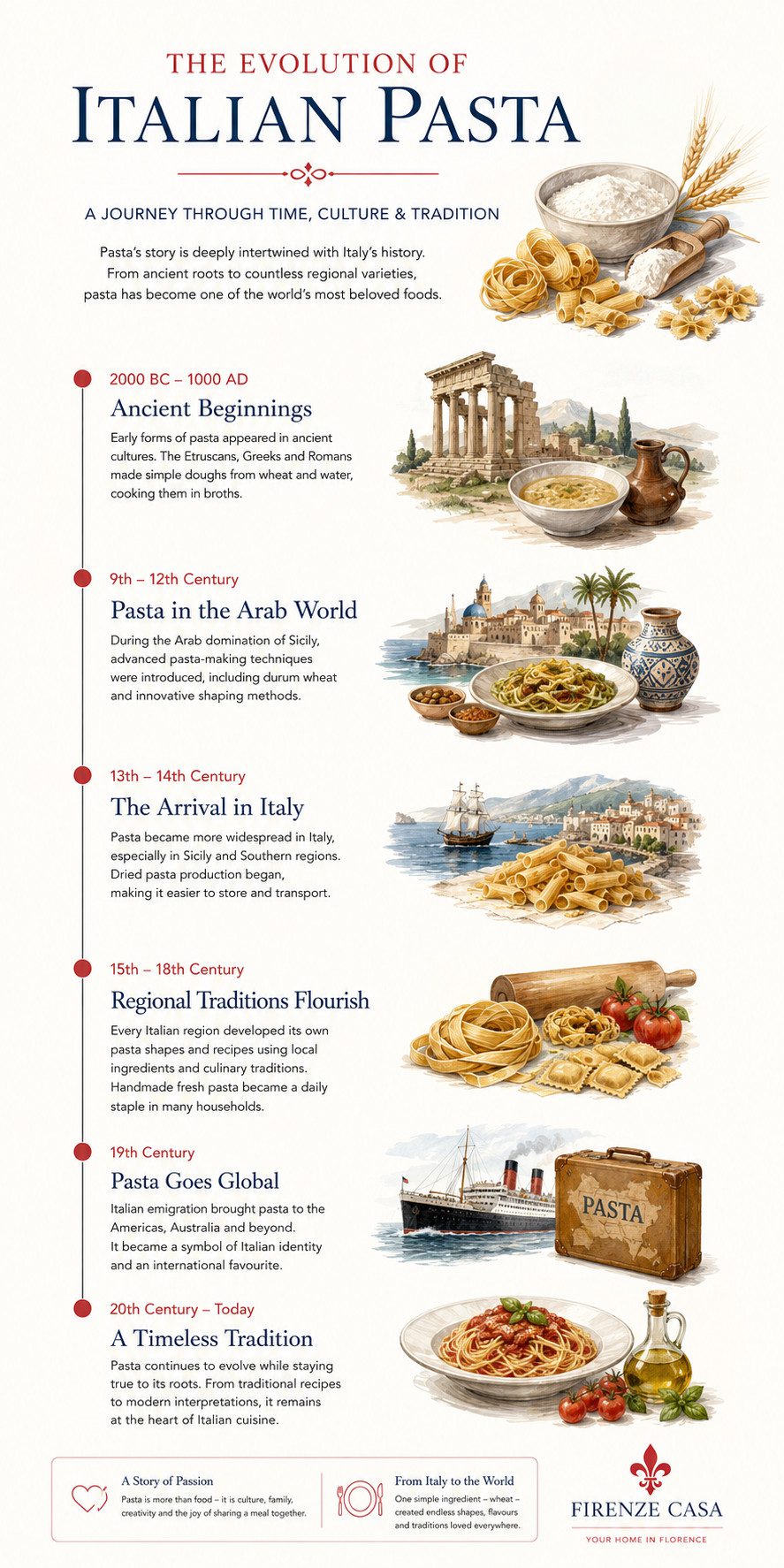
The Evolution of Italian Pasta
| Period | Development |
|---|---|
| Antiquity | Different Mediterranean cultures prepare cereal doughs and early foods related to later pasta traditions. |
| Roman period | Foods such as laganum demonstrate the long history of flour-and-water dough preparations in Italy. |
| Middle Ages | Dried pasta production becomes increasingly important in Sicily and the Mediterranean. |
| 12th century | Written evidence documents commercial production of dried pasta in Sicily. |
| 16th century | Tomatoes arrive in Europe from the Americas. |
| 17th–18th centuries | Tomato-based pasta dishes become increasingly important, particularly in southern Italy. |
| 19th century | Mechanical production and improved drying methods expand the availability of dried pasta. |
| 19th–20th centuries | Italian migration carries regional pasta traditions around the world. |
| Today | Hundreds of regional shapes and recipes remain central to Italian food culture. |
What Is Italian Pasta?
The Italian word pasta literally refers to dough, but in culinary use it describes an enormous family of foods made primarily from wheat and liquid. Ingredients vary according to region and type.
Dried pasta generally combines durum wheat semolina with water. Fresh pasta often uses softer wheat flour and eggs, particularly in northern and central Italy.
Shape is equally important. Italian cooks developed hundreds of forms because different surfaces, ridges, tubes and ribbons interact differently with sauces.
Fresh Pasta and Dried Pasta
One of the most common misunderstandings is that fresh pasta must automatically be better than dried pasta. Italians generally treat them as different products for different recipes.
Fresh Pasta – Pasta Fresca
Fresh pasta often contains eggs and has a softer, more tender texture. It is especially associated with northern and central Italy.
Tagliatelle, pappardelle, ravioli, tortellini and cappelletti are familiar examples. Broad fresh ribbons work particularly well with slow-cooked meat sauces, mushrooms and other substantial accompaniments.
Dried Pasta – Pasta Secca
Dried pasta is traditionally made from durum wheat semolina and water. The strength of the wheat helps the pasta retain a firm structure during cooking.
Spaghetti, linguine, penne, rigatoni and many other familiar shapes belong to this category. Dried pasta works particularly well with tomato, seafood, vegetable and olive oil-based sauces.
Our guide to Durum Wheat – The Secret Behind Italian Pasta explains why this grain is so important to the texture and cooking properties of dried pasta.
The Origins of Pasta – Myth and Reality
The history of pasta is more complicated than a single invention. Many ancient societies prepared foods based on cereals and water, while the Italian pasta tradition developed gradually through centuries of technical and cultural change.
Ancient Mediterranean dough preparations, medieval Sicily, improved drying techniques and regional Italian cooking all contributed to what eventually became modern pasta.
This makes simplistic origin stories misleading. Pasta did not suddenly appear at one particular moment, nor can its history be attributed convincingly to one traveller or one culture.
Our dedicated article The Origins of Pasta: Myth vs Reality looks more closely at the evidence and separates popular legends from the historical development of pasta in Italy.
The Medieval Development of Dried Pasta
Dried pasta represented a decisive innovation because it could be stored and transported much more easily than fresh dough.
Sicily became particularly important in this development. Its position within Mediterranean trading networks connected different cultures and food traditions, while dried pasta could travel with merchants and sailors over long distances.
Once pasta could be preserved reliably, it became far more practical as an everyday staple. This development helped lay the foundation for the later importance of dried pasta throughout southern Italy.
The Tomato Changed Italian Pasta
Tomatoes reached Europe from the Americas during the sixteenth century, but they were not immediately adopted as a standard pasta ingredient.
Over time, southern Italian cooks began combining tomato-based preparations with pasta. Naples became particularly important in the development of dishes that brought together dried pasta and tomato sauce.
The combination proved remarkably successful. Affordable ingredients, strong flavours and excellent compatibility with dried pasta helped create dishes that eventually became symbols of Italian cuisine around the world.
The Main Types of Italian Pasta
Hundreds of pasta shapes exist across Italy, but they can be understood more easily by grouping them according to form and use.
Long Pasta
Spaghetti, linguine, bucatini and vermicelli belong to the broad family of long pasta. Their shape makes them particularly suitable for smooth sauces, seafood and olive oil-based preparations.
Different long shapes behave differently. Bucatini, for example, has a hollow centre, while linguine provides a broader surface than spaghetti.
For a detailed comparison, see Long Pasta Explained: Types, Uses & Best Sauces.
Short Pasta
Penne, rigatoni, fusilli and farfalle demonstrate the enormous variety of short pasta. Many shapes include ridges, twists or openings designed to capture pieces of sauce.
Short pasta works particularly well with chunky vegetable preparations, substantial meat sauces and baked dishes.
Our guide to Short Pasta Explained: Types, Uses & Best Sauces explains the most important shapes and how to use them.
Ribbon Pasta
Tagliatelle and pappardelle provide broad surfaces capable of supporting substantial sauces. These shapes are strongly associated with fresh egg pasta traditions.
In Tuscany, pappardelle with wild boar ragù is a classic example of the relationship between a broad pasta shape and a rich sauce.
Tube Pasta
Rigatoni, paccheri, ziti and cannelloni use hollow structures to trap sauce. Their shape works particularly well with hearty or baked preparations.
Stuffed Pasta
Ravioli, tortellini, cappelletti and agnolotti contain fillings based on meat, cheese, vegetables or other ingredients.
Because the filling already contributes substantial flavour, stuffed pasta is often served simply with broth, butter or a restrained sauce.
Small Pasta for Soups
Pastina, stelline and ditalini belong to the world of soups and broths. These small forms remain deeply connected with Italian home cooking.
Why Pasta Shape Matters
Pasta shapes are not merely decorative. Their geometry influences how much sauce reaches every bite.
Smooth strands work well with sauces that coat evenly. Ridges provide additional surfaces for thicker preparations, while hollow pasta can trap small pieces of meat or vegetables.
Broad ribbons support substantial ragù, whereas delicate filled pasta usually requires lighter treatment. This explains why traditional regional recipes often specify a particular pasta rather than simply saying “use any pasta”.
Classic Italian Pasta Sauces
The sauce-pasta relationship is one of the central principles of Italian cooking. Traditional combinations evolved because certain shapes simply work better with particular textures.
Tomato Sauces
Tomato-based sauces work with numerous shapes, including spaghetti, penne, rigatoni and paccheri. The precise choice depends on whether the sauce is smooth or contains larger pieces of vegetables or meat.
Meat Ragù
A substantial ragù needs pasta capable of carrying its weight. Tagliatelle, pappardelle and ridged short pasta are therefore natural choices.
Seafood
Spaghetti and linguine are frequently used with seafood. Olive oil, garlic, herbs and shellfish can coat long strands without overwhelming the delicate ingredients.
Pesto
Traditional Ligurian pesto is famously associated with trofie, although other pasta shapes are also used. The twisted form captures the pesto especially effectively.
Butter and Sage
Butter and sage works beautifully with filled pasta because the sauce enhances the filling without masking it.
For a broader guide to these combinations, see Classic Italian Pasta Sauces Explained.
Traditional Pasta and Sauce Pairings
| Pasta | Traditional Pairing | Region |
|---|---|---|
| Tagliatelle | Ragù alla Bolognese | Emilia-Romagna |
| Pappardelle | Wild boar ragù | Tuscany |
| Pici | Aglione or traditional Tuscan sauces | Tuscany |
| Spaghetti | Carbonara | Lazio |
| Trofie | Pesto Genovese | Liguria |
| Orecchiette | Cime di rapa | Puglia |
| Busiate | Pesto Trapanese | Sicily |
Why Italians Eat Pasta Al Dente
One of the defining characteristics of Italian pasta is its texture. Properly cooked dried pasta generally retains a slight resistance when bitten.
The expression al dente literally means “to the tooth”. Pasta should therefore be cooked through while remaining firm rather than soft or mushy.
This texture affects much more than personal preference. Firm pasta combines differently with sauce and continues to absorb liquid when finished briefly in the pan.
Our article Why Italians Eat Pasta al Dente explains the tradition and cooking method in greater detail.
Regional Pasta Traditions Across Italy
Italian cuisine is fundamentally regional. Climate, local agriculture and historical influences produced very different pasta traditions from north to south.
Northern Italy
Northern and north-central regions are strongly associated with fresh egg pasta. Emilia-Romagna is famous for tagliatelle, tortellini and other filled pasta, while rich meat ragù and butter-based preparations appear frequently.
Central Italy
Central Italy includes several distinctive traditions. Rome is famous for Carbonara, Cacio e Pepe, Amatriciana and Gricia.
Tuscany has its own strong pasta identity. Pappardelle often accompanies game, particularly wild boar, while thick hand-rolled pici belongs especially to the Siena area.
Our guide to Typical Florentine and Tuscan Food explores pappardelle al cinghiale, pici and other dishes that place pasta within the wider cuisine of Florence and Tuscany.
Southern Italy
Durum wheat and dried pasta dominate many southern traditions. Campania and Puglia are associated with numerous famous shapes, while tomatoes, vegetables, olive oil and seafood play central roles.
Sicily
Sicilian pasta reflects centuries of Mediterranean cultural exchange. Ingredients can include aubergines, almonds, pistachios, seafood and breadcrumbs.
Sardinia
Sardinia developed particularly distinctive forms such as malloreddus and fregola, demonstrating just how local Italian pasta traditions can remain.

Pasta Traditions in Tuscany
Tuscany is better known internationally for steak, wine and rustic soups than for a single famous pasta shape. Nevertheless, several pasta traditions form an important part of regional cooking.
Pappardelle al cinghiale is among the best known. Wide ribbons provide enough structure for a rich wild boar ragù, creating one of the classic dishes of Tuscan countryside cooking.
Pici belongs particularly to southern Tuscany and the Siena area. These thick, hand-rolled strands demonstrate how a simple flour-and-water dough can become an important regional speciality.
Traditional Tuscan cooking generally reflects the same philosophy found throughout the region: relatively simple ingredients, strong seasonal influences and respect for local products. :contentReference[oaicite:2]{index=2}
Italian Pasta Etiquette
Pasta traditions also include customs that can surprise visitors. They are not arbitrary rules so much as habits shaped by the way Italians structure meals and prepare particular dishes.
Pasta Is a Primo
In a traditional Italian meal, pasta usually appears as a primo piatto. It is not normally served as a side dish beside meat or fish.
Spaghetti Bolognese Is Not the Traditional Bologna Pairing
In Bologna, traditional ragù is associated with tagliatelle. The broad fresh pasta provides a better surface for the substantial meat sauce than smooth spaghetti.
Cheese Does Not Go on Everything
Parmigiano Reggiano and other cheeses are essential to many Italian pasta recipes. However, grated cheese is not automatically added to every dish. Seafood pasta is the most familiar example where cheese is traditionally avoided.
Do Not Overcook the Pasta
The al dente texture remains a central expectation in Italian pasta cooking.
For these customs and other common mistakes, see Italian Pasta Etiquette: Common Mistakes to Avoid.
How Italians Finish Pasta with Sauce
A common mistake outside Italy is to place plain pasta on the plate and pour sauce over the top. Italian cooks frequently combine the pasta and sauce before serving.
The pasta may finish cooking briefly in the pan with the sauce. A little cooking water can help bind the ingredients because it contains starch released by the pasta.
The goal is a unified dish in which the sauce coats the pasta rather than forming a separate layer.
Major Pasta Categories at a Glance
| Category | Examples | Typical Uses |
|---|---|---|
| Long Pasta | Spaghetti, Linguine, Bucatini | Tomato, seafood and olive oil-based sauces |
| Short Pasta | Penne, Rigatoni, Fusilli | Vegetable sauces, ragù and baked dishes |
| Ribbon Pasta | Tagliatelle, Pappardelle, Fettuccine | Meat sauces, mushrooms and truffles |
| Tube Pasta | Paccheri, Ziti, Cannelloni | Hearty sauces, fillings and baked dishes |
| Stuffed Pasta | Ravioli, Tortellini, Agnolotti | Broth, butter, sage and light sauces |
| Soup Pasta | Pastina, Stelline, Ditalini | Soups and broths |

Italian Pasta Around the World
Italian migration helped transform pasta from a collection of regional traditions into a global food. Millions of emigrants carried family recipes and cooking techniques to the Americas, Australia and other parts of Europe.
New ingredients and local tastes inevitably produced adaptations. Some dishes developed abroad and later became associated internationally with “Italian food” even though they differed substantially from the traditions of specific Italian regions.
This does not make culinary evolution inherently wrong. However, understanding the original regional context helps explain why Italians sometimes react strongly when a famous dish is prepared in a very different way.
Interesting Facts About Italian Pasta
- Italy has hundreds of recognised pasta shapes and many additional local variations.
- Durum wheat semolina provides the characteristic structure of most dried Italian pasta.
- Fresh pasta and dried pasta are intended for different culinary purposes; one is not automatically superior to the other.
- Different pasta shapes developed partly to work with different sauces.
- Traditional Ragù alla Bolognese is associated with tagliatelle rather than spaghetti.
- Pappardelle with wild boar is one of Tuscany’s classic pasta combinations.
- Pici is a traditional thick hand-rolled pasta associated particularly with southern Tuscany.
- Al dente pasta retains slight firmness when bitten.
Frequently Asked Questions
Is pasta originally Italian?
The history is more complex than a simple invention story. Various cultures prepared cereal doughs, but Italy developed an exceptionally diverse pasta tradition with hundreds of shapes, regional recipes and specialised production methods.
Did Marco Polo bring pasta to Italy?
No reliable historical evidence supports that popular story. Pasta was known in Italy before Marco Polo returned from Asia.
Why are there so many pasta shapes?
Different shapes interact differently with sauces. Ridges, tubes, twists, ribbons and smooth strands can each suit particular ingredients and textures.
What is the difference between fresh and dried pasta?
Fresh pasta commonly contains eggs and retains moisture. Dried pasta is generally made from durum wheat semolina and water and is dried for long storage.
Why is durum wheat used for Italian pasta?
Durum wheat provides a strong structure that works particularly well for dried pasta and helps it retain firmness during cooking.
Why do Italians cook pasta al dente?
The slightly firm texture gives pasta greater structure and allows it to combine effectively with sauce without becoming soft or mushy.
Why don’t Italians eat spaghetti Bolognese?
The traditional Bologna pairing for ragù is tagliatelle. Its broad surface works particularly well with the rich meat sauce.
Which pasta is typical in Tuscany?
Pappardelle and pici are two important examples. Pappardelle is famously paired with wild boar ragù, while pici is particularly associated with the Siena area.
Why Italian Pasta Is Worth Understanding
Italian pasta looks simple because its basic ingredients can be simple. Yet behind that simplicity lies an extraordinary combination of history, geography and practical knowledge.
The development of dried pasta reflects Mediterranean trade and food preservation. Regional shapes reveal local ingredients and cooking habits. Durum wheat determines texture, while sauces and pasta forms evolved together.
Tuscany contributes its own traditions through pappardelle, pici and substantial countryside sauces. Elsewhere, tagliatelle, trofie, orecchiette, spaghetti and countless other forms tell the stories of their own regions.
Understanding these differences makes eating pasta in Italy much more interesting. Instead of seeing a menu as a list of interchangeable shapes and sauces, you begin to recognise a culinary map of the country.
Further Reading on Firenze Casa
Continue exploring Italian pasta, its history, ingredients, shapes and traditions:
- The Origins of Pasta: Myth vs Reality
- Classic Italian Pasta Sauces Explained
- Italian Pasta Etiquette: Common Mistakes to Avoid
- Durum Wheat – The Secret Behind Italian Pasta
- Short Pasta Explained: Types, Uses & Best Sauces
- Long Pasta Explained: Types, Uses & Best Sauces
- Why Italians Eat Pasta al Dente
- Typical Florentine and Tuscan Food
References
- Serventi, Silvano & Sabban, Françoise – Pasta: The Story of a Universal Food.
- Capatti, Alberto & Montanari, Massimo – Italian Cuisine: A Cultural History.
- David, Elizabeth – Italian Food.
- Hazan, Marcella – Essentials of Classic Italian Cooking.
- Zanini De Vita, Oretta – Encyclopedia of Pasta.

