

Few foods are as closely associated with Italy as pasta. From spaghetti and penne to handmade pappardelle and delicate ravioli, pasta has become one of the country’s defining culinary traditions. Yet one question continues to inspire myths and debate: where did pasta really come from?
The familiar story that Marco Polo returned from China carrying the secret of noodles is memorable, but historical evidence points to a much older and more complex development. Pasta-like foods existed around the Mediterranean long before his journey, while medieval Sicily had already become an important centre for dried pasta. For the broader story of shapes, regional traditions and preparation, see our Italian Pasta: History, Types & Traditions.
Marco Polo myth: Pasta existed in Italy before his return from Asia
Ancient precedent: Mediterranean cultures prepared various wheat-dough foods
Medieval turning point: Sicily became an important centre for dried pasta
Key ingredient: Durum wheat became fundamental to Italian dried pasta
Modern development: Regional traditions and industrial production created today’s extraordinary variety
Historical Timeline
| Period | Development |
|---|---|
| Ancient Mediterranean | Greeks, Romans and other cultures prepared various flat or layered wheat-dough foods. |
| Ancient Rome | Laganum, made from sheets of dough, appears in Roman culinary tradition. |
| Early Middle Ages | Arab and Mediterranean influences contributed to the development of food and agriculture in Sicily. |
| 12th century | Written evidence describes dried pasta production in Sicily for export. |
| 1295 | Marco Polo returns from Asia, long after pasta-like foods were already known in Italy. |
| 16th–18th centuries | Southern Italy, particularly Naples, becomes increasingly important in pasta production and consumption. |
| 19th century | Mechanisation and improved drying methods expand pasta production dramatically. |
| Today | Hundreds of shapes and regional traditions make pasta one of Italy’s great culinary symbols. |
The Marco Polo Myth
One of the most persistent stories in culinary history claims that Marco Polo brought pasta to Italy from China. According to the legend, the Venetian explorer encountered noodles during his travels across Asia and introduced them after returning home in 1295.
The problem is straightforward: forms of pasta were already known in Italy before Marco Polo’s return. Medieval records from Sicily describe dried pasta production, while still earlier Mediterranean sources refer to foods made from sheets or pieces of wheat dough.
There is also no reliable contemporary evidence that Marco Polo introduced pasta to Italy. Historians therefore treat the story as a later legend rather than an account of pasta’s origins.
Marco Polo encountered noodle traditions in Asia, but this does not mean that he introduced pasta to Italy. Similar flour-and-water foods developed in different cultures independently.
Pasta Before Marco Polo
The strongest argument against the Marco Polo legend is that pasta-like foods existed in Italy and the wider Mediterranean centuries before his famous journey. These early preparations should not be confused with modern spaghetti or penne, but they demonstrate a much longer culinary evolution.
Ancient Mediterranean Doughs
Greek and Roman cuisines included foods prepared from cereal dough. One of the best-known examples is laganum, associated with thin sheets of dough that were cooked or layered with other ingredients.
It is tempting to call laganum an ancient form of lasagne, but that comparison should be understood broadly. Ancient recipes differed substantially from modern pasta dishes, and the historical relationship is one of gradual culinary development rather than direct identity.
How Pasta Gradually Evolved
Pasta did not appear through a single invention. Milling, wheat varieties, kneading, shaping and drying techniques changed over centuries, while different regions developed their own ways of preparing dough.
Eventually, these developments produced fresh sheets, filled pasta, strands and numerous forms of dried pasta. The extraordinary variety familiar today is therefore the result of continuous adaptation rather than one moment of discovery.
Sicily and the Development of Dried Pasta
Medieval Sicily occupies a particularly important position in pasta history. The island sat at the crossroads of Mediterranean trade and was shaped by Greek, Roman, Byzantine, Arab, Norman and other cultural influences.
Under Muslim rule from the ninth century onward, Sicily experienced major changes in agriculture, irrigation and food culture. Historians often connect this period with the development and spread of dried pasta traditions, although it is safer to speak of cultural influence and technological development than of a single invention introduced by one people.
Why Drying Pasta Changed Everything
Fresh dough is highly perishable. Properly dried pasta, by contrast, can be stored and transported for long periods, making it particularly valuable for merchants, travellers and sailors.
By the twelfth century, geographical accounts describe substantial production of dried pasta in Sicily for export to other Mediterranean markets. This provides strong evidence that organised pasta manufacture existed long before Marco Polo returned from Asia.
The Importance of Durum Wheat
Durum wheat eventually became fundamental to Italian dried pasta because its hard grain and protein characteristics produce firm semolina dough capable of maintaining its structure during cooking.
The relationship between grain, milling and pasta texture is explored in more detail in Durum Wheat – The Secret Behind Italian Pasta.
Ancient Rome and the Origins of Lasagne
Modern lasagne has a long and complicated history. Roman cuisine included laganum, consisting of sheets of dough used in preparations that provide an interesting ancient precedent for later layered dishes.
However, Roman laganum was not modern lasagne. Familiar ingredients such as tomato sauce appeared only much later, after tomatoes reached Europe from the Americas and gradually entered Italian cooking.
The comparison nevertheless illustrates a recurring theme in Italian food history: apparently timeless dishes often combine very old techniques with ingredients and methods introduced centuries later.
When Did Modern Italian Pasta Appear?
The pasta we recognise today developed gradually during the medieval and early modern periods. Regional specialists created increasingly varied shapes, while improvements in milling, extrusion and drying made production more reliable.
Southern Italy became particularly important for dried pasta. Naples emerged as a major centre of production, and technological developments eventually allowed pasta to become an affordable everyday food for a much larger population.
By the nineteenth century, mechanical presses and industrial production had transformed the scale of manufacturing. At the same time, regional handmade traditions remained strong, creating the coexistence of dried and fresh pasta that still characterises Italian cuisine today.
Why the Marco Polo Story Survived
The myth survives partly because it offers an appealingly simple story: a famous traveller visits China, discovers noodles and brings them home. The real history is considerably harder to summarise because it involves many cultures, regions and technological developments over centuries.
The legend became widely repeated in modern popular culture, cookbooks and travel writing. Repetition gradually turned an attractive story into something many people assumed to be historical fact.
Rejecting the myth does not diminish Marco Polo’s importance. It simply places both his travels and pasta within their proper historical contexts.
Myth vs Reality
| Popular Myth | Historical Reality |
|---|---|
| Marco Polo introduced pasta to Italy. | Pasta-like foods and dried pasta were known in Italy before his return. |
| Pasta originated exclusively in China. | Different cultures developed flour-and-water foods independently. |
| The Romans ate modern pasta. | Romans ate dough-based foods such as laganum, but these differed from modern pasta. |
| The Arabs simply invented Italian pasta. | Arab influence was important in medieval Sicily, but pasta evolved through multiple cultures and techniques. |
| There was one inventor of pasta. | Pasta emerged gradually through centuries of culinary development. |
| Italian pasta has always looked the same. | Regional traditions gradually created hundreds of different shapes and preparations. |
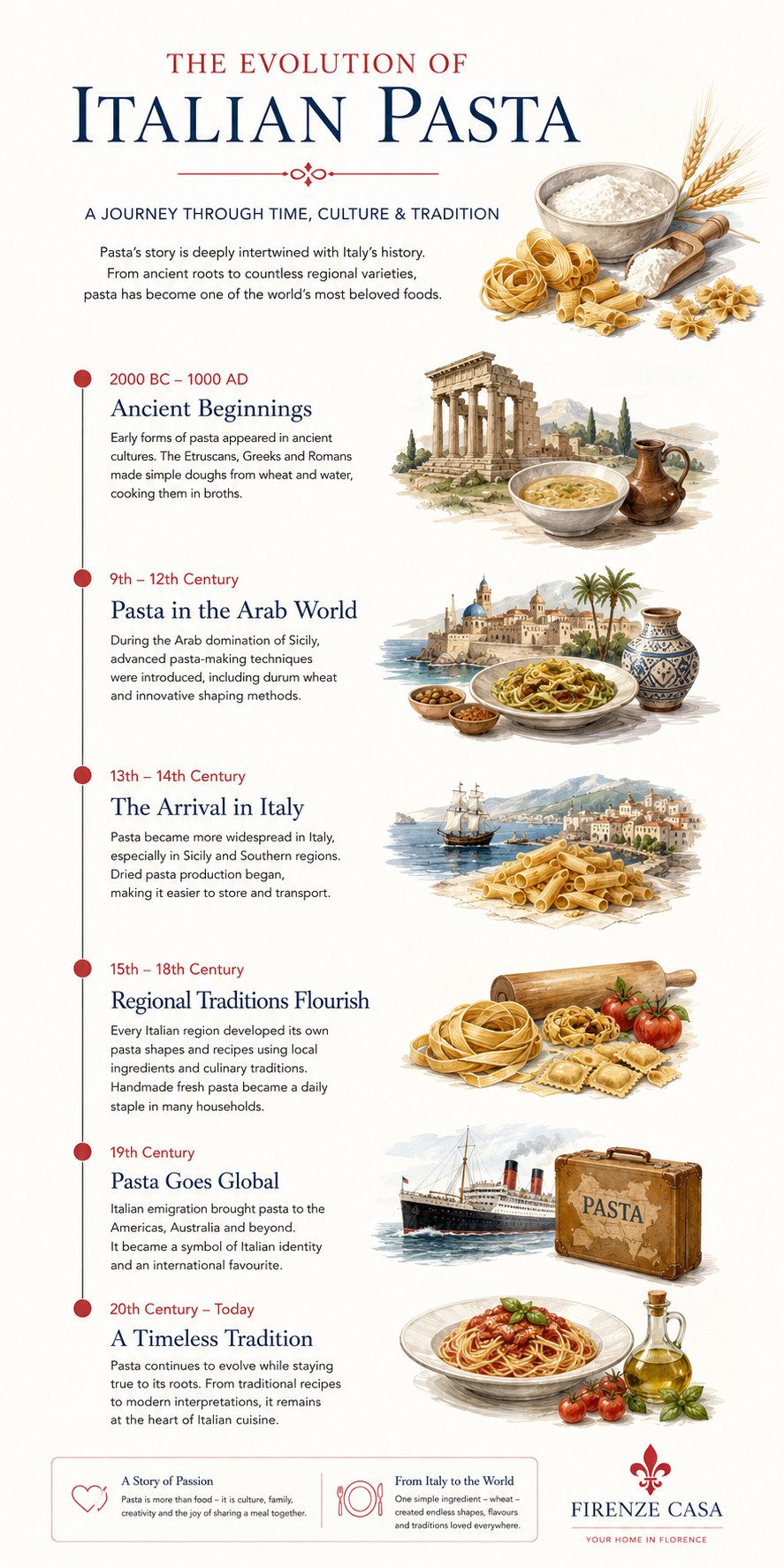
🔍 Click to view the infographic in full size
Why Italy Became the Home of Pasta
Even if no single country can claim to have invented every form of flour-and-water noodle, Italy transformed pasta into an extraordinary culinary system. Regional traditions created hundreds of shapes, recipes and techniques adapted to local ingredients and eating habits.
Durum wheat became fundamental to dried pasta, while northern and central regions developed rich traditions of fresh and filled pasta. Different shapes evolved alongside different sauces, turning the relationship between pasta and condiment into a central principle of Italian cooking.
This relationship is explored further in our guides to Classic Italian Pasta Sauces, Short Pasta and Long Pasta.
Tuscany contributes its own traditions, including broad pappardelle and handmade pici. These regional dishes form part of the wider food culture explored in our Firenze Casa guides to Florence and Tuscany.

Interesting Facts About the Origins of Pasta
- There is no reliable historical evidence that Marco Polo introduced pasta to Italy.
- Ancient Mediterranean cultures prepared various foods from cereal dough long before the Middle Ages.
- Roman laganum is an important ancient precedent for later sheet-based pasta dishes.
- Medieval Sicily was producing dried pasta for export before Marco Polo returned from Asia.
- Durum wheat became fundamental to high-quality Italian dried pasta.
- Italy developed hundreds of pasta shapes and numerous regional variations.
- Fresh and dried pasta represent different culinary traditions rather than different levels of quality.
Frequently Asked Questions
Did Marco Polo bring pasta to Italy?
No. Historical evidence shows that pasta-like foods and dried pasta were already known in Italy before Marco Polo returned from Asia in 1295.
Where did pasta really originate?
There is no single birthplace for every type of pasta or noodle. Different cultures developed dough-based foods independently, while Italy gradually created its distinctive pasta tradition.
What was laganum?
Laganum was an ancient Roman preparation involving sheets of dough. It provides an interesting precedent for later pasta dishes but was not identical to modern lasagne.
Why was Sicily important in pasta history?
Medieval Sicily became an important centre for dried pasta production and Mediterranean trade, allowing pasta to be stored and exported over considerable distances.
Did the Arabs invent Italian pasta?
Arab culture had an important influence on medieval Sicily and probably contributed to the development of dried pasta traditions. Pasta itself, however, evolved from multiple earlier culinary traditions.
Why are there so many Italian pasta shapes?
Different regions developed shapes suited to local ingredients, sauces and cooking traditions, creating Italy’s remarkable variety of pasta forms.
Why do Italians cook pasta al dente?
A firm texture helps pasta retain its structure and combine properly with sauce. Our guide to Why Italians Eat Pasta al Dente explains the tradition in detail.
Why the History of Pasta Is Worth Discovering
The real history of pasta is more interesting than the Marco Polo legend because it reveals how food develops through cultural contact rather than sudden invention. Ancient Mediterranean traditions, medieval Sicily, agricultural knowledge, regional craftsmanship and industrial technology all contributed to what pasta eventually became.
Italy’s achievement was not simply to adopt one existing food but to create an extraordinarily diverse culinary culture around pasta. Shapes, sauces, cooking methods and regional traditions became inseparable from local identity.
Understanding this history makes even an everyday plate of pasta more interesting: it is the result of centuries of adaptation, migration and culinary creativity.
Further Reading on Firenze Casa
- Italian Pasta: History, Types & Traditions
- Durum Wheat – The Secret Behind Italian Pasta
- Classic Italian Pasta Sauces Explained
- Italian Pasta Etiquette: Common Mistakes to Avoid
- Short Pasta Explained: Types, Uses & Best Sauces
- Long Pasta Explained: Types, Uses & Best Sauces
- Why Italians Eat Pasta al Dente
References
- Zanini De Vita, Oretta – Encyclopedia of Pasta.
- Serventi, Silvano & Sabban, Françoise – Pasta: The Story of a Universal Food.
- Capatti, Alberto & Montanari, Massimo – Italian Cuisine: A Cultural History.
- David, Elizabeth – Italian Food.
- Montanari, Massimo – A Short History of Spaghetti with Tomato Sauce.

