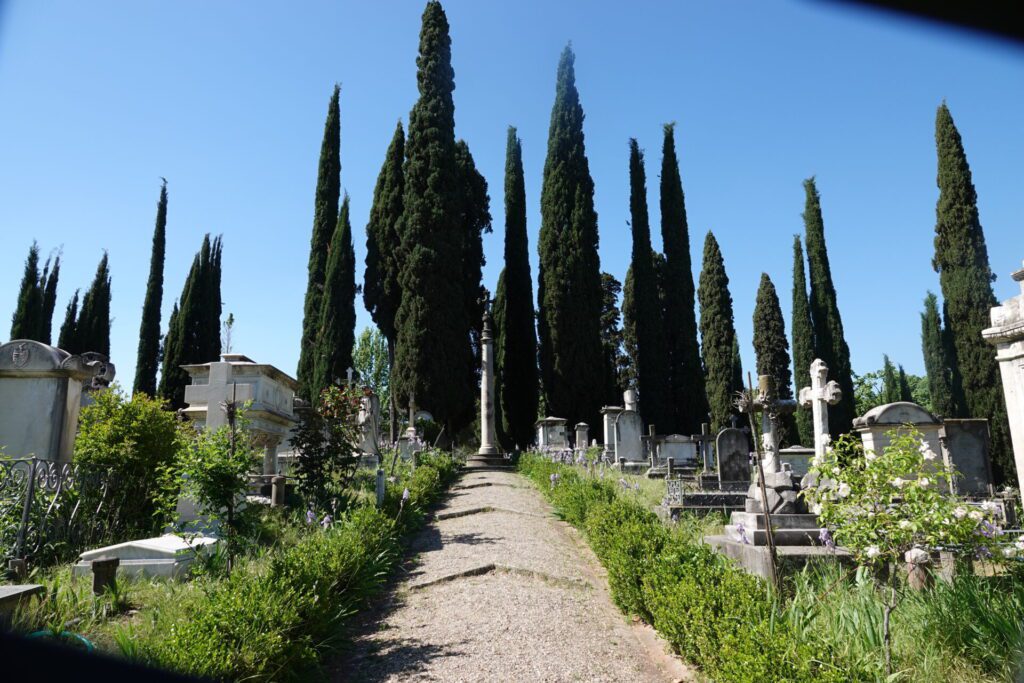
At one of Florence’s busiest traffic circles near Porta alla Croce, a small, enclosed green hill rises quietly behind an iron fence. Surrounded by constant movement, the Cimitero degli Inglesi appears almost detached from the city — a place easily overlooked, yet deeply atmospheric.
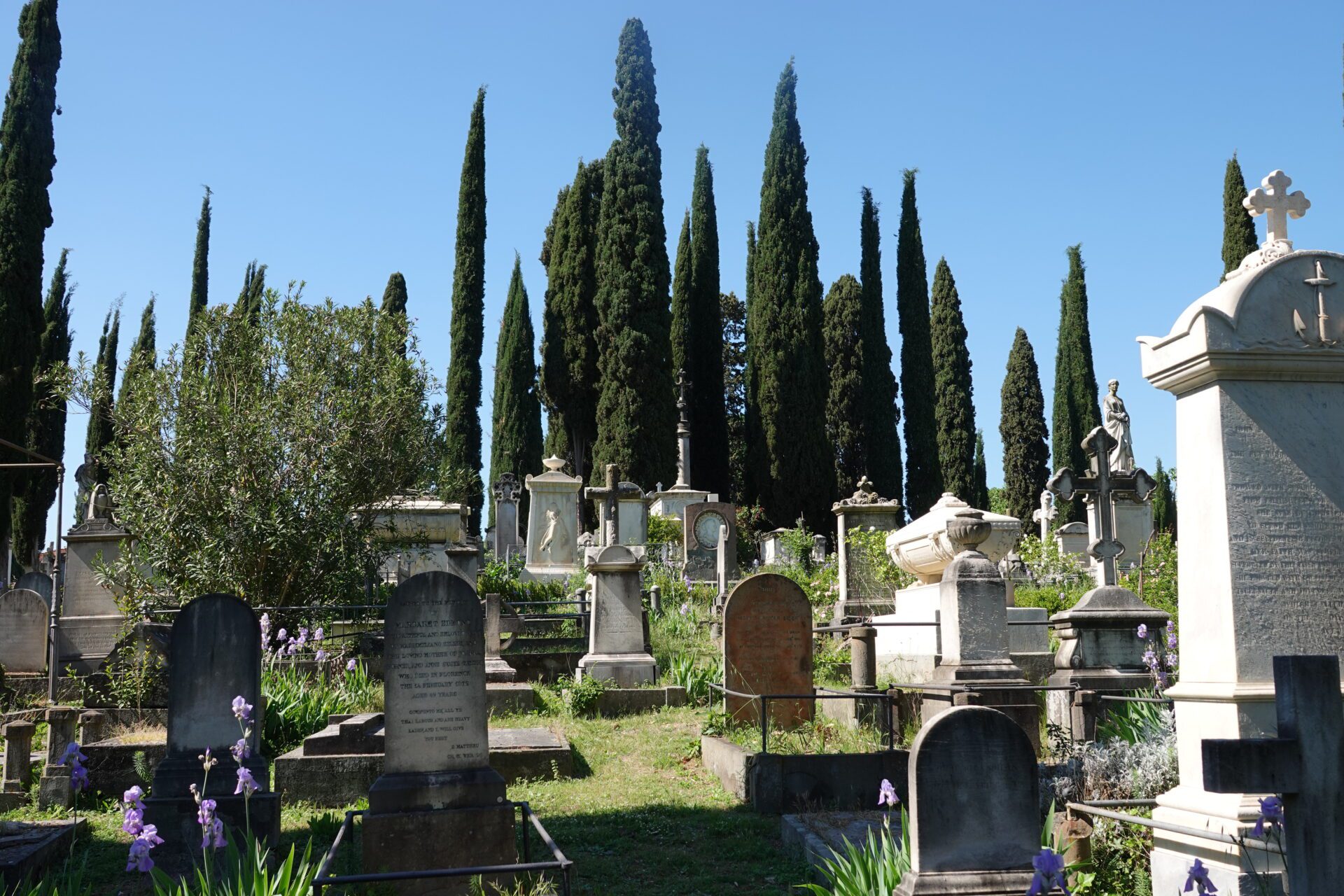
Tall cypress trees, historic gravestones, and narrow paths create a sense of calm that contrasts sharply with the surrounding streets. It feels less like a monument and more like a pause — a quiet layer of Florence that reveals itself only to those who stop.
More Than an “English” Cemetery
Despite its name, the Cimitero degli Inglesi was never exclusively English. Established in 1827 by the Evangelical Reformed Church of Florence, it served as a burial ground for non-Catholic foreigners at a time when they were not permitted to be buried in Catholic cemeteries.
In this historical context, the term “English” was often used broadly to describe Protestant communities. In reality, the cemetery reflects a much wider international presence — including British, American, and particularly Swiss residents.
A Strong Swiss Connection
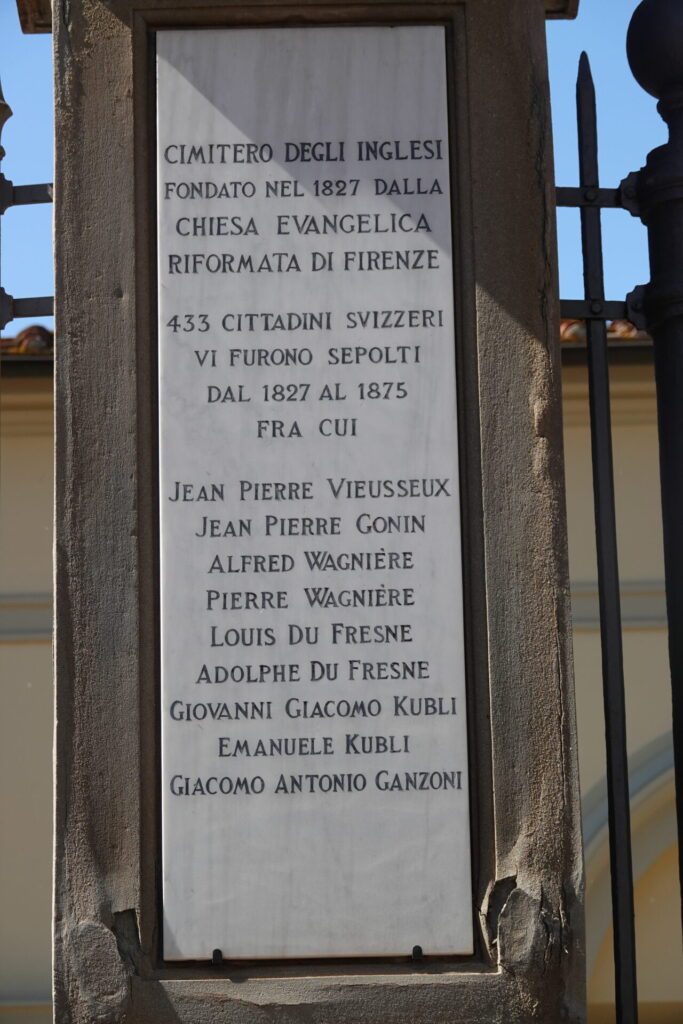
One of the most overlooked aspects of the cemetery is its significant Swiss history. Between 1827 and 1875, 433 Swiss citizens were buried here. The cemetery itself remains Swiss property, as still indicated on the entrance plaques — not in the sense of ownership by the Swiss state, but as part of a historical legacy linked to the Swiss Protestant community that established and maintained it.
This also helps explain a common misconception. Despite its name, the “English Cemetery” was never exclusively English, but served a broader international Protestant community, in which Swiss residents played a particularly important role.
Among them is Jean Pierre Vieusseux, a key figure in Florence’s intellectual life and founder of the Gabinetto Scientifico Letterario G. P. Vieusseux.
Established in 1819, it became an important meeting place for European writers, thinkers, and travelers, reflecting the international cultural exchange that shaped Florence in the nineteenth century.
Alongside him are many lesser-known Swiss residents — merchants, professionals, and families — whose presence reflects a strong and often overlooked Swiss community in nineteenth-century Florence. Rather than being defined by a few prominent individuals, the cemetery reveals a broader network of people who quietly contributed to the city’s international character.
Writers, Thinkers, and a Cultural Network
The cemetery is also known as the resting place of several notable literary figures. Among them is Elizabeth Barrett Browning, one of the most important English poets of the nineteenth century, who lived for many years in Florence.
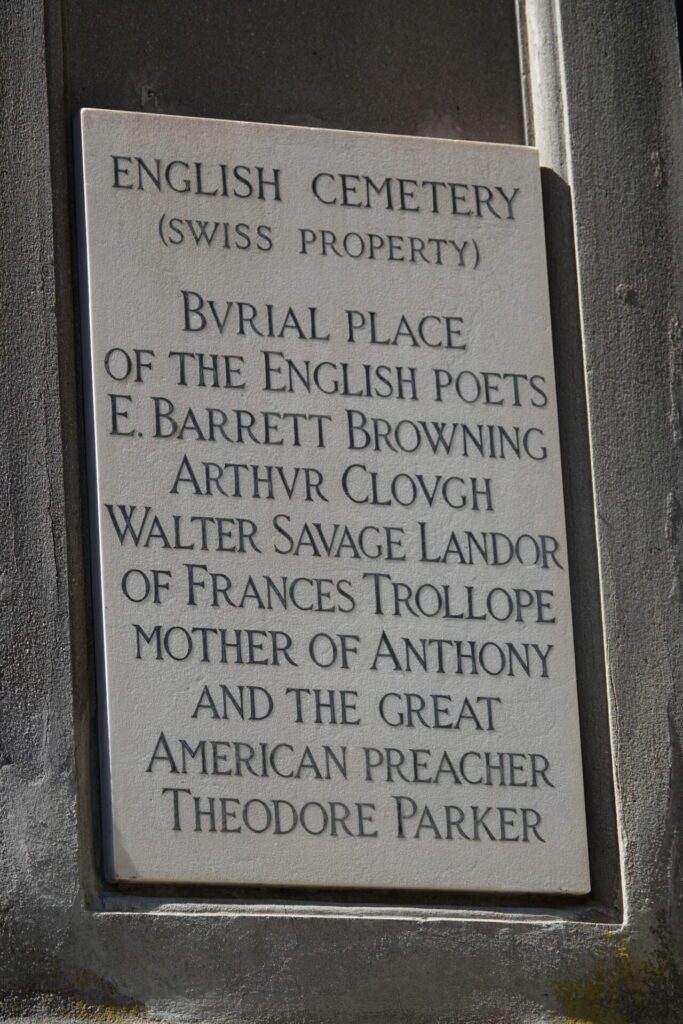
Nearby lie the writer Fanny Trollope, the poet Arthur Hugh Clough, and the essayist Walter Savage Landor. Their presence reflects how Florence became a place of inspiration, retreat, and intellectual exchange for many international residents.
Why the Cemetery Appears Elevated
The cemetery’s slightly elevated position is a result of urban transformation. Originally located outside Florence’s medieval walls, it remained unchanged when the city expanded in the nineteenth century. As the surrounding streets were raised, the cemetery became an “island” — a quiet, elevated space within the modern city.
A Place of Quiet Contrast
What makes the Cimitero degli Inglesi remarkable is not only its history, but its atmosphere. Just beyond its walls, traffic moves continuously. Inside, there is silence — interrupted only by wind in the trees or distant city sounds softened by space.
It is not a major attraction. There are no crowds, no queues. Instead, it offers a different way of experiencing Florence: slower, more reflective, and deeply connected to the lives of those who once chose this city as their home.
Practical Information
Opening hours vary depending on the season (summer and winter schedules differ), and access is limited to specific days and times.
For current opening hours, please refer to the official information: English Cemetery – official visitor information
Staying Nearby
Places like this are best experienced in the quieter hours of the day, when Florence slows down. Staying in a quiet apartment in Florence’s historic center allows you to explore these lesser-known locations without haste and to discover a more personal side of the city.