Bologna from Florence is one of the easiest and most rewarding day trips beyond Tuscany. Thanks to high-speed trains taking around 35–40 minutes, visitors can leave Florence in the morning and spend a full day exploring a city famous for medieval architecture, historic porticoes, university life and exceptional cuisine.
Bologna offers a striking contrast to Florence. Its red-brick streets, medieval towers, lively food markets and student neighbourhoods create a distinctly Emilian atmosphere, while landmarks such as Piazza Maggiore, the Basilica of San Petronio and the UNESCO-listed porticoes make the city exceptionally rewarding on foot.
Destination: Bologna, Emilia-Romagna
Journey from Florence: Approximately 35–40 minutes by high-speed train
Best transport: High-speed train
Main attractions: Piazza Maggiore, San Petronio, Two Towers and historic porticoes
Historic identity: Medieval city and major university centre
Food highlights: Tagliatelle al ragù, tortellini and mortadella
Recommended time: Full day
Ideal for: Food, history, architecture, university culture and easy car-free travel
This excursion is part of our Tuscany Day Trips from Florence – Complete Guide. Bologna lies in Emilia-Romagna rather than Tuscany, but its exceptionally fast rail connection makes it one of the easiest excursions from Florence.
Why Visit Bologna from Florence?
Bologna provides a completely different experience from Florence while requiring remarkably little travel time. Florence’s international image is closely associated with Renaissance art and the Medici, whereas Bologna is characterised by medieval architecture, university traditions, porticoes and one of Italy’s strongest culinary identities.
The historic centre is compact enough to explore on foot. Piazza Maggiore, the Quadrilatero market district, the Two Towers and university quarter are all within comfortable walking distance of one another.
Visitors interested in comparing the development of two very different Italian cities may also enjoy our History of Florence – Complete Guide.
Bologna is one of the rare day trips where the journey is almost effortless. Take an early high-speed train, explore entirely on foot and return to Florence after dinner if you want to experience the city into the evening.
The History of Bologna
Bologna’s history reaches back more than two thousand years. The area was an important Etruscan centre before becoming the Roman colony of Bononia in the second century BC.
During the Middle Ages, Bologna developed into a prosperous commune and an important centre of commerce, craftsmanship and learning. Its wealth and political ambition produced churches, civic palaces and numerous towers that transformed the medieval skyline.
The city’s history was shaped by periods of communal government, struggles between powerful families, papal authority and later integration into unified Italy. Despite these political changes, Bologna remained an important commercial and intellectual centre.
The University of Bologna
The University of Bologna is traditionally dated to 1088 and is widely regarded as the oldest university in the Western world. Its early development helped establish Bologna as one of Europe’s leading centres of legal and scholarly education.
Students and teachers arrived from many parts of Europe, and the university profoundly influenced the social and architectural development of the city. Academic life did not remain confined to a single campus but became embedded throughout Bologna’s streets and buildings.
That tradition remains visible today. Students still give the historic centre a youthful atmosphere, particularly around Via Zamboni and the university district.
The date 1088 is the traditional foundation date associated with the University of Bologna. Medieval universities developed gradually rather than through the type of single founding act expected of a modern institution.
La Dotta, La Grassa and La Rossa
Bologna is often described through three famous nicknames that summarise different aspects of the city.
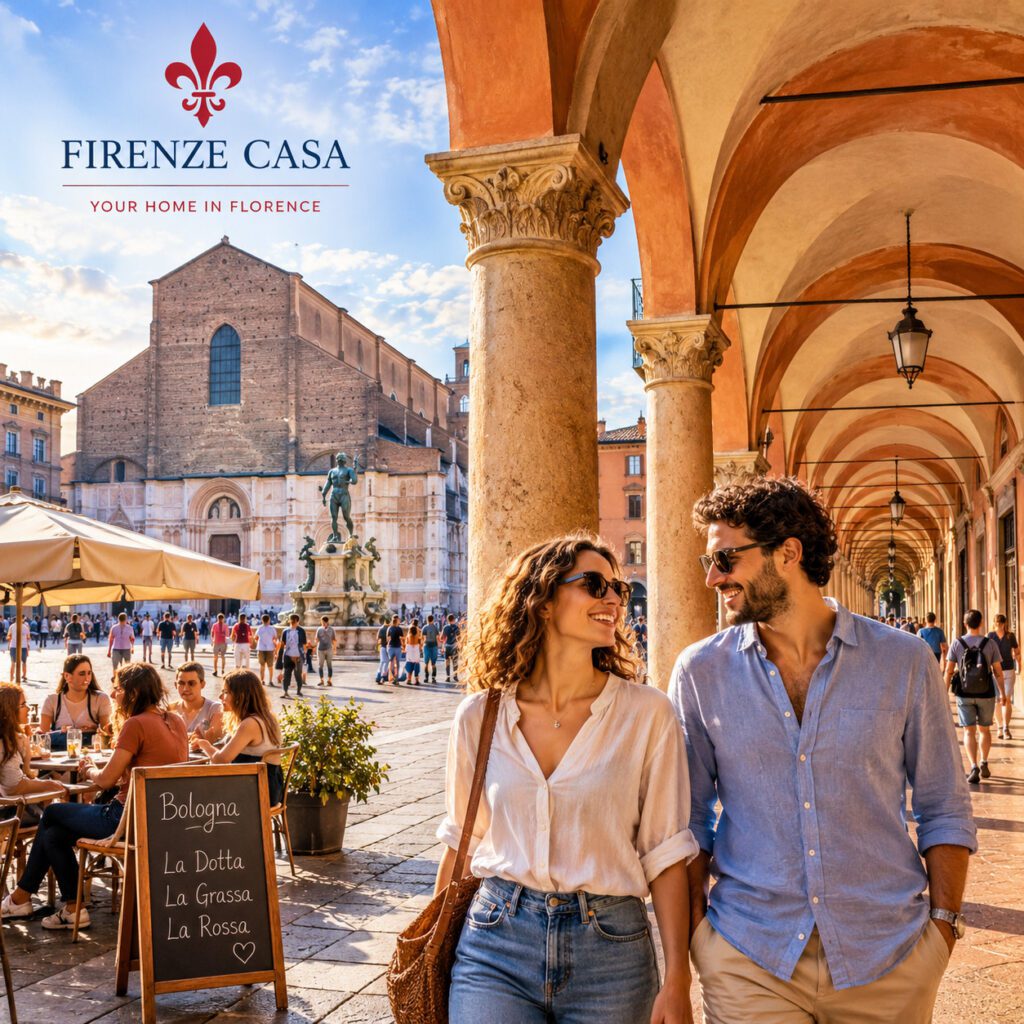
La Dotta, “the Learned”, refers to the university and centuries of scholarship. La Grassa, “the Fat”, celebrates Bologna’s rich culinary traditions, while La Rossa, “the Red”, is commonly associated with the warm colours of its brick buildings and terracotta roofs.
Together, these names capture the unusual combination of intellectual life, food culture and historic architecture that gives Bologna its distinctive identity.
The UNESCO Porticoes of Bologna
Few architectural features define Bologna as strongly as its porticoes. Covered walkways extend for many kilometres across the city and have shaped everyday urban life for centuries.
The earliest porticoes developed as upper floors projected beyond the original building line, supported below by wooden or later masonry structures. Over time, they became a defining element of Bolognese streets.
In 2021, UNESCO inscribed a representative series of Bologna’s porticoes on the World Heritage List. The designation recognises selected components that illustrate the long development and architectural variety of this extraordinary urban system rather than every portico in the city.
Walking beneath them is one of Bologna’s signature experiences. They provide shade in summer, shelter in poor weather and a continuous architectural rhythm that makes the centre particularly pleasant to explore on foot.
Bologna has tens of kilometres of porticoes across the city. UNESCO protects a representative group of twelve components that demonstrate their historical and architectural development.
Piazza Maggiore
Piazza Maggiore is the civic heart of Bologna and the natural starting point for a first visit. Medieval and Renaissance buildings surround the broad square, creating one of northern Italy’s most impressive urban ensembles.
The Palazzo d’Accursio, Palazzo del Podestà and Basilica of San Petronio all face or connect closely with the piazza. Nearby stands the Fountain of Neptune, another major landmark of central Bologna.
Unlike some monumental squares that function mainly as visitor attractions, Piazza Maggiore remains deeply integrated into everyday city life, hosting events, meetings and public gatherings throughout the year.
Basilica of San Petronio
The enormous Basilica of San Petronio dominates Piazza Maggiore. Construction began in the late fourteenth century, and the church remains one of the largest Gothic buildings in Italy.
Its façade is famously unfinished, with marble decoration covering only the lower portion. The contrast between the elaborate lower section and exposed brick above gives the basilica its distinctive appearance.
Inside are numerous chapels and important works of art, while the long astronomical meridian line created in the seventeenth century by Giovanni Domenico Cassini demonstrates the historic relationship between religion and scientific observation.
The Fountain of Neptune
Just beside Piazza Maggiore stands the monumental Fountain of Neptune. The bronze figure was created by Giambologna in the sixteenth century and became one of Bologna’s most recognisable civic monuments.
The fountain combines sculpture, hydraulic engineering and political symbolism and provides an interesting connection with Renaissance artistic culture beyond Florence.
The Two Towers
The medieval skyline of Bologna was once filled with towers built by powerful families. The most famous survivors are the Asinelli and Garisenda towers, together known as the Two Towers.
The Torre degli Asinelli rises dramatically above the surrounding streets, while the shorter Garisenda is notable for its pronounced lean. Together they remain among Bologna’s most recognisable symbols.
Access arrangements can change because conservation and safety work periodically affects the area, so visitors should check current conditions before planning around a tower visit.
The Two Towers are historic structures requiring ongoing conservation. Check current access arrangements shortly before travelling rather than assuming that climbing or approaching every area will be possible.
The Archiginnasio
The Archiginnasio is one of Bologna’s most important buildings connected with its university tradition. Constructed in the sixteenth century, it brought several university schools together within a single monumental complex.
Its arcaded courtyards and interior walls are covered with heraldic decorations commemorating generations of students. The building also contains the famous Anatomical Theatre, a remarkable reminder of Bologna’s long tradition of medical education.
For visitors interested in the history of universities, science or medicine, the Archiginnasio is one of the most rewarding stops in the city.
The Quadrilatero Market
Immediately beside Piazza Maggiore lies the historic Quadrilatero, a compact network of streets associated for centuries with food markets and specialised trades.
Delicatessens, fresh pasta shops, bakeries, produce stalls and wine merchants make this one of the best places to experience Bologna’s culinary identity at street level.
The district is particularly lively around lunchtime, when shopping, aperitivo and informal eating blend naturally into everyday city life.
Visit the Quadrilatero before lunch rather than late in the afternoon. The combination of food shops, market activity and local customers gives the district much more atmosphere.
The University District
The streets around Via Zamboni form one of Bologna’s liveliest areas. University buildings, libraries, inexpensive restaurants, bookshops and cafés create a markedly different atmosphere from the monumental centre around Piazza Maggiore.
This district illustrates why Bologna does not feel like a city preserved exclusively for tourism. Students continue to shape its rhythms, public spaces and cultural life throughout the year.
A walk through the area is particularly worthwhile if you want to understand the university as a living institution rather than simply a historical fact.
Walking Beneath Bologna’s Porticoes
One of Bologna’s greatest pleasures requires no ticket at all. Simply walking through the city reveals constantly changing porticoes, from monumental arcades to narrow residential passages.
Architectural styles vary according to period and neighbourhood. Some porticoes are elegant and symmetrical, while others retain a more irregular medieval character.
They also make Bologna unusually comfortable for walking in both hot weather and rain, which is another reason the city works so well as a year-round day trip.
What to Eat in Bologna
Food is one of the strongest reasons to visit Bologna. The city’s cuisine forms part of the broader culinary tradition of Emilia-Romagna and is based on fresh pasta, cured meats, cheeses and rich sauces.
- Tagliatelle al ragù – Fresh egg pasta traditionally served with slow-cooked meat ragù.
- Tortellini in brodo – Small filled pasta traditionally served in broth.
- Mortadella Bologna – The city’s famous delicately seasoned cured meat.
- Lasagne verdi alla bolognese – Green pasta layered with ragù, béchamel and Parmigiano Reggiano.
- Crescentine – Fried dough traditionally served with cured meats and cheeses.
The contrast with Tuscan cooking makes Bologna particularly interesting for food lovers staying in Florence. Before or after the excursion, our Florentine and Tuscan Food – Complete Guide provides a useful comparison with the culinary traditions of Florence and Tuscany.
Order tagliatelle al ragù rather than looking for “spaghetti Bolognese”. In Bologna, ragù is traditionally paired with fresh egg pasta capable of holding the rich sauce.
Bologna’s Main Attractions at a Glance
| Attraction | Why Visit? |
|---|---|
| Piazza Maggiore | The civic heart of Bologna and the natural starting point for sightseeing. |
| San Petronio | Monumental Gothic church with extraordinary historical and scientific interest. |
| Two Towers | The most recognisable survivors of Bologna’s medieval tower landscape. |
| Archiginnasio | Historic university building and Anatomical Theatre. |
| Quadrilatero | Historic food district and one of the best places to experience Bolognese cuisine. |
| Porticoes | UNESCO-recognised urban tradition defining the experience of walking through Bologna. |
Beyond Bologna’s Main Attractions
Bologna rewards visitors who spend time away from its checklist of monuments. Residential streets beneath the porticoes, university cafés, food shops and smaller churches reveal a city shaped as much by everyday life as by major heritage sites.
This balance between historic architecture and contemporary urban culture makes Bologna particularly attractive after several days in museum-rich Florence.
Allow time for an unplanned walk. The combination of red façades, changing arcades and busy neighbourhood life is one of the city’s strongest impressions.
Shopping in Bologna
Bologna offers an appealing mixture of food shops, independent retailers, bookstores and familiar Italian fashion brands.
Via dell’Indipendenza is one of the principal shopping streets, while the Quadrilatero is much more interesting for edible souvenirs such as carefully packed regional products.
Remember that some cheeses, cured meats and other foods may be subject to customs restrictions when travelling outside the European Union.
How Much Time Should You Spend in Bologna?
Bologna can be visited comfortably as a full-day excursion from Florence. The very short high-speed rail journey allows much more sightseeing time than the distance between the two regions might suggest.
| Available Time | Recommended Activities |
|---|---|
| 3–4 Hours | Piazza Maggiore, San Petronio, Fountain of Neptune and Two Towers area. |
| Half Day | Add the Quadrilatero, Archiginnasio and a traditional lunch. |
| Full Day | Add the university district, longer walks beneath the porticoes and time for food shopping or aperitivo. |
A full day is particularly worthwhile because lunch is part of the Bologna experience rather than simply a break between attractions.
How to Get to Bologna from Florence
By High-Speed Train
The high-speed train is by far the easiest option. Frecciarossa and Italo services connect Firenze Santa Maria Novella with Bologna Centrale in roughly 35–40 minutes on many departures.
From Bologna Centrale, the northern edge of the historic centre is immediately accessible, while Piazza Maggiore can be reached on foot in roughly 20 minutes.
Because high-speed trains use reserved seats and fares can vary, booking in advance can be worthwhile when travelling at popular times.
By Car
Driving offers little advantage for a straightforward day trip. The motorway journey takes considerably longer than high-speed rail and adds parking and restricted-traffic concerns in Bologna.
A car makes more sense only if Bologna is part of a broader Emilia-Romagna itinerary beyond the city.
By Organised Tour
Bologna is so easy to reach independently that a general sightseeing tour is rarely necessary. Guided food experiences, however, can be worthwhile for travellers wanting deeper context about local markets, pasta and regional culinary traditions.
For this particular day trip, the high-speed train is difficult to beat. It is faster than driving and delivers you directly to a city designed to be explored on foot.
Best Time to Visit Bologna
Bologna works well throughout the year, helped by the protection offered by its extensive porticoes. Spring and autumn generally provide the most comfortable walking temperatures.
| Season | What to Expect |
|---|---|
| Spring | Mild weather and lively outdoor cafés. |
| Summer | Long days and warm temperatures, with welcome shade beneath the porticoes. |
| Autumn | Comfortable sightseeing conditions and a particularly appealing season for food lovers. |
| Winter | Cooler temperatures but excellent covered walking routes and rewarding indoor dining. |
Practical Tips for Visiting Bologna
- Use the high-speed train rather than driving for a simple day trip.
- Book trains ahead if you want specific departure times or lower advance fares.
- Wear comfortable shoes because the historic centre is best explored on foot.
- Allow a proper lunch rather than trying to eat quickly between monuments.
- Visit the Quadrilatero before or around lunchtime for the liveliest atmosphere.
- Check current access around the Two Towers before travelling.
- Leave some unscheduled time simply to walk beneath the porticoes.
Frequently Asked Questions About Bologna from Florence
Is Bologna worth visiting from Florence?
Yes. The extremely fast train connection makes Bologna one of the easiest ways to experience a completely different Italian region while staying in Florence.
How long does the train from Florence to Bologna take?
Many high-speed services take roughly 35–40 minutes between Firenze Santa Maria Novella and Bologna Centrale.
Is one day enough for Bologna?
Yes. A full day provides time for the main monuments, the university district and a relaxed Bolognese lunch.
Is Bologna in Tuscany?
No. Bologna is the capital of Emilia-Romagna, north of Tuscany, but its rapid train connection makes it an excellent day trip from Florence.
What food should I try in Bologna?
Tagliatelle al ragù, tortellini in brodo and mortadella are excellent starting points for discovering the city’s culinary traditions.
Can Bologna be explored on foot?
Yes. The principal historic sights are concentrated within a compact centre, and the porticoes make walking particularly pleasant.
Why are Bologna’s porticoes famous?
They form an exceptional historic network of covered public walkways. A representative series of the porticoes was inscribed on the UNESCO World Heritage List in 2021.
Should I visit Bologna or another Tuscan city?
Choose Bologna if food, university culture and an easy high-speed train journey appeal to you. For a more specifically Tuscan experience, Arezzo or Pisa are excellent alternatives.
Why Bologna Is Worth a Day Trip from Florence
Bologna from Florence is worth considering because few excursions offer such a dramatic change of atmosphere with so little travel time. In less than an hour, Renaissance Florence gives way to medieval towers, kilometres of porticoes, university streets and one of Italy’s most celebrated food traditions.
Piazza Maggiore, San Petronio and the Two Towers provide the monumental highlights, but Bologna’s deeper appeal lies in the interaction between history and everyday life. Students, market traders, residents and visitors continue to share the same arcaded streets.
The culinary contrast is equally valuable. A day in Bologna provides an excellent opportunity to compare the rich egg-pasta tradition of Emilia-Romagna with the simpler, ingredient-driven cuisine encountered in Tuscany.
For travellers using Florence as a base, Bologna therefore adds something genuinely different rather than repeating another version of a Tuscan hill town.
Bologna proves that staying in Florence does not limit you to Tuscany. High-speed rail makes it possible to experience another region, another cuisine and another urban tradition and still return to Florence the same evening.
Further Reading on Firenze Casa
- Tuscany Day Trips from Florence – Complete Guide
- Arezzo from Florence – Art and History
- Pisa from Florence – A Perfect Day Trip
- Vinci from Florence – Leonardo’s Birthplace
- History of Florence – Complete Guide
- Florentine and Tuscan Food – Complete Guide
References
- UNESCO World Heritage Centre – The Porticoes of Bologna
- Università di Bologna – History of the University
- Comune di Bologna – Historical and Cultural Information
- Bologna Welcome – Historic Centre and Porticoes
- Basilica di San Petronio – Historical Information
- Archiginnasio di Bologna – University and Anatomical Theatre
- Historical Studies on Medieval Bologna and Its Communal Institutions