
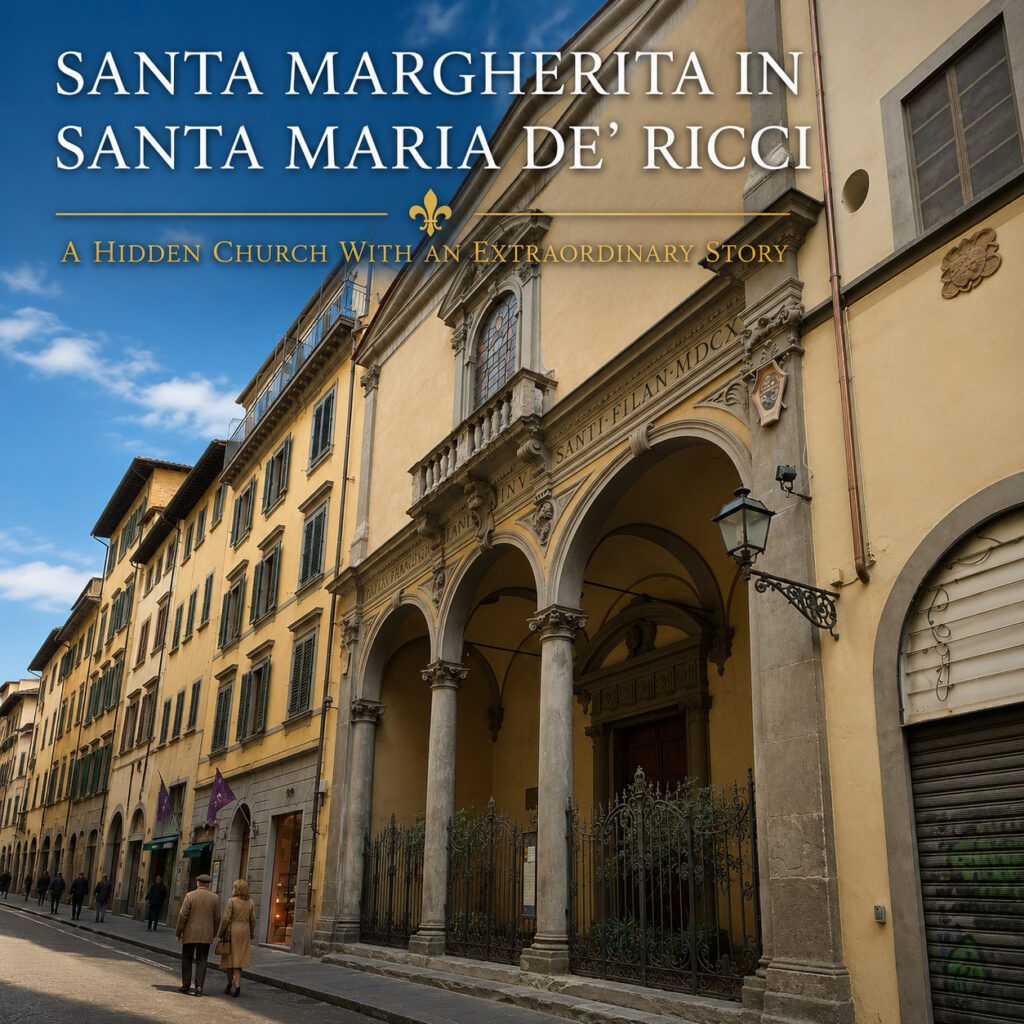
Santa Margherita in Santa Maria de’ Ricci is one of those small Florentine churches whose quiet appearance conceals an extraordinary history. Standing on Via del Corso in the heart of Florence, only a short walk from the Duomo, the church is associated with a notorious act of sacrilege in 1501, a venerated image of the Annunciation and a punishment that seems almost unimaginable today.
Also known as Santa Maria de’ Ricci or the Madonna dei Ricci, the church rewards visitors who enjoy discovering the less obvious layers of Florence. Its story connects religion, crime, Renaissance society, architecture and popular devotion within a remarkably small building.
Where: Via del Corso, Florence
Also known as: Santa Maria de’ Ricci, Madonna dei Ricci
Origins of the present church: Early 16th century
Historic event: The sacrilege committed by Antonio Rinaldeschi in 1501
Later architecture: Gherardo Silvani and Zanobi del Rosso
Why it matters: An unusual combination of Florentine religious devotion, crime, art and urban history
A Small Church on Via del Corso
Santa Margherita in Santa Maria de’ Ricci stands in one of the oldest and most interesting parts of central Florence. Via del Corso connects the area around the Duomo with the medieval streets leading towards Via dei Calzaiuoli and Piazza della Repubblica.
The church belongs naturally to the quieter religious buildings that complement Florence’s famous basilicas. Our Complete Guide to the Most Important Churches in Florence explores the monumental side of the city’s religious heritage; Santa Maria de’ Ricci reveals something different – a neighbourhood church whose significance comes primarily from the story preserved within its walls.
Santa Maria de’ Ricci is easy to miss when walking through Via del Corso. Look for its small portico rather than expecting the monumental façade of one of Florence’s great basilicas.
The Extraordinary Story of Antonio Rinaldeschi
The event that changed the history of Santa Maria de’ Ricci took place on 21 July 1501.
Antonio di Giuseppe Rinaldeschi had reportedly spent the night drinking and gambling at the Osteria del Fico. After losing heavily at dice, he wandered angrily through the streets around the Duomo.
Near the small church of Santa Maria degli Alberighi stood an image of the Annunciation. In a drunken act of rage, Rinaldeschi picked up horse dung from the street and threw it at the sacred image, striking the figure of the Virgin.
In the religious and social climate of early sixteenth-century Florence, the act was regarded as an extremely serious offence. Witnesses reported Rinaldeschi to the authorities. He was arrested, imprisoned in the Bargello and brought before the Florentine magistrates.
An act directed against a sacred image had a significance in Renaissance Florence that is difficult to understand from a modern perspective. Religion was deeply embedded in civic life, and an attack on a venerated image could be interpreted as an offence against both faith and the social order.
A Death Sentence for Sacrilege
The consequences for Rinaldeschi were severe. Despite his repentance, he was sentenced to death.
He was executed by hanging at the Bargello, one of the principal buildings of Florentine justice. The punishment transformed what might otherwise have remained an obscure act of drunken vandalism into a story remembered in Florence for centuries.
The episode also provides a striking glimpse into the judicial culture of Renaissance Florence. The city celebrated today for humanism, art and architecture was also a society governed by laws and religious assumptions very different from our own.
That contrast is one reason the story of Rinaldeschi remains so compelling. It brings us unusually close to the values, fears and beliefs of ordinary Florentines at the beginning of the sixteenth century.
The Story Preserved in Nine Scenes
The extraordinary sequence of events was recorded in a painted panel divided into nine scenes. It functions almost like an early visual narrative, showing Rinaldeschi’s story step by step.
The scenes depict his gambling and departure from the tavern, the act against the sacred image, his arrest, trial and eventual execution. In the final scene, angels and demons struggle symbolically over his soul.
The panel survives today in the Museo Stibbert in Florence. Beyond its artistic interest, it is a remarkable visual document of how a sensational event could be transformed into a moral narrative for contemporary viewers.
The nine scenes documenting Rinaldeschi’s offence, arrest, trial and execution resemble a visual chronicle. They allowed viewers to follow the entire story even in an age when literacy was far from universal.
The Madonna and the Birth of Santa Maria de’ Ricci
The attack had another consequence. Rather than diminishing the importance of the damaged image, the sacrilege intensified devotion towards it.
The Ricci family supported the creation of a church where the sacred image could be appropriately protected and venerated. The present church was founded in the early sixteenth century and became closely associated with the Madonna dei Ricci.
The original Annunciation eventually found its place at the high altar. The image therefore remains at the centre of the building whose history developed around the events of 1501.
This transformation is particularly characteristic of Renaissance religious culture. An act intended as an insult ultimately increased the sacred significance attached to the image.
From Renaissance Church to Baroque Interior
Santa Margherita in Santa Maria de’ Ricci did not remain architecturally unchanged. During the seventeenth century, Gherardo Silvani remodelled the church and added the portico that still gives the façade much of its distinctive appearance.
Another substantial transformation followed between 1769 and 1772 under Zanobi del Rosso. The resulting interior reflects the richer decorative language of the late Baroque period rather than presenting a purely early Renaissance appearance.
This layering is typical of historic Florentine churches. Buildings were altered as religious practices, artistic tastes and patronage changed. What we see today is therefore the result of several centuries rather than a single architectural campaign.
The modest exterior gives little indication of the church’s complicated architectural history. Santa Maria de’ Ricci combines an early sixteenth-century foundation with seventeenth- and eighteenth-century transformations.
Santa Margherita and the Church’s Present Name
The full name Santa Margherita in Santa Maria de’ Ricci reflects another chapter in the history of Florence’s small parish churches.
In the nineteenth century, changes to the city’s ecclesiastical organisation brought connections with the nearby church of Santa Margherita dei Cerchi. A fourteenth-century image of Saint Margaret of Antioch associated with that church was transferred here in 1831.
This helps explain a name that can initially seem confusing. The building historically associated with the Madonna dei Ricci acquired the additional dedication to Santa Margherita through later changes in Florence’s parish structure.
A Connection with Dante’s Florence
The link with Santa Margherita dei Cerchi creates an intriguing connection with the world of Dante. The nearby medieval church is traditionally associated with Dante Alighieri and Beatrice Portinari, although some of the popular stories surrounding their relationship belong as much to Florentine tradition as to securely documented biography.
This makes Via del Corso and the surrounding streets especially interesting for anyone following medieval and literary Florence. Only a short distance away stands Palazzo Portinari Salviati, associated with the Portinari family and the memory of Beatrice.
The concentration of these places within such a small area demonstrates how closely different layers of Florence’s history overlap. Renaissance devotion, Dante’s literary memory, aristocratic residences and medieval streets can all be encountered within a few minutes’ walk.
Santa Maria de’ Ricci is not itself one of the principal Dante sites. Its later connection with Santa Margherita dei Cerchi, however, places it within a fascinating network of streets and churches associated with the memory of Dante and Beatrice.
Santa Maria degli Alberighi – The Church That Disappeared
The story becomes even more interesting because the original image attacked by Rinaldeschi was associated with Santa Maria degli Alberighi, a small medieval church that no longer survives as an independent building.
Santa Maria degli Alberighi belonged to the ancient network of parish churches in central Florence. It stood near the present church and had origins reaching back to medieval Florence.
During the reforms of the late eighteenth century, the old parish was suppressed. Parts of the former church were subsequently incorporated into the expanded apse and sacristy of Santa Maria de’ Ricci.
The present building therefore preserves not only an image connected with the lost church but even physical traces of another piece of medieval Florence.
Florence contains many buildings whose walls preserve fragments of structures that have disappeared. Santa Maria de’ Ricci is a particularly good example: part of the story of the lost Santa Maria degli Alberighi survives within the later church.
Santa Maria de’ Ricci and Palazzo Portinari Salviati
One reason Santa Margherita in Santa Maria de’ Ricci is particularly rewarding is its immediate urban setting. The church stands on the same historic street as Palazzo Portinari Salviati.
The two buildings tell very different stories. The palace leads towards Beatrice Portinari, Renaissance banking, the Salviati and the Medici. Santa Maria de’ Ricci leads into popular devotion, crime, punishment and the religious mentality of sixteenth-century Florence.
Seen together, they demonstrate something fundamental about exploring the city. Florence’s history is rarely contained within a single monument. Palaces, churches, street corners and surviving inscriptions constantly intersect.
A short walk along Via del Corso can therefore reveal considerably more history than its modest length might suggest.
Why Santa Margherita in Santa Maria de’ Ricci Is Worth Discovering
Santa Margherita in Santa Maria de’ Ricci will never compete with Santa Croce, Santa Maria Novella or San Lorenzo in scale or artistic fame. That is precisely why it is interesting.
The church preserves a story that brings Renaissance Florence unusually close to everyday human behaviour: drinking, gambling, anger, religious belief, punishment, repentance and public memory.
The event of 1501 also demonstrates how profoundly differently Florentine society understood sacred images. What appears today to be an act of vandalism was interpreted as an offence serious enough to cost a man his life and inspire the creation of a church.
For visitors who have already seen Florence’s great monuments, Santa Maria de’ Ricci offers something quieter and perhaps more revealing: a small place through which an entire world of Florentine beliefs and values can still be glimpsed.
Florence is not only the history of great artists and powerful families. Small churches such as Santa Maria de’ Ricci preserve stories of ordinary people, popular beliefs and events that once captivated the entire city.
Further Reading on Firenze Casa
Continue exploring the churches, people and history surrounding Santa Maria de’ Ricci:
- The Most Important Churches in Florence – Complete Guide
- Basilica of Santa Croce – Florence’s Monumental Church
- Basilica of Santa Maria Novella – Art and Architecture in Florence
- Basilica of San Lorenzo – The Medici Church of Florence
References
- Ministero della Cultura – Catalogo Generale dei Beni Culturali: Storie della vita di Antonio di Giuseppe Rinaldeschi.
- Arcidiocesi di Firenze / Chiese Italiane – historical and architectural documentation on Santa Margherita in Santa Maria de’ Ricci.
- Archivio di Stato di Firenze – documentation concerning Antonio di Giuseppe Rinaldeschi and the Otto di Guardia.
- Historical documentation concerning Santa Maria degli Alberighi and the ancient Florentine parishes.
- Cocchi, Arnaldo – Le chiese di Firenze dal secolo IV al secolo XX.
- Cesati, Francesco – La grande guida delle strade di Firenze.

