
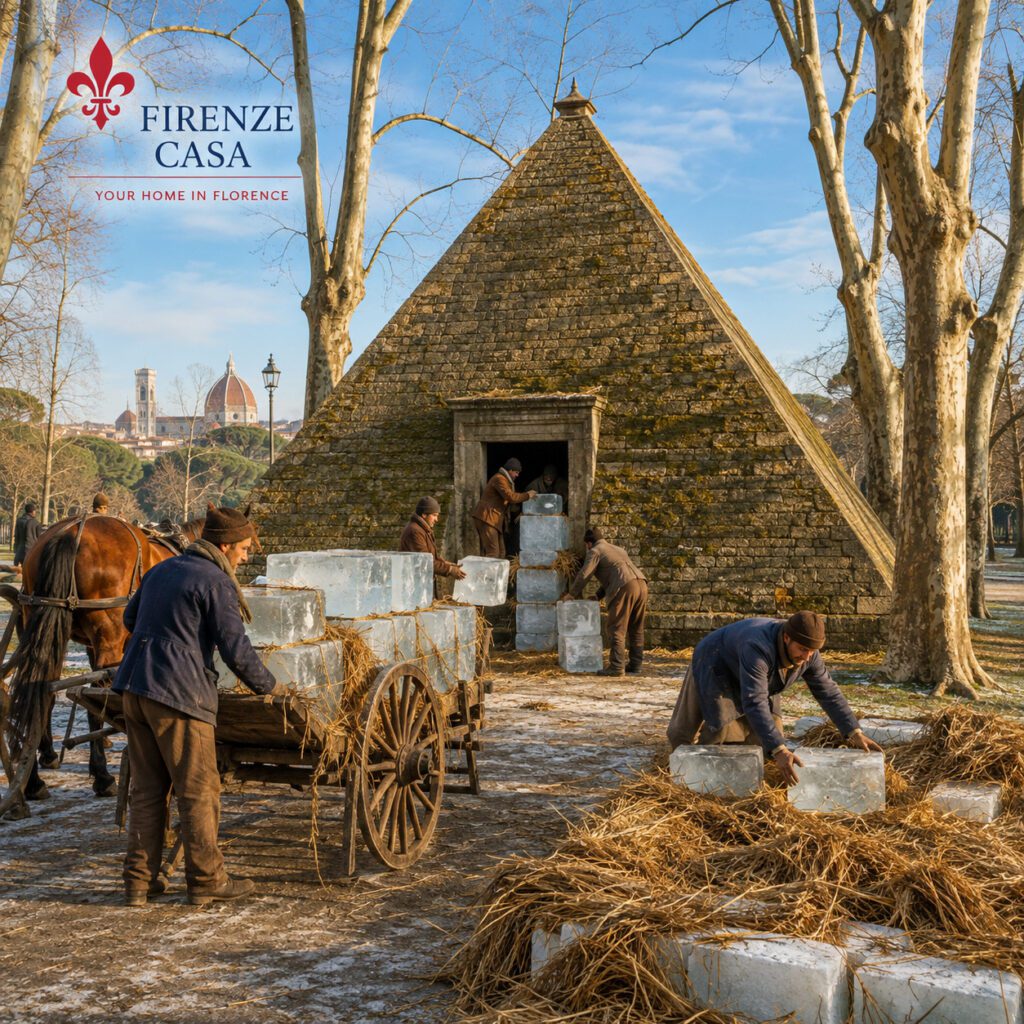
The Ghiacciaia delle Cascine provided a practical solution to an old problem. Long before electricity and modern refrigeration, Florentines needed reliable ways to keep food and drinks cold. Workers stored natural ice inside insulated chambers and preserved it for use during Florence’s hot summers.
Today, the building offers a fascinating glimpse into pre-industrial Florence. Its story connects architecture, engineering, food preservation and everyday life in an unexpected way.
The Ghiacciaia is easy to miss when walking through the Cascine. Look for the distinctive stone pyramid among the trees. Once you know its original purpose, this unusual building becomes much more interesting.
The Ghiacciaia delle Cascine at a Glance
| Period | Development |
|---|---|
| 16th century | The Medici develop the Cascine as a large agricultural estate. |
| Late 18th century | The Lorraine rulers modernise the estate and its infrastructure. |
| Late 18th century | Giuseppe Manetti designs the pyramid-shaped Ghiacciaia. |
| 19th century | The ice house supports food preservation and hospitality. |
| Late 19th century | Mechanical refrigeration gradually makes traditional ice houses obsolete. |
| Today | The Ghiacciaia survives as one of the Cascine’s most unusual historic structures. |
What Is a Ghiacciaia?
The Italian word ghiacciaia means ice house. Before electric refrigeration existed, people used these specialised buildings to store large quantities of natural ice. Ice houses existed throughout Europe, especially on noble estates, at monasteries and near royal residences.
The principle was simple but remarkably effective. Builders used thick masonry, underground chambers, insulation, controlled ventilation and drainage to keep temperatures low. These techniques allowed ice to survive for months and provided cold storage well into summer.
Before mechanical refrigeration, ice was a valuable commodity. Storing enough of it to last through a Tuscan summer required careful engineering and considerable organisation.
Why Was the Ghiacciaia Built?
Florence’s hot summers created an obvious problem. Meat, fish, dairy products and prepared foods spoiled quickly without cooling. The grand-ducal household also organised banquets, receptions and celebrations throughout the year. Its kitchens therefore needed fresh ingredients regardless of the season.
Stored ice helped solve these problems. Cooks could preserve food for longer and cool wine and other beverages. Ice also had medical uses, and physicians used cold applications in various treatments. The Ghiacciaia therefore served a practical purpose within the larger estate.
The Medici Estate and the Origins of the Cascine
To understand the ice house, it helps to know the original purpose of Parco delle Cascine. The area did not begin as the public park Florentines know today. The Medici family developed the Cascine as a large agricultural estate during the sixteenth century.
This purpose distinguished the Cascine from the formal Boboli Gardens. Boboli demonstrated courtly power through terraces, fountains and sculpture. The Cascine concentrated much more strongly on production. Fields, meadows, trees and agricultural buildings shaped the landscape.
The Ghiacciaia fitted naturally into this system. Different buildings supported the operation of the estate, and the ice house provided valuable cold storage. It helped preserve food, drinks and other perishable goods.
The ice house makes much more sense when seen as part of the wider history of Parco delle Cascine. The park began as a productive grand-ducal estate rather than an ornamental garden.
Giuseppe Manetti and the Pyramid
The unusual pyramid is associated with architect Giuseppe Manetti. He worked extensively on the Cascine during the period of Lorraine rule in Tuscany. Manetti also designed the nearby Palazzina Reale, and his work reflects the changes taking place here during the late eighteenth century.
The pyramid shape immediately attracts attention today. Yet the building had a practical function rather than a purely decorative one. Much of the actual storage space lay below ground, where the earth helped maintain lower and more stable temperatures.
Engineering Before Refrigeration
The Ghiacciaia used no electricity and contained no refrigeration machinery. Instead, its designers relied on basic principles of physics. Thick masonry walls slowed the transfer of heat, while the underground chamber benefited from cooler ground temperatures.
Workers packed ice closely together inside the chamber and used natural materials for additional insulation. Drainage played an equally important role. Meltwater had to leave the chamber quickly because standing water would accelerate the melting process.
Together, these techniques created an effective cold-storage system. The large mass of stored ice also helped maintain a stable internal temperature. The system could preserve valuable ice long after winter had ended.
The visible pyramid is only part of the story. The coolest and most important part of an ice house lay underground, protected from Florence’s summer heat by earth and thick masonry.
How Did Natural Ice Storage Work?
Before refrigeration, communities had to obtain their ice during winter. Workers collected natural ice when sufficiently cold conditions allowed it. They then transported the ice to storage facilities as quickly as possible, often choosing cooler hours to reduce melting.
At the ice house, workers packed the frozen material tightly inside the chamber. Insulating material helped reduce contact with warmer air. The accumulated mass of ice created its own cold environment, while good drainage slowed further melting.
The entire system required careful planning. A poor winter or insufficient supply could reduce the amount of ice available during the following summer. Successful cold storage therefore depended on both engineering and favourable weather.
Ice and the Florentine Table
Ice had many culinary uses. Kitchens could keep certain foods fresh for longer and serve chilled drinks during warm weather. Wealthy households also used ice to prepare frozen desserts, which became increasingly sophisticated in European court culture.
Florence developed an especially strong association with frozen desserts. Tradition frequently connects this history with Renaissance architect and artist Bernardo Buontalenti. Stories credit him with creating an influential early frozen dessert for the Medici court.
Historians continue to debate the precise origins of modern gelato. What is certain is much simpler: frozen desserts required cold. Reliable access to natural ice therefore played an essential role before mechanical refrigeration became available.
The Ghiacciaia did not “invent” Florentine gelato. Instead, it represents the technology that made storing natural ice possible. That ice supported the wider culture of chilled drinks and frozen desserts.
From Valuable Resource to Obsolete Technology
For centuries, natural ice remained valuable because there was no easy alternative. That changed dramatically during the nineteenth century. Mechanical refrigeration gradually allowed businesses and households to produce cold without depending on winter weather.
Traditional ice houses consequently lost their importance. Buildings that had once formed essential parts of estates became obsolete, and many disappeared or found other uses. The survival of the Ghiacciaia delle Cascine is therefore particularly significant.
Visiting the Ghiacciaia delle Cascine Today
Today, the Ghiacciaia delle Cascine remains one of the park’s most unusual historical landmarks. Many visitors still pass it without recognising its original function. Once you know what to look for, its distinctive pyramid shape makes it easy to recognise.
You can see the exterior while exploring Parco delle Cascine. The interior is generally not accessible to visitors. The Ghiacciaia should therefore be considered a historic feature of the park rather than a conventional attraction.
A short stop is sufficient to see the exterior. However, the building becomes much more rewarding when combined with other landmarks in the Cascine.
Combine the Ghiacciaia with Parco delle Cascine
The Ghiacciaia should not be the only reason for travelling to this part of Florence. Instead, include it in a longer exploration of Parco delle Cascine. Florence’s largest public park stretches along the Arno and contains broad avenues, mature trees and extensive recreational areas.
Other landmarks include the Palazzina Reale, Le Pavoniere and the Monumento all’Indiano. Walking or cycling makes it easy to explore several of these places during the same visit.
The Cascine also hosts Florence’s large traditional open-air market on Tuesday mornings. The market provides a very different experience from the quiet historical atmosphere around the Ghiacciaia.
Combine the Ghiacciaia with a longer walk or bicycle ride through Parco delle Cascine. The historic structures become more meaningful when you understand them as parts of the former grand-ducal estate.
Visitor Information
Location: Parco delle Cascine, Florence.
What you can see: The exterior of the historic pyramid-shaped ice house.
Interior: Generally not open to visitors.
Suggested visit: 15–30 minutes as part of a longer Cascine walk.
Combine with: Palazzina Reale, Le Pavoniere, Monumento all’Indiano and the riverside avenues.
Best approach: Walking or cycling through Parco delle Cascine.
Why the Ghiacciaia Is Worth Seeing
Florence is famous for buildings created to impress. The Ghiacciaia is interesting for exactly the opposite reason. Its builders created it to solve an everyday problem, and that practical purpose reveals another side of the history of Florence.
Palaces and formal gardens represented power and prestige. Buildings such as the Ghiacciaia supported the systems behind that world. They helped grand-ducal households store food and manage valuable resources throughout the year.
This makes the pyramid much more than an architectural curiosity. It provides a small but revealing window into how Florence actually worked before modern technology changed everyday life.
Interesting Facts About the Ghiacciaia
- The Ghiacciaia served as a historic ice-storage building before mechanical refrigeration.
- Its distinctive pyramid form makes it one of the most unusual structures in Parco delle Cascine.
- Much of the cold-storage area lay below ground.
- Thick masonry and natural insulation helped slow the melting of stored ice.
- Drainage removed meltwater and helped maintain lower temperatures.
- Stored ice supported food preservation, chilled drinks and other practical uses.
- The building formed part of the wider agricultural and service landscape of the Cascine.
- Today, visitors can normally see the exterior while exploring the park.
Frequently Asked Questions
What is the Ghiacciaia delle Cascine?
The Ghiacciaia delle Cascine is a historic ice house in Parco delle Cascine. It stored natural ice before mechanical refrigeration became available.
Why does the Ghiacciaia look like a pyramid?
The visible structure has a distinctive pyramid form. The design formed part of a larger cold-storage system that included a protected underground chamber.
Can you enter the Ghiacciaia delle Cascine?
The interior is generally not open to visitors. You can view the exterior while walking through Parco delle Cascine.
What was the ice used for?
Stored ice helped preserve food and cool beverages. It also supported other household, culinary and medical uses.
Is the Ghiacciaia connected with Florence’s gelato history?
It belongs to the broader history of natural ice storage that made frozen foods and desserts possible before refrigeration. Claims about the exact invention of gelato should be treated separately.
How long should I allow for a visit?
About 15–30 minutes is sufficient to see the exterior. Combine it with a longer walk or bicycle ride through the Cascine.
Further Reading on Firenze Casa
Continue exploring Parco delle Cascine and Florence’s lesser-known history:
- Parco delle Cascine Florence – The City’s Largest Park
- The Most Beautiful Parks in Florence
- The Medici Family: The Dynasty That Shaped Florence
- History of Florence
References
- Comune di Firenze – Parco delle Cascine.
- Feel Florence – Parco delle Cascine.
- Treccani – Ghiacciaia.
- Touring Club Italiano – Firenze e dintorni.
- Najemy, John M. – A History of Florence 1200–1575.
- Montanari, Massimo – Food Is Culture.
A Hidden Piece of Everyday Florence
The Ghiacciaia delle Cascine is easy to overlook, yet its modest purpose makes it particularly interesting. Historic Florence depended on far more than palaces, churches and works of art. The city also needed practical infrastructure.
Ice had to be collected, transported and stored. Food needed protection from the summer heat, while large households required reliable systems throughout the year. The pyramid in the Cascine preserves a small part of that forgotten world.
For visitors who enjoy Florence’s quieter stories, the Ghiacciaia offers exactly the kind of hidden detail worth discovering.

